
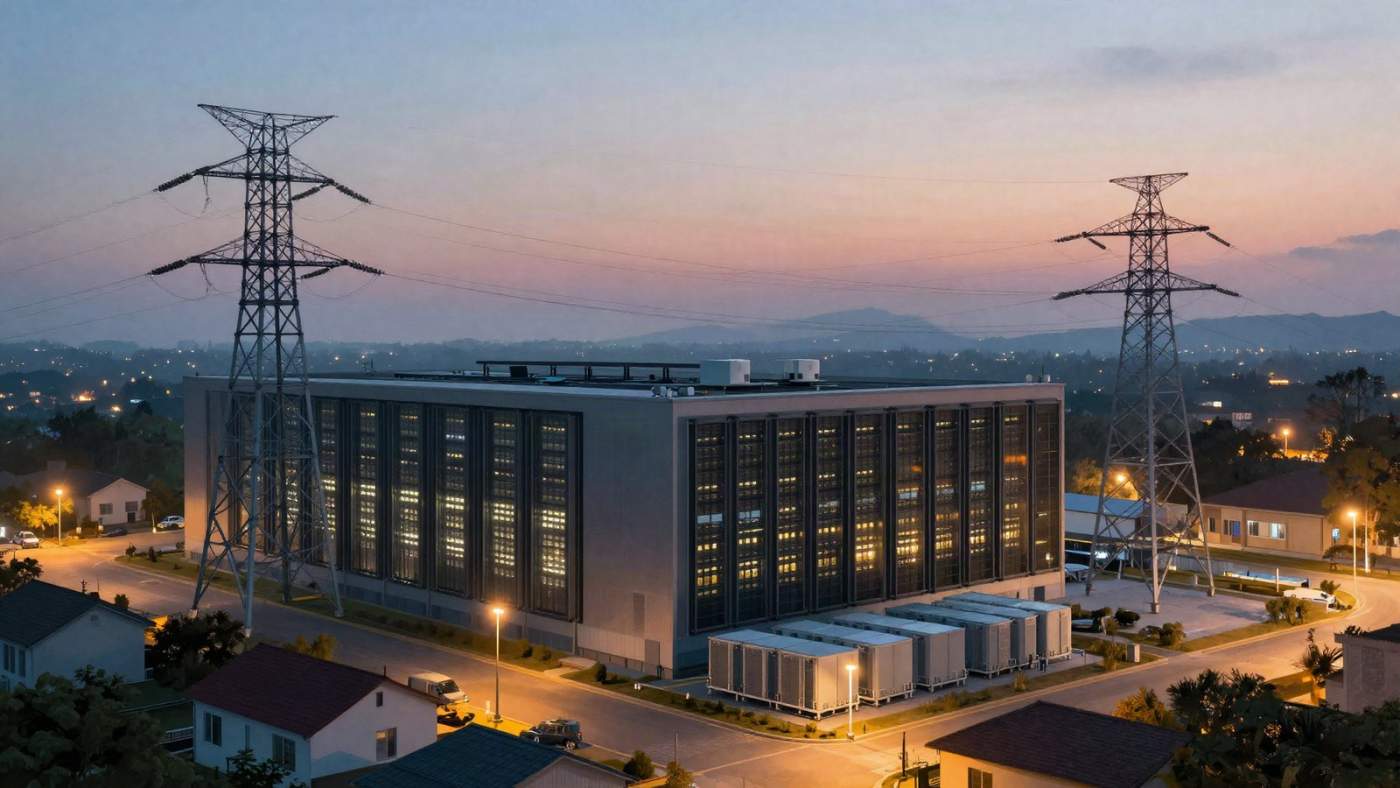
OpenAI is launching a program called Grid Protectors. The company’s future data center campuses are meant to cut their power use when the grid is under strain, for example during a heat wave or a cold snap. The starting point is a planned campus in Georgia, where OpenAI has committed up to 1,000 megawatts of flexible demand. According to the company, that equals the average electricity demand of roughly 700,000 households.
The announcement lands in a debate that is heating up in the US: who pays for grid upgrades needed by AI data centers, and do they push up electricity prices for households? With Grid Protectors, OpenAI wants to show that large data centers can help stabilize the grid instead of only adding load.
What the Grid Protectors Program involves
In its announcement on November 2, OpenAI describes the program as a national effort in the US. Working with utilities, regulators and policymakers, the company wants to develop arrangements under which its future campuses draw less power when the grid is tight. Each arrangement is supposed to define how much demand can be reduced, how quickly and for how long.
The facilities are to be designed for this flexibility from the start. Depending on location and equipment, OpenAI also wants to supply power to the grid from on-site generation or storage, and to smooth changes in demand with batteries and power controls. The arrangements will differ by location, and OpenAI says it will share additional commitments once they are finalized.
OpenAI points to the expected build-out as the reason: US data center capacity is projected to exceed 100 gigawatts by 2030. Families and small businesses should not be asked to subsidize a compute campus’s electricity needs, the company writes. Large facilities should pay their own costs and help utilities manage the grid.
The Georgia model
The first case is the planned campus in Effingham County, Georgia, also known as Project Camellia. OpenAI has committed to pay the full infrastructure and electric-service costs required to serve the project. The contract with the utility also includes up to 1,000 megawatts of so-called demand response: the utility can reduce the energy delivered to the campus during periods of high demand.
Georgia Power confirmed the key figures in a release from August. The contract was filed with the Georgia Public Service Commission in July, covers 3,200 megawatts of new demand and has since been approved. According to Georgia Power, the flexible load means the utility can build less new generation capacity.
The utility expects households to benefit. From its whole portfolio of large-load contracts, which includes the OpenAI project, Georgia Power projects savings of around $950 million per year starting in 2029. A typical household using 1,000 kilowatt-hours a month is expected to save at least $15 per month. These are the utility’s projections, not guaranteed figures.
On an annual basis, Georgia Power cites $180 in savings for the typical household, up from a previous commitment of $102. For 2029 to 2031, the utility puts the total benefit for its customers at about $2.85 billion.
The campus is still in development. OpenAI intends to use Effingham as the pilot for Grid Protectors.
How demand response works
Demand response means a consumer lowers its power draw when the grid operator asks. Instead of firing up an extra power plant at peak times, demand goes down. For a data center, that can mean temporarily powering down servers, shifting work or switching to on-site storage and generation.
OpenAI stresses that its new facilities are very different from data centers built only a few years ago and can adjust their power demand. The company says the 1,000 megawatts it has committed could keep air conditioning running in hundreds of thousands of homes during extreme heat, more households than Washington, D.C. and Boston combined.
The restaurant argument
OpenAI explains the logic with an analogy. A restaurant in a vacation town needs enough tables and kitchen space for the busy season but pays for that capacity all year. Regular customers keep it going in the off season. OpenAI wants to be that regular customer.
Applied to the grid: power lines, substations and other infrastructure are fixed costs whether demand is high or low. A data center that draws power steadily all year spreads those fixed costs across more kilowatt-hours sold. If it cuts back at peak times, the grid does not have to be built out for even higher peaks. Other customers are supposed to benefit too.
At the same time, OpenAI writes that flexibility cannot replace investment in new energy supply and transmission. Long-term contracts and financial assurances are meant to protect other customers if a project is delayed, reduced or canceled.
What is still open
The announcement leaves many questions unanswered:
- Frequency and duration: OpenAI does not say how often or for how long the Georgia campus can actually be curtailed.
- Workloads: The company does not explain which compute jobs would pause or move during a curtailment, or whether ChatGPT and API users might notice anything.
- Other sites: Beyond Georgia, OpenAI names no specific campuses or utilities. It only says the arrangements will differ by location.
- Compensation: Whether and how OpenAI is rewarded for its flexibility, for example through lower rates, is not part of the announcement.
Why this matters for the AI industry
Power has become a bottleneck for AI infrastructure. The major labs are investing billions in new data centers. Anthropic, for instance, is building its first data center in Canada, and Meta is funding its data center expansion with a multibillion-dollar share offering. Each of these sites needs grid connections measured in gigawatts. How much capital is at stake also shows in the debate over Anthropic’s credit rating.
That increases political pressure. When household power bills rise because utilities build out for data centers, it turns into a local fight. Grid Protectors is also a response to that criticism: OpenAI is positioning itself as a customer that pays its own way and gives back capacity in emergencies.
For developers, there are no direct consequences for now. In the long run, though, it shows how closely compute availability is tied to energy supply. If data centers regularly have to make room for the grid, that could affect how AI services are planned and priced. OpenAI makes no concrete statements about that.
Our take
The idea itself is not new. Industrial plants have long offered grid operators interruptible loads. What is new is the scale: 1,000 megawatts of flexibility at a single site is a big tool for a utility. Whether the program delivers depends on details OpenAI has not published yet: how often curtailment happens, who carries the costs and whether other sites get similar commitments. Until then, Grid Protectors is mainly a promise with a first, contractually backed example in Georgia.