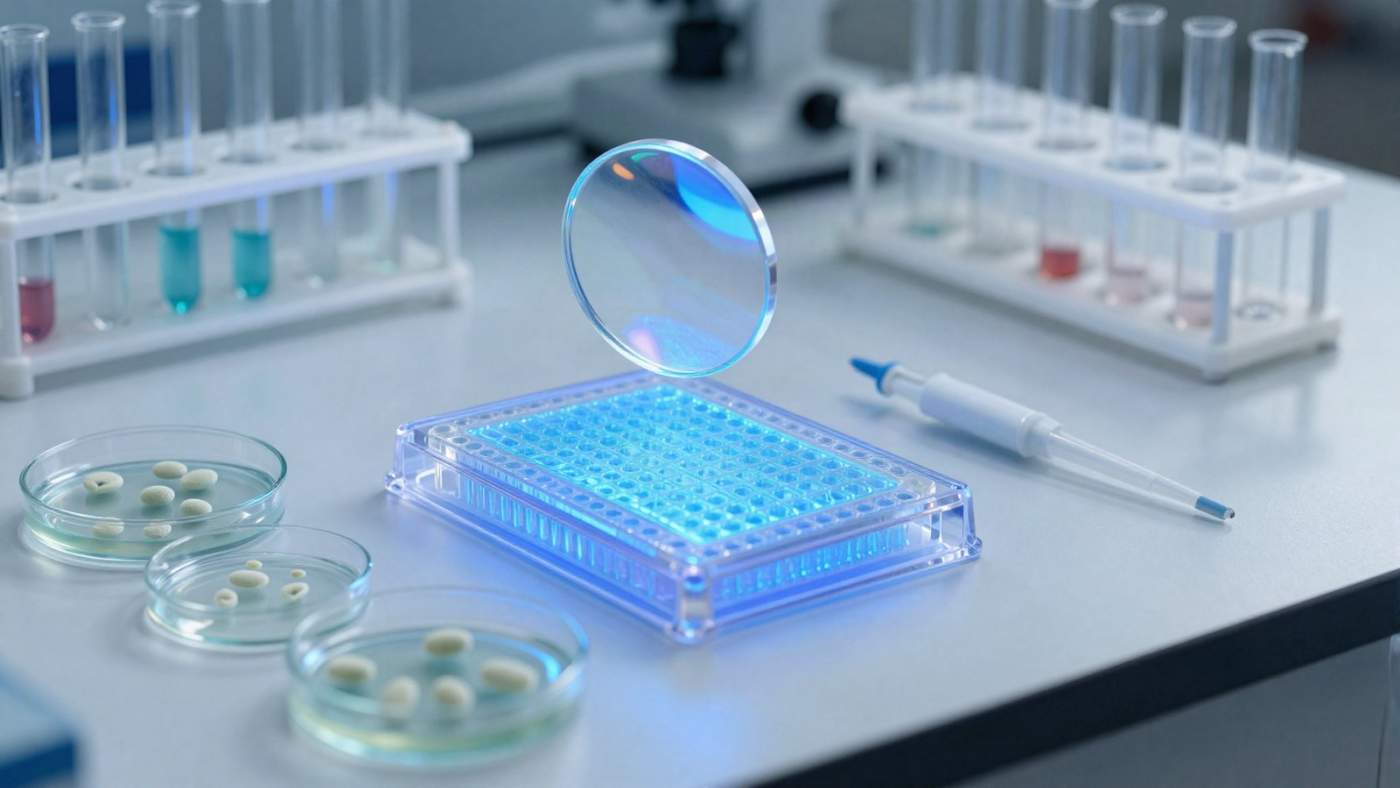
BioBasicsBench is a new benchmark OpenAI is using to measure how well AI agents handle everyday work in a biology lab. OpenAI developed it together with Ligo, a biotech company focused on enzyme design. Introduced on November 6, 2026, the test contains 100 tasks drawn from routine wet-lab work, the part of biology where scientists handle real biological samples. According to OpenAI’s announcement, GPT-6 Astra earned an average of 66.7 percent of the available credit at the highest shared reasoning setting, while GPT-5.6 Sol reached 43.8 percent.
The numbers suggest a big jump. OpenAI itself stresses, however, that higher benchmark scores do not yet mean models can make reliable judgments in the lab. That caveat is exactly what makes the benchmark interesting.
What makes BioBasicsBench different
Many science benchmarks rely on charts and images taken from papers, material that has already been selected, cleaned up and interpreted. Real lab work looks different: failed runs, blurry images, conflicting controls. BioBasicsBench therefore uses raw data. Scientists built the tasks from their own experiments and paired each one with an expert-written grading rubric.
The 100 tasks cover five areas:
- Protein methods
- Imaging and cytometry
- Quantification and assays
- Nucleic acid methods
- Molecular cloning
They range from reading the molecular weight of a DNA sample on a gel to detailed assay analysis. The inputs are deliberately varied: gel and blot images (31 tasks), protocols and lab notebook entries, some of them photographed handwritten notes (27), tables and instrument exports (20), photos of benches and equipment (18), microscopy (14), sequencing files (12) and videos of bench work (7). A single task can combine several kinds of data.
According to OpenAI, every task went through three reviews: an internal review by a Ligo scientist who had not written it, an external review by a PhD-level scientist working in a wet lab, and a final internal review. Grading looks at more than the final answer. The rubrics give partial credit for the conclusion, numerical results and reasoning, and for recognizing when the evidence cannot support a conclusion at all.
BioBasicsBench: the results at a glance
OpenAI tested only its own models: GPT-5.2, GPT-5.4, GPT-5.5, GPT-5.6 Sol, GPT-6.1 Sol, GPT-6 Luna and GPT-6 Astra. The evaluation covers 37 combinations of model and reasoning effort, with five attempts per task, for a total of 18,500 results. At the “xhigh” setting, the highest one available for all seven models, the picture looks like this (mean reward, 95 percent confidence interval):
- GPT-6 Astra: 66.7% (60.3–73.1%)
- GPT-6.1 Sol: 62.0% (55.6–68.4%)
- GPT-5.6 Sol: 43.8% (37.6–50.0%)
- GPT-6 Luna: 38.3% (32.3–44.5%)
- GPT-5.5: 35.4% (29.7–41.0%)
- GPT-5.4: 33.2% (28.3–38.4%)
- GPT-5.2: 31.2% (26.2–36.3%)
Token use stands out: at “xhigh”, GPT-6 Astra averaged 4,704 output tokens per task, GPT-5.6 Sol needed 9,099 and GPT-5.2 as many as 27,620. The better model was also the more economical one. OpenAI attributes the gains mainly to stronger native multimodal capabilities, meaning better handling of images, video and raw data.
Where GPT-6 Astra does better
OpenAI illustrates the differences with examples from the benchmark:
- Knowing the limits of the data: GPT-5.6 Sol classified cells as dead based on a dye signal. Because the detector could also pick up light from a second dye, brightness alone could not justify that conclusion. Astra recognized the ambiguity and asked for better controls.
- Detail in photos: in a cloning experiment, GPT-5.6 Sol saw no colonies on the negative control plate and built its conclusions on that. Astra noticed that the plate was labeled with the wrong antibiotic and rejected it as a reliable control.
- Keeping experimental context in mind: when cells seemed to disappear in a series of microscope images, GPT-5.6 Sol looked for a biological explanation. Astra recognized a z-stack, a series of images taken at different focal depths.
Where the models still fall short
OpenAI is notably open about the best model’s mistakes. In one case, Astra let a familiar assumption override the controls: it grouped the bands in a colony PCR correctly but attached the wrong meaning to the groups, and would have picked the wrong colonies for further work. In another, it discounted observations that contradicted its preferred interpretation. And when counting bacterial colonies, a routine task, Astra overcounted one plate by about 12 percent because it failed to separate close neighbors, missed visible colonies and marked empty agar.
Mistakes like these are not cosmetic in a lab. A miscounted plate skews estimates of how efficiently DNA was introduced into cells; a wrongly chosen colony leads to follow-up experiments with the wrong plasmid.
What it means for labs
For research groups already using AI assistants for analysis, the benchmark carries a sober message. Even the best model tested earns about two thirds of the available credit on average, leaving a third on the table. AI agents are therefore best used as a second opinion or as a tool that flags anomalies, such as a mislabeled plate or a questionable control. Responsibility for conclusions and follow-up experiments stays with the people in the lab. OpenAI frames its own goal cautiously: progress on these tasks could help scientists spend less time troubleshooting and more time deciding which experiments to pursue next.
Context
BioBasicsBench is a vendor benchmark: OpenAI co-developed it, tested only its own models and published the results itself. There are no comparison figures for models from Anthropic, Google or open-weight providers. How meaningful the numbers are will only become clear once independent groups can run the test; the announcement does not say whether or how the dataset will be released.
The approach itself still makes sense. Instead of posing ever harder specialist problems, BioBasicsBench measures whether agents can reliably handle unglamorous routine work, and whether they recognize when they cannot say anything with confidence. That resembles the idea behind SemiAnalysis’ GDPx, which measures agents on real-world work tasks. At the same time, OpenAI’s note that it is tracking these capabilities with biosafety and biosecurity in mind shows that AI lab skills remain a double-edged topic, one reason the UK is funding a dedicated AI biosecurity lab. And as with OpenAI’s math results, what counts is what can be independently verified.