SDR 101.96 million. That is the exact amount the International Monetary Fund transferred to El Salvador on October 1, 2026 — roughly 138 to 139 million US dollars, depending on the exchange rate used. Notably, the country had previously breached a self-agreed cap on state Bitcoin purchases. The El Salvador Bitcoin IMF case shows how an international lender balances rule compliance against political reality, and why the disbursement is not a signal for new Bitcoin demand.
The episode highlights the tension between El Salvador’s Bitcoin experiment and the conditions of a 40-month lending program. For anyone trying to understand how crypto policy and IMF diplomacy intersect, here are the key facts.
Table of Contents
Key Takeaways
- The IMF Executive Board completed the second and third reviews of the Extended Fund Facility program on October 1, 2026, and released SDR 101.96 million (roughly $138-139 million).
- El Salvador had missed several performance criteria, including the Bitcoin accumulation limit, visible through additional purchases by state wallets since the first review.
- The IMF accepted the explanation that the additional Bitcoin came from private donations without using public funds; donor names and amounts were not disclosed.
- Operational control of the Chivo wallet moved to a private operator in September 2026; the state is expected to fully unwind its remaining stake, according to IMF Deputy Managing Director Dan Katz.
- Analysts stress this is not a bullish signal for Bitcoin — the funds flow into the state budget, not into new Bitcoin purchases.
What the IMF Decided on October 1, 2026
The decision was not made lightly. The IMF Executive Board examined, as part of the second and third program reviews, whether El Salvador was meeting the terms of its Extended Fund Facility program. This 40-month program ties financial support to clear conditions on fiscal discipline and limits on state Bitcoin activity.
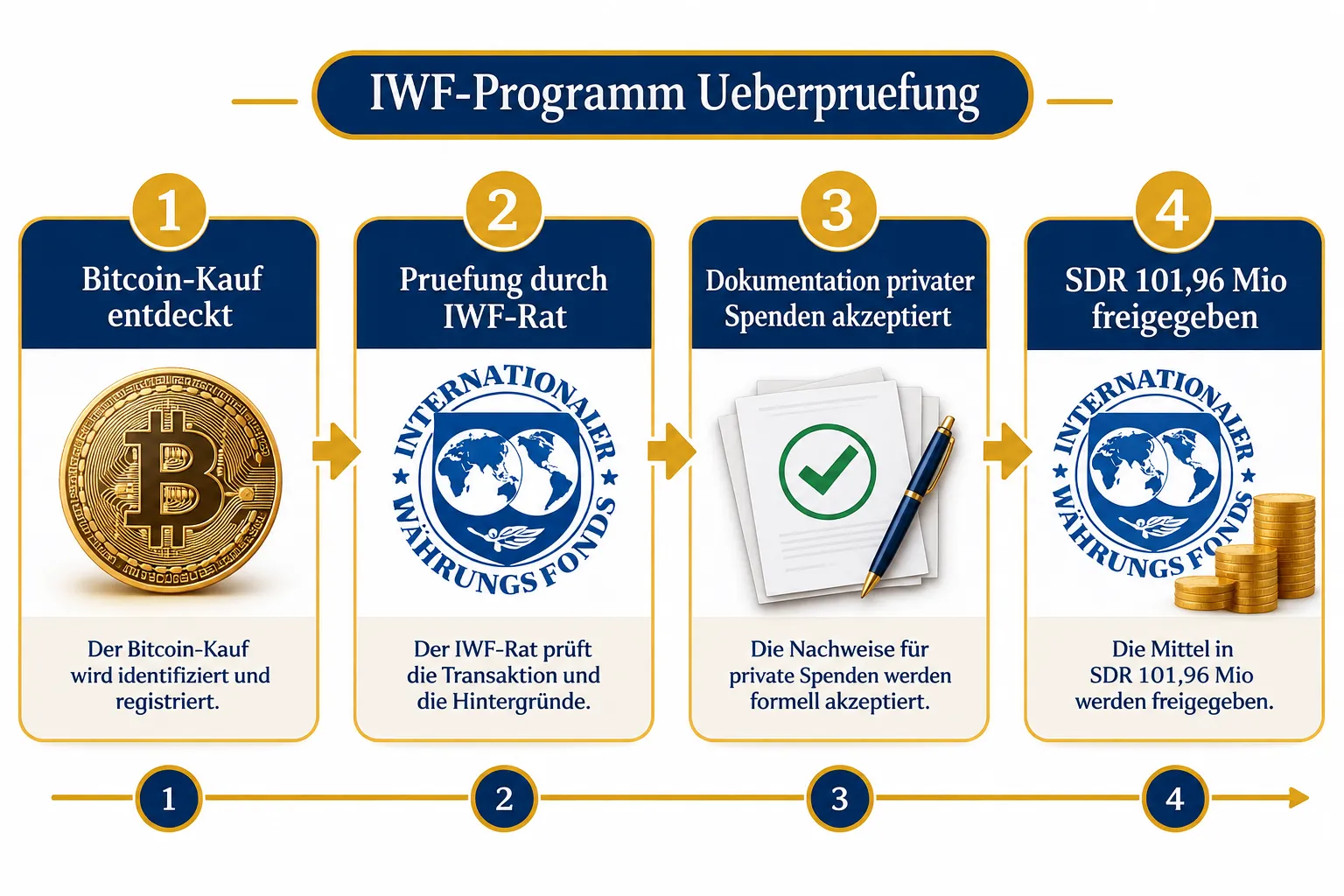
At the end of the review came the release of SDR 101.96 million — about $139 million according to Bloomberg, about $138 million according to crypto.news, depending on the exchange rate applied on the reference date. This difference is purely technical and doesn’t change the fundamental point: El Salvador receives further capital from the ongoing program despite formally breaching a central condition.
For the Salvadoran state budget, the sum matters because it is part of a longer-term financing package meant to accompany fiscal reforms. The disbursement flows directly into public coffers, not into Bitcoin reserves.
El Salvador Bitcoin IMF: How the Breach Happened
The core of the conflict lies in a simple number: a contractually defined ceiling on how much additional Bitcoin the Salvadoran state is allowed to acquire. This limit was part of the original program agreement with the IMF. Already during the first review, it emerged that state wallets held more Bitcoin than the agreement permitted.
The Salvadoran government argued that the additional holdings did not come from public funds but from private donations. The IMF examined this claim and ultimately accepted the documentation provided as sufficient not to treat the breach as a serious contract violation. Importantly, neither the donors’ names nor the exact donation amounts were made public. This lack of transparency remains an open point that could become relevant in future assessments.
The IMF, however, was clear about its expectations going forward: no further Bitcoin accumulation beyond documented donations is expected. This wording leaves little room for interpretation — additional, actively financed state purchases would no longer be tolerated.
Performance Criteria at a Glance
The Bitcoin limit was not the only criterion missed. Several performance targets of the program were not fully met. The table below summarizes the key points discussed during the review:
| Area | Status per IMF Review |
|---|---|
| Bitcoin accumulation limit | Missed, explained by private donations |
| Other performance criteria | Partially missed |
| Documentation of donations | Accepted, but not public |
| Expectation going forward | No further accumulation beyond donations |
Chivo Wallet: Privatization and State Control
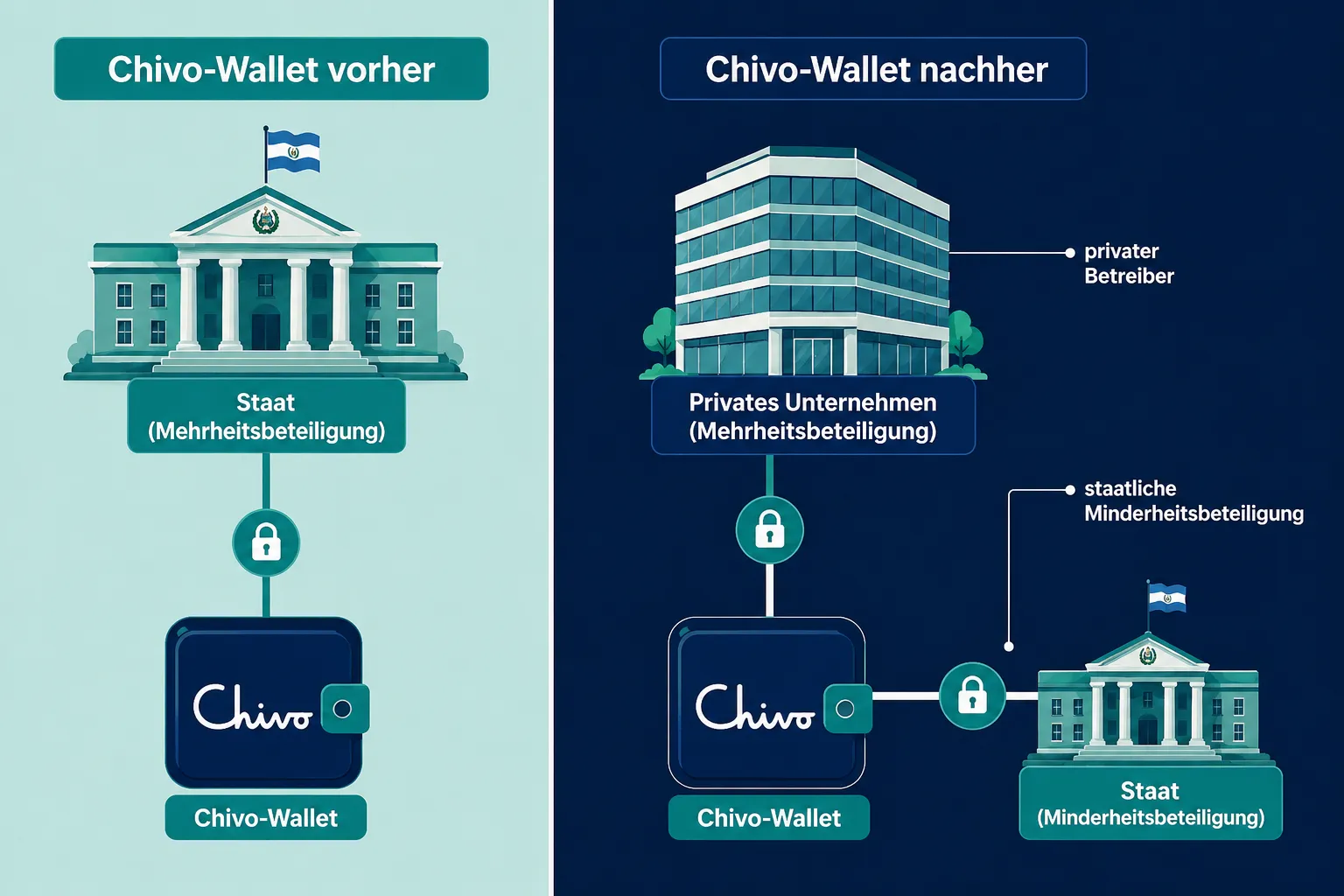
A second key component of the agreement concerns the Chivo wallet, the state-initiated Bitcoin wallet that originally served as the centerpiece of El Salvador’s Bitcoin strategy. Already in September 2026, before the current IMF decision, majority ownership and operational control of the wallet passed to a private operator.
Following this restructuring, the state retains only a minority stake. At the same time, an important responsibility remains: custodial duty for customer assets — that is, safeguarding users’ digital holdings — still rests with the state or the state-affiliated structure.
IMF Deputy Managing Director Dan Katz, who chaired the Executive Board discussion, made clear that even this remaining minority stake is not meant to be permanent. Katz said the state’s involvement should be “fully unwound,” in his own words. This statement shows the IMF is pursuing the complete separation of the state from operational Bitcoin structures as a long-term goal, not merely a reduction.
This development fits a broader trend: El Salvador had already amended its Bitcoin Law in 2025. Mandatory Bitcoin acceptance for private businesses was abolished at that time. Taxes have since had to be paid in US dollars, not Bitcoin. The privatization of the Chivo wallet in September 2026 thus fits into a series of steps gradually withdrawing the state from operational Bitcoin infrastructure.
Why This Is Not a Bullish Signal for Bitcoin
For crypto-interested observers, the temptation is to read the IMF disbursement as a sign that international institutions are becoming more lenient toward Bitcoin. This interpretation falls short, however, and is explicitly rejected by several analysts, including investingLive.
Several points clearly argue against a bullish reading:
- The released $139 million flows into the Salvadoran state budget, not into Bitcoin purchases.
- This is not new demand from third parties or institutional buyers — no additional capital is flowing into the Bitcoin market.
- The IMF explicitly stated it does not expect further Bitcoin accumulation beyond documented donations.
- The Chivo wallet structure, according to IMF Deputy Managing Director Dan Katz, continues to move toward full privatization, not toward a stronger state Bitcoin presence.
“The IMF’s message is more ‘we’ll forgive it, but don’t do it again’ than a loosening of the Bitcoin limit,” analysts summarize the situation.
This phrasing captures the core of the decision precisely. The IMF shows leniency toward a past deviation while simultaneously signaling clear limits for the future. For investors betting on state-driven Bitcoin demand as a price driver, the El Salvador Bitcoin IMF case offers no supporting argument.
Market Context: Bitcoin Price and Crypto Market on October 2, 2026
On October 2, 2026, the day after the IMF decision, Bitcoin traded at roughly $84,500 to $85,300 — after the crypto market had already closed its best quarter since 2017, a slight gain over the course of the day. The entire crypto market recorded a market capitalization of about $2.99 trillion at that time.
These figures do not point to a pronounced market reaction to the IMF news. The slight price movement falls within the range of normal daily fluctuations and cannot be clearly attributed to the El Salvador decision. This supports the assessment that the market views the IMF disbursement as largely neutral — neither a burden nor a buy signal.
For crypto market observers, it remains relevant that such institutional decisions tend to carry long-term signaling value rather than short-term price swings. The real message is directed less at traders than at other states considering their own Bitcoin strategies: rule violations are noted but can be tolerated with plausible documentation, as long as clear future limits are respected.
What This Means for El Salvador and the IMF Relationship
The case marks a turning point in the relationship between El Salvador and the IMF. The combination of leniency toward past violations and clear statements about the future reveals a pattern: the IMF does not want to jeopardize the ongoing financing program, but in return demands structural concessions — visible in the privatization of the Chivo wallet and the announced full dissolution of the state’s stake.
For El Salvador, this means the room for independent Bitcoin initiatives within the IMF program keeps shrinking. The 2025 law change, the abolition of mandatory Bitcoin acceptance, and now the privatization of the wallet infrastructure together paint the picture of a state gradually withdrawing from a direct operational role in the Bitcoin ecosystem while continuing to rely on IMF financial support.
Conclusion
The IMF’s release of $139 million to El Salvador despite a documented Bitcoin rule breach shows a nuanced picture of international financial policy: pragmatism toward past deviations combined with strict statements for the future. The El Salvador Bitcoin IMF case offers neither an argument for loosening international Bitcoin rules nor a signal of new institutional Bitcoin demand.
For investors and crypto-interested readers, it is worth watching the next steps: the announced full dissolution of the state’s Chivo wallet stake, compliance with the Bitcoin limit in upcoming IMF reviews, and the broader development of El Salvador’s fiscal policy under the 40-month program. Anyone following the story should keep an eye on official IMF communications and reputable financial news sources rather than overweighting short-term price moves.
Sources
- crypto.news (2026): Reporting on the IMF program review and the release of $138 million to El Salvador.
- Bloomberg via WuBlockchain (2026): Report on the release of SDR 101.96 million (about $139 million) and statements by IMF Deputy Managing Director Dan Katz.
- investingLive (2026): Market analysis of the IMF decision and the lack of a bullish signal for Bitcoin.