On October 3, 2026, Germany’s national holiday marking reunification, a Heidelberg-based company released an AI model it hopes can keep pace with top products from the US and China on key benchmarks. The name: Aleph Alpha Kolibri. What stands out isn’t just the performance, but the fact that the full model weights are openly available and that training relied on an unusually high share of German-language text.
For German tech decision-makers, this is more than a footnote. Aleph Alpha Kolibri is a concrete offer to public institutions, industry, and regulated sectors that want to run AI infrastructure within their own country, rather than relying exclusively on American or Chinese cloud providers.
Table of Contents
Key Takeaways
- Aleph Alpha Kolibri is a bilingual Mixture-of-Experts model with 78.1 billion total parameters, of which only about 3.46 billion are active per token.
- The model weights are available under the Apache 2.0 license on Hugging Face; the underlying code base, architecture, and training methods themselves are explicitly excluded from that license according to the model card.
- Roughly 21 to 23 percent of the training data is German-language text, supported by a purpose-built bilingual tokenizer for German and English.
- Benchmark figures such as 96.9% on AIME 2025 come from Aleph Alpha’s own reporting and have not yet been independently verified.
- Training took place on 768 Nvidia B200 GPUs in data centers in Germany and Finland, making the model an example of European AI infrastructure.
What Is Aleph Alpha Kolibri?
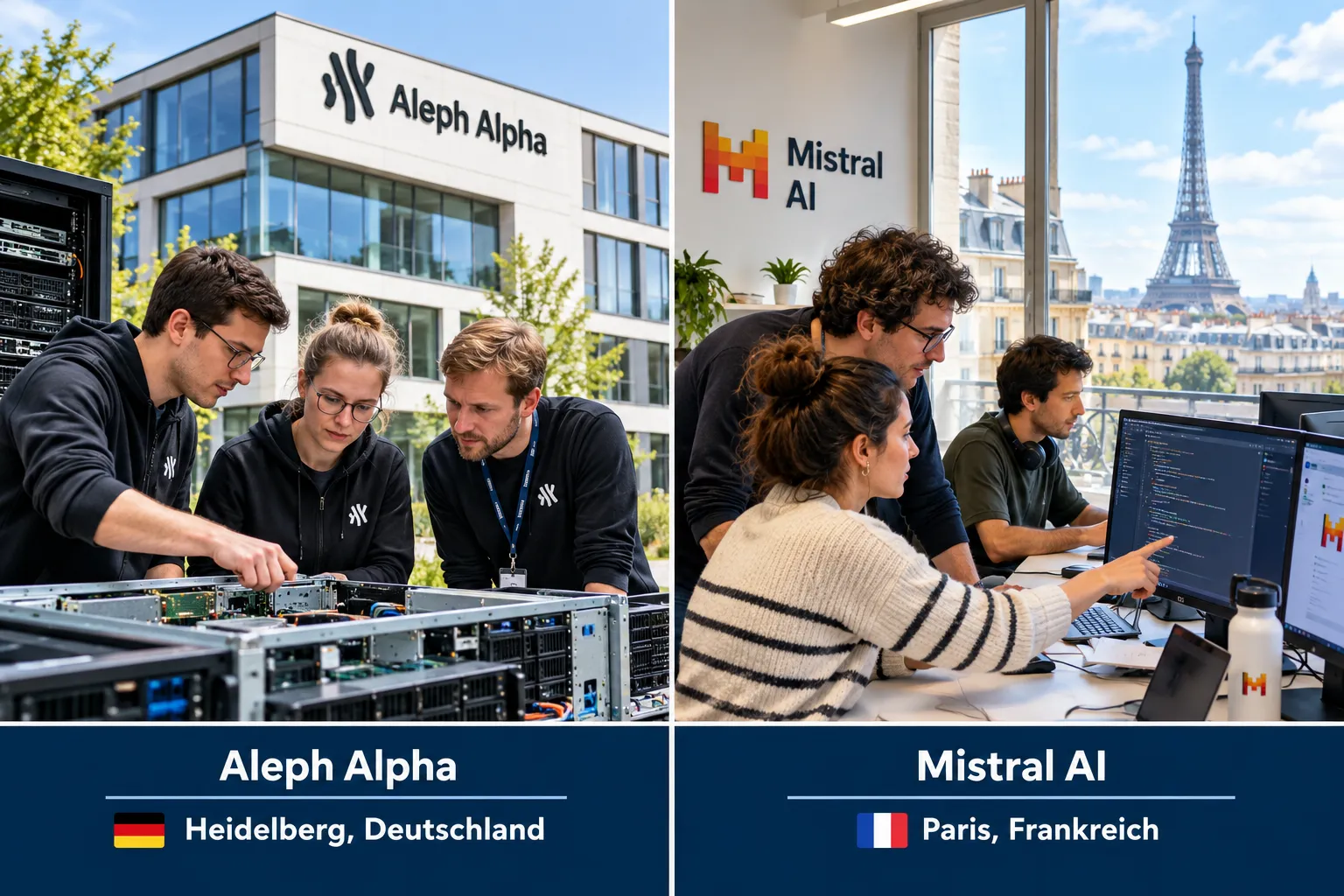
Aleph Alpha was founded in 2019 in Heidelberg and today employs around 200 people across four locations in Germany. Alongside the French provider Mistral AI, the company is considered one of the few European attempts to play an independent role in the global race for large language models.
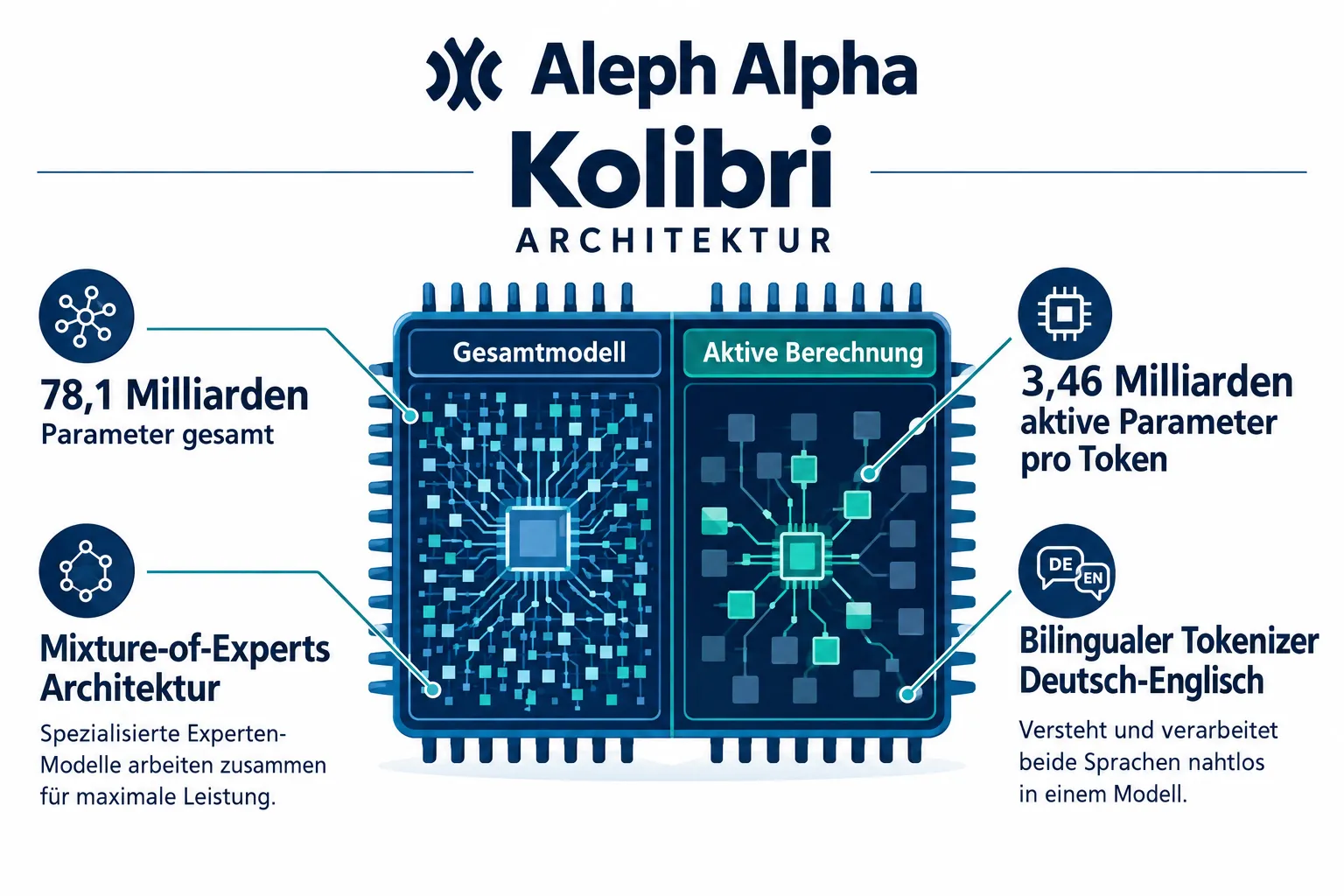
With Kolibri, Aleph Alpha is bringing a model to market that is deliberately not conceived as a pure research project, but as a deployable tool for organizations with high requirements around data protection and control. The name Kolibri (German for “hummingbird”) fits the technical idea behind it: a hummingbird is small and efficient, yet moves with remarkable precision. That’s exactly what the model’s Mixture-of-Experts architecture attempts to achieve technically.
“Kolibri demonstrates that we have the talent and expertise in Germany to develop competitive AI models,” explained Ilhan Scheer, CEO of Aleph Alpha, around the time of the release.
Scheer also emphasized that developing European AI models is, above all, about freedom of choice: organizations should be able to decide for themselves which infrastructure, which provider, and which model they use for sensitive applications.
Kolibri’s Technical Architecture
Kolibri is built as a Mixture-of-Experts (MoE) Transformer. This architectural principle differs fundamentally from classic, densely connected language models.
The key figures at a glance:
| Characteristic | Value |
|---|---|
| Total parameters | 78.1 billion |
| Active parameters per token | around 3.46 billion |
| Training context window | up to 262,144 tokens |
| Serving context window | up to 1,048,576 tokens (1 million) |
| Training hardware | 768 Nvidia B200 GPUs |
| Training locations | Germany and Finland |
The decisive advantage of the MoE architecture lies in compute efficiency: although the model has 78.1 billion parameters in total, only a fraction of that, around 3.46 billion parameters, is activated to process a single token. The model dynamically selects which “expert” sub-networks are most relevant for a given input. The result is a model that is considerably cheaper to run in practice than a comparably sized, densely connected model, without giving up much on quality.
The training data itself is also worth a closer look: according to the technical report, synthetic data generated with the GLM-5.2/5.3 models from Z.ai as well as Qwen3.8-27B was used, among other sources, for training. This shows that even European model development today builds heavily on a global ecosystem of tools, even if sovereignty ultimately centers on the finished product and its operation.
German-Language Optimization: Tokenizer and Training Data
The most striking feature of Aleph Alpha Kolibri in international comparison is the high share of German-language training data. Depending on the source, that share lies between roughly 21 and 23 percent of all pretraining tokens. For comparison: most large Western language models train predominantly on English-language text, with German often making up only a small, single-digit percentage.
This weighting is made possible, among other things, by a purpose-built bilingual tokenizer for German and English. Samuel Weinbach, co-founder and co-Chief Research Officer of Aleph Alpha, explained that this tokenizer was specifically designed to break down German text more efficiently than standard tokenizers trained primarily on English-language research.
This has practical consequences: a tokenizer that represents German words using fewer individual tokens needs fewer computing steps for the same German text. That not only saves compute time and cost for German-heavy applications, it also tends to improve how well the model captures grammatical peculiarities of the German language, such as compound nouns or inflectional forms.
License and Availability: Apache 2.0 With Limits
Aleph Alpha has made Kolibri’s full model weights available on Hugging Face under the name Aleph-Alpha/Kolibri-1. The license for this is Apache 2.0, one of the most permissive open-source licenses out there, which also allows commercial use, modification, and redistribution without licensing fees.
One important restriction is clearly spelled out in the official model card: the Apache 2.0 license applies exclusively to the published model weights. The underlying code base, the precise model architecture, and the training methods themselves are explicitly not covered. Anyone deploying Kolibri can therefore freely use and adapt the weights, but does not automatically gain insight into, or rights to, the full development methodology behind it.
In practice, this means for IT decision-makers:
- The weights can be downloaded locally and run on your own infrastructure.
- Fine-tuning adjustments for company-specific data are generally possible.
- The underlying training code remains proprietary to Aleph Alpha.
- Before any production deployment, the exact model card should be reviewed carefully, particularly for derivative commercial products.
Kolibri’s Benchmark Numbers: What They Actually Mean
Aleph Alpha published several benchmark results alongside the launch, intended to place the model among leading international systems. These figures come exclusively from the vendor’s own reporting and had not, at the time of release, been independently verified or reproduced by third parties.
| Benchmark | Reported score (vendor claim) |
|---|---|
| AIME 2025 (mathematics, English) | 96.9 percent |
| AIME 2026 (mathematics) | 96 percent |
| GPQA Diamond (expert knowledge) | 84.3 percent |
| LiveCodeBench v6 (coding) | 85.9 percent |
These numbers sound impressive but should be treated with appropriate caution. Benchmark results published by a vendor itself depend heavily on how the tests were conducted, which prompt variants were used, and whether the model was specifically optimized for exactly these kinds of benchmarks. A reliable assessment requires independent testing by external research institutions or community benchmarks, which, for Kolibri, were still pending at the time of release.
In practical terms for business decision-makers: the published figures can serve as an initial indicator of capability, but should be supplemented with your own tests using company-relevant tasks before any purchasing decision or larger pilot project.
Use Cases: Government, Industry, and Regulated Sectors
Aleph Alpha explicitly does not position Kolibri as a general consumer chat product, but as an infrastructure building block for organizations with high regulatory requirements. According to the company, the focus is on:
- Public administration and government agencies that don’t want to, or aren’t allowed to, run AI applications on US or Chinese cloud servers.
- Automotive suppliers that need to protect confidential design and process data.
- Semiconductor manufacturing, where intellectual property and production secrets are especially sensitive.
- Aerospace, where export controls and security requirements significantly restrict the use of external cloud AI.
The common denominator across these sectors is the desire for on-premises operation: AI models should run on their own, or at least European, infrastructure, with documented data provenance and in line with GDPR and the EU AI Act. An openly available model like Kolibri, which can be run locally without depending on an external API, fits precisely into that requirement profile.
Aleph Alpha Kolibri in the European Context
Kolibri’s release doesn’t stand in isolation. Just three days later, on October 6, 2026, the French company Mistral AI unveiled its own model, Mistral Large 4, also known internally as “Le Chonk,” with roughly one trillion parameters and 49 to 52 billion active parameters. Important for context: Mistral AI and Aleph Alpha Kolibri are two entirely separate companies from two different countries that independently released their own respective models.
Even so, both companies are frequently mentioned together in industry coverage, because they’re seen as the two most visible European “champions” in the global AI race against US providers like OpenAI or Google and Chinese providers like DeepSeek or Alibaba. The two companies pursue different priorities: Mistral AI leans more toward very large, broadly deployable models, while Aleph Alpha targets efficiency, German-language optimization, and regulated sectors in Germany specifically with Kolibri.
Critical Perspective: What Remains Open
Despite the impressive specs, there are a few points decision-makers should consider before any production deployment. As mentioned, the benchmark figures remain independently unverified so far. The licensing situation is more nuanced than a simple “open source” label might suggest, since the architecture and training code remain proprietary. And even though a high share of German-language training data can improve language quality, that’s no substitute for an independent evaluation of model quality in concrete business applications.
Frequently Asked Questions About Aleph Alpha Kolibri
Is Kolibri fully open source? The model weights are freely available under the Apache 2.0 license. According to the model card, the code base, architecture, and training methods themselves are excluded from that.
Who is Kolibri particularly suited for? The model targets government agencies and regulated industries such as automotive suppliers, semiconductor manufacturing, and aerospace that need on-premises deployment and documented data provenance.
Are the benchmark figures independently verified? No. The published numbers, such as 96.9 percent on AIME 2025, come from Aleph Alpha’s own reporting and had not been independently verified by third parties as of release.
Conclusion and Next Steps
Aleph Alpha Kolibri marks a notable step for Germany’s AI landscape: a capable, bilingual model with an efficient Mixture-of-Experts architecture, open weights, and a clear focus on German-language use and regulated industries. The combination of a high share of German training data, a dedicated bilingual tokenizer, and European training infrastructure in Germany and Finland sets Kolibri noticeably apart from models trained primarily in English.
At the same time, the vendor-published benchmark figures should be treated as an initial reference point rather than a final verdict on quality. Companies and government agencies considering Kolibri should, as a next step, run their own test cycles with realistic tasks, carefully review the license terms for their specific use case, and realistically calculate the infrastructure requirements for on-premises operation. Anyone who does this homework gets, with Kolibri, a tool that opens up genuine alternatives to US and Chinese AI offerings, without having to compromise on data protection and control.