A hung Node process burning CPU time for hours while nobody notices why: that is a nightmare every DevOps team has lived through. With Node.js 26.11.0, exactly this problem gets a native fix right inside the runtime. The version shipped on October 7, 2026, maintained by Antoine du Hamel as part of the Current release line. Besides the new watchdog mechanism, the release also brings a rename of the synchronous SQLite classes, new Buffer helpers, and several dependency updates. For more on the longer-term release rhythm of Node.js, see our article on the Node.js 27 release cycle.
This article breaks down the most important changes in Node.js 26.11.0 and what developers and operations teams should pay attention to right now.
Table of Contents
Key Takeaways
- Node.js 26.11.0 shipped on October 7, 2026 as a Current release, maintained by Antoine du Hamel.
- The new –process-timeout flag automatically stops hung processes via a watchdog thread and prints the call stack, using exit code 124.
- Buffer.stringLength() calculates a string’s length before decoding, useful for memory budgeting with untrusted input.
- The SQLite classes DatabaseSync and StatementSync are now called Database and Statement; old names remain as silent, working aliases.
- Alpine Linux is now officially Tier 2 support, and starting with Node 27 the project moves to a single major release per year.
Node.js 26.11.0 Overview: Release Dates and Background
Node.js 26.11.0 is part of the Lithium line, which became the Current version on May 5, 2026. According to the official roadmap this line is maintained through 2029, making it a dependable long-term choice for production environments. The October 7, 2026 release falls within the regular maintenance phase, where smaller feature additions and security backports are rolled in.
Antoine du Hamel is responsible for this release, coordinating the commit roundup, quality assurance, and the release itself as maintainer. The sourcing for this release comes from the official Node.js blog and from coverage by linuxcompatible.org, both of which confirm the technical details.
Node.js 26.11.0 is not a major release and therefore does not bring breaking changes in the strict sense. Instead, the focus is on practical improvements that are most noticeable in operations and debugging.
The New –process-timeout Flag in Node.js 26.11.0
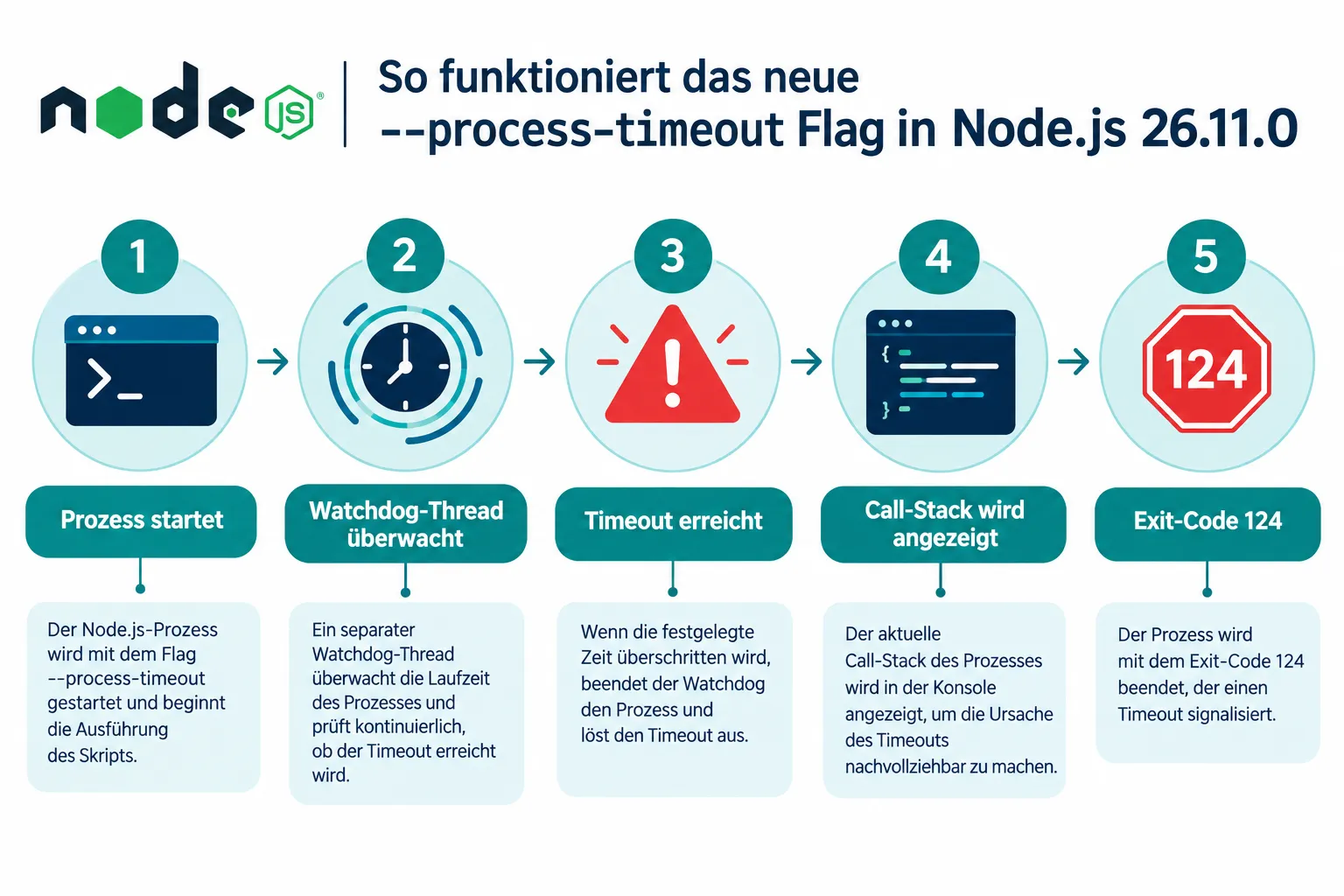
The most notable addition in Node.js 26.11.0 is the new –process-timeout flag, developed by James M Snell. It addresses a problem many teams know well: processes that stop responding for various reasons but also do not crash outright. These zombie processes tie up resources, skew monitoring data, and make debugging significantly harder.
The flag works through a dedicated watchdog thread that runs alongside the main process. Once this thread detects that the configured timeout was exceeded, it intervenes automatically:
- The hung process is stopped in a controlled manner.
- The current call stack is printed, so the cause of the stall stays traceable.
- The process exits with the familiar Unix exit code 124, traditionally used for timeout situations.
"A watchdog thread that detects hung processes and terminates them with a call stack removes a lot of manual diagnostic work from developers."
For CI/CD pipelines and container orchestration, this is a direct win. Instead of a hung test runner or worker process blocking an entire pipeline for minutes, the flag lets teams set a hard upper bound. The familiar exit code 124 also means existing scripts and monitoring rules that already react to that code can keep working without changes.
Buffer.stringLength() and New Header Validation
Besides the process timeout, Node.js 26.11.0 brings two further improvements that are especially relevant for security-conscious backend teams.
The new Buffer.stringLength() method calculates the length of a string before it is actually decoded. That sounds minor at first, but has a clear practical benefit: for untrusted input, say from user uploads or external APIs, teams can check a memory budget upfront without paying the full cost of decoding. This reduces the risk of oversized or maliciously crafted input consuming memory uncontrollably.
Alongside this, new header validation helpers were made public. These existed internally before but are now available as a documented API. This lets HTTP headers be systematically checked before processing, making it easier to build more robust HTTP servers and middleware components.
Both additions fit a clear trend: Node.js is putting increasing emphasis on input validation and resource protection before data moves deeper into application logic.
SQLite Rename: Database and Statement Instead of Sync Suffixes
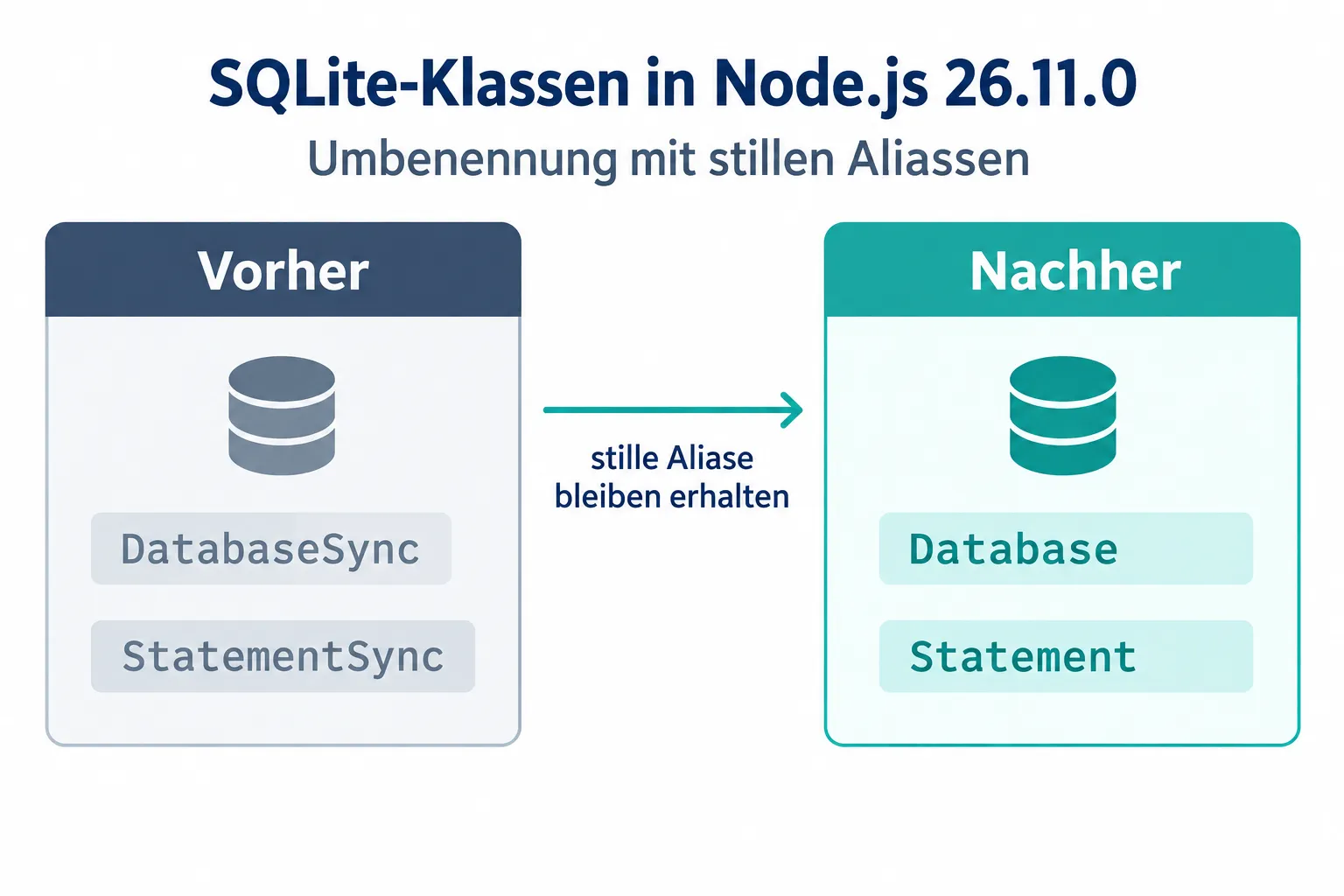
One of the most discussed changes in Node.js 26.11.0 concerns the native SQLite module. The synchronous classes were renamed:
| Old Name | New Name |
|---|---|
| DatabaseSync | Database |
| StatementSync | Statement |
Important in practice: this rename is not breaking. The old names DatabaseSync and StatementSync remain fully functional as silent aliases. Existing code keeps running unchanged; nothing needs to be adjusted immediately.
Still, it’s worth looking at the reasoning behind this decision. The shorter names Database and Statement feel more consistent with the rest of Node.js’s API design and avoid the somewhat clunky Sync suffix, which originally served mainly to distinguish these from possible future asynchronous variants. Teams writing new code should prefer the shorter names to align with the current naming convention. Existing codebases face no urgent pressure, but a gradual migration whenever convenient makes sense.
Other Notable Changes in Node.js 26.11.0
Beyond the three headline topics, Node.js 26.11.0 contains a number of other adjustments that together improve stability and platform coverage.
Alpine Linux was promoted to official Tier 2 support. That means more formal backing for this lightweight Linux distribution, which is especially popular in container images and Kubernetes environments. For teams relying on Alpine-based Docker images, this increases reliability for future Node.js updates.
On the dependency side, there are several updates as well:
- OpenSSL was updated to version 3.5.9.
- npm now ships at version 11.20.0.
- V8 backports were merged in to keep the JavaScript engine current.
- Timezone data was updated to the 2026e release.
- undici, the HTTP client library, was updated to version 8.11.2.
These updates are typical maintenance work for a Current release line, but they are no less important: OpenSSL and timezone updates in particular directly affect the security and correctness of date and encryption operations in production systems.
Release Strategy: Node 26 Lithium and the Future Starting With Node 27
Node.js 26.11.0 is part of the Lithium line, which has been the Current version since May 5, 2026 and is scheduled to be maintained through 2029. This long maintenance window gives companies planning certainty for multi-year infrastructure decisions.
One notable strategic announcement goes beyond this specific release: starting with Node 27, the project team is changing its release cadence. Until now, two major releases shipped per year; going forward there will be only one major release per year.
For backend teams, this has several consequences:
- Less frequent, but presumably larger, major releases.
- Longer lead times for migration planning between major versions.
- Potentially more stable Current lines, since switching happens less often.
This shift signals that the Node.js project is leaning more toward predictability and maturity rather than maximizing release frequency.
Practical Recommendations for Developers and DevOps Teams
Given the changes included in Node.js 26.11.0, there are clear, actionable steps for teams running production Node.js environments.
For DevOps and platform teams:
- Test the new –process-timeout flag in CI/CD pipelines and container deployments to stop hung processes early and automatically.
- Check whether monitoring and alerting rules already react correctly to exit code 124.
- For Alpine-based container images, use the upgraded Tier 2 support level as an argument for either adopting or continuing to rely on this base.
For application developers:
- Use Buffer.stringLength() when processing untrusted input to check memory limits upfront.
- Integrate the new header validation helpers into HTTP server and middleware code to catch problematic input early.
- Use the shorter class names Database and Statement directly in new SQLite code; migrate existing code gradually, without time pressure.
For medium-term planning:
- Factor the announced shift to one major release per year starting with Node 27 into your own release and upgrade roadmap.
- Use the long maintenance window of the Lithium line through 2029 as an argument for a stable production base.
Conclusion
Node.js 26.11.0 is a release that looks unspectacular at first glance but bundles several practically relevant improvements on closer inspection. The new –process-timeout flag solves a real operational problem, hung processes, with a built-in watchdog mechanism and a familiar exit code. The SQLite rename to Database and Statement brings more consistency to the API without endangering existing code, since the old names remain as silent aliases. The release is rounded out by Buffer.stringLength(), public header validation helpers, the promotion of Alpine Linux to Tier 2 support, and several dependency updates to OpenSSL, npm, V8, timezone data, and undici.
Teams should roll out Node.js 26.11.0 to test and staging environments promptly, evaluate the new process timeout mechanism, and prepare their build and deployment processes for the announced annual major release cadence starting with Node 27. Anyone already running on the Lithium line benefits from a long maintenance window through 2029 and can adopt this update into the regular patch cycle without breaking changes.
Frequently Asked Questions
Is Node.js 26.11.0 a breaking-change release? No. The SQLite rename and all other changes are backward compatible; old API names keep working via silent aliases.
Does existing SQLite code need to be updated immediately? No. DatabaseSync and StatementSync remain usable. Switching to Database and Statement is recommended but not urgent.
What does exit code 124 mean for the new process timeout? It is the established Unix exit code for timeout situations, which the new –process-timeout flag adopts when a process is stopped automatically.
How long is Node 26 (Lithium) supported? According to the official roadmap, through 2029.
References
- Node.js Foundation, official Node.js blog, Node.js 26.11.0 release announcement, 2026.
- linuxcompatible.org, coverage of Node.js 26.11.0, 2026.