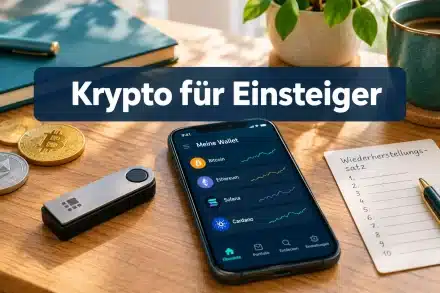
Anyone who sets up their first crypto wallet incorrectly risks losing not just access to an app, but real money, irreversibly, with no customer service to call for help. That’s exactly what separates cryptocurrencies from a traditional bank account: nobody can reset a forgotten password. For anyone approaching crypto wallets for the first time, this distinction is the single most important thing to understand. This guide walks through, step by step, how to set up a first wallet securely, what separates hot wallets from cold wallets, and the most common mistakes beginners make.
Table of Contents
Key Takeaways
- A crypto wallet doesn’t manage coins directly, it manages the private keys that grant access to them [9].
- Hot wallets are convenient for everyday use, while cold wallets offer far stronger protection for larger amounts [1][6].
- The recovery phrase is the only way to restore a wallet, so it must never be stored digitally [5][2].
- Beginners should keep a clear separation between an everyday wallet and a vault, and always verify transactions before sending [3][10].
- Regulated, custodial providers remain a solid entry point in 2026, before moving on to self-custody wallets [7][8].
What Is a Crypto Wallet? Basics for Beginners
A crypto wallet doesn’t store coins the way a physical wallet stores cash. Instead, it manages cryptographic keys: a public key that works like an account number, and a private key that functions like a master password [9]. The actual coins always live on the blockchain. The wallet is simply the tool that proves someone has access to a particular balance.
For beginners, this distinction matters because it explains why wallet security is so critical. Anyone who loses their private key loses access to their balance, regardless of which app or device was used [2]. Anyone who hands their private key to a third party effectively surrenders full control over their assets.
Broadly speaking, experts distinguish between custodial and non-custodial wallets. With custodial solutions, an exchange or platform holds the private keys in trust. With non-custodial wallets, full control, and therefore full responsibility, rests with the user [1].
Hot Wallet vs. Cold Wallet: The Key Difference for Crypto Wallet Beginners
Choosing between a hot wallet and a cold wallet is the single most important decision for any crypto wallet beginner. A hot wallet is connected to the internet, for example as a smartphone app or browser extension. A cold wallet stores private keys offline, usually on a dedicated hardware device [6][4].
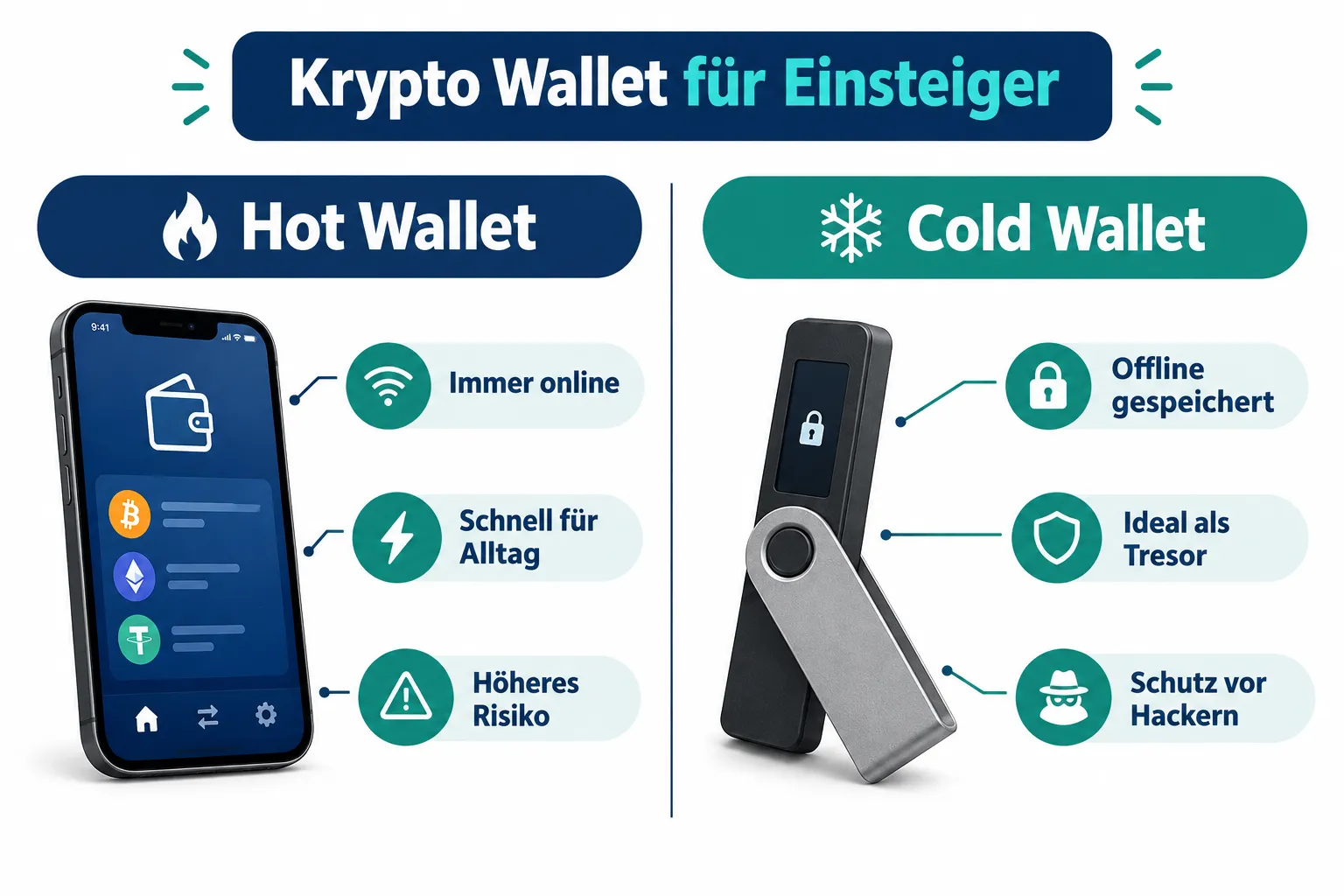
| Feature | Hot Wallet | Cold Wallet |
|---|---|---|
| Connection | Always online | Offline, connected only when needed |
| Use case | Everyday use, small amounts | Long-term storage, larger amounts |
| Risk | Higher exposure to hacks or malware | Much lower, physical theft is possible |
| Examples | Mobile apps, browser wallets | Hardware wallets |
| Cost | Usually free | One-time purchase cost |
For 2026, most beginner guides recommend a clear division of roles: a hot wallet for small, everyday amounts and a hardware wallet as a vault for the bulk of your holdings [1][8]. Popular beginner-friendly hardware wallets stand out for their simple interfaces, responsive support, and broad support for different cryptocurrencies [4].
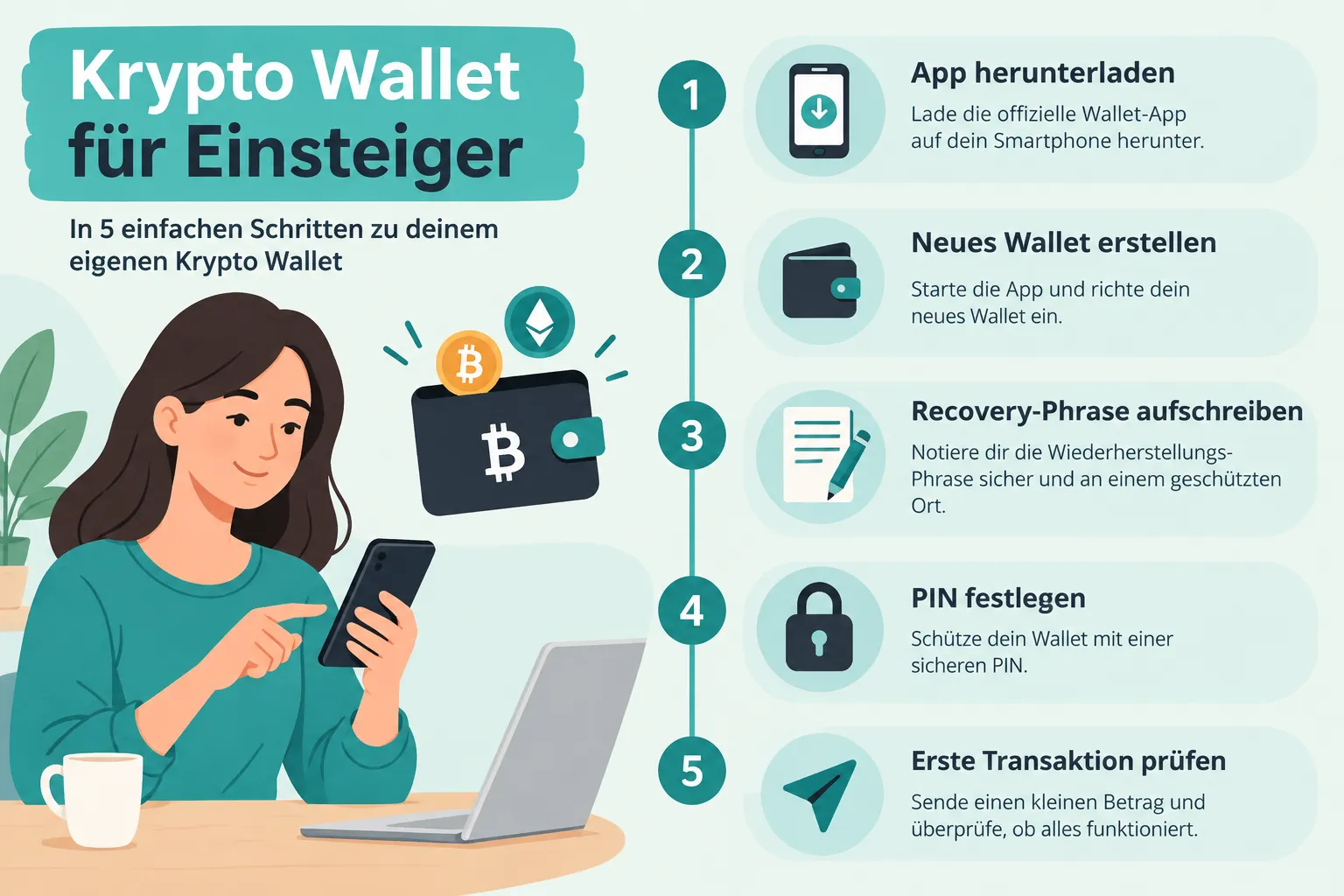
Crypto Wallet for Beginners: How to Set Up Your First Wallet
As of September 2026, the following process is a proven, standard path for getting started [7]. It works for both mobile apps and desktop applications.
- Choose a provider. For a first encounter with crypto, a regulated, custodial provider is often a good fit, since support and onboarding tend to be especially beginner-friendly [7][8].
- Download the app officially. Only download from the official website or official app store, never via links from social media or emails.
- Create a new wallet. The app automatically generates a key pair. For non-custodial wallets, this is when the recovery phrase appears.
- Write down the recovery phrase. This sequence of words, usually 12 or 24, should be written down by hand on paper, never photographed or saved digitally [5].
- Set a PIN or password. A strong, unique password protects access on the device itself.
- Send a small test amount. Before larger transactions, it’s worth sending a small test transfer to verify the address and network.
Mobile-first approaches have become the standard in 2026: most beginner wallets are designed primarily as smartphone apps and increasingly support multiple blockchains at once, so-called multi-chain wallets [10][3].
The Recovery Phrase: Why It Must Never Be Stored Digitally
The recovery phrase, also called a seed phrase, is the master key to a wallet. Anyone who knows this sequence of words can restore the entire balance on any other device [2]. That’s exactly what makes it the biggest security risk if it’s stored incorrectly.
The recovery phrase belongs on paper, never in a cloud service, a photo, an email, or a notes app.
Digital storage opens the door to attackers: cloud backups can be hacked, screenshots often end up unintentionally in photo sync services, and notes apps are rarely end-to-end encrypted [5]. The gold standard in 2026 remains physical, analog storage, for example on fireproof paper or specialized metal plates, split across two separate, secure locations [1][6].
A growing trend is so-called “seedless” or user-friendly backup solutions, where multiple encrypted backup fragments are distributed across different devices or trusted parties. These approaches reduce the risk of user error for beginners, but they don’t replace the fundamental rule that no unsecured digital copy should ever exist [3].
Separating Your Everyday Wallet From Your Vault: Using Cold Storage Correctly
A frequently underestimated security principle is this: not all of your crypto holdings belong in a hot wallet. Experienced users strictly separate a small “everyday wallet” for transactions from a “vault” for long-term storage [6][1].
The principle mirrors how people traditionally handle cash: nobody carries their entire life savings around town in their wallet. For crypto wallet beginners, this means, in practice:
- Small amounts for active use stay in the hot wallet.
- Larger amounts are moved promptly into a hardware wallet.
- The vault is only connected occasionally and deliberately, never left permanently connected.
This separation significantly reduces the attack surface, since a compromised smartphone or an infected computer would, at worst, only put the smaller everyday amount at risk [4].
Checking Transactions: Understanding Networks and TXIDs
Every crypto transaction runs over a specific network, such as Bitcoin or Ethereum. If an address is used on the wrong network, the funds can be lost irretrievably [10]. Before sending anything, beginners should therefore check two things: the destination address and the selected network.
After sending, every transaction generates a so-called TXID (transaction ID). This unique identifier can be entered into a public blockchain explorer to track the transaction’s status, pending, confirmed, or failed [3]. This check gives beginners peace of mind and helps them quickly determine, in case of a problem, whether a transaction actually arrived.
Common Beginner Mistakes When Setting Up a Crypto Wallet
Many problems don’t stem from hacking attacks but from avoidable user errors. According to current beginner-focused analyses, the most common mistakes include [3][5][8]:
- Photographing the recovery phrase or saving it to cloud services.
- Choosing the wrong network when entering an address.
- Leaving large amounts permanently in a hot wallet instead of moving them to a cold wallet.
- Clicking unknown links or fake support contacts that ask for the recovery phrase.
- Skipping a test transfer before the first larger transaction.
- Relying on a single backup with no physical copy stored in a second location.
Important: no legitimate provider, exchange, or technical support team will ever actively ask for your recovery phrase. Such a request is, in practically every case, an attempted scam [2].
Security Tips and Selection Criteria for 2026
Nearly all current beginner guides repeat the same core security principles [1][4][5][6]:
- Enable two-factor authentication on every account that offers it.
- Install regular software updates for your wallet app.
- Use bookmarks instead of search results to avoid phishing websites.
- Send small test amounts before larger transactions.
- Keep backups in at least two physically separate locations.
When choosing a wallet, current guides also recommend paying attention to the following criteria: support for multiple blockchains, a clear and understandable interface, active ongoing development by the provider, and a transparent open-source or security-audit track record [8][10].
Outlook: Where Wallet Security Is Heading
Looking beyond 2026, several industry observations suggest that user-friendly backup mechanisms and multi-chain support are likely to keep gaining ground [3][10]. This is an assessment based on current trends, not a guarantee. The fundamental rules, physically storing the recovery phrase, separating everyday and vault wallets, and carefully checking every transaction, are likely to remain in place regardless of new technologies. Once you have moved past the basics, our guide to DeFi and yield farming for advanced users explores how to put your holdings to work.
Conclusion
Getting started with cryptocurrency doesn’t begin with buying a coin, it begins with setting up a secure wallet. Anyone who understands the fundamentals, the difference between hot and cold wallets, physically storing the recovery phrase, separating everyday funds from vault storage, and carefully checking every transaction, lays the foundation for handling digital assets safely over the long term. As a next step, it’s worth starting with a small amount through a regulated provider, then setting up your own hot wallet, and eventually investing in a hardware wallet as your holdings grow. Patience and care in these first steps pay off in the long run. Once your wallet is set up, our comparison of crypto exchanges for beginners covers the natural next step: buying your first coins.
References
[1] Wallets – https://misscrypto.de/wallets [2] Wallets – https://www.krypto.de/wallets/ [3] Beginners – https://cryptoslate.com/crypto-wallets/beginners/ [4] Best Crypto Wallets – https://www.avast.com/de-de/c-best-crypto-wallets [5] How to Safely Store Crypto – https://financer.de/krypto/wie-kann-ich-krypto-sicher-aufbewahren/ [6] Wallet – https://www.capitalo.de/krypto/wallet [7] Buying Cryptocurrency in Germany: What Beginners Need to Know – https://codeble.de/2026/06/24/kryptowaehrungen-kaufen-in-deutschland-was-einsteiger-wissen-müssen/ [8] Top Crypto Wallets For Beginners – https://coinbureau.com/analysis/top-crypto-wallets-for-beginners [9] What Is a Wallet and Where Do I Get One – https://www.bitpanda.com/de/academy/was-ist-eine-wallet-und-wo-bekomme-ich-eine [10] Crypto Wallets – https://cryptoslate.com/crypto-wallets/
Frequently Asked Questions
What is the difference between a hot wallet and a cold wallet?
A hot wallet stays connected to the internet and suits small everyday amounts, while a cold wallet stores keys offline and offers much stronger protection for larger holdings.
Why should the recovery phrase never be stored digitally?
Digital storage like cloud backups or screenshots opens the door to attackers; the recovery phrase should only ever be written on paper and kept offline.
What happens if you lose your recovery phrase?
Without the recovery phrase and no backup, access to your funds is generally lost permanently, since nobody can reset a forgotten crypto password.
What is a TXID and what is it used for?
A TXID is the unique identifier of a transaction that can be entered into a blockchain explorer to check its status: pending, confirmed, or failed.