
Three days, one rate hike, one exploit and a market capitalization of $2.86 trillion: rarely have so many market-moving events converged as tightly as between September 17 and 19, 2026. Wednesday’s Bitcoin Fed rate hike ended expectations of looser monetary policy without bringing the crypto market to its knees. Instead, Bitcoin has since been trading in a wide, jittery range, while investors simultaneously digest a security incident in the DeFi sector.
This update breaks down the key numbers, flows and risks of September 20, 2026: from the monetary policy reaction, through institutional ETF movements, to the oracle exploit at the Starknet protocol Nostra.
Table of Contents
Key Takeaways
- The Fed unanimously raised its benchmark rate by 25 basis points to 3.75-4.00% on September 17, 2026, the first increase since 2023.
- Bitcoin has since fluctuated between roughly $75,700 and $81,500, currently trading in the $76,000 to $81,000 range.
- Bitcoin spot ETFs recorded a net inflow of $159.45 million on September 17, after multi-day outflows had previously pushed flows into negative territory.
- The US Senate rejected the CLARITY Act on September 15 by a vote of 49 to 50; the market showed little visible reaction.
- The DeFi protocol Nostra on Starknet lost roughly $3.5 million to an oracle price manipulation involving the NSTR token.
Bitcoin Fed Rate Hike: The September 17 Decision and Market Reaction
On September 17, 2026, the Federal Open Market Committee (FOMC) raised its benchmark rate by 25 basis points to a new target range of 3.75 to 4.00 percent. The decision was unanimous and marks the first Bitcoin Fed rate hike since 2023. For many market observers, this signaled that the central bank is once again weighing inflation risks more heavily than growth, after months of speculation about rate cuts.
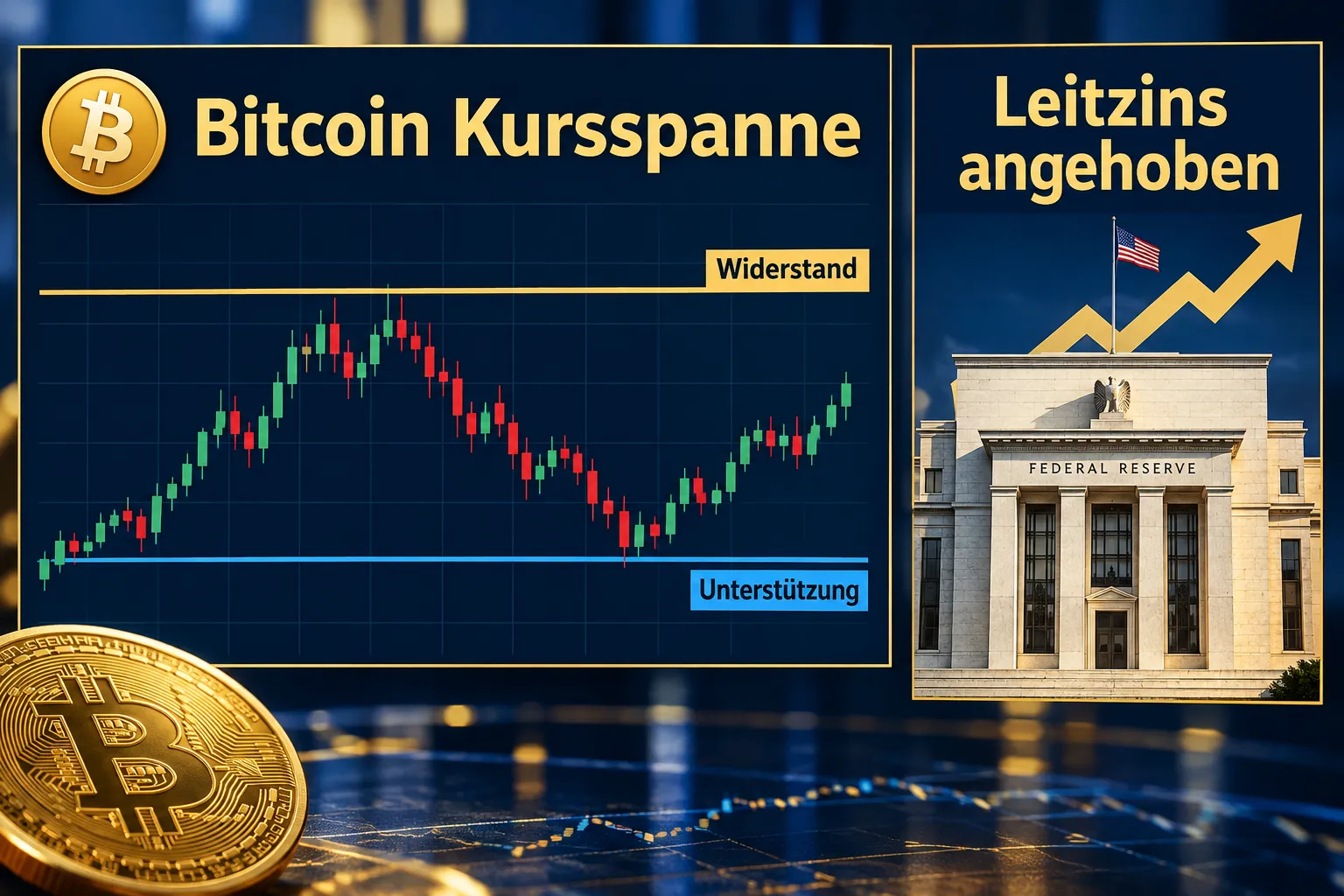
The crypto market’s immediate reaction was mixed but not panicked. Since the decision, Bitcoin has moved in a range of roughly $75,700 to $81,500, with a current snapshot between $76,000 and $81,000. This roughly $5,800 range within just a few days shows how strongly the market is reacting to every new headline without finding a clear direction. Ethereum moved in a notably tighter range over the same period, between $2,440 and $2,570.
Notably, sentiment held up: the Fear and Greed Index climbed to 71 despite the tighter monetary policy, firmly in Greed territory. That suggests many investors had already priced in the rate hike and treated the reaction as a “sell the rumor, buy the fact” event. At the same time, total crypto market capitalization briefly climbed to $2.86 trillion on September 19, showing that capital largely stayed in the market rather than fleeing on a large scale.
The situation is compounded by Goldman Sachs’ forecast of a further 25-basis-point rate hike in October 2026. Should that scenario play out, the Fed would deliver two restrictive moves within just a few months, further fueling the debate over how the Bitcoin Fed rate hike affects risk assets.
ETF Flows: Institutional Money Between Confidence and Caution
For an overview of earlier ETF movements, see our article Bitcoin Tops $81,000 Amid Short Squeeze and ETF Inflows.
Movements in US spot Bitcoin ETFs tell the story of a market oscillating between structural demand and short-term nervousness. After a series of robust weekly inflows in early September, during which cumulative net inflows climbed to a record level over the years [7], the picture reversed sharply mid-month. On September 15 and 16, net outflows of roughly $296 million and $450 million were recorded, while Bitcoin traded around $75,800 at the same time [4].
These outflows pulled cumulative net inflows across all spot Bitcoin ETFs down from a peak near $63 billion in October 2025 to roughly $55 billion [4]. Even the week before, individual trading days had brought outflows of $46.6 million and $120.2 million, though flows remained positive on a monthly basis [6].
On September 17, the day of the Fed decision, the picture flipped again: Bitcoin spot ETFs recorded a net inflow of $159.45 million. BlackRock’s iShares Bitcoin Trust (IBIT) led with roughly $183.7 million in inflows, while several smaller funds saw moderate outflows [10]. This rotation between issuers suggests institutional investors are not moving uniformly in one direction, but rather reallocating selectively.
Ethereum ETFs showed the opposite picture on the same day: a net outflow of $39.24 million stood in contrast to Bitcoin. Cumulatively, the balance since launch remains clearly positive at $13.11 billion in inflows. Analysts describe this rapid swing from nearly a billion dollars in weekly inflows to double-digit-million outflows as a sign of fragile institutional demand whose positioning can reverse quickly as soon as expectations about Fed policy or real yields shift [4][6].
Regulation: CLARITY Act Fails, SEC Comment Period Underway
For more background on the failed bill, read our article CLARITY Act: Why the Bill Failed in the US Senate.
On the regulatory front, September 2026 brought a clear setback for the crypto industry. The US Senate rejected the CLARITY Act, the central piece of legislation for comprehensive digital asset regulation, by a vote of 49 to 50 on September 15. The bill would have established clear jurisdiction between the SEC and CFTC and brought long-awaited legal certainty to many market participants.
The market reaction is notable: despite the narrow rejection, Bitcoin and Ethereum showed little visible response to the news. This suggests the market had either already priced in the failure or views the bill’s significance for short-term price formation as limited.
In parallel, another regulatory process is underway: the US Securities and Exchange Commission is currently running a public comment period on its “Regulation Crypto Assets” framework. The deadline for submissions runs until October 20, 2026. This process could have greater practical impact in the medium term than the failed CLARITY Act, as it directly affects SEC oversight practices toward issuers, exchanges, and custodians. Market participants and industry associations are likely to use the coming weeks to influence the final shape of the framework through submissions.
Nostra Exploit: Oracle Manipulation Costs Starknet Protocol $3.5 Million
Alongside the macroeconomic developments, a security incident in the DeFi sector drew attention. Nostra Finance, a lending protocol running on the Starknet layer-2 network, reported an oracle manipulation exploit on September 17, 2026. A single account exploited a manipulated price source for the NSTR token to borrow against artificially inflated collateral [1][2].
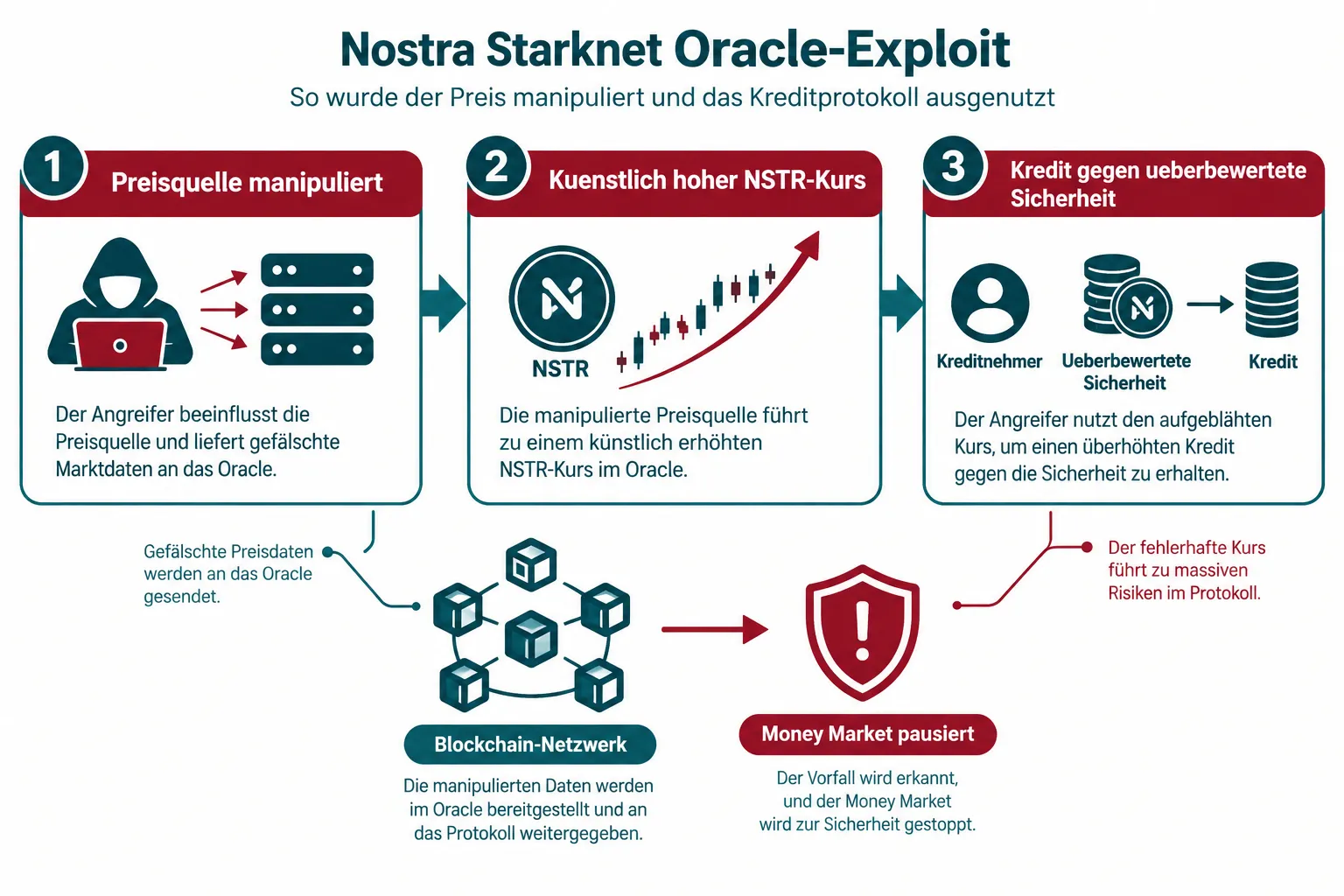
According to security analyses, the oracle price of NSTR was pushed from roughly $0.006 to about $49.50, a distortion by a factor of 8,000 [1]. Based on this artificially inflated valuation, the attacker drained roughly $3.5 million in digital assets from the money market. Nostra responded immediately and fully paused the affected money market, including deposit, borrowing, and liquidation functions [2][8].
Reports indicate the origin of the incident traces back to faulty price data that had already emerged from a Pragma publishing pipeline on September 4 and spread across several Starknet price feeds. This had already triggered dozens of liquidations in the Vesu/Nostra money market beforehand [1]. Crucially, the actual flaw was not in Nostra’s own smart contract code, but in the oracle infrastructure that relays external price data to the protocols.
This case is relevant to DeFi users for several reasons. First, it shows that significant losses can occur even without a classic code bug, if a protocol’s price source is manipulable. Second, the incident highlights the particular risks around smaller, newer tokens like NSTR, whose low liquidity makes price manipulation easier. Third, the case underscores the importance of robust, decentralized, and multiply-secured price oracles as a basic prerequisite for safe lending in DeFi.
Several industry observers have called the Nostra exploit a “wake-up call” for the Starknet ecosystem, as it exposes the ecosystem-wide dependence on external oracle infrastructure [5][9]. For investors engaging with DeFi protocols, the core lesson remains: with smaller or newer protocols, it’s worth scrutinizing which oracle providers are used, how many independent price sources feed in, and whether safeguards such as price deviation limits are implemented.
Technical Analysis: Bitcoin Fed Rate Hike and the Next Price Levels
From a technical standpoint, the Bitcoin Fed rate hike has ushered in a consolidation phase in which clear levels should determine the next direction.
Bitcoin (BTC):
| Level | Price (USD) | Significance |
|---|---|---|
| Key resistance | 81,500-82,200 | Breakout needed for further upside potential |
| First support | 79,000 | Short-term hold within the range |
| Second support | 76,000 | Critical level, lower edge of the current trading range |
A sustained breakout above the 81,500 to 82,200 dollar zone would be the strongest technical signal for a continuation of the upward move. As long as this zone is not overcome, Bitcoin remains trapped in its wide sideways range, where pullbacks to 79,000 or even 76,000 dollars would be normal corrective moves within the trend.
Ethereum (ETH):
| Level | Price (USD) | Significance |
|---|---|---|
| Resistance | 2,650-2,700 | Zone for a possible upward reversal |
| Support | 2,500 | Important psychological and technical level |
Ethereum currently trades below its resistance zone and must defend the $2,500 mark as support to avoid slipping into a deeper correction. A break above $2,650 to $2,700, on the other hand, could attract fresh capital and offset its relative weakness versus Bitcoin since the rate hike.
Outlook: What the Market Needs to Watch Through October
The coming weeks are likely to be shaped by several parallel areas of tension. Goldman Sachs’ expected second Bitcoin Fed rate hike in October 2026 will continue to test market sentiment, especially in combination with the expiration of the SEC’s “Regulation Crypto Assets” comment period on October 20. At the same time, it remains to be seen whether ETF flows stabilize after the September 17 recovery or turn negative again. How that tension resolved just days later is covered in our analysis of the Bitcoin rally past $85,000 on September 21.
In the DeFi sector, the Nostra incident is likely to further fuel the debate over oracle security, particularly on layer-2 networks like Starknet that rely heavily on external price feeds. Further audits and possibly stricter security standards at similar protocols are likely.
Conclusion
September 20, 2026 shows a crypto market that is handling monetary policy shocks better than in previous cycles, while remaining sensitive to technical and regulatory details. The Bitcoin Fed rate hike has shifted market expectations without fundamentally breaking the upward structure, while the Nostra exploit serves as a clear reminder of the remaining security risks in the DeFi sector.
For technically and financially engaged market participants, clear next steps emerge: closely track ETF flow developments in the coming trading days, watch the $81,500 and $76,000 price levels for Bitcoin as well as $2,650 and $2,500 for Ethereum, follow the outcome of the SEC comment period, and critically review the oracle infrastructure used when engaging with smaller DeFi protocols. Anyone keeping these four factors in view will be significantly better prepared for the next market phase than those focused on price alone.
Sources
[1] Nostra Halts Starknet Money Market After $3.5M NSTR Oracle Exploit – https://www.cryptotimes.io/2026/09/18/nostra-halts-starknet-money-market-after-3-5m-nstr-oracle-exploit/
[2] Nostra Halts Market After $3.5M Oracle Exploit Starknet – https://www.gncrypto.news/news/nostra-halts-market-after-3-5m-oracle-exploit-starknet/
[4] Bitcoin ETF Outflows Expose The Fragility Behind The August Rally – https://www.investing.com/analysis/bitcoin-etf-outflows-expose-the-fragility-behind-the-august-rally-200687822
[5] Nostra Starknet Oracle Exploit $3.5 Million – https://crypto-jazz.com/defi/2026/09/18/nostra-starknet-oracle-exploit-3-5-million/
[6] Bitcoin ETF Outflows Expose A Fragile Institutional Bid – https://www.investing.com/analysis/bitcoin-etf-outflows-expose-a-fragile-institutional-bid-200687561
[7] $986M Weekly Inflows Trigger Bitcoin – https://finance.yahoo.com/markets/crypto/articles/986m-weekly-inflows-trigger-bitcoin-100055125.html
[8] Nostra Had Approximately $35 Million In Assets Lent Out Due To Alleged Price Manipulation Of Its NSTR Oracle – https://ground.news/article/nostra-had-approximately-35-million-in-assets-lent-out-due-to-alleged-price-manipulation-of-its-nstr-oracle
[9] Nostra’s $3.5 Million Oracle Exploit Is A Starknet DeFi Wake-Up Call Sep 18 2026 – https://cubed.run/blog/nostra-s-3-5-million-oracle-exploit-is-a-starknet-defi-wake-up-call-sep-18-2026
[10] Spot Bitcoin ETFs Posted About $160 Million Of Inflows On September 17 – https://hedgeco.net/news/09/2026/spot-bitcoin-etfs-posted-about-160-million-of-inflows-on-september-17.html
Frequently Asked Questions
When did the Fed raise rates and by how much?
On September 17, 2026, the FOMC unanimously raised its benchmark rate by 25 basis points to 3.75-4.00%, the first increase since 2023.
How did Bitcoin's price react to the rate hike?
Bitcoin fluctuated between roughly $75,700 and $81,500 after the decision, trading in the $76,000-$81,000 range, while the Fear and Greed Index climbed to 71 (Greed territory).
What happened with the Nostra exploit?
The DeFi protocol Nostra on Starknet lost roughly $3.5 million to an oracle price manipulation involving the NSTR token.
What happened to the CLARITY Act?
The US Senate rejected the CLARITY Act on September 15 by a vote of 49 to 50, and the market showed little visible reaction.