On average, critical security vulnerabilities surface about ten days after a major PHP release, and that is exactly what is happening again. While many teams are still busy migrating to PHP 8.4, PHP 8.5 is already production-ready, running stably at version 8.5.10, and Laravel has simultaneously shipped several features that directly change everyday developer work. PHP 8.5 and Laravel 2026 is no longer a preview, it is the current reality for every backend team planning maintenance windows, renewing hosting contracts, or setting up new projects.
This article summarizes what has technically changed, which security updates now take priority, and how Laravel projects should prepare for the new version landscape.
Table of Contents
Key Takeaways
- PHP 8.5 has officially been released and is currently at bugfix version 8.5.10; PHP 8.6 is already in Beta 2.
- Older branches remain security-relevant: PHP 8.4.25 (August 27, 2026, bugfix), PHP 8.4.24 (July 30, 2026, security update), and PHP 8.3.33 (security update) still need prompt patching.
- Starting October 2026, PHP 8.5 becomes the default version at many hosting providers, so deployment pipelines should be tested now.
- Laravel 2026 brings three practical productivity boosts with
Cache::funnel(), an extended query builder, and new validator methods (whenFails(),whenPasses()). - The choice between PHP and Node.js remains strategically relevant, especially now that PHP performance and ecosystem maturity are back in focus.
PHP 8.5 and Laravel 2026: Current Version Status and Lifecycle
The PHP version landscape is unusually active this fall of 2026. The official release overview lists PHP 8.5 as the current main branch, while two older branches are still actively maintained at the same time [5]. For backend teams this means: there is not one PHP version that matters, but a support matrix.
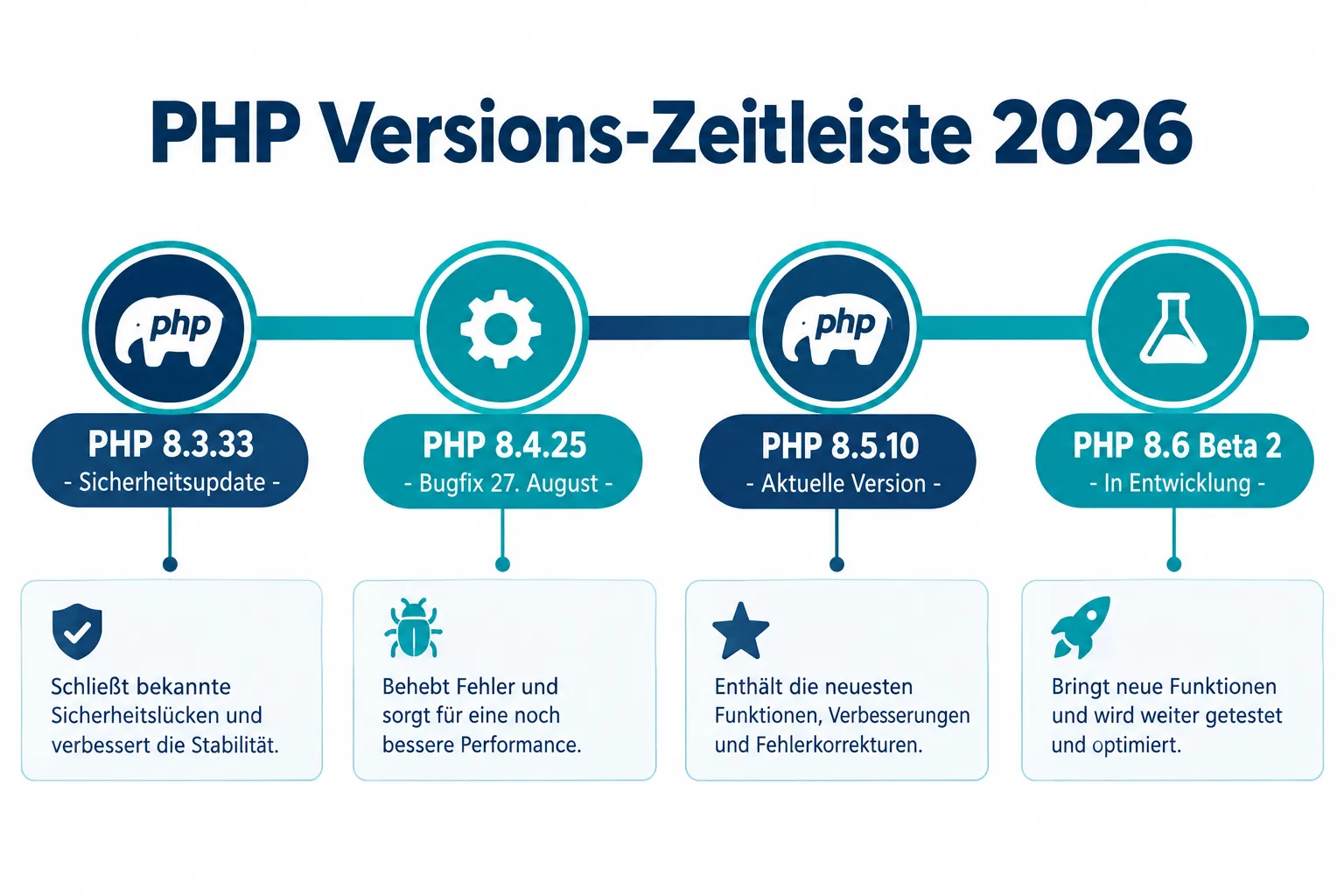
Concretely, the situation looks like this:
| Version | Date | Type | Relevance |
|---|---|---|---|
| PHP 8.5.10 | current | Bugfix | Production standard |
| PHP 8.4.25 | August 27, 2026 | Bugfix | Active LTS maintenance |
| PHP 8.4.24 | July 30, 2026 | Security update | Patch urgently |
| PHP 8.3.33 | , | Security update | Older production systems |
| PHP 8.6 | , | Beta 2 | Not yet production-ready |
At the same time, distribution repositories confirm the availability of release candidates such as 8.5.11rc1 and 8.4.26rc1 for Fedora and Enterprise Linux [2], which shows how tightly the maintenance cycles follow one another. Debian-based systems via deb.sury.org also received critical fixes for Uriparser and GD libraries with 8.5.10 and 8.4.25 [7]. Anyone obtaining PHP via a package manager should actively monitor these channels.
Practical consequence: teams with legacy systems on PHP 8.3 need to keep an eye on the 8.3.33 security branch, while new projects should build directly on PHP 8.5.
New Language Features and Performance in PHP 8.5
PHP 8.5 brings several improvements for backend developers that go beyond cosmetic syntax changes. According to current launch analyses, the focus is on developer productivity, clearer error handling, and incremental performance gains in interplay with the JIT engine [6].
For daily work, these are especially relevant:
- More robust type safety, which surfaces runtime errors earlier in the development cycle.
- Finer-grained performance optimizations in the JIT area, which are especially noticeable in compute-heavy applications like API aggregation or data processing.
- Improved error messages, which speed up debugging in complex codebases.
These improvements are evolutionary rather than revolutionary, but that is exactly what makes them attractive for production environments. Moving from PHP 8.4 to 8.5 requires no major refactoring in most codebases, and benefits directly from the runtime improvements.
"A stable, incremental PHP release is often more valuable for enterprise teams than a jump with many breaking changes."
Important at the framework level: other PHP frameworks are also aligning their release cycles with the new version. Phalcon’s documentation, for example, shows that both the 5.x and 4.x branches continuously ship compatibility updates against new PHP versions [3][4]. That signals broader ecosystem alignment around PHP 8.5, not just at Laravel.
Security Updates in September 2026: Where Action Is Needed
The security situation around PHP in late summer and fall 2026 deserves particular attention. The combination of PHP 8.4.24 (security update, July 30, 2026) and the critical fixes for the Uriparser and GD libraries in the Debian packages [7] shows that these are not routine patches, but fixes with direct attack potential, for example in image-data processing or URL parsing in web applications.
For backend teams, three concrete steps follow:
- Check the current version: is the production environment running 8.3.x, 8.4.x, or already 8.5.x?
- Prioritize the patch window: security updates like 8.4.24 and 8.3.33 should take precedence over feature updates.
- Run CI/CD tests against the target version: especially for libraries that process images or external URLs.
Maintaining several branches in parallel, 8.3, 8.4, and 8.5, is normal in the PHP lifecycle, but it increases complexity for teams running multiple production environments. Anyone running multiple projects on different PHP versions should maintain a central overview of support end dates.
PHP 8.5 as the Hosting Default Starting October 2026
A turning point for many teams: starting October 2026, hosting providers are increasingly setting PHP 8.5 as the default version for new deployments. Cloud provider Clever Cloud, for instance, explicitly announced the switch to PHP 8.5 as default in its changelog [9]. In practice this means:
- New containers or environments will start with PHP 8.5 by default going forward, unless a different version is explicitly specified.
- Existing projects that have no fixed version specified in
composer.jsonor the hosting configuration can switch to PHP 8.5 unnoticed. - Teams should now review their deployment configuration and explicitly pin the PHP version instead of relying on the provider default.
This step is a clear signal: PHP 8.5 is no longer "the new version," it is becoming the baseline for new projects. Anyone still actively developing against PHP 8.3 should add a migration plan toward 8.5 to their roadmap.
Laravel 2026: New Features for Everyday Backend Work
While PHP evolves at the language and security level, Laravel 2026 has followed suit with several features that are immediately usable in production.
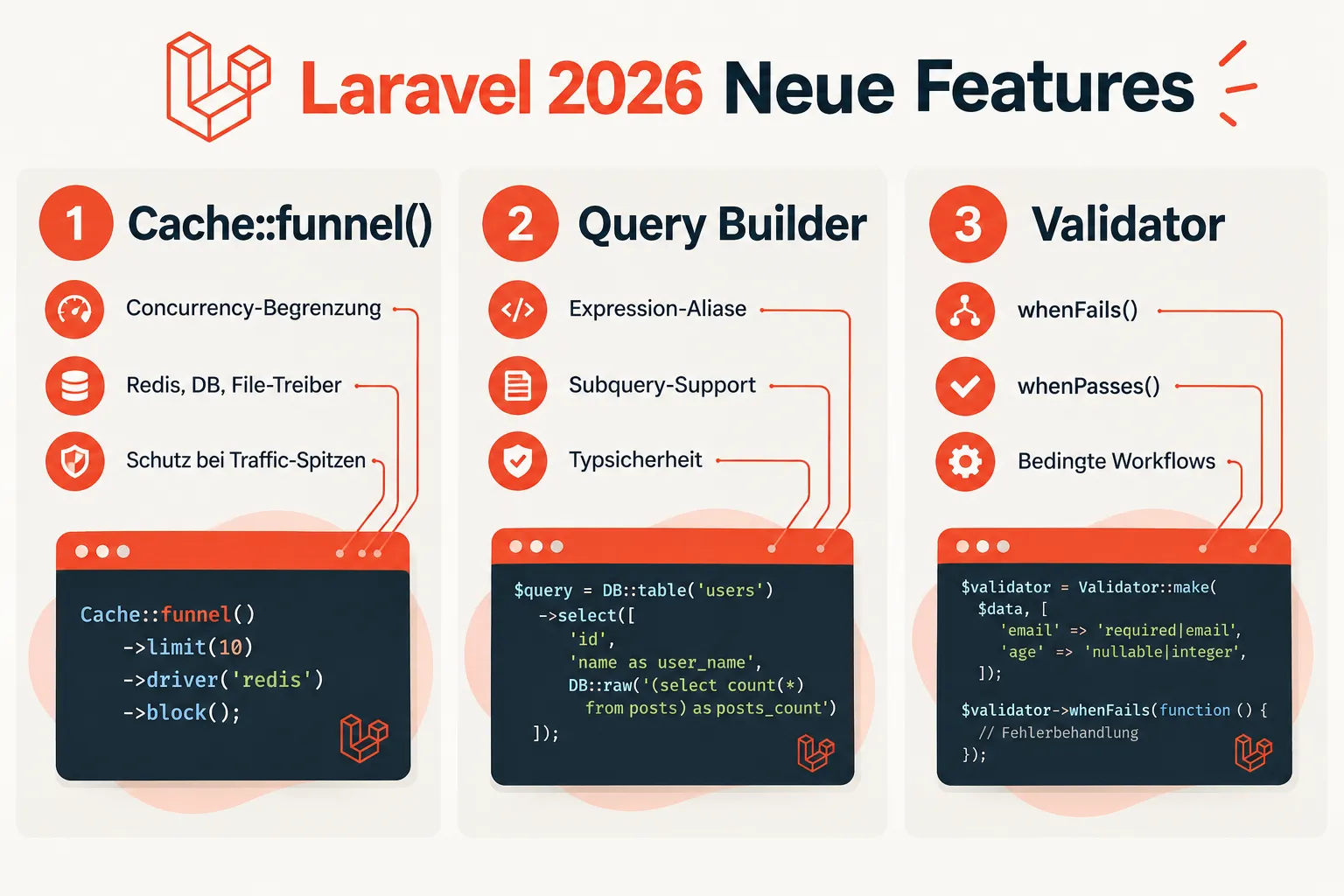
Cache::funnel() for Controlled Concurrency
Cache::funnel() makes it possible to limit concurrent execution of certain code sections via the cache. This is especially valuable for:
- High traffic, when many requests access the same resource at the same time.
- Background jobs and queue processing, to avoid duplicate or overlapping processing.
- API rate management, when external services only allow a limited number of parallel requests.
The function supports Redis-, database-, and file-based cache drivers, making it flexible to integrate into existing infrastructure without additional message-queue components. If you also want to optimize the database side, our article on Database Performance Optimization covers concrete approaches to indexing and query tuning.
Extended Query Builder
The Laravel query builder has been extended with query expression aliases, improved subquery support, and enhanced type safety. For enterprise applications with large datasets, this means: complex SQL queries can be structured more clearly and maintained more easily, reducing error-proneness during refactoring.
More Expressive Validation
New validator methods such as whenFails() and whenPasses() enable conditional validation workflows. Instead of writing separate if-else blocks after validation, the logic can be coupled directly to the validation result, making controller code more compact and readable.
Laravel 13.32: Mercure Broadcasting and Filesystem Updates
In September 2026, Laravel 13.32 shipped as a concrete release that extends broadcasting capabilities. According to Laravel News, it added Mercure broadcasting support as well as filesystem improvements [1]. Mercure is a lightweight protocol for real-time updates over Server-Sent Events; for teams that want to implement real-time features without a complex WebSocket infrastructure, it is a practical alternative.
The overall release activity in September 2026 also shows that the Laravel ecosystem as a whole continues to evolve at high speed, including complementary AI-adjacent functionality in the broader ecosystem [1]. Anyone wanting to track individual patch releases can find a chronological overview of all Laravel version steps on release-tracking services like Releasebot [8].
State of PHP 2026: Adoption and Support Matrix
The "State of PHP 2026" report confirms a trend that is already visible in the version data: adoption of new PHP versions is happening increasingly faster, while at the same time the pressure to consistently apply security updates for older branches is rising [10]. For backend teams, that concretely means: a pure "feature-first" strategy is no longer enough; risk management across the entire support matrix becomes a fixed part of infrastructure planning.
A sensible support matrix for 2026 should at minimum answer these questions:
- Which PHP version is running in production, staging, and local development?
- When does security support for the respective version end?
- Is the Laravel version officially compatible with the PHP version in use?
- Is there a documented migration plan for the next version step?
Analysts expect the share of production PHP 8.5 installations to increase significantly by the end of 2026, as more hosting providers follow Clever Cloud’s example and make PHP 8.5 the standard [9][10]. This assessment is a forward-looking expectation, not a confirmed number, but it should factor into planning.
PHP 8.5 and Laravel 2026 vs. Node.js: The Backend Choice Still Matters
With the performance improvements in PHP 8.5 and the productivity features in Laravel 2026, many teams are once again facing the question: PHP or Node.js? Both ecosystems have technically evolved, but the decision depends less on individual benchmark numbers than on team structure, existing infrastructure, and application type.
PHP with Laravel scores particularly well in 2026 through:
- A mature, coherent framework ecosystem with clear conventions.
- Built-in concurrency tools like
Cache::funnel()that solve typical scaling problems directly within the framework. - A broad hosting availability, further simplified by the PHP 8.5 default switch at cloud providers.
Node.js remains strong for event-driven, highly I/O-intensive applications with many concurrent connections. For teams that need a deeper technical comparison of both platforms, it’s worth reading the detailed PHP vs. Node.js comparison on code404zero.com, which breaks down performance aspects and architectural decisions in detail.
Conclusion: How Backend Teams Should Prepare for PHP 8.5 and Laravel 2026
PHP 8.5 and Laravel 2026 mark not a single big upheaval, but a series of coordinated, practically relevant steps: a stable new PHP major version, active security maintenance for older branches, an upcoming hosting default switch, and a Laravel framework that pays directly into developer productivity with Cache::funnel(), an extended query builder, and more flexible validation methods.
Concrete next steps for backend teams:
- Check which PHP version is currently running in production, and apply open security updates (8.4.24, 8.3.33) promptly.
- Explicitly pin the PHP version in deployment configurations before hosting providers switch to PHP 8.5 as default in October 2026.
- Test Laravel projects for compatibility with PHP 8.5 and evaluate new features like Cache::funnel() specifically in areas with high concurrency.
- Maintain a documented support matrix that makes PHP and Laravel version status transparent across all environments.
Teams that implement these steps now not only avoid security risks, but also position their backend architecture directly for the next PHP generation, including PHP 8.6, which is already in Beta 2.
Frequently Asked Questions
nWhat is the current PHP version and its status?
nPHP 8.5 has officially been released and is currently at bugfix version 8.5.10, while PHP 8.6 is already in Beta 2.
nWhich older PHP branches still need patching?
nOlder branches remain security-relevant: PHP 8.4.25 (August 27, 2026, bugfix), PHP 8.4.24 (July 30, 2026, security update), and PHP 8.3.33 (security update) still need prompt patching.
nWhen does PHP 8.5 become the hosting default?
nStarting October 2026, PHP 8.5 becomes the default version at many hosting providers, so deployment pipelines should be tested now.
nWhat productivity features does Laravel 2026 bring?
nLaravel 2026 brings three practical productivity boosts: Cache::funnel(), an extended query builder, and new validator methods (whenFails() and whenPasses()).
nReferences
[1] laravel-news – https://laravel-news.com/archive/2026/09 [2] Php 8511rc1 And 8426rc1 Rpms Now Available For Fedora And Enterprise Linux – https://www.linuxcompatible.org/story/php-8511rc1-and-8426rc1-rpms-now-available-for-fedora-and-enterprise-linux/ [3] Releases – https://docs.phalcon.io/5.11/releases/ [4] Releases – https://docs.phalcon.io/4.2/releases/ [5] Index – https://www.php.net/releases/index.php [6] Php 8 5 Launch Major Updates – https://www.nandann.com/blog/php-8-5-launch-major-updates [7] Php 8510 And 8425 Now Available On Debsuryorg With Critical Uriparser And Gd Fixes – https://www.linuxcompatible.org/story/php-8510-and-8425-now-available-on-debsuryorg-with-critical-uriparser-and-gd-fixes/ [8] Laravel – https://releasebot.io/updates/laravel [9] 09 01 Php 8.5 Default – https://www.clever.cloud/developers/changelog/2026/09-01-php-8.5-default/ [10] State Of Php 2026 – https://devnewsletter.com/p/state-of-php-2026/