Over 90 percent of all programs in the world are built, at their core, from just three components. Not a thousand secret tricks, not a genius IQ, but variables, loops, and functions. Once you understand these three concepts, you understand the logic behind every app, every trading bot strategy, and every smart contract running in crypto today. That’s exactly why programming fundamentals are the best starting point for anyone who has only ever been a spectator of the digital world and now wants to shape it themselves.
This article takes away your fear of writing your first line of code. No prior knowledge, no jargon, just everyday analogies and simple Python examples you can try out immediately.
Table of Contents
Key Takeaways
- Variables, loops, and functions are the three central building blocks of every programming language, and therefore the core of any programming fundamentals.[1][4]
- A variable is like a labeled box that stores a value, one you can retrieve or change again later.
- A loop repeats a task automatically, just like you fold laundry piece by piece, without needing a new instruction for every single item of clothing.
- A function is like a recipe or a small machine: it takes an input, processes it, and delivers a result that you can reuse as often as you like.
- Python is considered a particularly beginner-friendly language for practicing these concepts before moving on to more complex topics like smart contracts.
What Do Programming Fundamentals Really Mean?
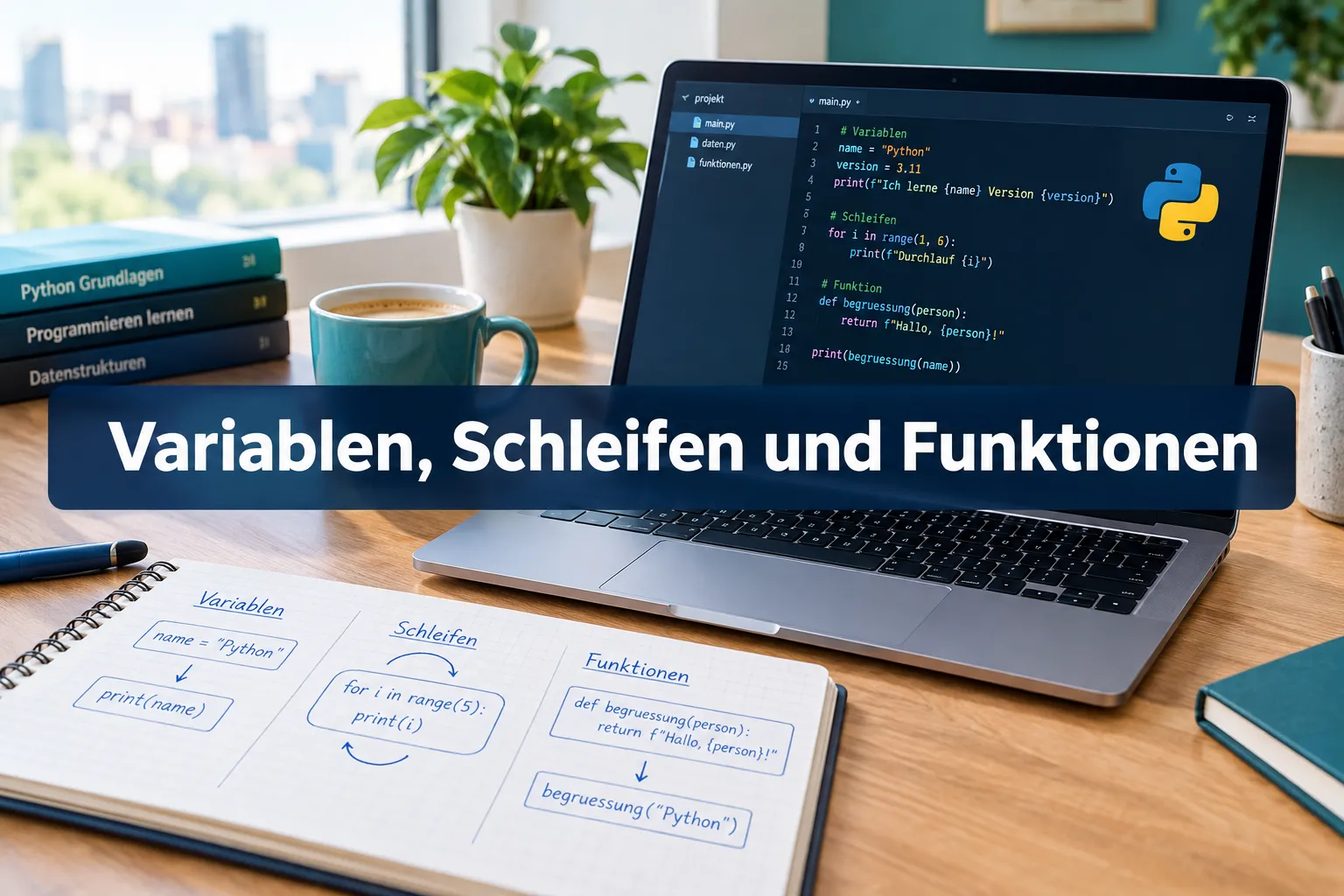
Many people think programming means typing mysterious strings of characters into a black console. In reality, programming is nothing more than formulating clear, small steps that a computer executes one after another. Current beginner resources consistently emphasize: to understand programming fundamentals, you first need to grasp variables as storage containers for data, then loops as a tool for repeating instructions, and finally functions as reusable blocks of code.[1][4]
These three building blocks aren’t just the foundation of classic software development, they’re also behind everything happening in crypto and blockchain today: trading scripts that automatically fetch prices, bots that monitor wallets, or smart contracts that check conditions. All of it rests on exactly these three basic elements.
This trio has also become the standard from a teaching perspective. Coding schools deliberately bundle variables, logical operators, decisions, loops, and functions into one connected learning block for absolute beginners, because these concepts build on and explain each other.[2]
Variables: The Labeled Boxes of Your Program
Picture a dresser with several drawers. Each drawer has a label: “Socks,” “T-Shirts,” “Sweaters.” You don’t need to know what a drawer looks like on the inside to know what’s in it. A variable in programming works exactly the same way: it’s a labeled box that stores a value, a number, a piece of text, or something else. The name of the variable is the label, and the stored value is the content of the drawer.
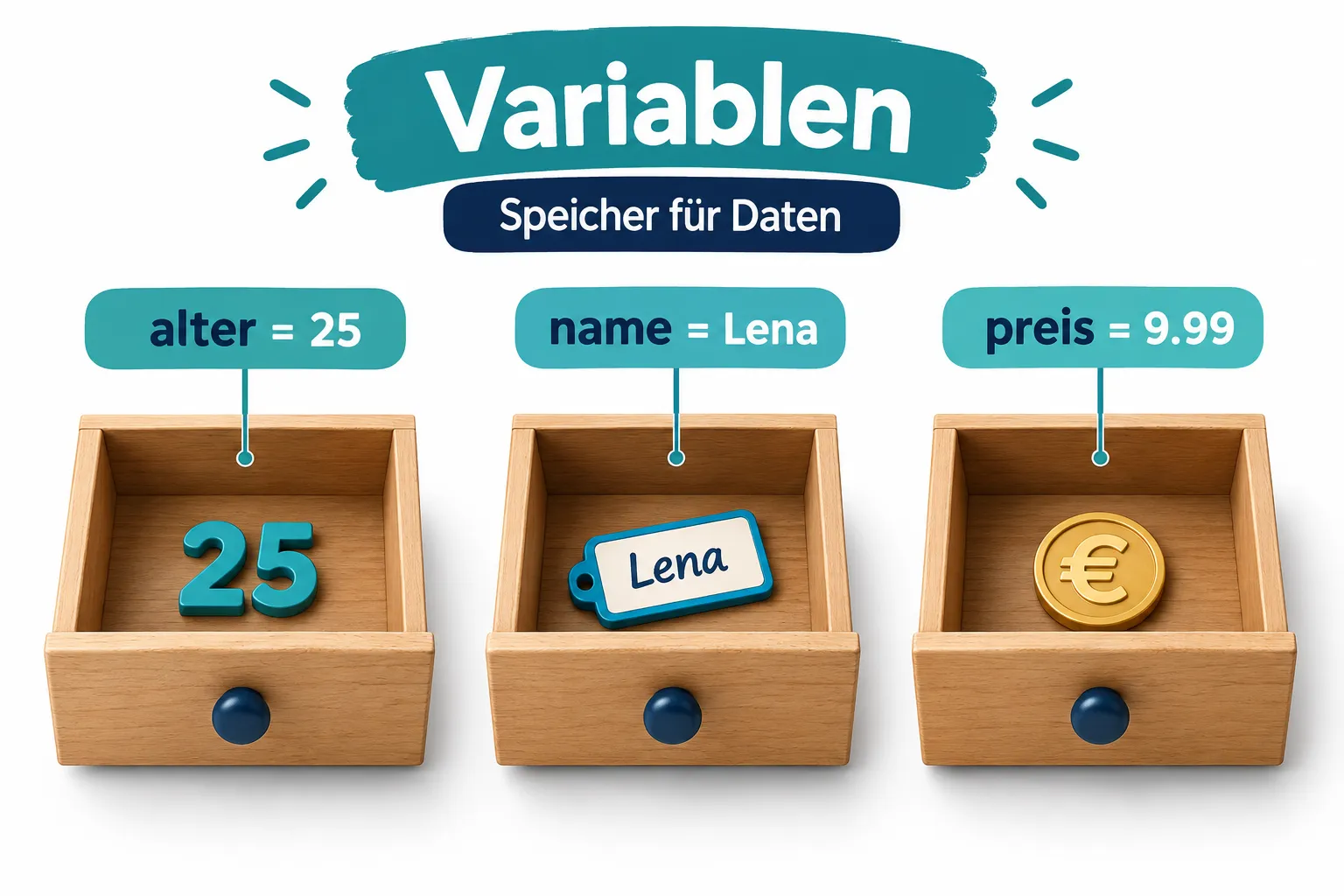
The big advantage: you can look into the drawer at any time, change its contents, or reuse it elsewhere in the program. That’s exactly what makes variables the most important tool when it comes to programming fundamentals.
Here’s a simple Python example:
# We create three "drawers" with content
name = "Lena"          # Text is stored in quotation marks
age = 29                # Number without quotation marks
crypto_holdings = 0.15  # Decimal number, e.g. amount of Bitcoin

# Now we print the contents of the drawers
print("Name:", name)
print("Age:", age)
print("Crypto holdings:", crypto_holdings, "BTC")
What happens here step by step? In the first line, the text “Lena” is stored in the box named name. In the second line, the number 29 lands in the box age. In the third line, we store a decimal number in crypto_holdings. The print commands retrieve the content of each box again and display it on the screen. As you can see: a variable is nothing complicated, just a named storage location for data.[1]
Loops: Repetition Without Frustration
Now for the next everyday analogy: folding laundry. You have a pile of ten T-shirts. You don’t tell yourself ten separate times, “Fold T-shirt one,” “Fold T-shirt two,” and so on. Instead, you simply think: “Repeat the folding until the pile is empty.” That’s exactly what a loop is, the central control structure that repeats instructions automatically, without you having to write them out again every single time.[1]
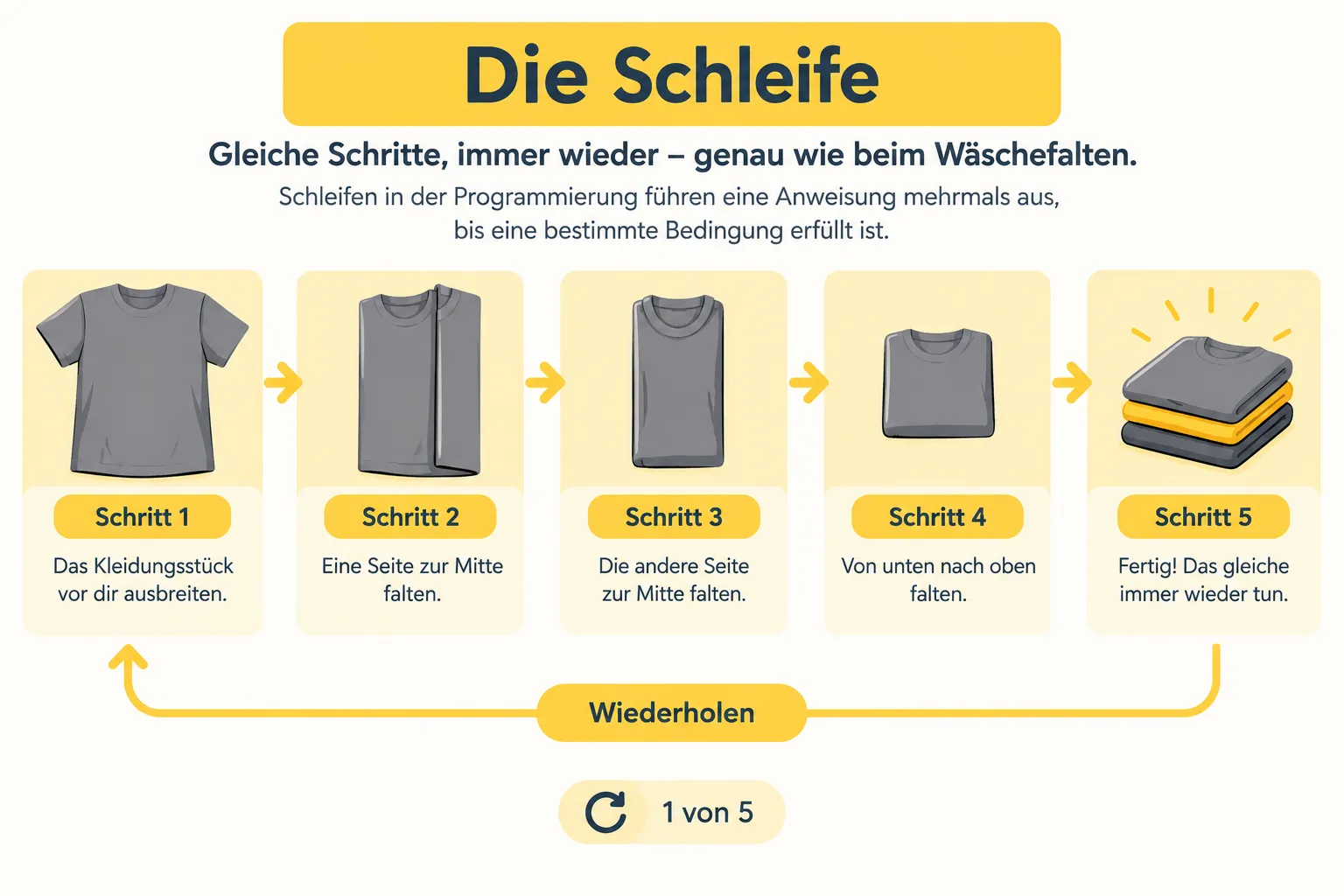
In programming there are two main types of loops: the for loop for a fixed number of repetitions, and the while loop for repetitions that run until a condition is met. This distinction is taught consistently in both university courses and beginner learning platforms.[8][10]
A simple example with a for loop in Python:
# We have 5 T-shirts to fold
number_of_tshirts = 5

# The loop repeats the command five times
for tshirt in range(1, number_of_tshirts + 1):
    print("T-shirt number", tshirt, "has been folded")

print("All T-shirts are folded!")
What does this code do? The line for tshirt in range(1, number_of_tshirts + 1): tells the computer: “Count from 1 to 5 and run the following command for each number.” The variable tshirt is what’s called the loop variable, it keeps track of which repetition we’re currently on. This exact classic explanation, involving a loop variable and a fixed repetition count, is also taught in university introductory lectures.[8]
An example with a while loop shows the second type:
# We count until our crypto holdings reach 1 BTC
holdings = 0.15

while holdings < 1.0:
    holdings = holdings + 0.1  # Each round adds 0.1 BTC
    print("Current holdings:", round(holdings, 2), "BTC")

print("Goal reached!")
Here the loop repeats for as long as the condition holdings < 1.0 is true. As soon as the holdings reach or exceed 1.0, the loop stops automatically. This kind of conditional repetition is especially useful when you don’t know in advance exactly how many times something needs to be repeated.[10]
Functions: Your Personal Recipe for Code
Picture a kitchen recipe: you add ingredients (flour, eggs, milk), follow a fixed set of steps, and end up with a pancake. You only have to write the recipe down once, after that you can use it as many times as you like, each time with slightly different ingredients but always with the same process. A function in programming works exactly the same way: it’s a reusable block of code that takes an input, does something with it, and returns a result.[1]
Functions matter so much because they prevent you from having to write the same code over and over again. You write the “recipe” once and simply call it by name afterward.
# We define a function (our "recipe")
def calculate_profit(purchase_price, sale_price):
    profit = sale_price - purchase_price
    return profit  # The result is returned

# Now we use the recipe multiple times with different numbers
profit_1 = calculate_profit(100, 150)
profit_2 = calculate_profit(500, 480)

print("Profit trade 1:", profit_1, "Euro")
print("Profit trade 2:", profit_2, "Euro")
What happens here? With def calculate_profit(purchase_price, sale_price): we define our recipe and give it a name. The words purchase_price and sale_price in the parentheses are the “ingredients” the function receives from the outside later on. Inside the function, the profit is calculated and returned as a result using return. We then call the recipe twice with different numbers, without ever having to write the calculation logic again. That’s the real magic of functions: build it once, use it infinitely.
The Three Building Blocks Working Together
In real programs, variables, loops, and functions almost always work together. A function can contain a loop, which in turn calculates with variables. Studies and practical guides therefore explicitly describe these three elements as the “most important elements” of programming, because together they make every program, no matter how complex, possible.[5]
A brief overview for context:
| Building Block | Everyday Image | Purpose in Code |
|---|---|---|
| Variable | Labeled box | Stores a value |
| Loop | Folding laundry | Repeats a task |
| Function | Recipe / machine | Turns input into a result |
“Programming isn’t a talent you either have or don’t have, it’s a skill you build step by step with the right fundamentals.”
This interplay is also used in modern learning environments: playful platforms guide beginners toward their first mini-projects using simple variables and short for loops, before more complex functions are introduced.[12]
Next Steps: How to Practice Programming Fundamentals
Theory alone isn’t enough, you learn programming by trying things out. Here are a few concrete exercise ideas to get started:
- Practice variables: Create three of your own variables (for example your favorite coin, its price, and the number of coins you own) and display them with
print. - Build a loop: Write a
forloop that counts from 1 to 10 and prints each number multiplied by 2. - Write a function: Create a function that adds two numbers and returns the result, test it with several pairs of numbers.
- Combine them: Build a function that internally uses a loop, for example to calculate the sum of several crypto amounts.
- Take a course or workshop: Anyone who wants to learn in a structured way can find practical beginner courses at community colleges and universities, such as compact weekend courses or two-day Python workshops that systematically teach exactly these three building blocks.[3][6]
- Use AI as a learning partner: Modern learning paths increasingly rely on AI assistants that explain code to beginners and adapt practice exercises, a useful complement to traditional courses.[13][15]
Above all, what matters is starting small, allowing yourself to make mistakes, and practicing for a few minutes regularly instead of many hours all at once.
Conclusion
Variables, loops, and functions aren’t abstract technical terms, they’re simple, everyday concepts: a labeled box, a repeating task, and a recipe that turns inputs into a result. Anyone who has internalized these three building blocks has the foundation for programming fundamentals, and with it the key to later understanding more complex topics like trading scripts, automations, or smart contracts in crypto. The best next step is simple: open a free Python editor, type out the examples from this article, change them, and observe what happens. That’s exactly how everyone learns to program, step by step, line by line.