On November 19, 2026, it’s not just a new PHP version arriving – the same day marks the launch of Grand Theft Auto 6. For some, it’s the biggest gaming release of the decade; for PHP developers everywhere, it’s the release date of PHP 8.6. Coincidence or not: while part of the tech community will likely be parked in front of a console, PHP 8.6 brings tangible improvements that directly change developers’ day-to-day work. In parallel, the Laravel ecosystem has reached an important milestone for AI tool integrations with Laravel MCP 1.0.
This article puts both developments into context: the official timeline and feature list of PHP 8.6, and the practical significance of Laravel MCP 1.0 for backend teams already building AI-powered applications today.
Table of Contents
- PHP 8.6 arrives as the General Release on November 19, 2026; feature freeze already took effect on September 22, 2026.
- Key new features include partial function application, the
clamp()function, aTimeDurationclass with nanosecond precision, and default values for readonly properties. - Laravel MCP 1.0 (released September 15, 2026) makes building Model Context Protocol servers for AI tool integrations production-ready, including searchable tool catalogs and PKCE-mandatory OAuth.
- Tailwind Labs is organizationally moving to Shopify, but remains independently developed and MIT-licensed.
- Laravel itself shipped several minor releases (13.27 to 13.32) between August and September with practical Eloquent and broadcasting features.
PHP 8.6 Release: Timeline and Status as of September 2026
The timeline for PHP 8.6 follows the established annual rhythm of PHP core development. Feature freeze took effect on September 22, 2026 – from that date on, no new language features are added, only bug fixes and stabilization work continue. The official release, known as the General Release, is scheduled for November 19, 2026 [8].
If you’ve read our earlier article on PHP 8.5 and its interplay with Laravel, you’ll recognize the pattern: PHP 8.5 followed the same cycle of a late-summer feature freeze and a final release in November. This predictability matters for teams that need to plan their migration timelines well in advance. Some uncertainty naturally remains around individual RFC details, but the broad pattern – freeze in September, release in November – has become a stable, reliable rhythm.
For development teams, this means: if you run production Laravel or Symfony applications, you should now set up test environments with the current beta and release-candidate builds of PHP 8.6 to catch compatibility issues early.
The Most Important New Features in PHP 8.6
PHP 8.6 isn’t a radical language overhaul, but a set of targeted improvements that make everyday code more readable and more robust.
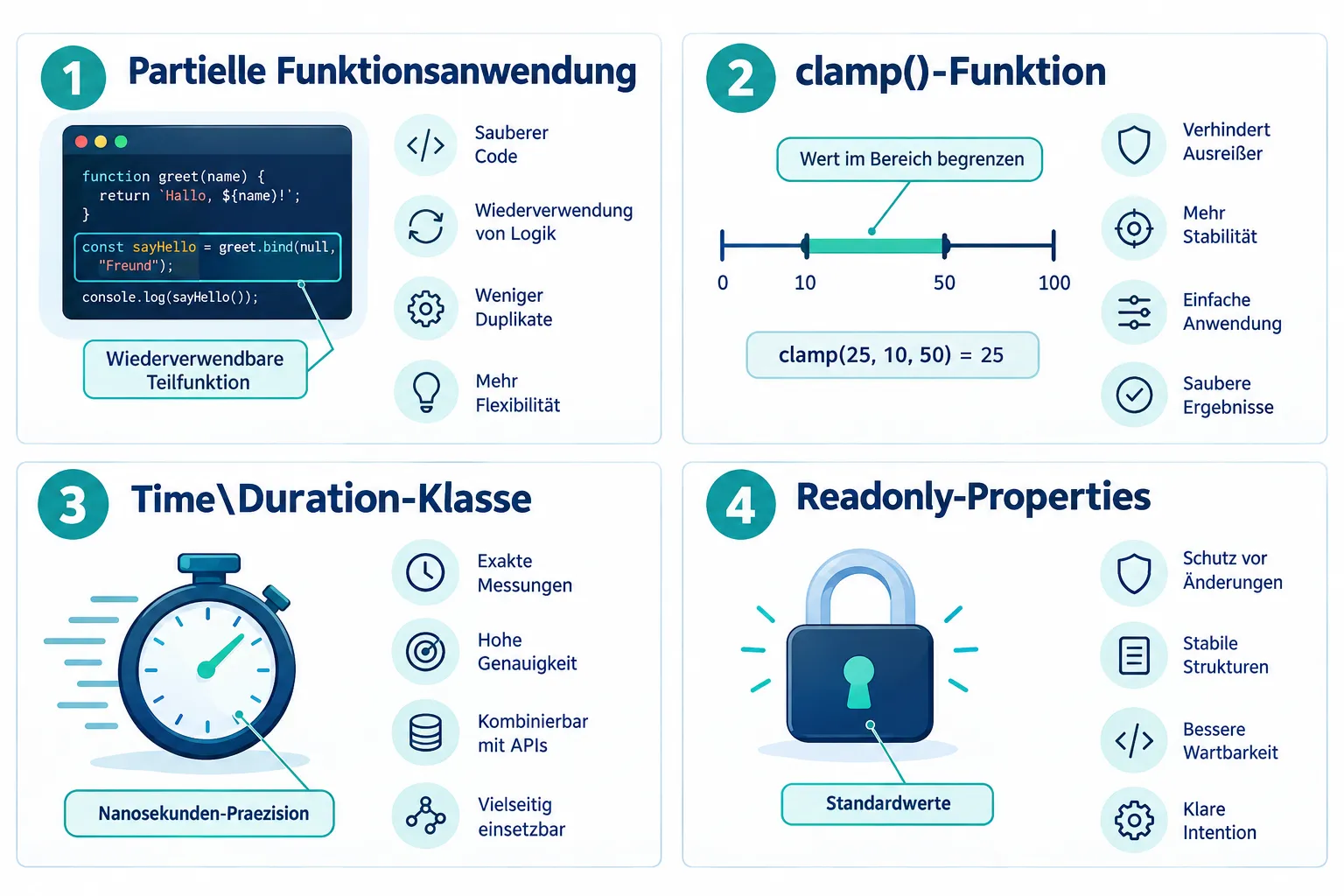
Partial Function Application
Partial function application lets you turn a function with some arguments already fixed into a reusable partial function. A classic example: str_replace(' ', '-', ?) creates a new function that only still expects the last parameter – useful for functional programming patterns and for callback chains in data-processing pipelines.
clamp(), TimeDuration, and More
The new clamp() function automatically constrains a value to a defined range, so developers no longer need to write nested min()/max() calls. The TimeDuration class brings time spans with nanosecond precision into the language core – relevant for performance measurements and time-critical applications. The package is rounded out by:
- Default values for readonly properties, simplifying object initialization
- DocComments directly on parameters, improving tooling and IDE support
- A new polling API (
IoPoll) for more efficient I/O operations - A global SortDirection enum as a unified standard for sort directions
- Safer session defaults, raising the baseline security level of web applications out of the box
This combination reflects the PHP core team’s philosophy: small, practical additions rather than major breaks – much like PHP 8.5, whose improvements have already proven their value in many Laravel projects.
Laravel MCP 1.0: Building Model Context Protocol Servers
While PHP 8.6 is still awaiting release, a significant step has already been taken in the Laravel ecosystem: the official laravel/mcp package reached version 1.0 on September 15, 2026 [1][5]. The package lets you build Model Context Protocol (MCP) servers directly with Laravel’s built-in tooling – the protocol through which AI models access external tools and data sources in a structured way [2][7].
“An MCP server is essentially a standardized bridge between an AI model and an application’s tools.”
Laravel MCP 1.0 supports protocol revision 2026-07-28 and relies on a stateless server model: every request is handled independently of previous interactions, which significantly simplifies horizontal scaling [1][4]. For teams already experienced with stateless APIs in Laravel, this architectural principle will feel familiar.
What Laravel MCP 1.0 Means for AI Tool Integrations
The practical core of Laravel MCP 1.0 is solving a problem that emerges as the number of tools grows: the more functions an AI assistant has available, the larger and harder to parse the response the model has to process first.
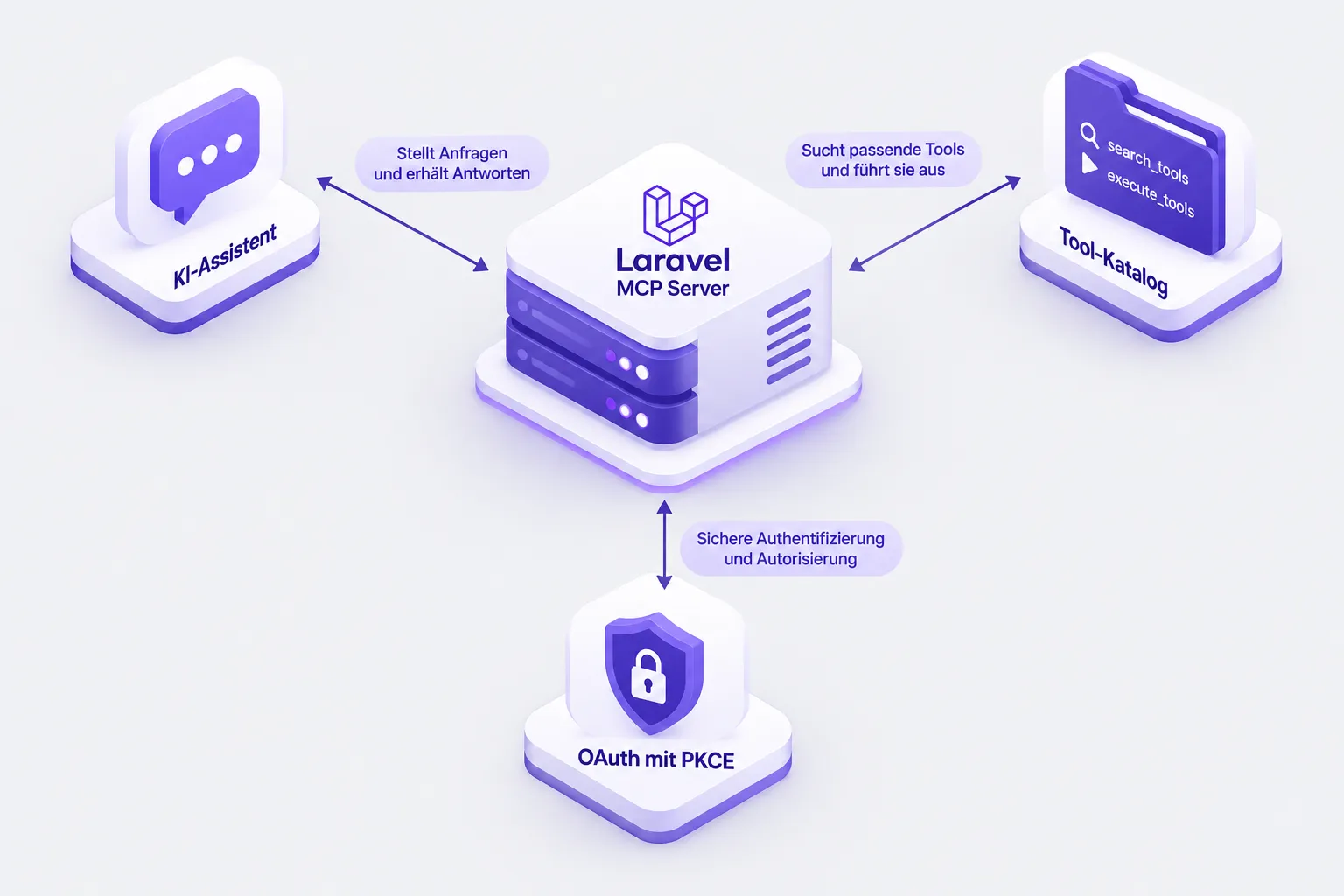
Laravel MCP 1.0 solves this with searchable tool catalogs via the search_tools and execute_tools methods. Instead of delivering every available tool at once, the AI model only sees the relevant matches. The result is measurable: the tools/list response stays at roughly 1,431 bytes regardless of whether the catalog contains 10 or 100 tools [1][6]. For production AI applications, this means lower latency and lower token costs, since the model no longer has to “read” the entire toolbox.
Other central building blocks of Laravel MCP 1.0:
| Feature | Practical Benefit |
|---|---|
| Cache hints for clients | Reduces repeated requests to the server |
| Stateless servers | Simple horizontal scaling without session storage |
| Searchable tool catalogs | Constant response size even with many tools |
| Revised OAuth with PKCE | Higher security for client authentication |
The overhaul of authentication in particular deserves attention: PKCE (Proof Key for Code Exchange) is now mandatory, supplemented by client ID metadata documents that standardize the authorization process for connected AI clients [1][2]. This reduces the risk of token interception and makes MCP servers more production-ready for enterprise environments.
For developers who still often see MCP as an experimental niche topic, version 1.0 marks the transition from a proof-of-concept tool to a production-ready foundation. If you’ve already modernized Laravel applications as part of a PHP 8.5 migration, laravel/mcp is a natural next step to expose existing business logic as AI-accessible tools without building a separate infrastructure [4].
Other Developments in the Laravel Ecosystem
Alongside Laravel MCP 1.0, September 2026 brought other relevant news for PHP and Laravel teams.
Tailwind Labs is moving to Shopify. On September 9, 2026, Adam Wathan announced that the team behind Tailwind CSS is moving to Shopify to give the framework a “stable long-term home” [9]. Importantly for developers: Tailwind CSS remains MIT-licensed and continues to be developed by the same well-known team – Shopify is acting only as a supporting partner, not as the new owner of the roadmap. New sign-ups for Tailwind Plus and ui.sh have been closed, though existing subscribers retain their access.
Laravel minor releases 13.27 to 13.32. Between August 25 and September 15, 2026, several minor versions shipped with practical additions: refreshForUpdate() on Eloquent models for more reliable locking under concurrent database access, the AsVector cast for vector-distance queries on MariaDB – relevant for similarity search in AI applications – and a new Mercure broadcast driver for real-time communication without additional WebSocket infrastructure [9].
PHP 8.6 and Laravel MCP 1.0: Outlook for Developers
The combination of PHP 8.6 and Laravel MCP 1.0 paints a clear picture for the coming months: PHP as a language is getting targeted, practical improvements, while the Laravel ecosystem is simultaneously making AI integration infrastructure production-ready.
For teams working on Laravel applications today, this creates two parallel areas of action: at the language level, it’s worth testing early against PHP 8.6 release candidates, especially because of the changed session defaults, which could affect existing behavior. At the application level, it’s worth taking a look at laravel/mcp to evaluate which internal tools or APIs could be exposed as AI-accessible functions via an MCP server.
Conclusion and Next Steps
PHP 8.6 continues the proven tradition of reliable annual cycles with its planned release on November 19, 2026, delivering tangible improvements for everyday development work with partial function application, clamp(), the TimeDuration class, and safer session defaults. At the same time, Laravel MCP 1.0 has made one of the most important building blocks for AI tool integrations in PHP applications production-ready – with searchable tool catalogs, consistently small response sizes, and significantly hardened OAuth authentication.
Concrete next steps for development teams: test PHP 8.6 release candidates early in staging environments, try out the laravel/mcp package in an internal pilot project, and review the current Laravel minor releases (13.27 to 13.32) for relevant Eloquent and broadcasting features. Anyone planning these steps now will be technically prepared for the official PHP 8.6 release in November 2026 – regardless of whether their evening on that day belongs to a deployment or to Grand Theft Auto 6.
References
[1] Laravel MCP 1.0 – https://laravel-news.com/laravel-mcp-1-0 [2] laravel – https://laravel.com/ai/mcp [4] laravel – https://laravel.com/framework/docs/mcp [5] github – https://github.com/laravel/mcp [6] Laravel MCP 1.0 Is Released – https://daily.dev/posts/laravel-mcp-1-0-is-released-qlrfaoxe5 [7] A Better Way To Build MCP Servers With Laravel – https://laravel.com/blog/a-better-way-to-build-mcp-servers-with-laravel [8] php-net.pro – https://php-net.pro/en/ [9] laravel-news – https://laravel-news.com/archive/2026/09