Two major releases a year, yet only one of them ever reached a production server at most companies. That simple fact sits at the root of one of the biggest structural changes in Node.js history. Starting in October 2026, the project is abandoning the two-release rhythm it has followed for a decade. The new Node.js 27 release schedule marks the start of a model with just one major release per year — and every future version automatically becomes a long-term-support release.
For developers running Node.js in production, that might sound like a purely organizational footnote. In reality, the decision addresses a very concrete problem: overworked, volunteer-run maintainers and a versioning scheme that, in practice, almost nobody fully understood anymore.
Table of Contents
Key Takeaways
- The Node.js 27 release schedule ends the previous model of two major releases per year (April and October) and replaces it with exactly one major release annually.
- Every new version will now be promoted to LTS — the distinction between short-lived odd-numbered and long-lived even-numbered releases disappears.
- Node.js 26 (May 2026) is the last release under the old scheme and will become LTS in October 2026 as usual.
- A new six-month Alpha channel (e.g. 27.0.0-alpha.1) gives library authors early access to breaking changes.
- For teams that only ever run LTS, practically little changes beyond the version numbering, which now aligns with the calendar year.
What actually changes in the Node.js 27 release schedule
The previous model had been standard since Node.js 4: an odd-numbered version shipped every April, ran for six months, and never reached LTS status. An even-numbered version followed every October and was automatically promoted into the long-term-support phase. That pattern repeated reliably — until now.
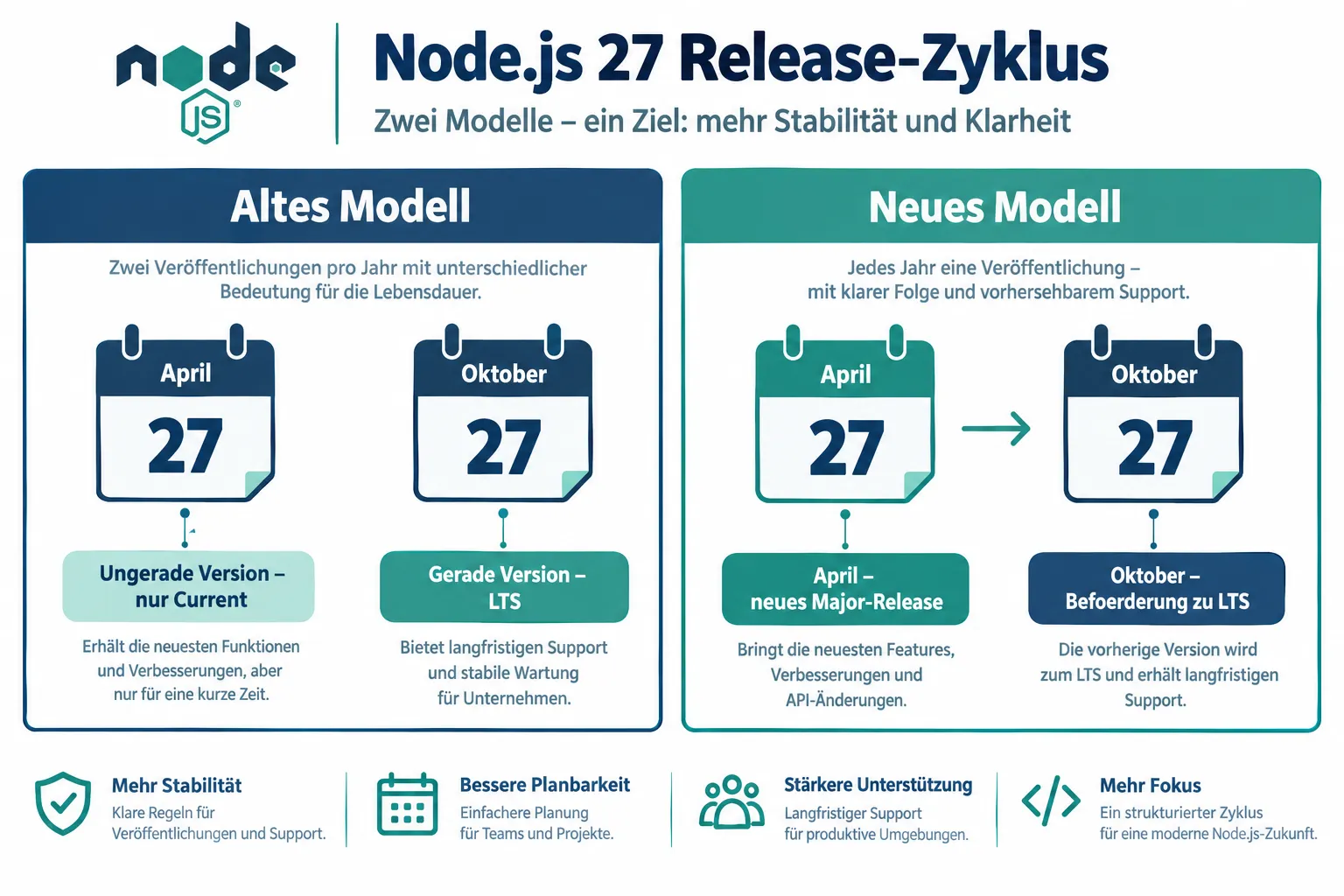
The new Node.js 27 release schedule flips that principle entirely. From now on there is only one major version per year, shipping in April and automatically becoming LTS that same October. A separate, short-lived “Current-only” release no longer exists.
The table below summarizes the difference:
| Attribute | Old model | New model (from Node.js 27) |
|---|---|---|
| Major releases per year | Two (April, October) | One (April) |
| LTS status | Even-numbered versions only | Every version |
| Numbering logic | Odd/even number | Aligned with calendar year |
| Breaking-change testing phase | No separate phase | Six-month Alpha channel |
| Support duration (LTS) | Roughly 30 months | Roughly 30 months (unchanged) |
The new numbering logic stands out in particular: Node.js 27 is scheduled to ship in 2027, Node.js 28 in 2028, and so on. The version number will now roughly correspond to its release year — a convention developers from other ecosystems, such as Ubuntu, will already recognize.
Also new is the Alpha channel. Before the actual major release, versions such as 27.0.0-alpha.1 become available. According to sources InfoQ and nodejsdesignpatterns.com, this pre-release stage runs for roughly six months and is aimed explicitly at library authors, framework teams, and CI pipelines that want to test breaking changes early, before they become production-relevant.
Why the Node.js 27 release schedule is changing now
The initiative traces back to a proposal from Rafael Gonzaga, a member of the Node.js Technical Steering Committee (TSC), who introduced the change in July 2025. His central argument: the previous system of multiple parallel release lines created maintenance overhead disproportionate to its actual benefit.
“The odd-numbered releases were skipped by most companies anyway, yet still caused significant effort for the volunteer release team.”
That assessment matches real-world observations: companies running Node.js in production environments overwhelmingly rely on LTS versions. The short-lived “Current” releases mainly served technically curious early adopters and a small subset of library authors. For the release team, that still meant patches, security fixes, and builds had to be maintained in parallel across two separate lines — with limited staffing, since most of the work is done on a volunteer basis.
James Snell, a longtime Node.js core contributor and one of the people who helped design the original release model roughly a decade ago, called the overhaul overdue. His endorsement carries weight: someone who helped build the old system and now considers it in need of reform signals clearly that this isn’t a short-lived fad but a well-considered structural correction.
There’s a second effect too: by unifying around a release model in which every version becomes LTS, the risk drops that teams accidentally put a non-LTS version into production. That reduces not just confusion but also potential security risks from unnoticed, expiring support.
Timeline: the path from Node.js 26 to Node.js 27
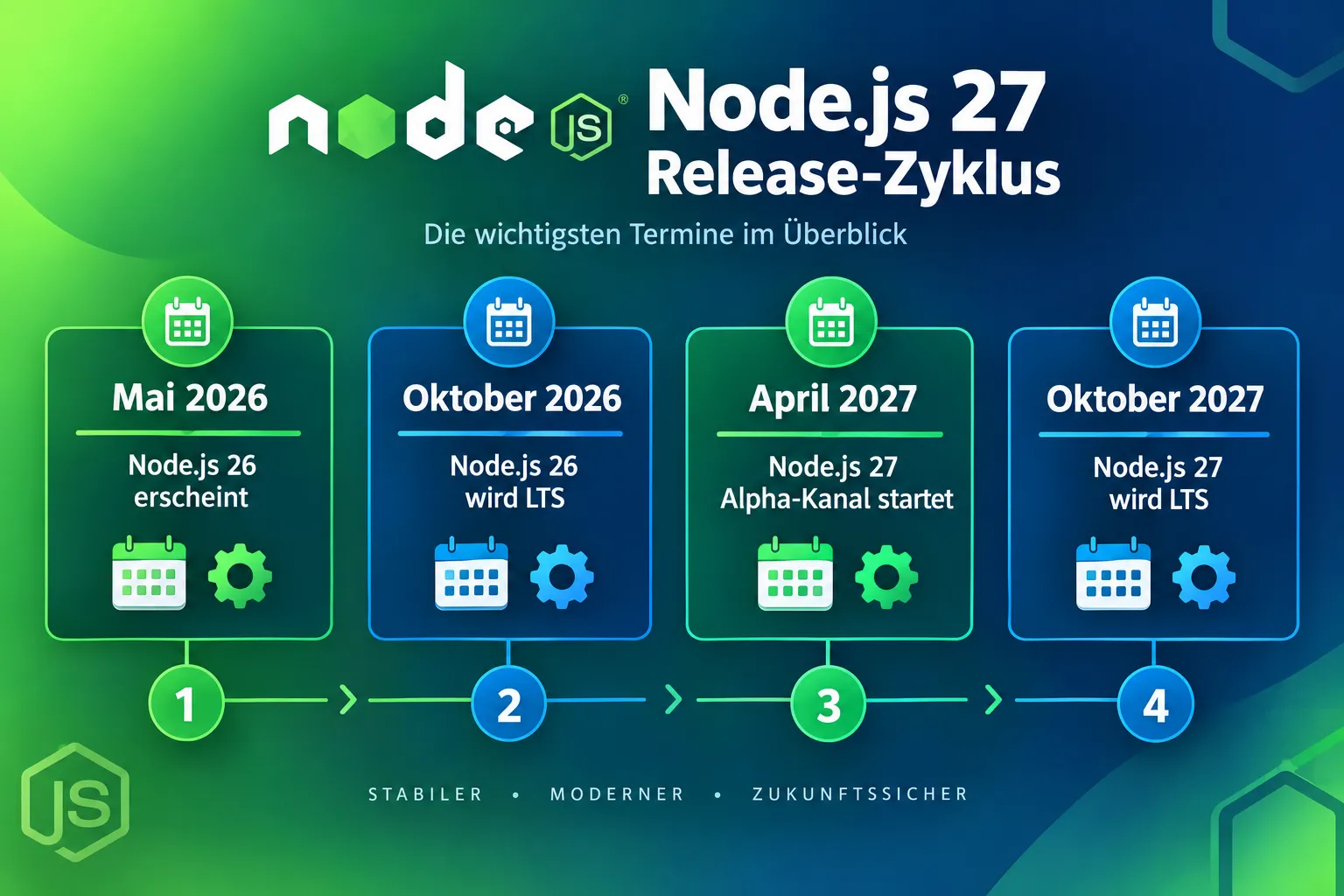
The transition doesn’t happen abruptly but through a clearly defined bridge version. Node.js 26, released in May 2026, is the last major version under the old pattern. It will be promoted to LTS as usual in October 2026 — at that point, the new rhythm effectively begins, since no further odd-numbered interim version will follow this transition.
The next steps at a glance:
- May 2026: Node.js 26 ships as the last release under the old scheme.
- October 2026: Node.js 26 becomes an LTS version — the new cycle effectively begins.
- April 2027 (likely with an Alpha phase already starting in autumn 2026): Node.js 27 launches, initially as an Alpha channel with versions like 27.0.0-alpha.1.
- October 2027: Node.js 27 is officially promoted to LTS.
- From 2028 onward: Node.js 28 follows the identical pattern, then Node.js 29, and so on — one major release per year.
According to the available sources, the support windows themselves remain largely stable: roughly 30 months of active LTS support, about 36 months total until end-of-life. So anyone worried about shorter update cycles can relax — the new Node.js 27 release schedule doesn’t fundamentally change support duration.
What the new Node.js 27 release schedule means for developers and companies
For the large majority of teams that already run exclusively on LTS versions, practically very little changes. Version numbers move closer to the calendar year, while the basic rhythm of release followed by later LTS promotion stays intact. Still, there are concrete points backend engineers and platform teams should start planning for now.
For developers and teams:
- CI/CD pipelines that previously targeted odd-numbered versions for early testing need to switch to the new Alpha channel instead.
- Documentation, internal style guides, and version-mapping tables built around the odd/even scheme should be updated.
- Dependency-management tools and package.json engine fields with version ranges should be reviewed against the new annual cadence.
For library authors:
- The six-month Alpha channel provides significantly more lead time to identify breaking changes before a version becomes production-ready.
- Release notes and compatibility matrices can be aligned precisely with the annual cadence, simplifying long-term maintenance.
For enterprises and IT governance:
- Budget and migration planning for large infrastructures can now follow a simpler, more predictable annual rhythm.
- Security and compliance teams benefit from the fact that accidentally running non-LTS versions in production is no longer possible.
A quick reality check matters here: the new Node.js 27 release schedule primarily affects the structure and cadence of releases — not the content quality or stability of individual versions. Also relevant to other current Node.js-adjacent security and release news — such as Next.js’s September 2026 security release — fast, clearly communicated update cycles are increasingly becoming a competitive factor for backend teams. Breaking changes will still occur; they’ll simply be communicated earlier and more transparently via the Alpha channel.
Frequently asked questions about the Node.js 27 release schedule
Do I need to adjust my production environment immediately?
No. As long as you exclusively run LTS versions, the upgrade path stays largely the same as before. The change matters most for teams that previously used Current releases specifically for testing.
What happens to Node.js 25, the last odd-numbered version?
Node.js 25 remains a pure Current release without LTS status under the old scheme and will reach end-of-life after roughly six months as usual.
Where can I track the current Node.js 27 release schedule in detail?
Platforms like endoflife.date maintain continuously updated overviews of release and support dates for all Node.js versions.
Conclusion and next steps
The new Node.js 27 release schedule isn’t a cosmetic adjustment — it’s a structural response to a long-known problem: a volunteer maintainer team unnecessarily strained by parallel release lines. With just one major release per year, continuous LTS status for every version, and a new Alpha channel for early testing, the project creates a leaner, more predictable system — without touching the proven roughly 30-month support windows.
For developers and engineering teams, a pragmatic three-step approach is worth adopting now: first, prepare your own CI/CD configuration for the upcoming Alpha channel; second, update internal version documentation and migration plans to the new calendar-year scheme; and third, firmly anchor the Node.js 26 and Node.js 27 timeline in your own release calendar. Teams that tackle these three points early will navigate the transition calmly, without unpleasant surprises in autumn 2026.
References
- InfoQ — “Node.js Moves to a Single Major Release Per Year Starting with Node.js 27” (2025)
- nodejsdesignpatterns.com — Analysis of the Node.js release schedule reform (2025)
- herodevs.com — Blog post on Node.js end-of-life and support changes (2025)
- endoflife.date — Node.js release schedule overview (2026)