
Two days before the CLARITY Act failed in the US Senate, few would have expected the SEC to move this fast. On October 1, 2026, the US securities regulator published a proposal that could fundamentally change the rules for how crypto assets are custodied by investment advisers. The topic of SEC crypto custody is thus back at the center of US financial regulation for the first time in years — and it does not concern exchanges like Coinbase or Kraken, but professional investment advisers and regulated funds.
The proposal is neither final nor immediately in effect. However, it marks a notable shift in how the regulator is addressing the reality of a now-enormous crypto market.
Table of Contents
Key Takeaways
- On October 1, 2026, the SEC proposed new custody rules for crypto assets held by investment advisers and regulated funds.
- Advisers would be allowed to self-custody clients’ crypto assets when no qualified custodian is available, subject to strict conditions.
- State trust companies would be recognized as eligible crypto custodians going forward.
- Self-custody requires, among other things, approval of every transfer by at least two authorized individuals and a quarterly reassessment of custodian availability.
- The proposal is now going through a 60-day public comment period and is not yet in effect.
What the SEC Is Actually Proposing for Crypto Custody
At its core, the proposal addresses a gap that has caused uncertainty for years: for many crypto assets, no qualified custodian exists under the SEC’s existing rules. Investment advisers wanting to hold such assets for clients were left with a regulatory dilemma.
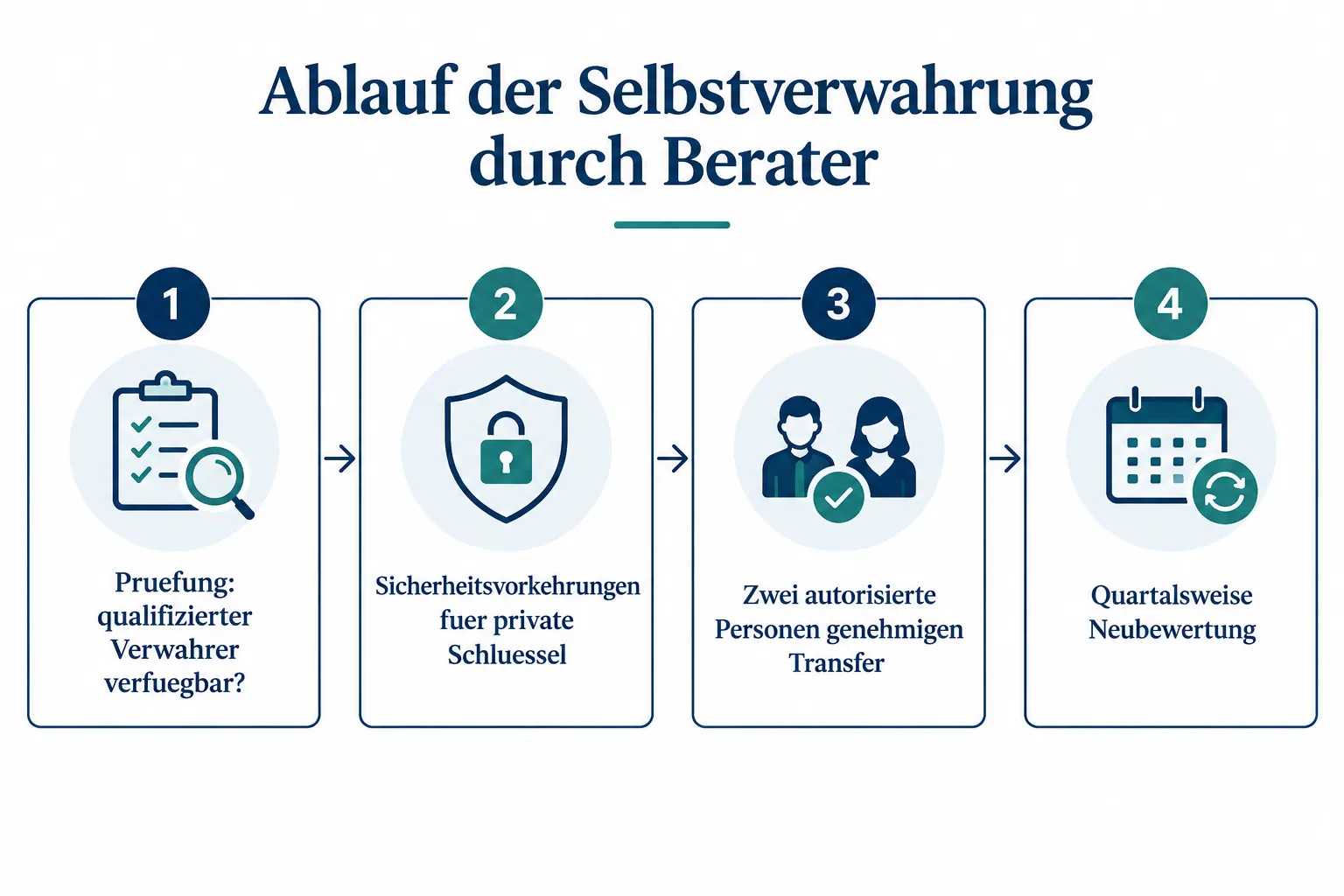
The new SEC crypto custody proposal creates a path forward with clear guardrails. Investment advisers would be allowed to self-custody clients’ crypto assets when no qualified custodian genuinely exists for that specific asset. However, this permission comes with a set of obligations:
- Quarterly reassessment: Advisers must regularly check whether a qualified custodian has since become available for the asset in question.
- Prompt transfer: If a qualified custodian becomes available, the assets must be transferred as soon as reasonably practicable.
- Private key safeguards: Technical and organizational measures to protect access keys are mandatory.
- Cybersecurity: Heightened requirements apply for IT security and systems to defend against attacks.
- Segregation of client assets: Individual clients’ assets must be clearly separated from one another.
- Two-person rule: Every transfer of a self-custodied crypto asset requires approval from at least two authorized individuals.
In addition, the circle of eligible custodians would be expanded. Until now, the debate centered mainly on banks and specialized crypto custody providers. The new proposal would also recognize state trust companies as qualified custodians — a step that could meaningfully increase the number of potential custody solutions available to funds and advisers.
Important for context: this proposal applies exclusively to investment advisers and regulated funds under US investment adviser law. It has nothing to do with the custody practices of crypto exchanges, and it is not connected to the SEC’s 2024 crypto ETF rules. This is a distinct, new regulatory initiative from October 2026.
Why the New SEC Crypto Custody Rules Matter
The significance of the proposal is best understood through the words of SEC Chair Paul Atkins. He described the crypto market as having grown from a niche curiosity into a multi-trillion-dollar asset class, while the existing rules had not kept pace.
"The crypto market has grown from a niche curiosity into a multi-trillion-dollar asset class, but the rules have not kept pace." — Paul Atkins, SEC Chair
This gap between market size and regulatory framework had real practical consequences. Funds and advisers wanting to manage crypto assets repeatedly ran into the problem that no qualified custody solution existed for certain tokens. That either created compliance risk or meant certain investment strategies were never implemented at all.
For the broader financial industry, the SEC crypto custody reform matters because it directly affects how professionally and institutionally crypto assets can be managed going forward. Clearer custody rules reduce legal uncertainty — a factor that has often kept institutional investors from engaging more strongly with digital assets.
At the same time, this is not a one-sided liberalization without safeguards. The requirements around cybersecurity, asset segregation, and the two-person rule show that the SEC is trying to balance flexibility with investor protection.
Reactions From SEC Commissioners: Between Progress and Caution
Within the Commission itself, the proposal’s release revealed a nuanced picture. Commissioner Hester Peirce, who is set to leave her post soon, summed up the prior regulatory situation with a memorable metaphor.
"The prior regulatory uncertainty was like a roller coaster." — Hester Peirce, SEC Commissioner
Peirce has long been one of the voices within the SEC pushing for clearer, more practical crypto rules. Her roller-coaster comparison captures how unpredictable the regulatory landscape has felt for market participants in recent years, with constantly shifting expectations and few reliable guardrails.
Commissioner Mark Uyeda, by contrast, struck a more cautionary tone. He emphasized that allowing advisers to self-custody creates an inherent conflict of interest: whoever holds a client’s assets also controls access to them — a setup that requires careful oversight.
Uyeda made clear that advisers’ fiduciary duties are not lifted by the new proposal. Advisers remain obligated to act in their clients’ best interest even under self-custody. This dual message — more flexibility alongside unchanged obligations — runs through the entire proposal.
The table below summarizes the key positions:
| Person | Role | Key Statement |
|---|---|---|
| Paul Atkins | SEC Chair | Rules must keep pace with a crypto market that has grown enormously |
| Hester Peirce | SEC Commissioner | Prior uncertainty was like a roller coaster |
| Mark Uyeda | SEC Commissioner | Self-custody carries a conflict of interest; fiduciary duties remain |
Next Steps: Public Comment Period and Timeline
The proposal, it should be clearly stated, is not yet a binding rule. Following its publication on October 1, 2026, a 60-day public comment period begins after publication in the Federal Register. During this phase, market participants, industry associations, legal experts, and individual citizens can submit comments.

Only after evaluating these comments can the SEC revise and finalize the proposal, or potentially withdraw or substantially amend it. This process is standard for US regulatory initiatives and is meant to ensure that differing interests and possible unintended consequences are considered before the rule takes effect.
For investment advisers and fund managers, this means in practice: the existing rules remain unchanged for now. Anyone following the upcoming regulatory development should keep an eye on the following milestones:
- Publication in the Federal Register and the official start of the comment period.
- Receipt and review of public comments by the SEC.
- Possible revision of the draft based on the feedback received.
- Final vote and publication of the finalized rule.
No specific date for final adoption has been announced so far. Based on past experience, such SEC proceedings can take anywhere from several months to more than a year.
Context: US Crypto Regulation in 2026
The SEC crypto custody proposal does not exist in isolation. It comes at a time when US regulation of digital assets is under significant pressure to provide clarity. In September 2026, the CLARITY Act failed in the US Senate — a bill intended to establish more comprehensive, statutory rules for crypto markets and to clarify the division of jurisdiction between the SEC and the commodities regulator CFTC.
Following that setback in Congress, the focus appears to be shifting toward administrative solutions. Both the SEC and the CFTC have since stepped up efforts to create clearer rules within their existing statutory authority, without waiting for new legislation from Congress. The October 1, 2026 custody proposal can be understood as part of this broader strategy.
For observers of US crypto regulation, this paints a nuanced picture: while a major legislative breakthrough at the congressional level remains elusive for now, regulators are pragmatically trying to adapt existing frameworks to the reality of a market that has grown substantially. This time, it is not exchange products or ETFs at stake, but the fundamental question of how professional asset managers are allowed to handle crypto assets.
If you are generally interested in securely self-custodying your own crypto assets, check out our beginner-friendly hardware wallet comparison.
Conclusion
The SEC crypto custody proposal from October 1, 2026 shows that the US regulator is willing to adapt custody rules to the growing significance of crypto assets, even without new federal legislation. The combination of greater flexibility for investment advisers alongside strict security and documentation requirements reflects an attempt to balance innovation with investor protection.
For investors and anyone interested in finance: the proposal is not currently in effect. Anyone following its further development should track the 60-day comment period and any changes published in the Federal Register. This article does not constitute financial advice and contains no buy or sell recommendations — it is intended solely as a factual overview of this regulatory development.