One sentence was enough to shake the security community: Google is no longer accepting product vulnerability reports through its Open Source Software Vulnerability Reward Program. The reason isn’t a budget cut, a scandal, or an internal restructuring. It’s a flood of AI-generated reports so massive and so flawed that the program became practically unusable. The decision around Google Bug Bounty AI Spam marks a turning point that reaches far beyond a single company and shows how generative AI is shaking the foundations of IT security research.
On October 1, 2026, Google officially announced the pause. For developers, open-source maintainers, and security researchers alike, this is more than a footnote. It’s a warning sign that established mechanisms for discovering security vulnerabilities can collapse under the pressure of automated submissions.
Table of Contents
Key Takeaways
- On October 1, 2026, Google announced it would temporarily stop accepting product vulnerability reports under its Open Source Software Vulnerability Reward Program (OSS VRP).
- The cause is a massive surge in AI-generated submissions, most of which are invalid or based on hallucinations.
- The pause does not affect reports already submitted before October 1, nor the OSS VRP supply-chain reports, which continue as usual.
- Google plans to overhaul the program and publish an update in the first quarter of 2027; alternatives include the Chrome VRP, Cloud VRP, and the Patch Rewards Program.
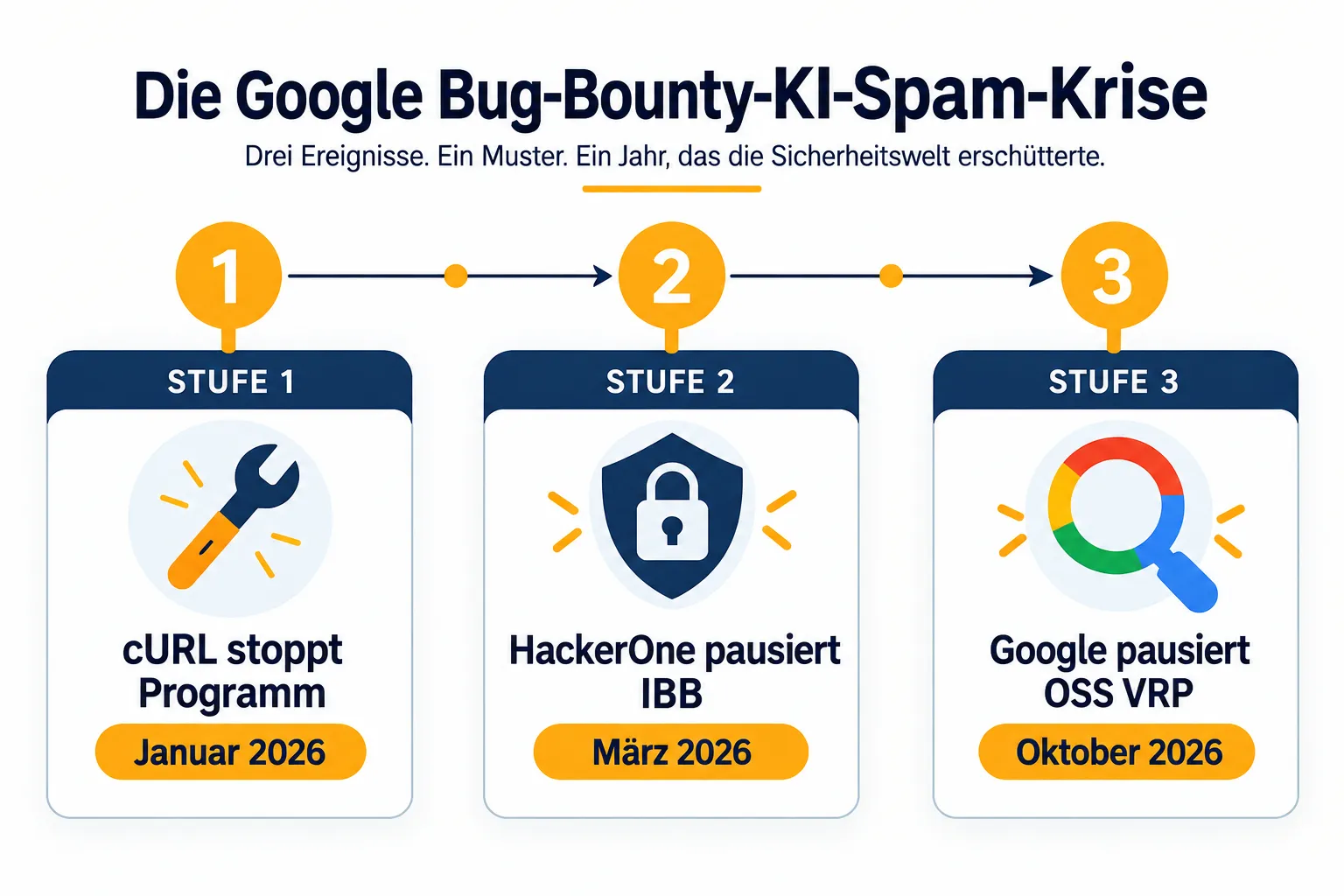
- Google is not an isolated case: cURL discontinued its bug bounty program in January 2026, and HackerOne stopped accepting new submissions for its Internet Bug Bounty Program in March 2026.
What Exactly Did Google Announce?
On October 1, 2026, Google announced that its Open Source Software Vulnerability Reward Program (OSS VRP) would immediately stop accepting new product vulnerability reports. According to the company, this form of Google Bug Bounty AI Spam was the decisive trigger. Engineers and open-source maintainers who normally review and validate incoming reports suddenly found themselves facing a flood of automated submissions.
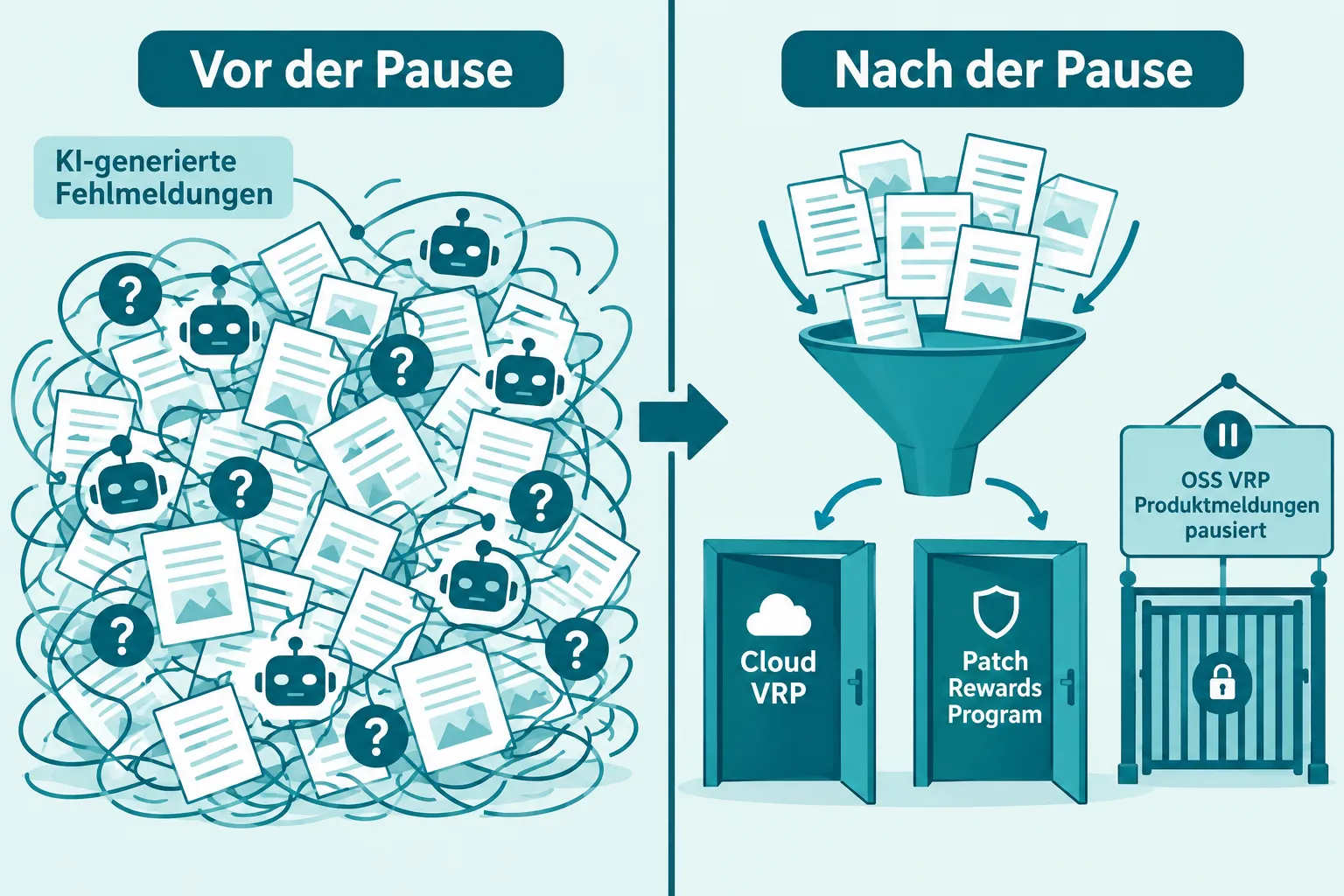
The problem wasn’t volume alone, it was quality. Most of these reports were simply invalid. A significant portion contained so-called hallucinations, vulnerabilities invented by AI models that didn’t actually exist in reality. Claimed bugs turned out, on closer inspection, to be either non-exploitable or entirely fabricated. For a team that has to take every report seriously and verify it manually, that meant an enormous workload with no real security payoff.
“Most submissions were invalid or contained hallucinations” — this core statement sums up why Google resorted to such a drastic step.
Important for researchers who were already active: the pause is not retroactive. All reports submitted before October 1, 2026, will continue to be processed normally. Also excluded are the OSS VRP supply-chain reports, i.e. reports about vulnerabilities in the software supply chain. This area continues unchanged, as it apparently wasn’t affected by AI-generated spam to the same extent.
Google Bug Bounty AI Spam in the Context of Existing Alternatives
Anyone who still wants to report vulnerabilities to Google despite the pause isn’t completely locked out. For certain Google Cloud repositories, product vulnerabilities can still be submitted via the Cloud VRP. Google also explicitly points to other ongoing programs as fallback options.
The table below summarizes which reporting channels are currently available:
| Program | Status after October 1, 2026 | Scope |
|---|---|---|
| OSS VRP (product reports) | Paused | Vulnerabilities in Google open-source products |
| OSS VRP (supply-chain reports) | Continuing | Vulnerabilities in the software supply chain |
| Cloud VRP | Continuing | Certain Google Cloud repositories |
| Chrome VRP | Continuing | Vulnerabilities in the Chrome browser |
| Patch Rewards Program | Continuing | Security improvements in open-source projects |
Google also announced it would structurally overhaul the OSS VRP. A concrete update on the new format is expected in the first quarter of 2027. Until then, it remains unclear how the company plans to distinguish between legitimate reports from human researchers and automatically generated noise in the future.
For developers in Germany who regularly work with Google open-source projects or conduct their own security research, this means one thing above all: anyone who finds a vulnerability in an affected product right now should check whether it can be submitted via Cloud VRP, Chrome VRP, or the Patch Rewards Program, rather than waiting for the OSS VRP to resume.
Not an Isolated Case: The Pattern Behind Google Bug Bounty AI Spam
Google’s decision doesn’t stand in isolation. It fits into a series of similar incidents that show the problem is structural in nature, not limited to a single company.
Back in January 2026, the open-source tool cURL announced it would discontinue its bug bounty program. The reason was almost identical: repeated, low-quality AI-generated vulnerability reports that drove maintainer workload to unsustainable levels. cURL developers had already publicly complained about the burden of automated false reports before that.
In March 2026, HackerOne followed with a similar measure. The platform stopped accepting new submissions for its Internet Bug Bounty Program for comparable reasons. Here too, the sheer volume of useless, AI-generated reports overwhelmed the existing review system.
These three cases, cURL, HackerOne, and now Google, paint a clear picture: generative AI models are increasingly being used to automatically search for vulnerabilities and draft reports. The problem isn’t the technology itself, but its uncritical application. The models can produce convincing-sounding but factually wrong security reports. For maintainers who have to take every report seriously, triage work becomes disproportionately expensive as a result.
Why Are Open-Source Programs Hit So Hard?
Open-source bug bounty programs are especially vulnerable to this development, for several reasons:
- Low barrier to entry: Anyone can theoretically submit a report, even in an automated way via scripts or AI tools.
- Financial incentive: Rewards for valid reports create an incentive to generate as many submissions as possible, including low-quality ones.
- Limited review capacity: Maintainers and security teams are often small and can’t process the flood at the same pace.
- Codebase complexity: Large, distributed open-source projects offer many attack surfaces that AI models can plausibly but incorrectly interpret.
Together, these factors create a situation in which the original goal of bug bounty programs, finding real security vulnerabilities faster, is turned on its head.
This pattern also shows up in other AI-related security topics, such as the GitLab AI Gateway vulnerability, which illustrates how AI systems introduce new risks into existing software supply chains.
What Does Google Bug Bounty AI Spam Mean for the Future of IT Security?
Google’s pause is more than an organizational measure. It raises fundamental questions about how security research can function in the age of generative AI. Three developments are already emerging.
First: companies will likely introduce stricter verification mechanisms. Automated pre-checks that filter out obviously implausible reports before they even reach human reviewers are conceivable. Reputation systems, where known, trustworthy researchers are given priority treatment, could also gain importance.
Second: the discussion around liability and responsibility for AI-generated reports will intensify. Who is liable when a researcher deliberately uses AI tools to mass-submit dubious reports? Clear rules are currently missing for this in most programs.
Third: the reform Google has announced for the first quarter of 2027 is likely to be a bellwether for the entire industry. If Google finds a working model that separates legitimate research from automated spam, other companies and platforms like HackerOne could follow suit.
For developers and security researchers, it’s worth taking a look at their own practices. Anyone using AI tools to assist with vulnerability research should manually verify every output before submitting a report. Automated submissions without human review don’t just damage the submitter’s own reputation, they harm the entire security community.
Practical Guidance for Security Researchers
Given the current situation, the following approach is recommended for anyone who wants to keep actively reporting vulnerabilities:
- Check whether the affected software is covered by Cloud VRP, Chrome VRP, or the Patch Rewards Program.
- Manually verify and test every analysis generated with AI tools before submission.
- Continue to submit supply-chain-related findings via the OSS VRP supply-chain process, since that channel remains unchanged.
- Keep an eye on the announced update in the first quarter of 2027 to stay informed about the reformed rules in time.
- If in doubt, consult the official program pages of the respective providers directly rather than relying on secondary sources.
Conclusion: A Wake-Up Call for Bug Bounty Programs in the AI Era
The pause triggered by the Google Bug Bounty AI Spam problem is not an isolated IT detail, but a symptom of a larger shift. Generative AI has drastically lowered the barrier to submitting security reports, with the unintended side effect that quality has suffered massively. Google, cURL, and HackerOne have independently drawn similar conclusions within just a few months. That suggests the entire industry is heading toward a realignment.
For developers and tech-savvy readers, this means something concrete: anyone engaged in security research should prepare for stricter review processes and possibly new verification requirements. At the same time, the fundamental importance of bug bounty programs for IT security remains untouched, they simply need to become more resilient against automated abuse.
As a next step, interested researchers should check alternative programs like Cloud VRP, Chrome VRP, and the Patch Rewards Program if they’ve currently found a vulnerability in an affected Google product. It’s also worth keeping an eye on the reform announced for the first quarter of 2027, since it’s likely to set the direction for how the entire security industry handles AI-generated submissions.