One single opinion from Europe’s securities regulator was enough to cut off a $184 billion stablecoin’s access to the EU market. That is exactly what happened on October 8, 2026, when ESMA published its opinion on the new MiCA stablecoin regulation.
Within three months, licensed crypto platforms across the entire EU must wind down all services related to non-compliant stablecoins — in practice, this affects above all Tether USDT and PayPal USD.
For millions of users of crypto exchanges across the EU, this is far more than a legal footnote. The new MiCA stablecoin rules change which digital assets platforms are even allowed to offer going forward, and they come with a hard deadline.
Table of Contents
Key Takeaways
- In an opinion dated October 8, 2026, ESMA requires MiCA-licensed crypto-asset service providers (CASPs) to stop offering non-compliant stablecoins.
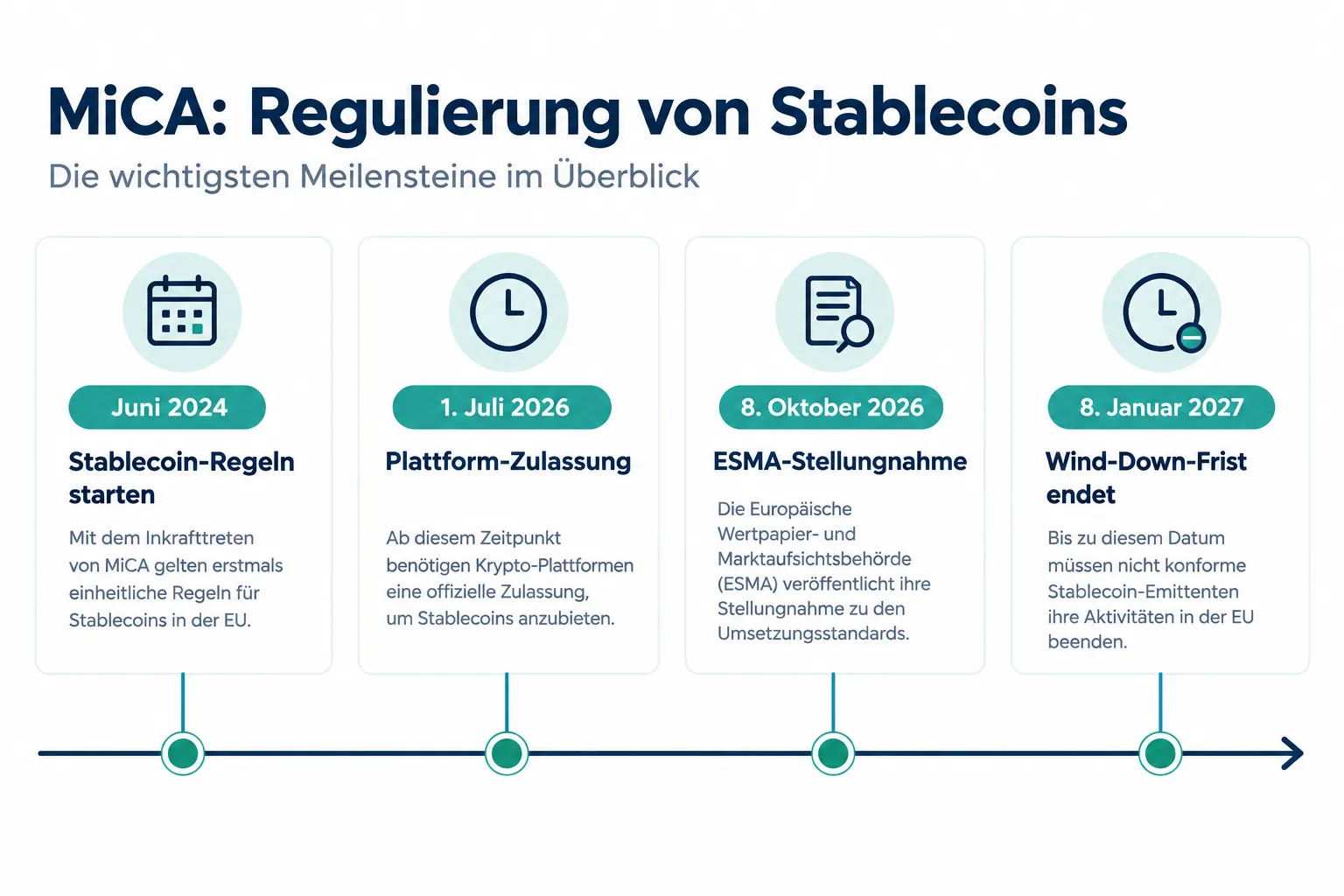
- The wind-down deadline ends no later than January 8, 2027, three months after publication.
- The restriction covers the full range of services: trading, custody, transfers, advisory, and portfolio management.
- In practice, this mainly affects Tether USDT (approx. $184 billion market cap) and PayPal USD, since neither issuer holds MiCA authorization as an e-money token.
- MiCA-compliant alternatives such as Circle USDC (roughly $73.8-74.3 billion market cap) could benefit from a shift in liquidity.
What do MiCA and CASP actually mean?
Before the details of the current development make sense, it helps to clarify the terminology. MiCA stands for “Markets in Crypto-Assets Regulation,” the EU law that has progressively regulated the European crypto market since 2024. It defines the requirements that crypto-asset issuers and service providers must meet before operating in the EU.
A similar regulatory pattern previously played out on the US side — read more in our article Bitcoin Correction and the AI Debt Bubble: When OpenAI’s Revenue Gap Collides With Crypto Capitulation.
A CASP (Crypto-Asset Service Provider) is any company offering crypto services, such as exchanges, wallet providers, or brokers. Since July 1, 2026, the full MiCA licensing rules apply to CASPs — anyone wanting to operate in the EU now needs authorization from a national regulator.
The stablecoin rules themselves — covering so-called Asset-Referenced Tokens (ART) and E-Money Tokens (EMT) — have already applied since June 2024. Stablecoins are digital assets pegged to a fiat currency such as the US dollar or the euro. These are exactly the tokens now at the center of ESMA’s new opinion.
ESMA’s October 8, 2026 opinion in detail
The European Securities and Markets Authority (ESMA) is the EU’s central financial markets regulator. On October 8, 2026, it published a formal opinion stating unambiguously that MiCA-licensed CASPs should no longer provide services related to stablecoins that fail to meet MiCA’s requirements.
ESMA bases this on Article 66(1) of the MiCA Regulation, which obliges crypto service providers to act “honestly, fairly, and professionally in the best interest of their clients.” According to the regulator, merely issuing risk warnings about the regulatory uncertainty of non-compliant stablecoins is no longer sufficient to meet that duty of care.
Notably, ESMA does not name specific tokens in its opinion. Which stablecoins are actually affected only becomes clear once platforms apply the MiCA criteria themselves — and from how the market has already begun reacting in practice.
Which stablecoins does the new MiCA regulation actually target?
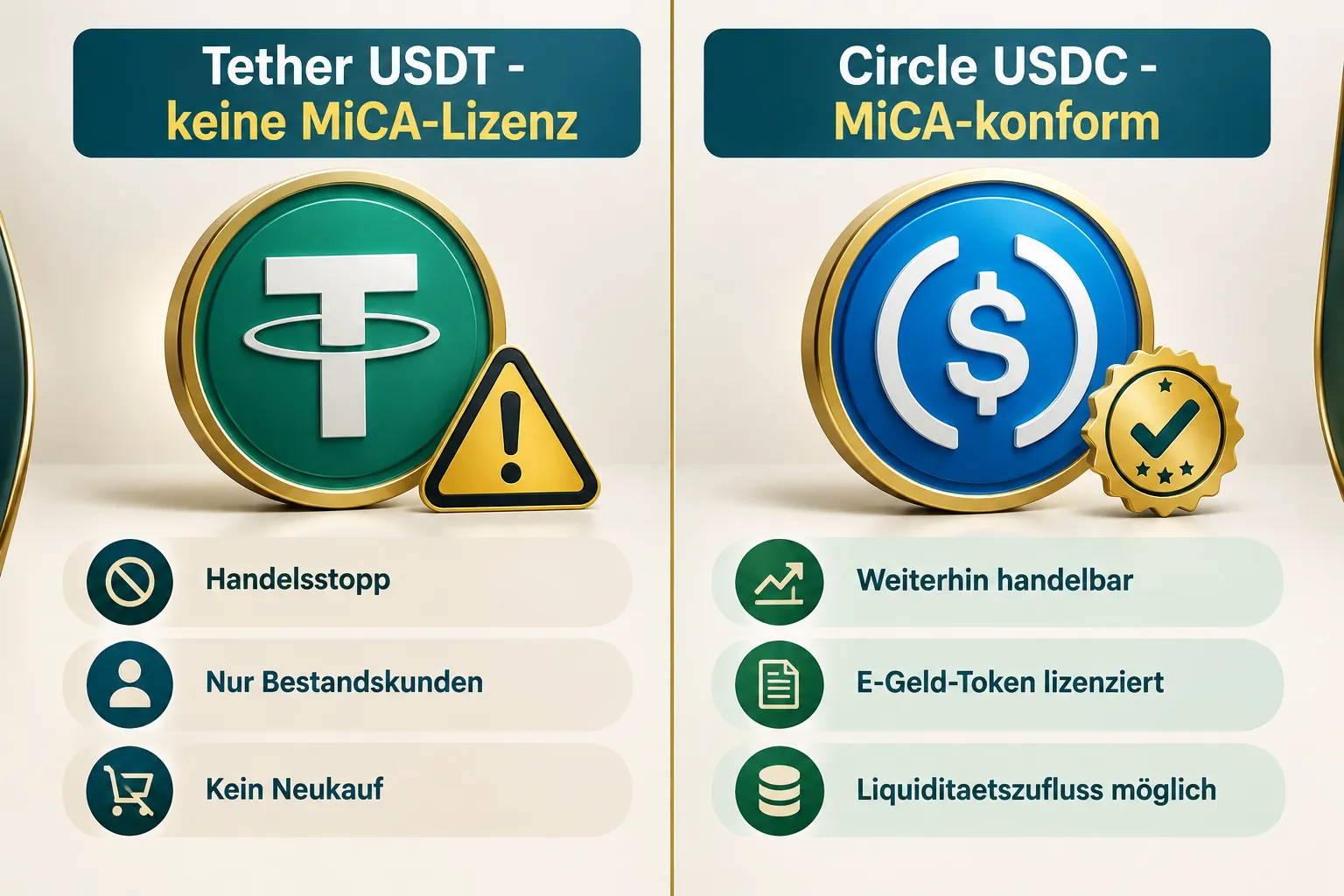
Although ESMA itself names no tokens, the practical picture is clear. Tether USDT, the world’s largest stablecoin with a market capitalization of roughly $184 billion, currently holds no MiCA authorization as an e-money token. The same applies to PayPal USD (PYUSD). Neither issuer has so far qualified for the corresponding EU license.
Crypto exchange Coinbase has already confirmed this in its own customer communication, informing its EU users accordingly. Other major platforms are expected to follow, since the regulatory logic applies equally to every CASP.
By contrast, Circle USDC, with a market capitalization of roughly $73.8 to $74.3 billion, is considered MiCA-compliant. Circle secured the required e-money token license early and can therefore continue to operate without restriction on EU platforms.
Overview: affected vs. compliant stablecoins
| Stablecoin | Issuer | MiCA status | Approximate market cap |
|---|---|---|---|
| USDT | Tether | Non-compliant | approx. $184 billion |
| PYUSD | PayPal | Non-compliant | not quantified in sources |
| USDC | Circle | Compliant | approx. $73.8-74.3 billion |
What can platforms still do during the wind-down phase?
The opinion clearly distinguishes between new business and winding down existing positions. During the transition period ending no later than January 8, 2027, platforms may continue to support existing customers with:
- Selling existing positions in non-compliant stablecoins
- Converting them into other, MiCA-compliant tokens
- Withdrawing to external wallets
- Transferring between own accounts or to third parties
- Safekeeping already-held balances
What is no longer permitted, effective immediately:
- New purchases of non-compliant stablecoins
- Active promotion of these tokens
- Regular trading in the classic order-book sense
The restriction therefore covers not just listing itself, but the full range of services, including investment advice and portfolio management. Anyone who has held, say, USDT as part of a managed crypto strategy should expect to hear from their platform in the coming weeks.
“Mere risk disclosures to clients are not sufficient, according to ESMA” — this phrasing from the opinion captures the core of the new stance: warnings do not substitute for active product responsibility.
Legal standing: guidance, not an immediately binding law
Understanding the MiCA stablecoin regulation requires understanding the legal nature of ESMA’s document. An opinion is not a directly binding legal norm, but guidance for national regulators. Actual enforcement rests with the regulators of individual EU member states — in Germany, that would be BaFin.
In practice, this means national authorities can adopt ESMA’s line one-to-one, but they can also set their own, stricter, or earlier requirements. Individual platforms may also set shorter deadlines than ESMA’s three months out of caution. Users affected should therefore not rely solely on the EU-wide end date of January 8, 2027, but keep an eye on communications from their own platform and their national regulator.
Possible market effects: a shift in liquidity
Analysts at several outlets expect the new MiCA stablecoin regulation to shift liquidity within the European crypto market. As USDT and PYUSD effectively disappear from the regular trading offering for European users, some of that demand is likely to move to MiCA-compliant alternatives such as USDC.
Whether this effect actually materializes at the scale some have forecast remains uncertain. What is clear, though, is that the regulatory line between compliant and non-compliant stablecoins will significantly shape competition for European users in the coming months.
What crypto platform users should keep in mind now
For investors and users in the EU, several practical points follow from this development, independent of individual investment decisions:
- Check your own platform’s communications. Exchanges like Coinbase are already informing customers directly about deadlines and affected tokens.
- Don’t confuse deadlines. January 8, 2027 is the outer EU-wide limit; individual platforms may act earlier.
- Understand what’s still possible with existing positions. Custody, withdrawal, conversion, and selling remain possible during the transition period.
- Don’t expect new purchases. Non-compliant stablecoins can no longer be regularly newly acquired, effective immediately.
- Check a token’s regulatory status before using it for transfers or payments within the EU going forward.
This content is intended solely as factual background on the regulatory situation and does not constitute investment advice or a recommendation to act.
Conclusion: a new reality for stablecoins in the EU
The MiCA stablecoin regulation marks a turning point for the European crypto market. With ESMA’s October 8, 2026 opinion, the era in which non-MiCA-compliant stablecoins like USDT and PYUSD could be traded without regulatory restriction on EU platforms comes to an end. The deadline of January 8, 2027 gives users time to manage, convert, or withdraw their holdings — but active new business with these tokens is already off the table.
For crypto platform users in the EU, the next concrete step is clear: check your platform’s current communications, identify affected holdings, and familiarize yourself with each provider’s specific deadlines. Since enforcement rests with national regulators, it’s also worth watching for any guidance from BaFin in the coming weeks. Staying informed makes it possible to navigate the transition without unnecessary time pressure and based on reliable, factual information.