Three weeks. That is how long it took a model that cannot write a single sentence to turn into a $7.5 billion company. On October 9, 2026, startup TypeSafe AI closed a Series A round of roughly $870 million, just weeks after quietly releasing an AI system called Jev that refuses to chat, refuses to write code, and refuses to hold a conversation. In an industry obsessed with chatty, text-generating models, TypeSafe AI Jev has become the loudest counterexample yet, an AI that says almost nothing, and is being rewarded for it at a scale few startups ever reach this fast.
The story of TypeSafe AI Jev is not just about funding size. It is about a bet that the next wave of valuable AI will not talk at all. It will just decide.
Table of Contents
Key Takeaways
- TypeSafe AI, founded in 2024, raised about $870 million in a Series A round on October 9, 2026, valuing the company at $7.5 billion.
- The round was led by Andreessen Horowitz (a16z), with Sequoia Capital and existing backer DCVC also participating.
- TypeSafe AI Jev, released September 15, 2026, is not a traditional language model, it does not generate text, code, or conversation.
- Jev answers only three closed question types: "Choice," "Score," and "Noul" (a probability estimate), making its output directly machine-readable.
- Jev runs on a transformer architecture but was trained with a method TypeSafe calls "Reinforcement Learning for Calibrated Decisions."
What Is TypeSafe AI Jev and Why It Breaks the LLM Mold
Most people picture an AI model as something that writes. It drafts emails, answers questions in full sentences, or produces lines of code. TypeSafe AI Jev does none of that. It was built to do the opposite: strip away open-ended generation and leave only structured, decisive output.
Jev launched publicly on September 15, 2026. Within weeks, it had spread across developer circles and social media, not because it could write clever prose, but because it could not, and that limitation turned out to be its selling point. Instead of a conversation, Jev gives software a direct answer it can act on immediately, with no parsing, no interpretation, and no guessing about what a paragraph of text actually meant.
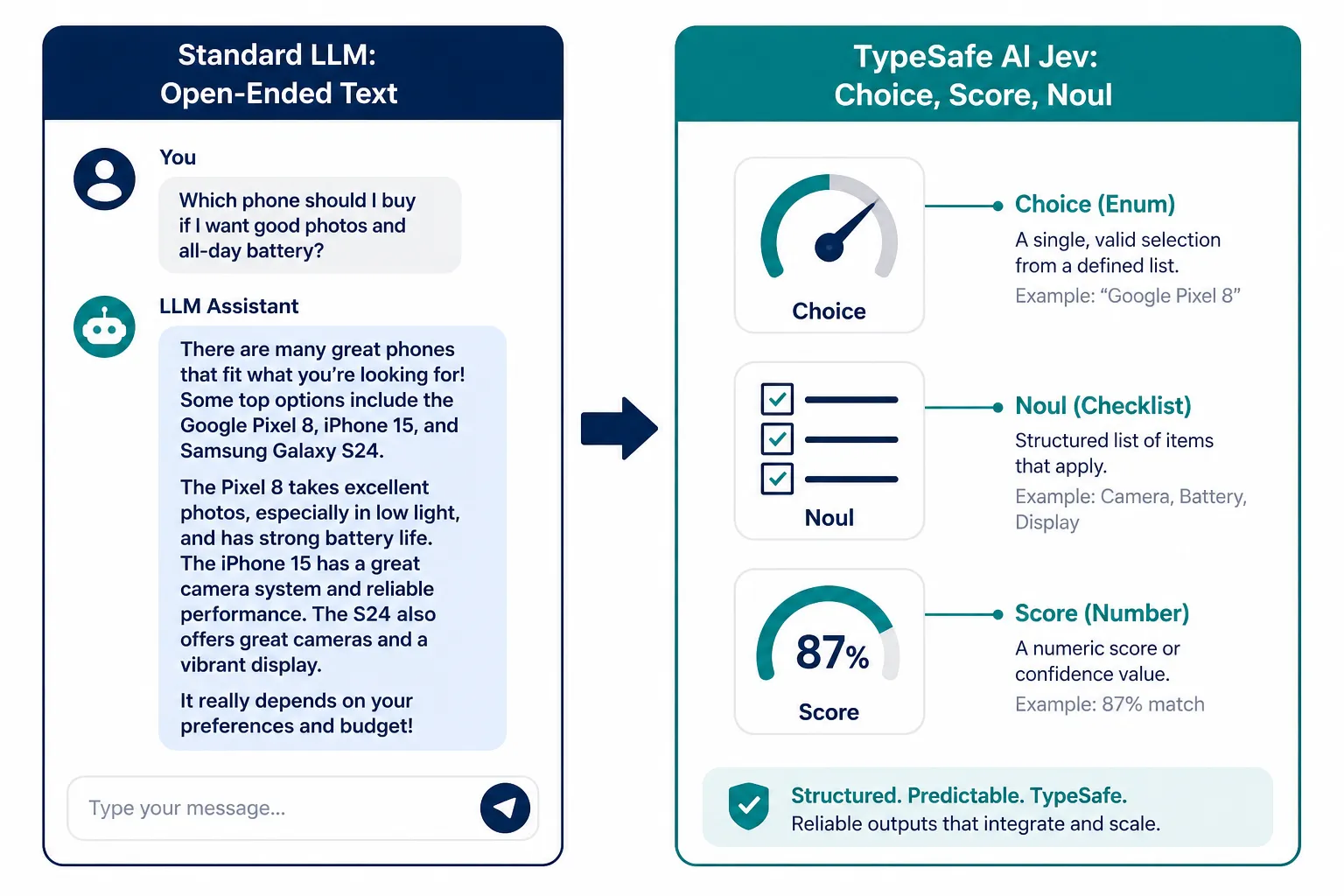
This matters because most business software does not actually want a conversation. It wants a decision. Should this transaction be flagged? Is this support ticket urgent or routine? Does this image match this description? Traditional language models can answer these questions, but they bury the answer inside sentences that still need to be decoded by other code. TypeSafe AI Jev skips that step entirely.
Inside the $870 Million Funding Round Behind TypeSafe AI Jev
The scale of the raise is what first caught the attention of Bloomberg and TechCrunch. A Series A of roughly $870 million is unusual on its own. Arriving only about three weeks after a product launch makes it extraordinary. Most startups spend a year or more proving product-market fit before investors commit capital at this level. TypeSafe AI Jev compressed that timeline into less than a month.
The round was led by Andreessen Horowitz, one of the most prominent venture firms backing foundation-model companies. Sequoia Capital joined as well, alongside DCVC, which had already backed TypeSafe AI in an earlier stage. Having three well-known investors, one new lead, one new major participant, and one returning backer, signals a level of conviction that goes beyond a single firm's enthusiasm.
The resulting $7.5 billion valuation places TypeSafe AI among the more highly valued AI startups to emerge in 2026, especially notable given the company's short operating history. Founded in 2024, TypeSafe AI reached this valuation in roughly two years, with the bulk of public attention concentrated in the final weeks before the round closed.
Who Is Behind TypeSafe AI and Jev
TypeSafe AI's founding team combines experience from two of the industry's most influential labs. The company was started in 2024 by:
- Diogo Almeida, a former OpenAI researcher
- Sasha Sheng, a former Meta engineer
- Erik Gafni, the third co-founder
This mix of research and large-scale engineering backgrounds likely shaped Jev's core design choice: instead of chasing the broadest possible model, the team narrowed its scope to a specific, underserved problem, reliable, structured decision-making.
How TypeSafe AI Jev Actually Works: Choice, Score, and Noul
Despite its unusual behavior, TypeSafe AI Jev is not built from scratch on some exotic new architecture. It runs on a transformer, the same foundational architecture behind most modern language models. What differs is not the engine, but what the engine is allowed to output.
TypeSafe has restricted Jev to exactly three response formats:
| Response Type | What It Does |
|---|---|
| Choice | Selects one option from a defined list |
| Score | Returns a numeric rating or ranking value |
| Noul | Returns a probability estimate for an outcome |
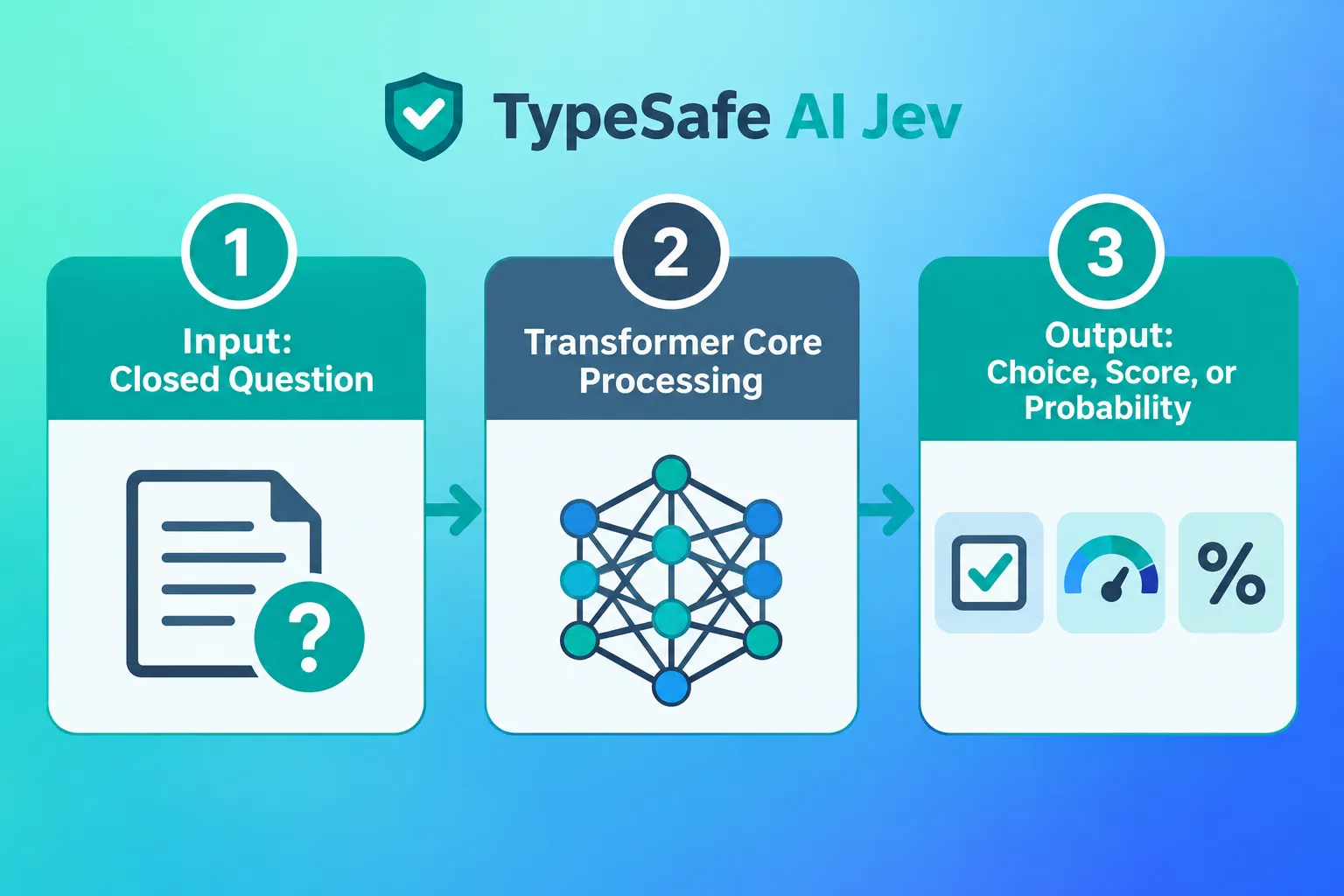
There is no fourth option, no free-text fallback, and no open conversation thread. Every query sent to Jev must map to one of these three shapes, and every answer comes back in that same structured form.
To train a model this disciplined, TypeSafe developed its own method: Reinforcement Learning for Calibrated Decisions. Rather than optimizing for fluent, convincing text, this training approach optimizes for calibration, making sure that when Jev says something has a 70 percent probability, that figure actually tracks reality as closely as possible across many examples. For a model whose entire job is producing a number, a label, or a probability, calibration is the single most important property it can have.
"Jev does not generate conversation. It generates decisions a machine can execute immediately."
This design also explains why Jev spread so quickly after its September 15, 2026 release. Developers did not need to write elaborate prompts to extract a usable answer, nor did they need extra code to strip formatting or interpret ambiguous phrasing. The output was already in the exact shape software needed.
Why a "Text-Free" Model Commands a $7.5 Billion Valuation
It is reasonable to ask why investors would value a model that deliberately does less than ChatGPT-style systems at $7.5 billion. The answer lies in what "less" actually means here. Jev is not a smaller or weaker language model, it is a different category of product aimed at a different job.
Large language models are extraordinarily good at open-ended generation, but that flexibility comes with a cost: outputs that need interpretation, validation, and formatting before other systems can trust them. For use cases built around classification, prioritization, verification, or routing, that flexibility is unnecessary overhead. TypeSafe AI Jev targets exactly that gap.
Consider how the three output types map onto everyday software needs:
- Choice fits tasks like routing a request to the correct team or category.
- Score fits tasks like ranking leads, risks, or quality levels.
- Noul fits tasks like estimating the likelihood that an event will occur.
Each of these is a narrow, well-defined problem that currently gets solved with a patchwork of rules engines, smaller classifiers, or awkwardly repurposed language models. A single, calibrated, purpose-built system that handles all three in one architecture is a meaningfully different proposition, one that venture investors, including a16z, Sequoia, and DCVC, were apparently willing to back at scale almost immediately after public launch.
What TypeSafe AI Jev Means for Developers and AI Agents
For developers, the practical appeal of TypeSafe AI Jev comes down to reliability of format. When software calls an API and expects a probability, a score, or a selection from a list, getting back a paragraph of explanatory text, however accurate, creates friction. Jev's output is described as structured and machine-readable by design, meaning it is built to be consumed directly by other software without an intermediate translation step.
This has direct relevance for three growing areas of software development:
- Applications that need fast, dependable yes/no or ranking logic embedded in their core features.
- AI agents that must chain decisions together without stopping to parse free-form text at every step.
- Automated workflows where a single wrong interpretation of an ambiguous text answer could break an entire pipeline.
In each case, a model that always answers in one of three predictable shapes, Choice, Score, or Noul, removes a layer of uncertainty that conversational models often introduce. That predictability, more than any flashy language capability, appears to be the core reason TypeSafe AI Jev attracted so much capital so quickly.
Conclusion
TypeSafe AI Jev represents a deliberate departure from the dominant AI narrative of bigger, more conversational, more general-purpose models. By building a transformer-based system that answers only in Choice, Score, or Noul formats, and training it with a calibration-focused method, TypeSafe AI has positioned Jev as infrastructure for decisions rather than a tool for dialogue. The result: an $870 million Series A, a $7.5 billion valuation, and backing from a16z, Sequoia Capital, and DCVC, all arriving within weeks of Jev's September 15, 2026 launch.
For developers and AI enthusiasts tracking where the industry moves next, TypeSafe AI Jev is worth watching closely. Anyone building applications, AI agents, or automated workflows that rely on classification, prioritization, verification, or routing should pay attention to how "text-free" decision models like Jev evolve, and whether this narrower, calibrated approach becomes a serious alternative to general-purpose language models for machine-to-machine tasks.