One model, six different outcomes: with the identical AI called Kimi K3, the success rate across 26 identical coding tasks ranged from 17 to 21 solved tasks, and costs varied by a factor of 3.8. That is the central finding of a recent benchmark test by AI agent provider Composio, which pitted six coding harnesses against each other. Anyone searching for an AI coding agent comparison today usually ends up asking which model is best. The study shows the real question is which execution environment, the so-called harness, was built around that model.
For developer teams working daily with autonomous coding assistants, this is an uncomfortable but valuable insight. Before expensively switching models, it is worth first looking at the framework that drives them.
Table of Contents
Key Takeaways
- With an identical model (Kimi K3), the success rate ranged from 17/26 (Codex) to 21/26 (Kimi Code), purely due to the harness.
- Cost per task ranged from $0.39 (Hermes Agent) to $1.47 (Claude Code), a factor of 3.7.
- Pi Agent was fastest at a median 161.7 seconds per task, while Claude Code at 347.6 seconds was more than twice as slow.
- Codex twice hit the 900-second time limit on a task that Pi Agent solved in 446 seconds.
- For tool selection: test a harness switch before considering expensive model upgrades.
What Was Tested: The Composio Benchmark in Detail
Provider Composio, which specializes in infrastructure for AI agents, published the comparison via an X thread. Six harnesses were tested: Kimi Code, Hermes Agent, Pi Agent, Claude Code, OpenCode, and Codex, each with the same underlying model, Kimi K3. All six combinations had to solve the same 26 agentic tasks: real, multi-step coding and automation workflows, including a complex expense-audit task with multiple intermediate steps.
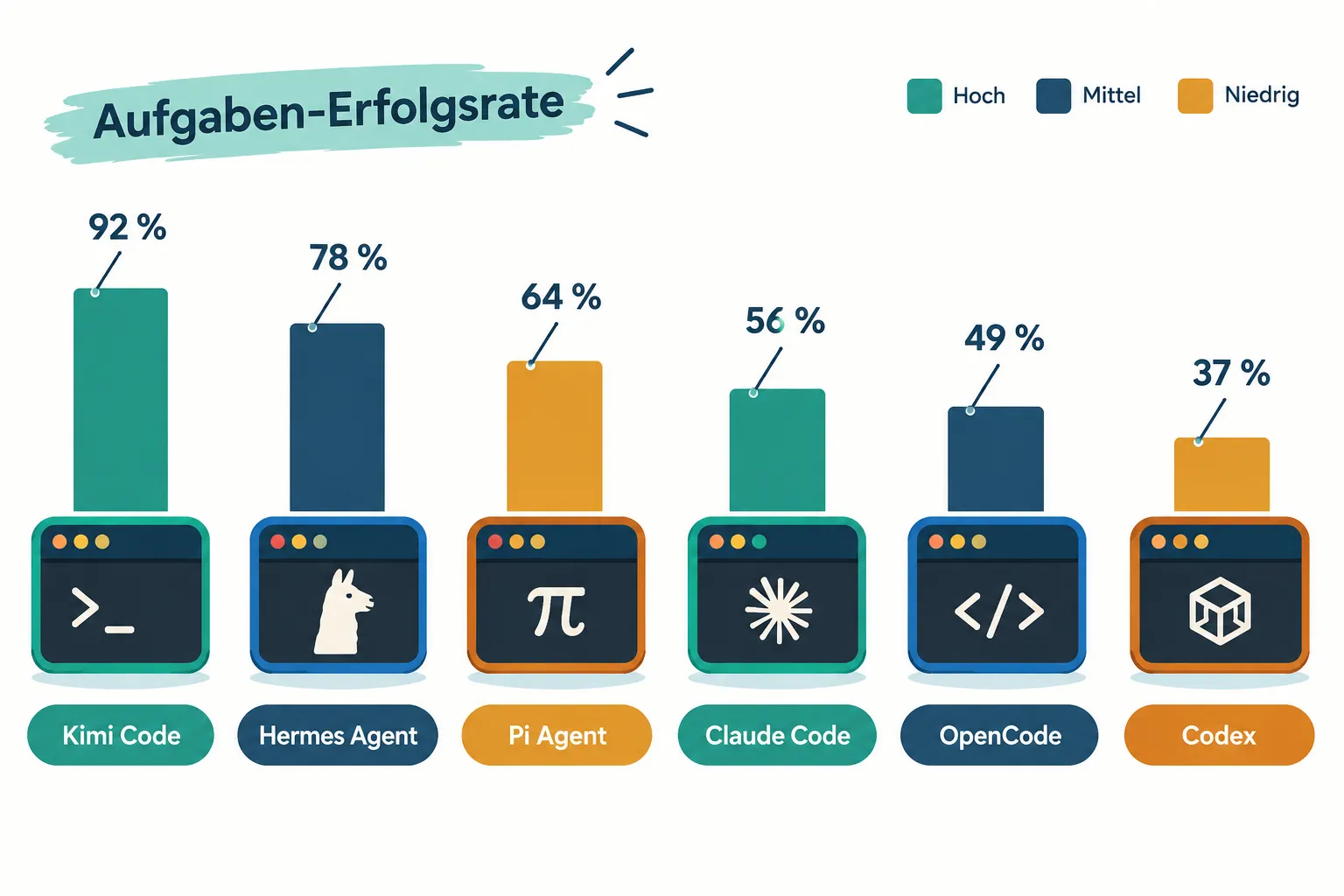
The methodological core matters here: the model stayed constant. Only the software layer that gives the model tools, file access, and terminal permissions differed. This isolates the effect of the harness without model differences distorting the result. It is exactly this controlled test setup that makes the Composio comparison so informative for a well-founded AI coding agent comparison.
AI Coding Agents Compared: The Results in a Table
The following overview summarizes all three measured metrics: success rate, average cost, and median runtime per task.
| Harness | Success Rate (of 26) | Cost per Task (USD) | Median Time per Task |
|---|---|---|---|
| Kimi Code | 21/26 | 0.54 | 297.1 s |
| Hermes Agent | 20/26 | 0.39 | 179.5 s |
| Pi Agent | 19/26 | 0.40 | 161.7 s |
| Claude Code | 19/26 | 1.47 | 347.6 s |
| OpenCode | 18/26 | 0.51 | 271.1 s |
| Codex | 17/26 | 0.47 | 236.2 s |
Three patterns stand out immediately. First: the success-rate leader, Kimi Code, is neither the cheapest nor the most expensive harness. Second: Pi Agent delivers the best balance of speed and cost without falling far behind on success rate. Third: Claude Code, at $1.47 per task, is about 3.7 times more expensive than Pi Agent yet achieves a lower success rate than Kimi Code and Hermes Agent. Anyone choosing purely on name recognition might end up with the worse choice for their own use case.
What Is a Harness? An Explanation for Beginners
Anyone who doesn’t work with agent architectures daily quickly stumbles over the term. A harness is, at its core, the software environment that connects an AI language model to the real work environment. The model itself, say Kimi K3, can only generate text. It doesn’t automatically know how to open a file, run a terminal command, or test a code change.
That’s exactly where the harness comes in. It provides the model with tools, such as:
- File access for reading and writing code
- Terminal commands for running scripts
- Memory and context management across multiple steps
- Error handling when a step fails
- Rules for when a task counts as complete
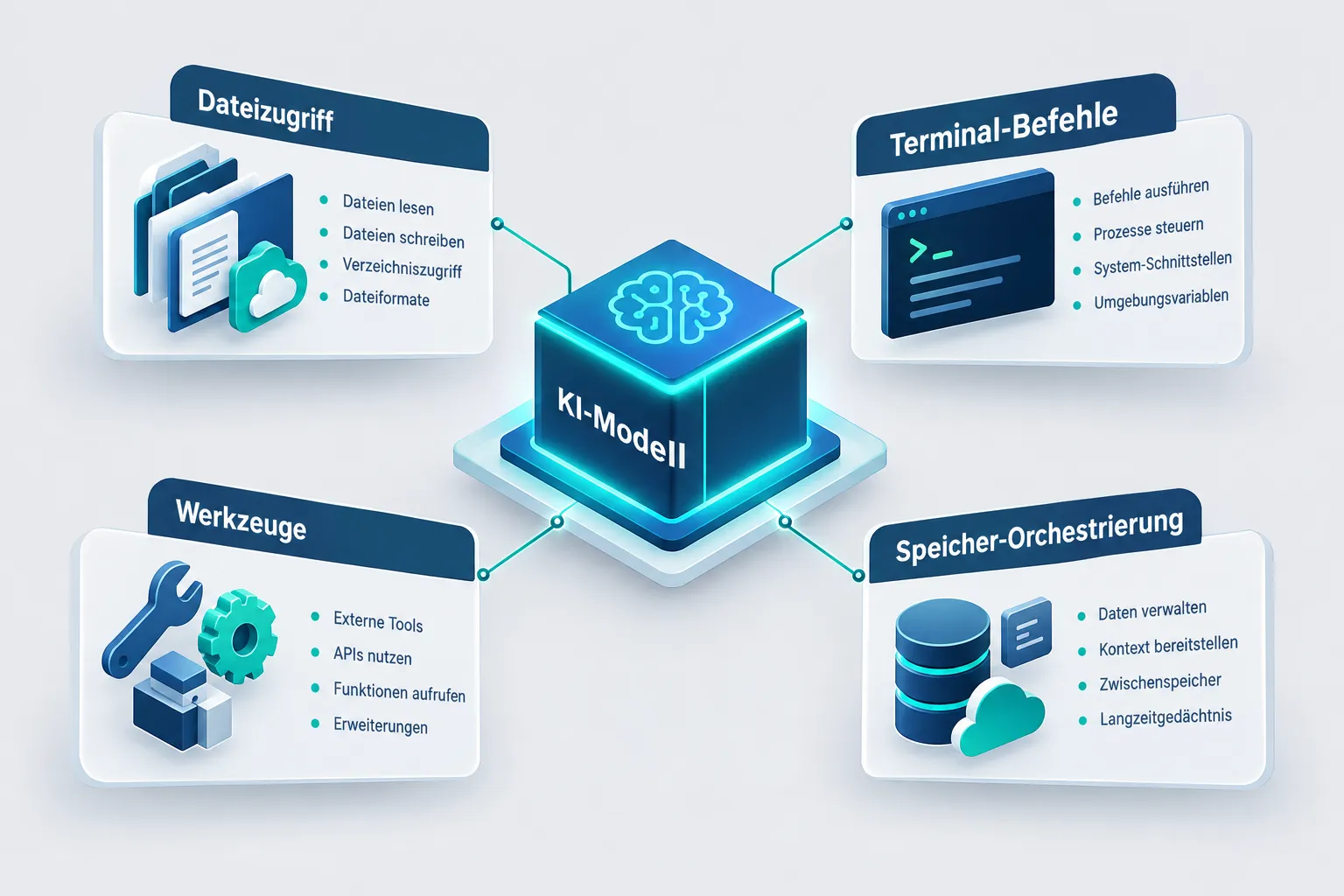
So two harnesses can use the same model and still work completely differently, depending on how efficiently they plan intermediate steps, how sparingly they use tokens, and how robustly they handle errors. That’s exactly why an AI coding agent comparison should never be just a model question, but always also a question of execution architecture.
Why the Harness Matters More Than the Model
The core message of the Composio study can be summarized like this: before teams switch models to cut costs or improve reliability, they should first test a different harness. On identical tasks with an identical model, harness choice alone changed the cost per task by a factor of 3.8 and the success rate from 17 to 21 out of 26 tasks.
This observation aligns with independent analyses from the broader market. A detailed harness-bench study with 106 tasks, six harnesses, and eight models reached a similar conclusion: the best harness configuration scored 76.2 points, the worst only 52.4, a gap of 23.8 points on identical models and tasks [14]. Notably, around 36 percent of observed failures were not due to poor model reasoning but to schema and output-contract violations, i.e., weaknesses in the harness itself [14].
“On identical tasks with an identical model, harness choice alone changed the success rate from 17 to 21 out of 26 tasks.”
If you’re also looking for free alternatives alongside commercial coding agents, check out our overview of Open Source GitHub Tools for more options. A comparison of several coding harnesses with the same Claude model (Opus 4.5) on the Terminal-Bench-2.0 benchmark confirms the pattern too: Letta Code reached a 59.1 percent success rate, while Claude Code with the same model only reached 41.6 percent, a difference attributed entirely to harness architecture [13]. Analysts expect that the biggest performance leaps through the end of 2026 will come less from new base models than from specialized harnesses with stricter output contracts and finer memory orchestration [13][14].
Codex and the 900-Second Limit: A Case Study
One particularly telling detail from the Composio test: Codex, the harness with the lowest success rate in the comparison, twice failed a fixed 900-second time limit on an expense-audit task. Pi Agent solved the same task in just 446 seconds, less than half the time.
This shows that harness weaknesses become especially visible on the largest and most complex workflows. Smaller, single-step tasks often barely reveal differences between harnesses. But once multi-step processes with many intermediate steps come into play, the efficiency of planning, tool usage, and error handling determines whether a task can be solved within a practical time window at all. For teams building complex automations, this detail may matter more than the raw success rate in the overall table.
AI Coding Agents Compared: What It Means for Developer Teams
Several actionable conclusions emerge from the data for practical tool selection:
- Test harness before model: Anyone wanting to cut costs or improve reliability should first check whether a different harness with the existing model delivers better results, before expensive model upgrades.
- Use case decides: For short, frequent tasks, a cheap, fast harness like Pi Agent or Hermes Agent pays off. For complex, rare workflows with high demands on success rate, a pricier harness like Kimi Code can be more economical despite higher cost per task, because fewer retries are needed.
- Check time limits: Fixed timeout thresholds in a harness can become the limiting factor on large workflows, regardless of model quality.
- Calculate cost per successful task, not just cost per attempt: a cheap harness with a low success rate can end up more expensive overall than a somewhat pricier harness with a high hit rate.
These principles hold regardless of the current market leader. Similar effects show up in other benchmarks too: on Terminal-Bench 2.1, the Codex CLI harness with the GPT-5.6 Sol model reached a top score of 89.5 percent [11], while Claude Code with the Fable 5.1 model and a 1-million-token context window achieved a 57.9 percent success rate on Terminal-Bench 4.0 and was rated leading for repository-adjacent work there [3]. Rankings shift depending on benchmark, model pairing, and task type, further evidence that a blanket “best agent” claim without context carries little weight.
Context: The Broader Market in 2026
The Composio test is not an isolated case but fits a bigger picture. Various market overviews from 2026 show that Claude Code, OpenAI Codex, Cursor, and GitHub Copilot each lead in different task types: Claude Code scores on complex refactoring, Codex on agent-based delegation, Cursor as an IDE driver, and Copilot as the enterprise standard [2][4][8]. Terminal and agent rankings also emphasize that Codex-based harnesses often lead on terminal-oriented tasks and computer interactions, including up to 1.9x faster interactions on the Mind2Web benchmark [3].
Pricing shows a wide spectrum: powerful harnesses like Claude Code, Codex CLI, and IDE agents like Cursor or Copilot mostly range between $20 and $200 per month, while open-source alternatives like Cline or OpenCode with your own API access are free to use and are gaining importance in the growing MCP tool ecosystem [6][9][10]. This price range makes clear: the differences of a few cents per task measured in the Composio test can add up to significant monthly sums across thousands of daily executions.
Conclusion
The Composio benchmark offers a rare, methodically cleaner look at a question often overlooked in practice: not just the model, but above all the harness, determines how reliably, quickly, and cheaply an AI coding agent actually works. With an identical model, the success rate fluctuated between 17 and 21 out of 26 tasks, costs varied by a factor of 3.8, and runtimes differed by more than double.
For developer teams, this means: before the next expensive model upgrade, a systematic harness test with your existing model and your typical tasks is worthwhile. Such an internal AI coding agent comparison, even with a smaller set of ten to twenty representative tasks, often delivers more meaningful results than any general leaderboard. Anyone who additionally documents fixed time limits, cost per successful task, and error types gains a solid basis for the next tool decision, regardless of which model currently leads the market.
Frequently Asked Questions
nWhat was the success rate range across harnesses in the Composio benchmark?
nWith the identical model Kimi K3, the success rate across 26 identical coding tasks ranged from 17/26 for Codex to 21/26 for Kimi Code, purely due to the harness.
nHow much did cost per task vary between harnesses?
nCost per task ranged from $0.39 for Hermes Agent to $1.47 for Claude Code, a factor of about 3.7 to 3.8, even though the underlying model was identical.
nWhich harness was fastest in the benchmark?
nPi Agent was fastest at a median 161.7 seconds per task, while Claude Code at 347.6 seconds was more than twice as slow.
nWhat is a harness in the context of AI coding agents?
nA harness is the software environment that connects an AI language model to the real work environment, providing tools such as file access, terminal commands, memory and context management, and error handling, so the model itself can only generate text but cannot act without it.
nReferences
[1] Best Ai Agents – https://www.datacamp.com/de/blog/best-ai-agents [2] Beste Ki Coding Agenten 2026 – https://techsy.io/de/blog/beste-ki-coding-agenten-2026 [3] Coding Ai Agents For Accelerating Engineering Workflows – https://mightybot.ai/blog/coding-ai-agents-for-accelerating-engineering-workflows/ [4] Best Ai Agent For Coding – https://myclaw.ai/de/blog/best-ai-agent-for-coding [5] Best Ai Model For Coding 2026 – https://blink.new/de/blog/best-ai-model-for-coding-2026 [6] Die Besten Ki Coding Tools – https://jens.marketing/die-besten-ki-coding-tools/ [8] Best Ai Agents – https://myclaw.ai/de/blog/best-ai-agents [9] Best Ai Coding Agents 2026 – https://nimbalyst.com/blog/best-ai-coding-agents-2026/ [10] Ai Coding Agents Complete Guide 2026 – https://codersera.com/blog/ai-coding-agents-complete-guide-2026/