A database server that ships HTTPS endpoints of its own, with no extra process standing between it and the request: that’s exactly what Oracle started publicly testing on September 25, 2026. With the MySQL 26.10 Early Access build, a long-held assumption behind many backend architectures disappears — the idea that REST APIs for MySQL data always have to run through a separate MySQL Router. At the same time, the version number itself marks a break: MySQL 26.10 no longer follows the old scheme of 8.0, 8.4, or 9.7, but a calendar-based numbering system instead.
For developers running MySQL in production, this preview build is worth a close look — even though it’s explicitly not meant for production use yet.
Table of Contents
Key Takeaways
- MySQL 26.10 is an Early Access preview build released September 25, 2026 via MySQL Labs — not suitable for production environments.
- Since June 16, 2026, Oracle has used a new versioning scheme called Calendar Versioning (CalVer), in a Year.Month format.
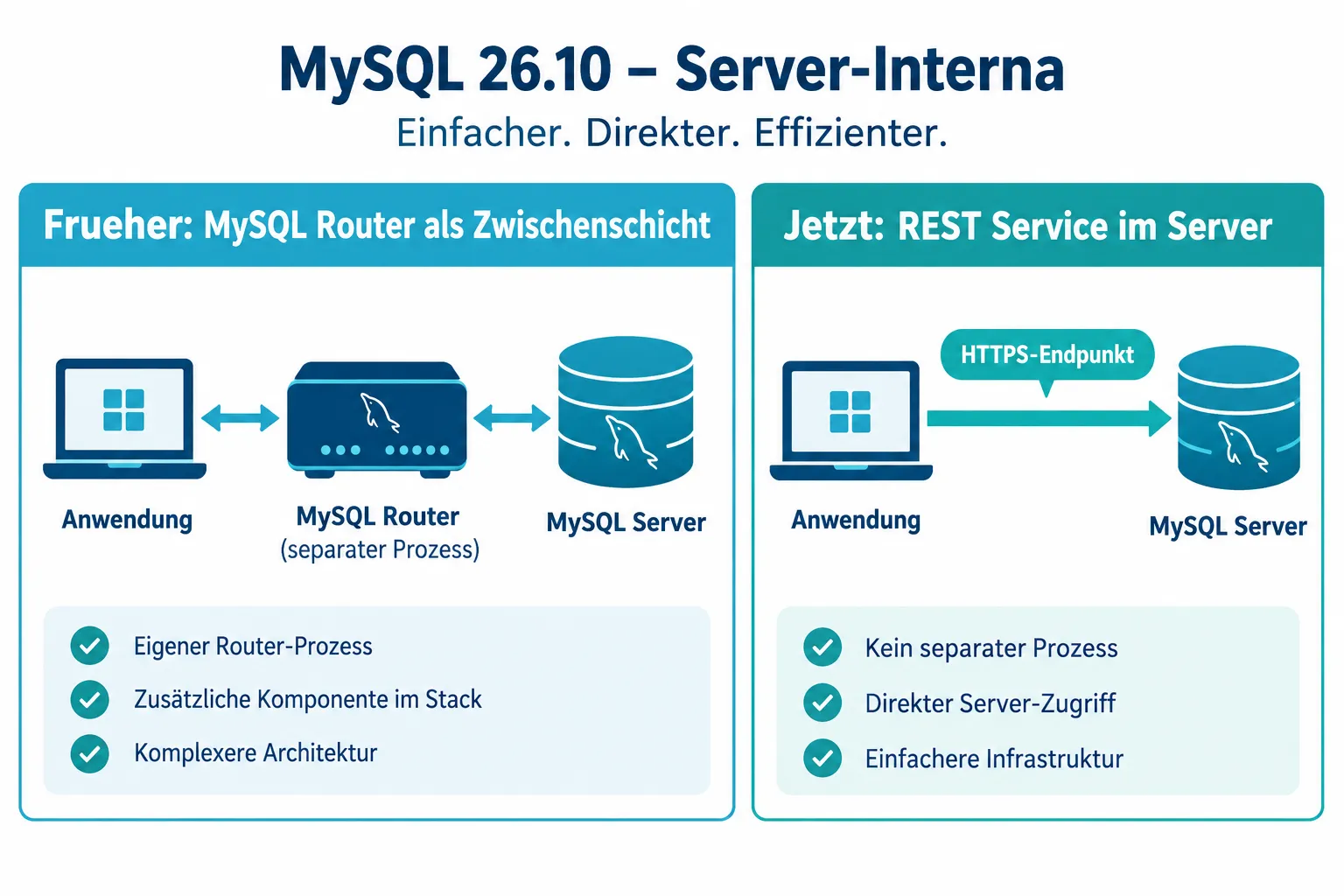
- The biggest technical change: the MySQL REST Service now runs directly as a server component, so a separate MySQL Router is no longer strictly required for REST APIs.
- Other changes in this build touch InnoDB, the optimizer, replication, SQL syntax, and the component architecture.
- The established LTS lines MySQL 8.4 and MySQL 9.7 remain unchanged and continue on their existing numbering scheme in parallel.
What Is MySQL 26.10 Early Access?
According to the Oracle MySQL Blog (author: Scott Stroz, MySQL Developer Advocate), MySQL 26.10 is the second Innovation release under the new calendar logic. The build has been available for download since September 25, 2026 in the “MySQL Early Access” section at labs.mysql.com, specifically under the entry “MySQL 26.10.0 Early Access Release.”
Oracle traditionally positions Early Access builds as a testing ground for the community. Installing one gives developers an early look at features that may make it into regular releases later, but comes with the usual caveats: instability, no guaranteed backward compatibility, and incomplete documentation. The full release notes are available at dev.mysql.com/doc/relnotes/mysql/26.10/en/news-26-10-0.html.
“This build is intended solely for preview, evaluation, and testing,” is Oracle’s explicit framing of MySQL 26.10.
The New Calendar Versioning (CalVer) Explained
If you’re seeing “26.10” for the first time, you might reasonably wonder what happened to the familiar version numbers like 8.0 or 9.7. On June 16, 2026, Oracle completely overhauled its versioning scheme for Innovation releases, moving away from sequential numbering toward Calendar Versioning.
The format is YY.M — year.month. MySQL 26.10 simply means: a release from October 2026. The goal is to make planning easier, since developers can tell how current a build is directly from its version number.
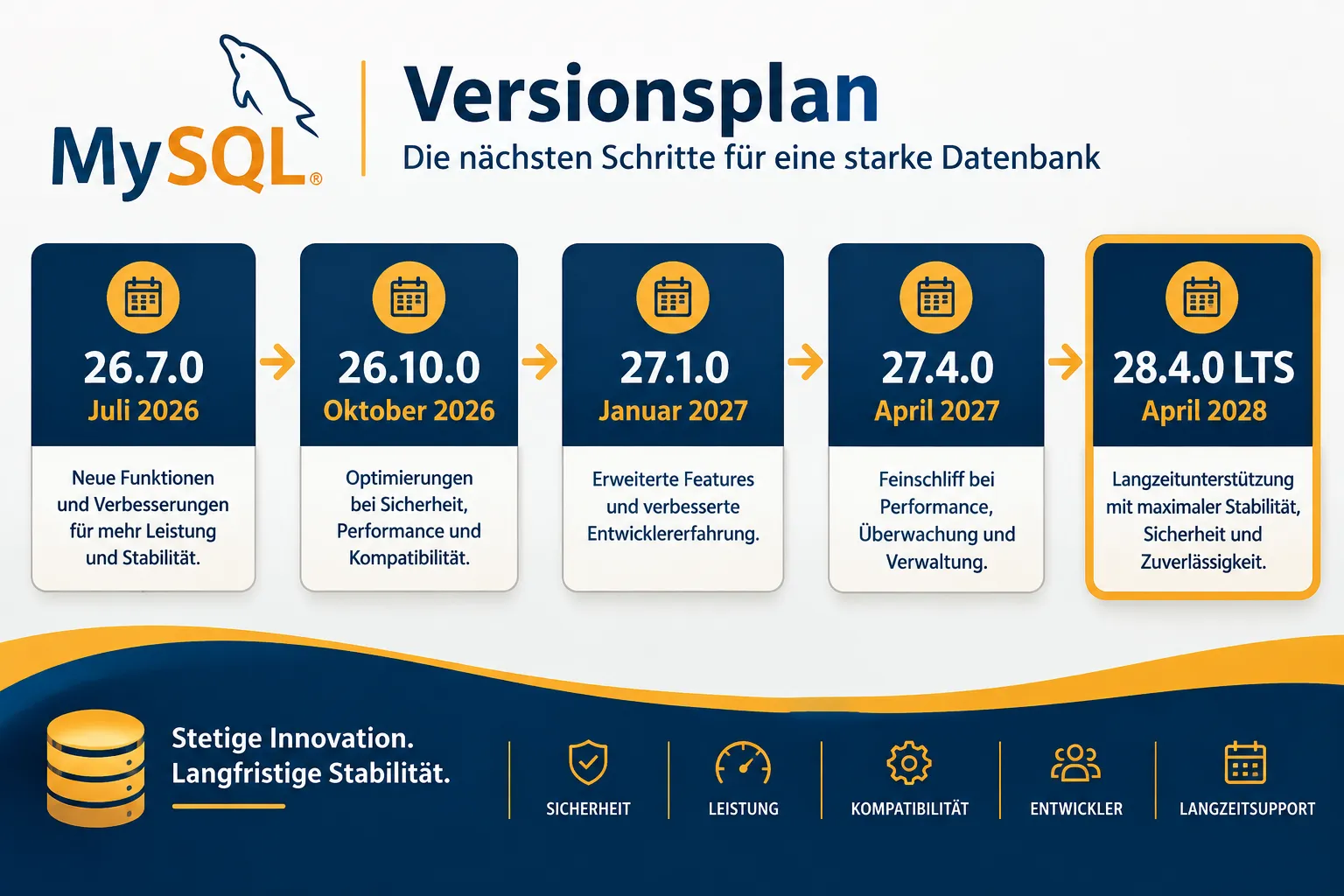
Oracle’s planned release cadence:
| Version | Date | Type |
|---|---|---|
| 26.7.0 | July 2026 | Innovation |
| 26.10.0 | October 2026 | Innovation |
| 27.1.0 | January 2027 | Innovation |
| 27.4.0 | April 2027 | Innovation |
| 28.4.0 | April 2028 | LTS |
Important for existing installations: the established Long-Term Support lines MySQL 8.4 and MySQL 9.7 are not affected by this change. They continue under their previous numbering scheme. CalVer currently only applies to the new Innovation releases like MySQL 26.10.
REST Service Built Directly Into the MySQL Server: The Biggest Change in MySQL 26.10
The most technically significant change in this build concerns the architecture of REST access to MySQL data. Until now, anyone wanting to expose HTTPS endpoints for their database had to run a separate MySQL Router process, which mediated between incoming REST requests and the actual database server.
With MySQL 26.10, the MySQL REST Service is now integrated as a server component. In practice, that means:
- HTTPS endpoints can be served directly from the MySQL server itself.
- An additional Router process is no longer strictly required for simple REST scenarios.
- The server’s component architecture has been extended accordingly to natively support this feature.
Why this matters: For PHP and Node.js backend teams that use MySQL as their primary data source, this potentially removes one deployment building block. Instead of orchestrating server plus Router plus application, the server alone could soon be enough to expose simple data access over REST. That lowers operational complexity — especially for smaller microservices or internal tools, where the extra Router overhead has often felt disproportionate.
One important caveat remains: this is still an early preview mechanism. Production readiness, security audits, and full configuration options are all likely to change before a final release.
Other Improvements in MySQL 26.10
Besides the REST story, Oracle’s release notes list several smaller but practically relevant changes. According to the Oracle MySQL Blog, these touch the following areas:
- InnoDB — bug fixes and internal optimizations to the storage engine.
- Optimizer — query planning adjustments meant to produce more efficient execution plans.
- Replication — stability improvements for replication scenarios between servers.
- SQL syntax — minor extensions and corrections to the supported SQL language scope.
- Component architecture — structural changes that, among other things, make the REST service integration possible in the first place.
Detailed changelogs for each individual fix are available in the official release notes at dev.mysql.com. Teams testing MySQL 26.10 should review their own replication and optimizer dependencies before migrating larger test datasets.
MySQL 9.7 LTS vs. MySQL 26.10: What’s the Difference?
A common point of confusion: MySQL 26.10 and MySQL 9.7 aren’t competing major versions — they’re two different development tracks.
MySQL 9.7.0 LTS has already been formally released and is intended as the first major LTS version since MySQL 8.4. Among other things, it brings:
- a Hypergraph query optimizer
- in-database JavaScript support
- JSON Duality Views
- dynamic data masking
Notably, some of these features were previously available only in the paid Enterprise Edition and are now, with 9.7, also part of the free Community Edition.
MySQL 26.10, by contrast, is an Innovation release under the new CalVer scheme — experimental, short-lived in its current form, but a preview of features that could eventually land in a future LTS release such as the 28.4.0 version planned for April 2028.
If you need stable production operation, you stay on MySQL 8.4 or MySQL 9.7. If you want to see where the server architecture is heading, you look at MySQL 26.10.
Who Should Care About MySQL 26.10?
If you’re just starting to evaluate MySQL as a backend database, it’s worth first reading our PHP vs. Node.js vs. MySQL comparison for beginners before diving into Early Access features like the new REST service.
This preview build isn’t equally interesting to every development team. It’s particularly relevant for:
- PHP backend developers who have so far built their own REST wrappers around MySQL access
- Node.js teams using MySQL as their primary database and making architecture decisions for upcoming projects
- DevOps owners evaluating whether the MySQL Router can be retired in the medium term
- Technical decision-makers who want to understand early how the new CalVer scheme will affect update cycles
For purely production databases running critical business processes, on the other hand, this build simply isn’t intended for that use.
How Developers Can Test MySQL 26.10 Right Now
Access to the Early Access build is straightforward. Oracle provides it directly through its own Labs platform, separate from the regular download channels for production-ready versions.
Steps to test it:
- Go to labs.mysql.com
- Open the “MySQL Early Access” section
- Select the “MySQL 26.10.0 Early Access Release” entry
- Install the build in an isolated test or development environment
- Try out REST service functionality against your own simple endpoints
- Consult the release notes in parallel to keep known limitations in view
A production-adjacent test database with real customer data should not be used for this purpose.
Roadmap: What’s Next
Oracle has already announced rough timeframes for upcoming Innovation releases, but there’s still no fixed GA (General Availability) date for MySQL 26.10 itself. As things stand, 26.10.0 will be followed by 27.1.0 in January 2027 and 27.4.0 in April 2027, before 28.4.0 arrives as the next major LTS milestone in April 2028.
For development teams, that means MySQL 26.10 remains, for now, a look into the workshop rather than a finished product. Anyone making production-relevant decisions should keep relying on MySQL 8.4 or 9.7, while watching which features from the 26.x line migrate toward a future LTS release.
Frequently Asked Questions About MySQL 26.10
Is MySQL 26.10 suitable for production use?
No. Oracle explicitly states that this build is intended only for preview, evaluation, and testing.
Does the new REST service fully replace the MySQL Router?
Not categorically. For simple REST scenarios, the server can handle the task directly; more complex routing and load-balancing scenarios will likely still benefit from the Router.
Does the new versioning also affect MySQL 8.4 and 9.7?
No. Both LTS lines continue unchanged under their existing scheme.
Where can I find the full technical details?
In the official release notes at dev.mysql.com/doc/relnotes/mysql/26.10/en/news-26-10-0.html.
Conclusion
MySQL 26.10 packs two shifts into a single Early Access build: a new, calendar-based version scheme, and a server that will eventually be able to speak REST endpoints on its own, without strictly needing a separate Router. Neither development is finished yet, but the direction is clear.
For development teams running PHP or Node.js backends on MySQL, this build is worth a structured look — in an isolated test environment, not in production. Understanding today how the integrated REST service works, and how CalVer releases differ from the existing 8.4 and 9.7 LTS lines, leaves you better prepared for when these features eventually arrive in a production-ready release like the LTS version planned for 2028. The recommended next step: download the Early Access build from MySQL Labs, install it in a sandbox, and keep an eye on the release notes in parallel.