Two central banks, two rate hikes, one week in September 2026, and the crypto market suddenly faces a new reality. While the Bank of Japan raises its policy rate to the highest level since 1995 and the ECB simultaneously hikes all three key rates, the rules of the game for risk assets are shifting worldwide. Anyone following current crypto news DeFi quickly notices: this is no longer just about price moves in individual coins, but about a fundamentally changed interest rate environment putting pressure on the entire DeFi landscape.
For traders relying on leveraged positions, yield farming, or carry trades, these developments are far from a footnote. They directly affect funding costs, liquidity, and the appeal of decentralized credit markets. At the same time, regulatory news around Binance, the SEC, and the CFTC is adding further movement to the market.
Key Takeaways
- The BoJ raised its policy rate in September 2026 by 25 basis points to 1.25 percent, the highest level since April 1995.[1]
- The ECB raised all three key rates, with the deposit facility standing at 2.50 percent since September 16.[8]
- Higher rates in Japan and the eurozone make yen carry trades more expensive and dampen liquidity in speculative crypto markets.[2]
- Regulatory signals, from a possible ECB block on Binance’s MiCA license to the SEC’s innovation exemption for tokenized stocks, are reshaping the framework for DeFi exchanges.
- For crypto news DeFi traders, a shift toward more sustainable yield models and regulation-friendly projects looks increasingly likely.
Crypto News DeFi in a Rate Shock: BoJ and ECB Tighten Course
The Bank of Japan decided at its two-day meeting on September 17 and 18, 2026, by a 7-to-2 majority on the Policy Board, to raise its policy rate by 25 basis points to 1.25 percent.[1] That’s the highest level in over 30 years. The reason is persistent inflation risk, driven by high oil prices and a weak yen.[1][2] The market had largely priced in this move in advance, with reports even suggesting the BoJ had long since prepared the decision internally.[13]
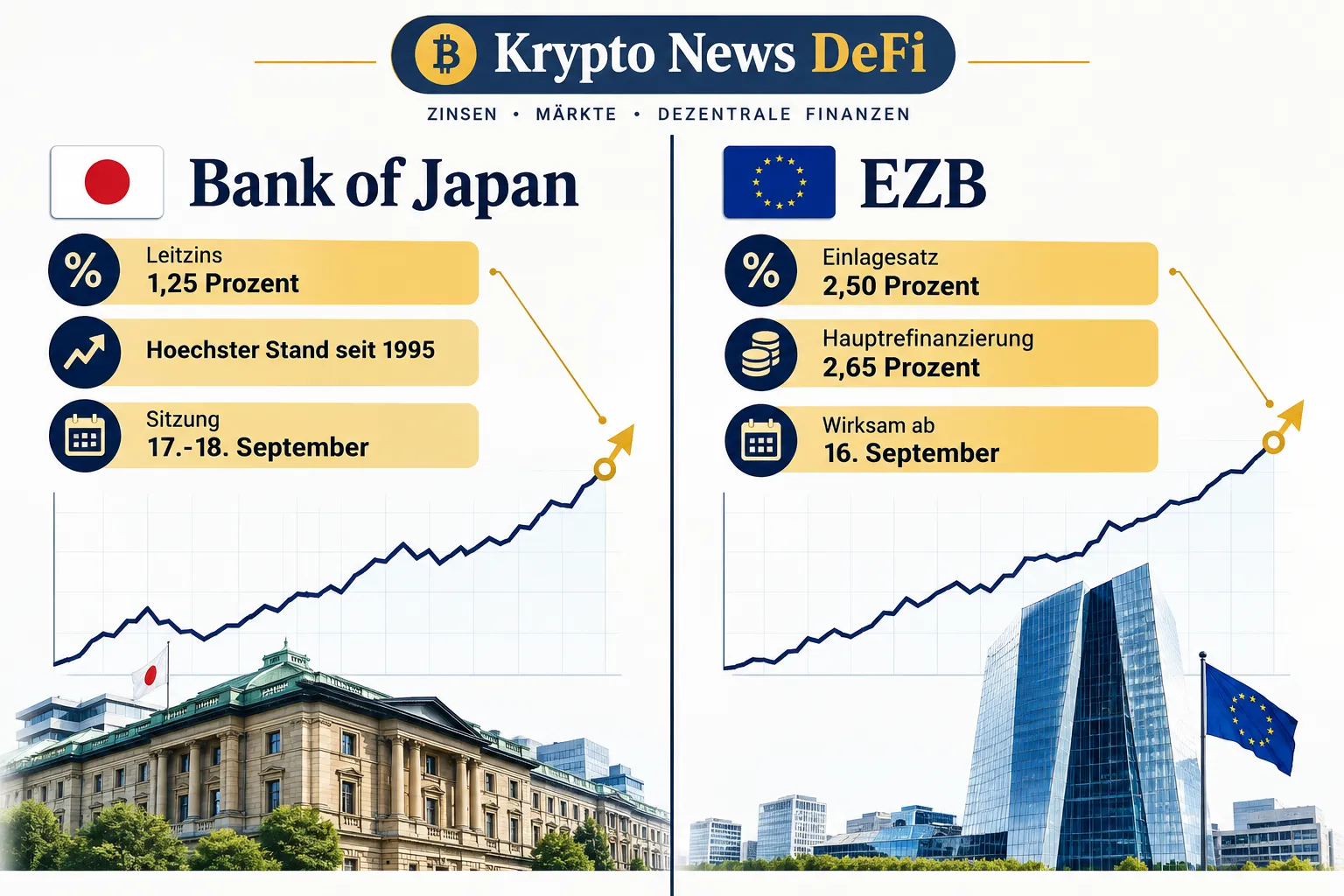
Analysts expect the central bank to continue its tightening course. Surveys see the policy rate at around 1.50 percent by the end of March 2027 and around 1.75 percent in the second quarter of 2027.[2][3] An economic policy advisor to Prime Minister Sanae Takaichi expects a rate hike every quarter into early 2027.[5]
Almost in parallel, the European Central Bank followed suit. On September 10, 2026, the ECB raised all three key rates by 25 basis points each: the deposit facility to 2.50 percent, the main refinancing rate to 2.65 percent, and the marginal lending facility to 2.90 percent, effective since September 16.[8][11] It was the second rate hike of 2026, following a pause in July and an earlier tightening in June.[9][15]
ECB President Christine Lagarde called the decision a “no-brainer,” but stressed that the future rate path was not discussed at the meeting.[4][10] The tightening is driven by resurging inflation risks from oil prices near 100 US dollars and the situation in the Middle East.[4][7] ECB projections put inflation for 2026 at around 3.0 percent and around 2.5 percent for 2027, while the growth forecast for 2026 was raised to 0.9 percent.[4]
“The rate decision was a no-brainer,” said Lagarde, though she declined to commit to the future course.[4]
Why This Matters for Crypto News DeFi
Both central banks are now clearly on a tightening path.[1][4][15] That raises global government bond yields and tightens funding conditions for risk assets such as cryptocurrencies and DeFi protocols worldwide.[2][15] The BoJ decision in particular has an impact: a smaller interest rate advantage of the yen against higher-yielding currencies weakens classic carry trades.[2][3] Less leveraged arbitrage activity means less liquidity in speculative markets, an effect that also hits parts of the crypto market.[2]
Regulation in Focus: Binance, SEC, and CFTC Shape Crypto News DeFi
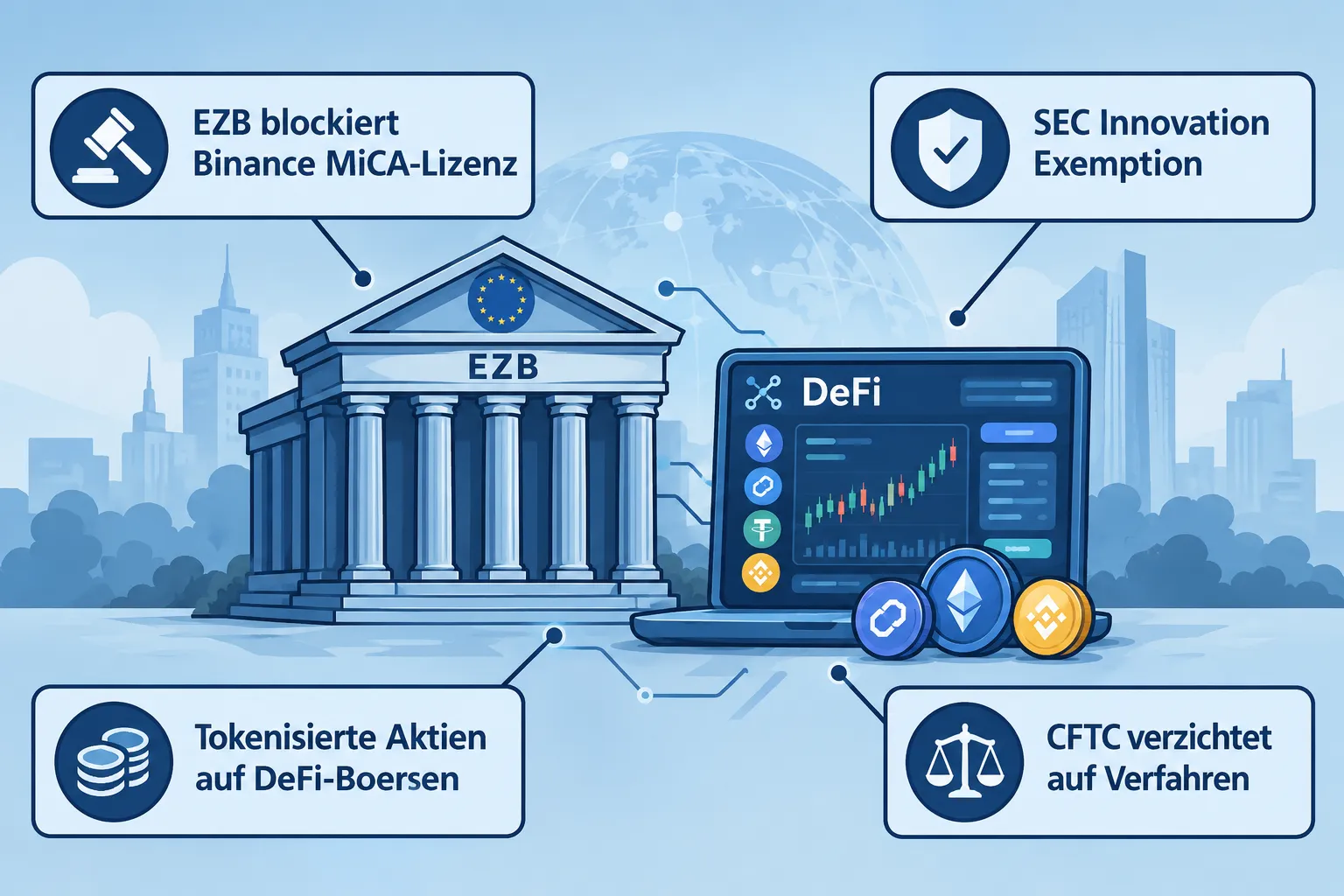
Besides monetary policy, regulatory signals are also moving the market. Reports suggest the ECB under Lagarde is currently blocking a MiCA license for Binance, which market observers see as a clear signal of stricter oversight of large crypto exchanges in Europe. Such a decision would not only affect Binance itself but also influence institutional investors’ confidence in centralized trading venues within the EU.
On the other side of the Atlantic, the US Securities and Exchange Commission appears to be taking a different course: a so-called innovation exemption is meant to allow tokenized stocks to be traded directly on DeFi exchanges. That would be a significant step toward regulated real-world-asset tokenization and could bring traditional securities and decentralized financial infrastructure closer together.
The CFTC also appears to be pursuing a more pragmatic approach. Reports indicate the agency is refraining from taking action against developers of a DeFi protocol, a signal many in the industry view as a relief. Rather than pursuing individual programmers over the use of their software, the regulator appears to be focusing more on platform operators and institutional actors.
What These Developments Have in Common
These three signals – stricter EU oversight of Binance, more room for tokenized stocks in the US, and CFTC restraint toward developers – paint a mixed picture:
- Europe is getting stricter on centralized exchanges.
- The US is gradually opening up to regulated DeFi innovation.
- The CFTC is drawing a line between developers and operators.
For traders, this means: the regulatory landscape remains uneven, but the direction is becoming clearer – more control for large, central players, more room for regulated, transparent DeFi structures.
What Does This Mean for DeFi Traders? Strategies for Higher Rates
Rising policy rates in Japan and the eurozone increase the yields of safe assets like government bonds. That reduces the relative appeal of many DeFi protocols, whose native yields often come from volatile trading volume and fluctuating credit demand. Historically, DeFi markets respond to such phases with declining total value locked (TVL) and more cautious use of leverage, especially among retail investors.
The table below summarizes the key rate decisions and their possible impact on the crypto market:
| Central Bank | New Policy Rate | Effective Date | Possible Impact on Crypto/DeFi |
|---|---|---|---|
| Bank of Japan | 1.25 percent | September 2026 | Weaker yen carry trades, less leverage liquidity[2] |
| ECB (deposit facility) | 2.50 percent | September 16, 2026 | Higher opportunity cost for risk assets[8] |
| ECB (main refinancing) | 2.65 percent | September 16, 2026 | More expensive borrowing for institutional players[11] |
Practical Portfolio Adjustments
For traders looking to manage their DeFi exposure in the coming quarters, several approaches stand out:
- Reduce leverage: higher funding costs make heavily leveraged positions riskier.
- Focus on real-world-asset projects: tokenization of bonds, stocks, or real estate is gaining importance, especially in light of the SEC innovation exemption.
- Favor regulation-friendly platforms: protocols with clear compliance structures are likely to be more resilient in a stricter environment.
- Plan for liquidity buffers: a decline in TVL can lead to higher volatility in the short term.
- Watch rate developments: further BoJ moves through early 2027 are likely and should factor into risk planning.[5]
Many market observers expect the DeFi sector’s focus to shift from short-term speculation toward more sustainable yield models, for example through collateralized lending and institutionally backed products. Robust, regulation-friendly projects could attract more capital, while riskier yield-farming constructs are likely to suffer from declining liquidity.
Outlook: Crypto News DeFi Between Rate Policy and Regulation
The combination of monetary tightening and regulatory realignment marks a turning point for the crypto market. The hard facts are clear: the BoJ has raised its policy rate to 1.25 percent, and the ECB its deposit facility to 2.50 percent.[1][8][12] Both moves raise the global interest rate level and, with it, the opportunity cost of exposure to cryptocurrencies and DeFi protocols.
At the same time, regulatory developments – from stricter EU oversight to more room for tokenized stocks in the US – are producing an increasingly differentiated market structure. Anyone operating in this environment should keep both forces in view: the macroeconomic rate landscape and the shifting regulatory environment.
Conclusion and Next Steps
Current crypto news DeFi makes it clear: rate policy and regulation are increasingly working together, reshaping the framework for decentralized financial markets. The rate hikes from the BoJ and ECB are making capital more expensive worldwide and dampening speculative liquidity, while regulatory signals around Binance, the SEC, and the CFTC are redefining the rules of the game for exchanges and developers.
For traders, a three-step approach is recommended: first, review portfolios with high DeFi exposure against tighter funding costs. Second, increasingly favor regulation-friendly, transparent projects that could benefit from the new market order. Third, actively track further rate developments from the BoJ and ECB in the coming quarters, as both central banks are likely to continue their tightening course. Anyone keeping these three factors in view is better positioned to make sound decisions in a more demanding market environment.
References
[1] Boj Set Raise Interest Rates 31 Year High Inflation Risks Loom 2026 09 16 – https://www.reuters.com/world/asia-pacific/boj-set-raise-interest-rates-31-year-high-inflation-risks-loom-2026-09-16/
[2] Boj Raise Rates 125 This Month Reach 175 Faster Than Expected 2026 09 09 – https://www.reuters.com/world/asia-pacific/boj-raise-rates-125-this-month-reach-175-faster-than-expected-2026-09-09/
[3] Boj Set Lift Rates Next Week Offer Few Clues Terminal Sources Say 2026 09 11 – https://www.reuters.com/world/asia-pacific/boj-set-lift-rates-next-week-offer-few-clues-terminal-sources-say-2026-09-11/
[4] Live Ecb Interest Rate Hike Expected 100 Oil Revives Inflation Fears 2026 09 10 – https://reuters.com/live/live-ecb-interest-rate-hike-expected-100-oil-revives-inflation-fears-2026-09-10/?arena_mid=xDLhQME6Pv5jFJvApsFe&arena_post_slug=lagardes-press-conference-has-finished
[5] Takaichis Reflationist Aide Projects Bank Japan Rate Hike September 2026 09 07 – https://www.reuters.com/world/asia-pacific/takaichis-reflationist-aide-projects-bank-japan-rate-hike-september-2026-09-07/
[7] Mopo Statement Explained September.en – https://www.ecb.europa.eu/press/press_conference/visual-mps/2026/html/mopo_statement_explained_september.en.html
[8] Ecb.mp260910314e508016.en – https://www.ecb.europa.eu/press/pr/date/2026/html/ecb.mp260910~314e508016.en.html314e508016.en.html
[9] Ecb Rate Hike 2 5 Eur Usd September 2026 – https://www.ebc.com/forex/ecb-rate-hike-2-5-eur-usd-september-2026
[10] Ecb Interest Rate Hike Lagarde Iran – https://www.cnbc.com/2026/09/10/ecb-interest-rate-hike-lagarde-iran.html
Frequently Asked Questions
How much did the Bank of Japan raise rates?
The BoJ raised its policy rate in September 2026 by 25 basis points to 1.25 percent, the highest level since April 1995.
What did the ECB do?
The ECB raised all three key rates by 25 basis points each, with the deposit facility standing at 2.50 percent since September 16.
Why does this matter for DeFi and crypto?
Higher rates in Japan and the eurozone make yen carry trades more expensive and dampen liquidity in speculative crypto markets, tightening funding conditions for risk assets.
What regulatory signals are also moving the market?
A possible ECB block on Binance's MiCA license, and the SEC's innovation exemption meant to allow tokenized stocks to trade directly on DeFi exchanges.