Table of Contents
Key Takeaways
- Free open source GitHub tools now cover almost every category: screen recording, PDF editing, image editing, AI workspaces, video rendering, and whiteboarding.
- Many projects run under MIT, AGPL, or Apache-2.0 licenses and can be self-hosted – data stays on your own infrastructure.
- The biggest advantage is control: your own server, your own data, no monthly subscription trap.
- The interface isn’t always as polished as paid software – but for technically skilled users that’s usually plenty good enough.
- The entire ecosystem around free open source GitHub tools is growing rapidly: GitHub currently lists over 19,000 public repositories under the “tools” topic alone [2][7].
Why Free Open Source GitHub Tools Are Disrupting the Software Market
This trend is no longer a niche phenomenon. Curated directories like DevPages now count 696 developer tools across 21 categories with a combined 3.8 million GitHub stars [5]. Rankings such as the daily leaderboard from OpenSourceStartups also show how dynamic the scene has become – the latest update is dated September 16, 2026 [1]. At the same time, the general base keeps growing: under the GitHub “open-source” topic there are tens of thousands more projects capable of replacing proprietary suites [10].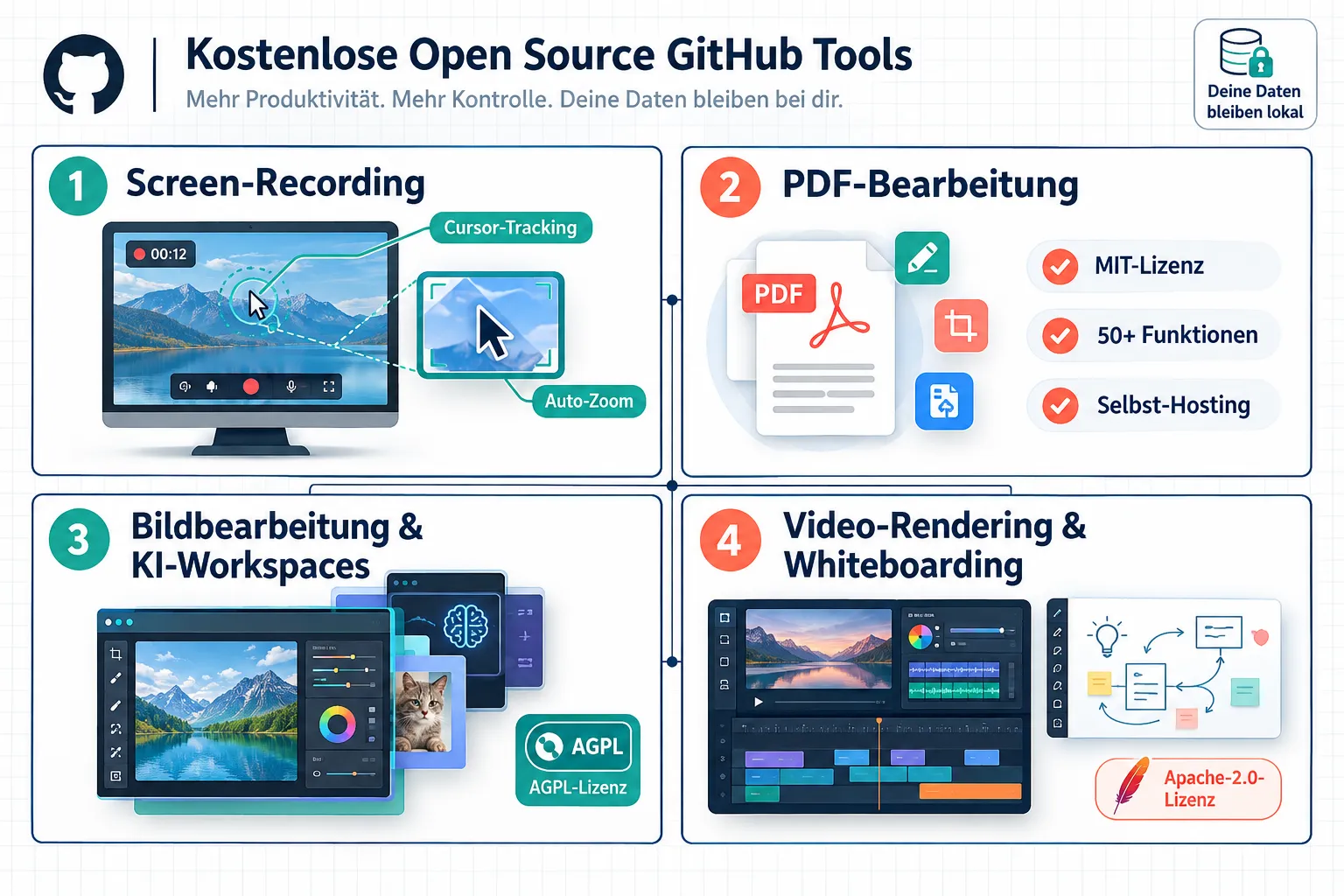
If you’re generally interested in current developments in technology and crypto, you’ll find more coverage in our blockchain and crypto news.
The appeal isn’t just about saving money. Whoever controls the source code also decides where data is stored, how updates roll out, and whether a feature still exists tomorrow. That’s exactly what makes free open source GitHub tools so attractive for technically skilled teams – even if the polish of some interfaces still lags behind commercial products.The 10 Best Free Open Source GitHub Tools at a Glance
The table below summarizes the key facts before each tool is introduced in detail.| Tool | Replaces | License | Core Function |
|---|---|---|---|
| Recordly | Paid screen recorders | AGPL | Auto-zoom, cursor tracking |
| Stirling-PDF | PDF subscription software | MIT | 50+ PDF functions, self-hosted |
| PhotoGIMP | Photoshop | – | Photoshop layout for GIMP |
| Open Notebook | NotebookLM (Business) | MIT | AI notes, podcasts, multi-model |
| Odysseus | AI workspace SaaS | AGPL | Chat, agents, local data |
| FreeDomain | Domain providers | AGPL | Free domains + hosting |
| Hyperframes | Video render APIs | Apache-2.0 | HTML/CSS to MP4 |
| Web-to-App | App builder kits | – | Website to Android app |
| Reclip | Download subscription services | – | YouTube/TikTok/X downloader |
| Excalidraw | Miro, FigJam | MIT | Encrypted whiteboard |
1. Recordly – screen recording without post-production – GitHub repo
Recordly records screen captures with automatic zoom, cursor tracking, and an optional camera overlay. What’s special: many effects that normally only happen in video editing are generated directly during recording. That saves time compared to paid tools like Loom or Camtasia. License: AGPL, meaning copyleft obligations apply when redistributing.2. Stirling-PDF – the self-hosted PDF hub – GitHub repo
Stirling-PDF bundles over 50 functions: merging, splitting, signing, redacting sensitive sections, OCR text recognition, and compression. The crucial difference from cloud services like Smallpdf: all files stay on your own server. For law firms, government agencies, or companies with data-protection requirements, that’s often the main reason to switch. The MIT license allows practically unrestricted use, including commercial.3. PhotoGIMP – the Photoshop transition for GIMP – GitHub repo
PhotoGIMP isn’t a standalone program but a patch for GIMP. It adjusts keyboard shortcuts, the menu structure, and the toolbar to match the Photoshop layout. Anyone who has worked with Adobe products for years will feel right at home immediately, without having to learn new shortcuts. That significantly lowers the entry barrier for one of the longest-established open-source graphics programs.4. Open Notebook – a self-hosted alternative to NotebookLM – GitHub repo
Open Notebook can be fed with PDFs, web pages, or YouTube links, chatted with, used to create summaries, and even generate podcasts. Unlike Google NotebookLM, the underlying AI model is freely selectable – the integration supports more than a dozen providers. That makes Open Notebook one of the most flexible free open source GitHub tools in the field of AI-assisted knowledge work. License: MIT.5. Odysseus – the self-hosted AI workspace – GitHub repo
Odysseus became known through streamer PewDiePie and offers chat, autonomous agents, research features, document management, email integration, and a memory function that retains context across sessions. The key advantage: all data stays on your own hardware, with no cloud dependency. That positions Odysseus as a direct answer to expensive, closed AI workspace subscriptions. License: AGPL.6. FreeDomain – a free domain project for quick projects – GitHub repo
FreeDomain provides domains for registration that can then be pointed at Cloudflare or your own DNS servers. Important for context: these are free domains within the platform’s own namespace, not arbitrary .com addresses. For prototypes, internal tools, or short-lived projects, it’s still a practical shortcut, with no registrar fees at all. License: AGPL.7. Hyperframes – turning HTML and CSS into video – GitHub repo
Released as open source by HeyGen, Hyperframes renders HTML and CSS code directly into MP4 files. The same code always produces the same result – a property that classic video render APIs rarely guarantee. The tool is explicitly designed for use by AI agents that need to generate video content programmatically, for example for automated marketing clips or product demos. License: Apache-2.0.8. Web-to-App – turning websites into Android apps locally – GitHub repo
Web-to-App wraps existing websites in a native Android app shell. The WebView component can be configured, the app can be signed, and optionally equipped with its own runtime environment. That replaces paid app-builder kits which often charge monthly fees for the same functionality, even though the technical effort is comparatively small.9. Reclip – self-hosted downloads from social media platforms – GitHub repo
Reclip provides its own download page for links from YouTube, TikTok, X, and Instagram, built technically on the proven yt-dlp library. Output comes as MP4 or MP3. Important note: the tool is intended solely for personal archiving of your own or freely licensed content – the terms of use of the respective platforms remain independently applicable and should be respected.10. Excalidraw – a hand-drawn whiteboard with encryption – GitHub repo
Excalidraw has become one of the best-known free open source GitHub tools in the field of visual collaboration. Its hand-drawn style evokes sketches on paper, while functionally it’s comparable to Miro, FigJam, or Lucidchart. Real-time collaboration with end-to-end encryption ensures that sensitive brainstorming sessions don’t sit in plaintext on someone else’s servers. License: MIT, so it’s also easily usable in commercial products.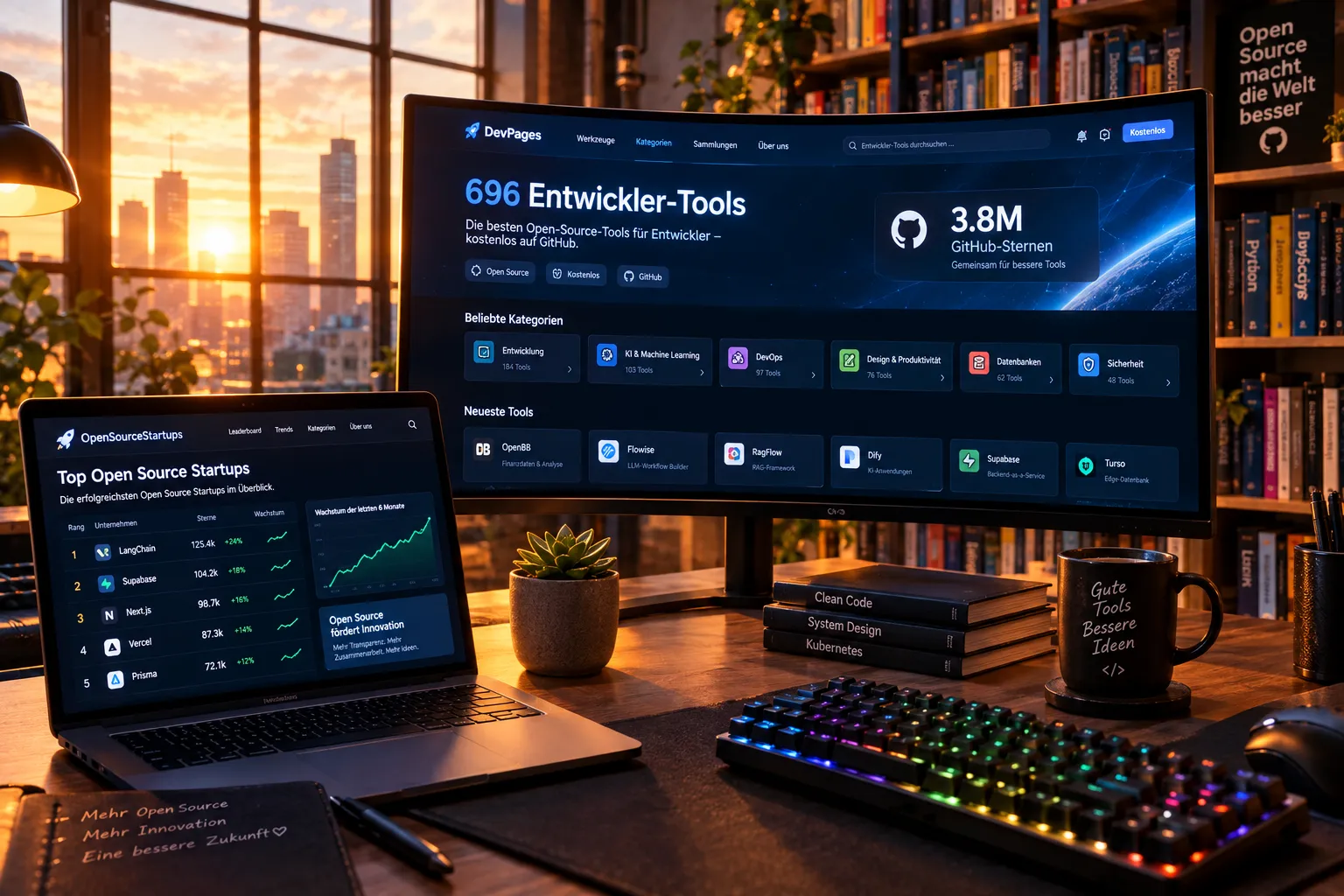
What Open Source Can’t Do: Limits and Practical Tips
Free open source GitHub tools are no miracle cure. Anyone who wants to run Stirling-PDF, Odysseus, or Open Notebook typically needs their own hosting – whether that’s a small VPS, a home server, or a Docker container. That means extra maintenance work: rolling out updates, setting up backups, and occasionally debugging issues yourself instead of contacting a support chat. The user experience differs too. Paid software invests a lot of budget in onboarding, tooltips, and polished design. Community projects sometimes lack that final polish, especially with younger or smaller repos. For developers and technically skilled users, that’s rarely a real obstacle – for less tech-savvy teams, however, the learning curve can be steeper. A realistic switch works best step by step:- Test a tool that solves a concrete, recurring problem (for example, Stirling-PDF for PDF workflows).
- Check the license terms, especially for AGPL projects with copyleft obligations.
- Realistically assess the hosting effort before migrating production-critical processes.
- Watch community activity on GitHub – active issues and commits point to sustainable maintenance.
Conclusion
The list built around Recordly, Stirling-PDF, Open Notebook, Odysseus, Excalidraw, and the other projects makes it clear: many features that people pay for monthly today already exist for free on GitHub. Free open source GitHub tools offer more control over data and infrastructure, but in return require some technical commitment to hosting and maintenance. For developers, tech teams, and open-source enthusiasts, it’s definitely worth taking a look at these repos – even trying a single tool can noticeably cut recurring subscription costs. The sensible next step: pick a repository, try it locally or on a small server, and carefully review the license terms for your own use case.Frequently Asked Questions
nWhat does Stirling-PDF replace and what license does it use?
nStirling-PDF bundles over 50 functions such as merging, splitting, signing, redacting, OCR, and compression, replacing paid PDF subscription software; it runs under the MIT license and keeps all files on your own server.
nWhat is PhotoGIMP and what does it change?
nPhotoGIMP is a patch for GIMP that adjusts keyboard shortcuts, the menu structure, and the toolbar to match the Photoshop layout, lowering the entry barrier for users coming from Adobe products.
nHow does Open Notebook differ from Google NotebookLM?
nOpen Notebook can be fed with PDFs, web pages, or YouTube links, used for chat and summaries, and even generate podcasts; unlike NotebookLM, the underlying AI model is freely selectable across more than a dozen providers, and it is released under the MIT license.
nHow large is the free open source GitHub tools ecosystem?
nGitHub currently lists over 19,000 public repositories under the tools topic alone, and curated directories like DevPages count 696 developer tools across 21 categories with a combined 3.8 million GitHub stars.
n