More than a hundred billion US dollars are locked into decentralized finance protocols by late 2026, and a significant share of that liquidity is actively deployed for yield farming [3]. Anyone who still believes DeFi is a niche playground for speculators is missing the point: tokenized government bonds, institutional liquidity programs, and regulated stablecoin strategies are now firmly part of this ecosystem. For advanced users who already understand wallets, exchanges, and the basics of hot and cold storage, the next question follows naturally: how does DeFi yield farming actually work technically, where are the real yield opportunities, and which risks are frequently underestimated?
This article is written for readers who already manage their own wallets and can execute transactions on exchanges. If you haven’t set up a wallet yet, start with our beginner’s guide to crypto wallets before attempting direct interaction with smart contracts.
Table of Contents
Key Takeaways
DeFi yield farming is built on liquidity pools and automated market makers (AMMs) that replace intermediaries such as banks or brokers.
Impermanent loss arises from price shifts between pooled assets and can fully erode fee income.
“Real yield” — returns backed by actual protocol revenue — has replaced pure token-emission models as the dominant paradigm [7].
Aave, Uniswap, and Lido remain among the largest protocols by TVL in 2026 and form the technical foundation of many advanced strategies [10].
MiCA in the EU and comparable frameworks worldwide are reshaping how protocols and users handle regulatory compliance.
What Is DeFi? Decentralized Finance Protocols Without Intermediaries
Decentralized Finance, or DeFi, refers to an ecosystem of financial applications that run on public blockchains and offer financial services without central intermediaries such as banks, brokers, or clearing houses. Instead of a company organizing lending, trading, or custody, smart contracts — self-executing code on the blockchain — handle these functions programmatically. Users interact directly with protocols through their own wallet, with control over private keys always remaining with the user.
The key difference from traditional financial intermediaries lies in transparency and composability: every contract is publicly auditable, and protocols can be combined like building blocks. A lending protocol, for instance, can serve as collateral for a position in another protocol. This “money lego” property enables complex strategies, but it also widens the attack surface — a flaw in one base protocol can cascade into dependent applications.
Liquidity Pools and AMMs: The Backbone of DeFi Yield Farming
Automated market makers (AMMs) replace the traditional order book with mathematical pricing formulas. Users, known as liquidity providers, deposit two tokens into a pool — say ETH and a stablecoin — and in return receive a share of the trading fees generated by every transaction in the pool. The price of assets within the pool automatically adjusts to the ratio of deposited tokens.
Uniswap advanced this model with the concept of concentrated liquidity: liquidity providers can allocate capital to specific, narrow price ranges, which increases capital efficiency and can boost fee returns — but it also sharpens the risk of impermanent loss if the price moves outside the chosen range [5]. This mechanism is exactly why liquidity pools are the starting point for nearly every form of DeFi yield farming, since the fees earned form the base return of many strategies.
Yield Farming vs. Staking Strategies Compared
Yield farming refers to actively seeking the highest risk-adjusted return across multiple protocols, often by combining liquidity provision, lending, and token rewards. Staking, by contrast, is typically more passive: users deposit tokens to support network security and receive a base yield in return.
Yield ranges across the DeFi ecosystem in 2026 span from conservative products backed by tokenized US Treasury bills, offering low single-digit percentage returns, to aggressive “points farms” that offer short-term, speculative incentive programs with significantly higher risk [2][3]. Advanced users typically distinguish three categories:
Base yield: Liquid staking through protocols like Lido, where deposited ETH remains liquid while still generating staking rewards [10].
Real yield: Returns generated directly from protocol revenue such as trading fees or lending interest, rather than pure token emissions [7].
Leveraged / aggregator strategies: Combining multiple protocols — for example, depositing into a lending protocol, using that collateral for another loan, and reinvesting the proceeds — which leverages returns but also raises liquidation risk.
The shift toward “real yield” is considered the dominant paradigm in the DeFi yield market in 2026, marking the end of pure emission-farming models that, in earlier market cycles, frequently led to unsustainable return promises [7][8].
Understanding Impermanent Loss: A Worked Example
Impermanent loss (IL) describes the loss in value that occurs when the price ratio between two assets deposited in an AMM pool changes, compared to simply holding those assets outside the pool. The term “impermanent” is somewhat misleading, since the loss becomes real and permanent the moment liquidity is withdrawn during a price shift.
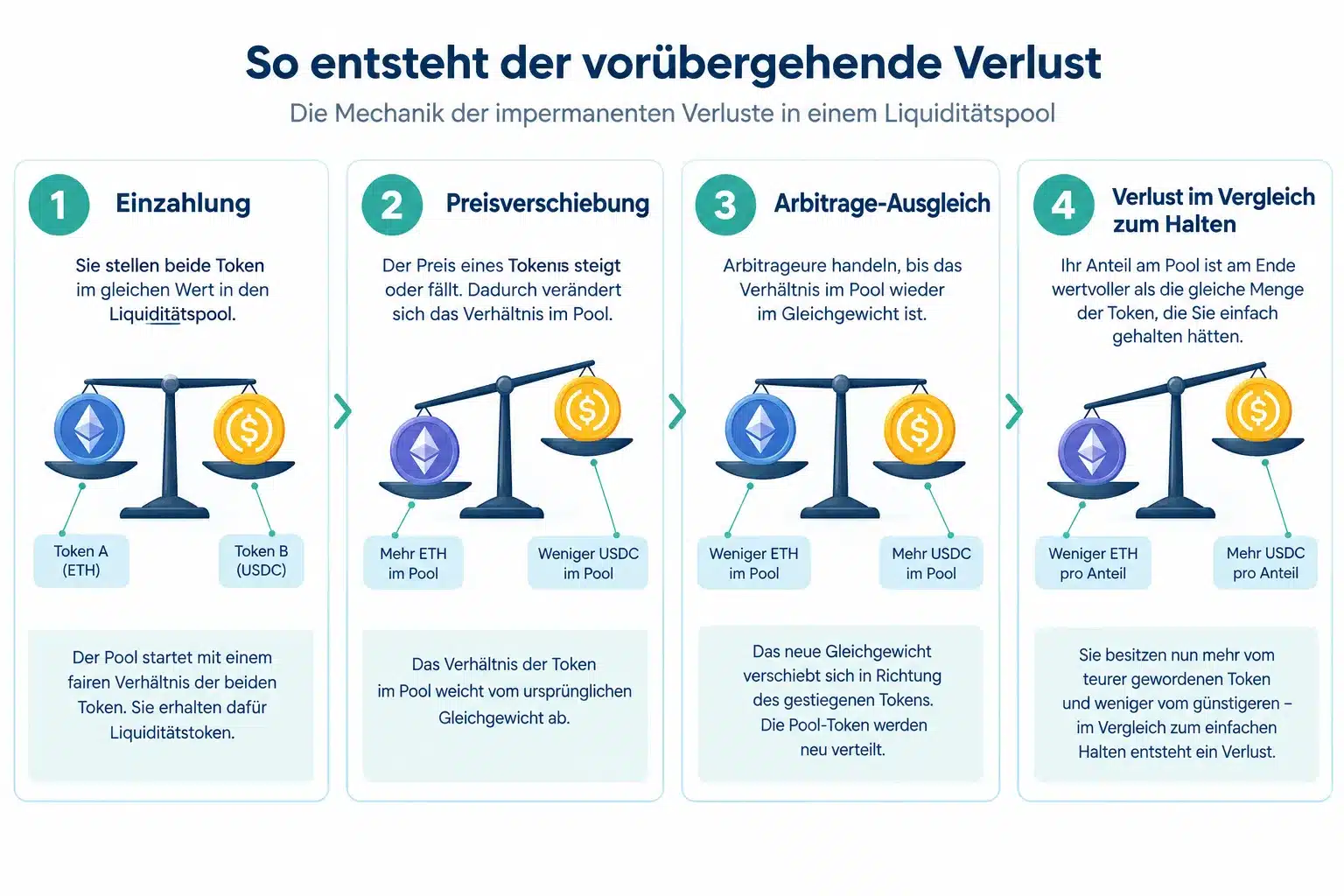
Worked example: A user deposits 1 ETH and 2,000 USDC into a pool, with ETH worth 2,000 USD at the time of deposit. The total stake is therefore 4,000 USD. If the ETH price subsequently rises to 4,000 USD, the AMM rebalances the ratio through arbitrage traders: the pool balance shifts toward less ETH and more USDC. Upon withdrawal, the user now receives roughly 0.71 ETH and 2,828 USDC, together worth about 5,656 USD. Had the user simply held the original 1 ETH and 2,000 USDC, that would have grown to 4,000 USD plus 2,000 USDC, or 6,000 USD total. The difference of about 344 USD represents the impermanent loss — a loss that can only be offset by sufficiently high trading fee income.
This calculation illustrates why concentrated liquidity on platforms like Uniswap is a double-edged sword: narrow price ranges increase fee yield per unit of capital deployed, but they also heighten sensitivity to price movements outside the chosen range [5].
Smart Contract Risks and Why Audits Matter
Every interaction with a DeFi protocol means placing trust in code rather than a legal institution. Smart contract risks include programming errors, logic flaws arising from the composition of multiple protocols, oracle manipulation, and governance attacks, where attackers hijack voting power to change protocol parameters in their favor.
Audits by specialized security firms reduce but do not eliminate residual risk. An audit examines the code at a specific point in time against known attack patterns; subsequent upgrades, new integrations, or previously unknown attack vectors remain potential weak points. Advanced users should therefore check whether a protocol has undergone multiple independent audits, whether an active bug bounty program exists, and whether the code has changed significantly since the last audit. Aave V4, for instance, introduces modular, segmented liquidity pools that improve capital efficiency across different market instances, but also create new dependencies between modules that require independent risk assessment .
Leading Protocols in 2026: Aave, Uniswap, and Lido Compared
By total value locked (TVL), Lido, Aave, and Uniswap remain among the structurally most important building blocks of the DeFi ecosystem through mid-to-late 2026 and often form the foundation of advanced yield strategies [10].
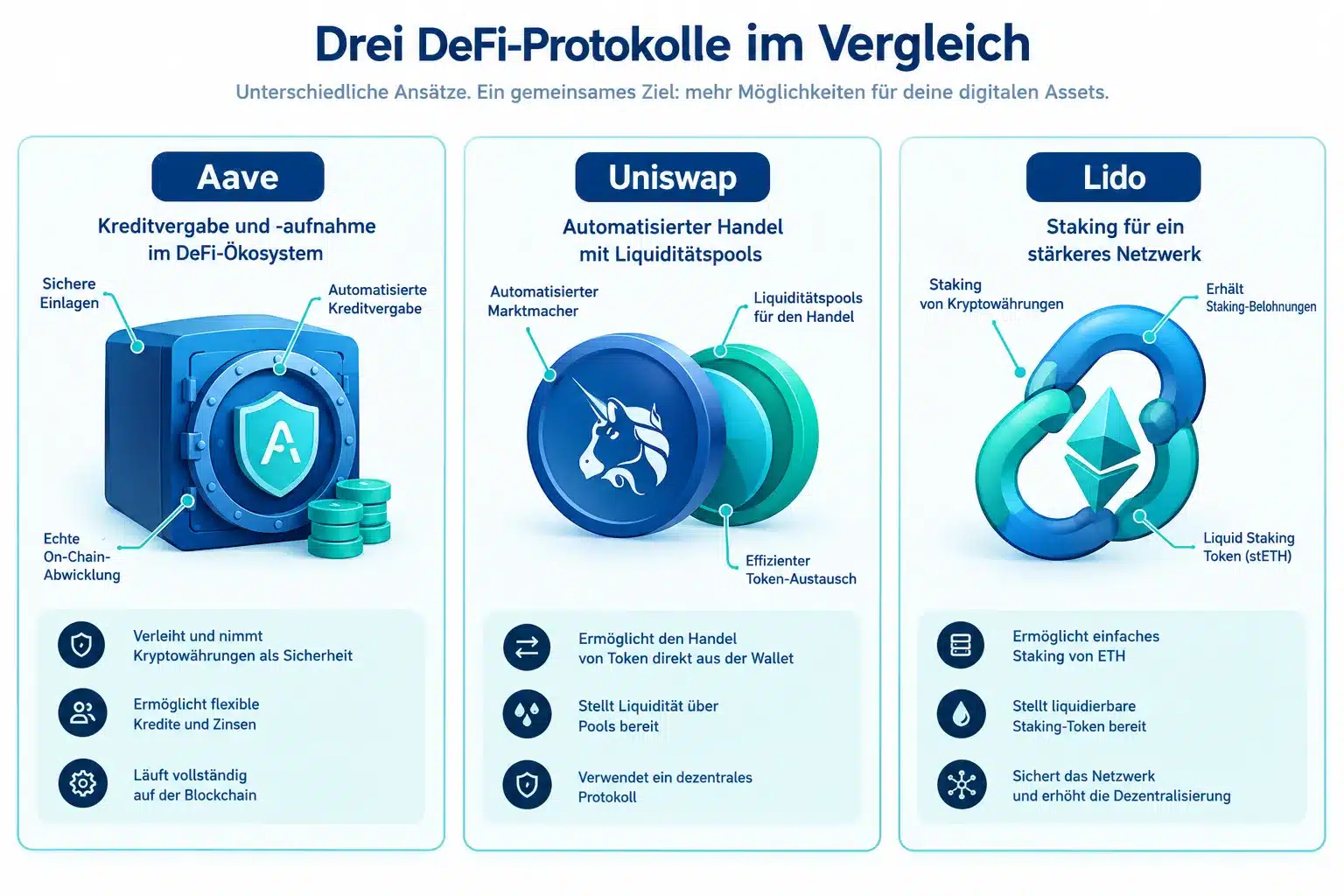
Protocol — Core Function — Relevance for Yield Farming: Aave — Decentralized lending protocol with modular liquidity markets (V4) — Interest income from deposits, base for leveraged strategies . Uniswap — AMM with concentrated liquidity — Fee returns from liquidity provision, high IL risk [5]. Lido — Liquid staking protocol for ETH and other assets — Base yield plus restaking layer, but concentration risk in the staking market [10].
Lido enables liquid staking, where deposited ETH can still be used as collateral in other protocols. Restaking layers build on this by using the same stake to additionally secure other networks — an efficiency gain that also raises concentration risk, since a flaw in the base protocol can affect multiple dependent layers simultaneously [10]. Institutional players increasingly use tokenized real-world assets such as US Treasuries as a bridge between traditional yields of around four percent and on-chain DeFi yield strategies [3][7].
Regulatory Landscape 2026: MiCA and Global Developments
The Markets in Crypto-Assets Regulation (MiCA) in the European Union has, since its full application, created a unified legal framework for crypto service providers within the EU. For DeFi yield farming, this means in particular that central access points that mediate access to protocols or custody customer funds fall under stricter licensing and transparency obligations. Genuinely decentralized protocols without an operating legal entity remain harder to regulate directly, but the regulatory gray zone is shrinking, for example through requirements placed on frontend operators or stablecoin issuers.
Outside the EU, individual jurisdictions pursue different approaches, ranging from pragmatic sandbox regulation to stricter capital markets requirements for tokenized securities. For advanced users, this means in practice: anyone using institutional RWA products or tokenized government bonds should check which issuer and jurisdiction stand behind the respective token, since regulatory interventions can have immediate effects on availability and liquidity.
Security Tips for Advanced DeFi Yield Farming Users
Anyone actively deploying capital in DeFi protocols should go beyond basic wallet security and observe protocol-specific due diligence:
Use a hardware wallet consistently: Signing smart contract interactions should go through a hardware wallet, with every transaction detail verified on the device display before confirmation.
Verify contract addresses: Before every interaction, cross-check the official contract address against multiple independent sources, since fake frontends and phishing domains frequently mimic identical-looking interfaces.
Diversify across protocols and chains: Avoid concentrating capital in a single protocol or chain to limit exposure to individual smart contract or network failures.
Recognize rug pull signals: Anonymous teams without a verified track record, disproportionately high short-term return promises, missing audits, and high concentration of token holdings in few wallets are typical warning signs.
Revoke approvals regularly: Unlimited token approvals for smart contracts that are no longer actively used should be revoked using specialized tools.
Outlook: Where Is DeFi Yield Farming Headed?
The shift toward real yield, the growing integration of tokenized real-world assets, and modular protocol architectures like Aave V4 suggest that DeFi yield farming continues moving toward institutional maturity [7]. At the same time, the trajectory remains speculative: how restaking concentration risks, regulatory tightening, and new attack vectors will concretely play out in the coming years cannot be predicted with certainty. Advanced users should treat these trends as a framework for their own risk assessment, not as a guarantee of future returns.
Conclusion
DeFi yield farming gives advanced users access to yield sources that go far beyond classic staking, from real-yield strategies to concentrated liquidity to institutional RWA bridges. These opportunities, however, are inseparable from technical and regulatory risks: impermanent loss can erode fee income, smart contract failures can permanently lock up or destroy capital, and regulatory frameworks like MiCA continuously change the rules of the game. The sensible next step is to test small positions in well-audited, established protocols like Aave, Uniswap, or Lido, consistently verify contract addresses, and diversify your strategy across multiple protocols and asset classes before committing larger capital allocations. If you want to weigh these yield sources directly against each other, our comparison of Staking vs Yield Farming breaks down the practical trade-offs.
References
[1] Best Defi Yield Farming Platforms – https://coinbureau.com/analysis/best-defi-yield-farming-platforms
[2] Defi Yield Farming Strategies 2026 Guide – https://defi-intel.com/guides/defi-yield-farming-strategies-2026-guide/
[3] Defi Yield Farming 2026 – https://coinxsight.com/blog/education/defi-yield-farming-2026
[5] Best Defi Yield Farming Platforms 2026 – https://yellow.com/research/best-defi-yield-farming-platforms-2026
[7] Real Yield Defi 2026 – https://cleansky.io/blog/real-yield-defi-2026/
[8] Defi Yield Farming Guide 2026 – https://protraderdaily.com/defi/defi-yield-farming-guide-2026
[10] Top 5 Defi Plattformen 2026 – https://cryptoticker.io/de/top-5-defi-plattformen-2026/
Frequently Asked Questions
What is DeFi yield farming?
Actively seeking the highest risk-adjusted return across multiple DeFi protocols, often by combining liquidity provision, lending, and token rewards.
What does "real yield" mean in DeFi?
Returns generated directly from actual protocol revenue, like trading fees or lending interest, rather than pure token emissions, the dominant paradigm in 2026.
How does impermanent loss actually happen?
When the price ratio between pooled assets shifts, the AMM rebalances the pool, so liquidity providers often end up with less total value on withdrawal than if they had simply held the tokens.
Which protocols are considered leading in DeFi yield farming in 2026?
Aave, Uniswap, and Lido rank among the most important building blocks by total value locked and often form the foundation of advanced yield strategies.