As of September 2026, Ethereum staking yields sit around 3 to 4 percent per year, while certain liquidity pools on decentralized exchanges occasionally promise upward of 30 percent [4]. This gap is no coincidence, it’s the result of fundamentally different risk mechanics. If you already have a wallet set up and some exchange experience, you’re now facing the real decision: staking vs. yield farming, which strategy fits your capital, your risk appetite, and your available time?
Both approaches are core strategies for passive income with cryptocurrencies, but they work in fundamentally different ways. Staking secures Proof-of-Stake networks and rewards participants for network loyalty. Yield farming provides liquidity to decentralized exchanges and is compensated through fees and incentive programs. This article compares both models directly, without starting from the basics.
Table of Contents
Key Takeaways
- Staking typically offers 3 to 12 percent p.a. in 2026 at manageable risk, while yield farming swings between 5 and over 50 percent p.a. but carries significantly more risk [1] [2].
- Slashing risk in staking usually stems only from faulty validator software, while impermanent loss and smart contract risk in yield farming are structural and harder to avoid.
- A new SEC no-action statement from April 2026 gives DeFi interfaces in the US more legal clarity, but it doesn’t change the underlying technical risks [5].
- The choice between staking and yield farming should be based on your personal risk profile, not just the nominal yield.
- Hybrid strategies combine both approaches, for example using staked ETH as collateral for additional farming.
What Is Staking? Mechanics, Lock-Up Periods, and Slashing in Detail
Staking locks cryptocurrency into a Proof-of-Stake network to validate transactions and secure block production. Validators, or delegators who delegate their coins to a validator, receive newly issued coins and a share of transaction fees in return. The market has become substantial: billions in value are staked across Ethereum, Cardano, Solana, and Polkadot alone, showing that passive income through network security is no longer a niche phenomenon [3] [9].
Two technical aspects matter most for advanced users:
Lock-up periods. Depending on the network and provider, coins are locked for days, weeks, or an indefinite period. Direct Ethereum staking through your own validator historically requires a longer commitment, while liquid staking solutions like Lido or Rocket Pool issue a tradable derivative token that simulates instant liquidity without removing the underlying lock-up.
Slashing risk. Validators who double-sign, go offline, or violate protocol rules lose part of their staked capital. With delegated staking, the delegator indirectly bears this risk too, which is why choosing a reliable validator with stable infrastructure matters more than chasing the highest yield.
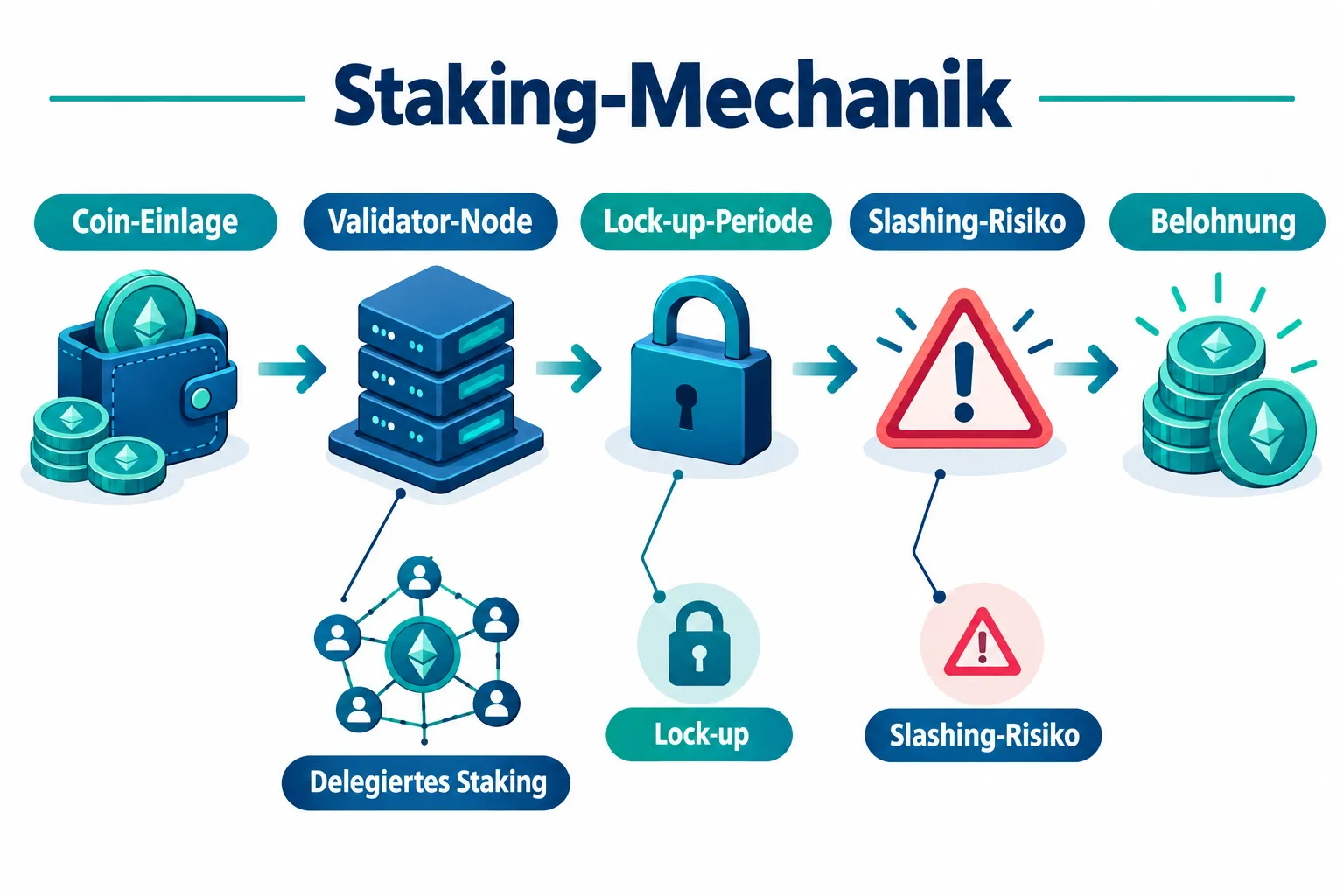
The difference between running your own validator and delegated staking mainly comes down to control and minimum capital: running your own Ethereum validator traditionally requires 32 ETH and technical know-how, while delegated staking via exchanges or staking pools is possible with small amounts, albeit with additional counterparty risk.
What Is Yield Farming? Impermanent Loss and Smart Contract Risk in Focus
Yield farming provides liquidity to pools run by automated market makers (AMMs), such as Uniswap, Curve Finance, or PancakeSwap. Users deposit two tokens into a pool and earn a share of trading fees plus, often, additional incentive tokens. The underlying AMM logic and broader DeFi concepts were already covered in depth in our article “Understanding DeFi and Yield Farming: Opportunities and Risks for Advanced Users”, so here the focus is on the direct comparison with staking.
Two risks deserve particular attention in this comparison:
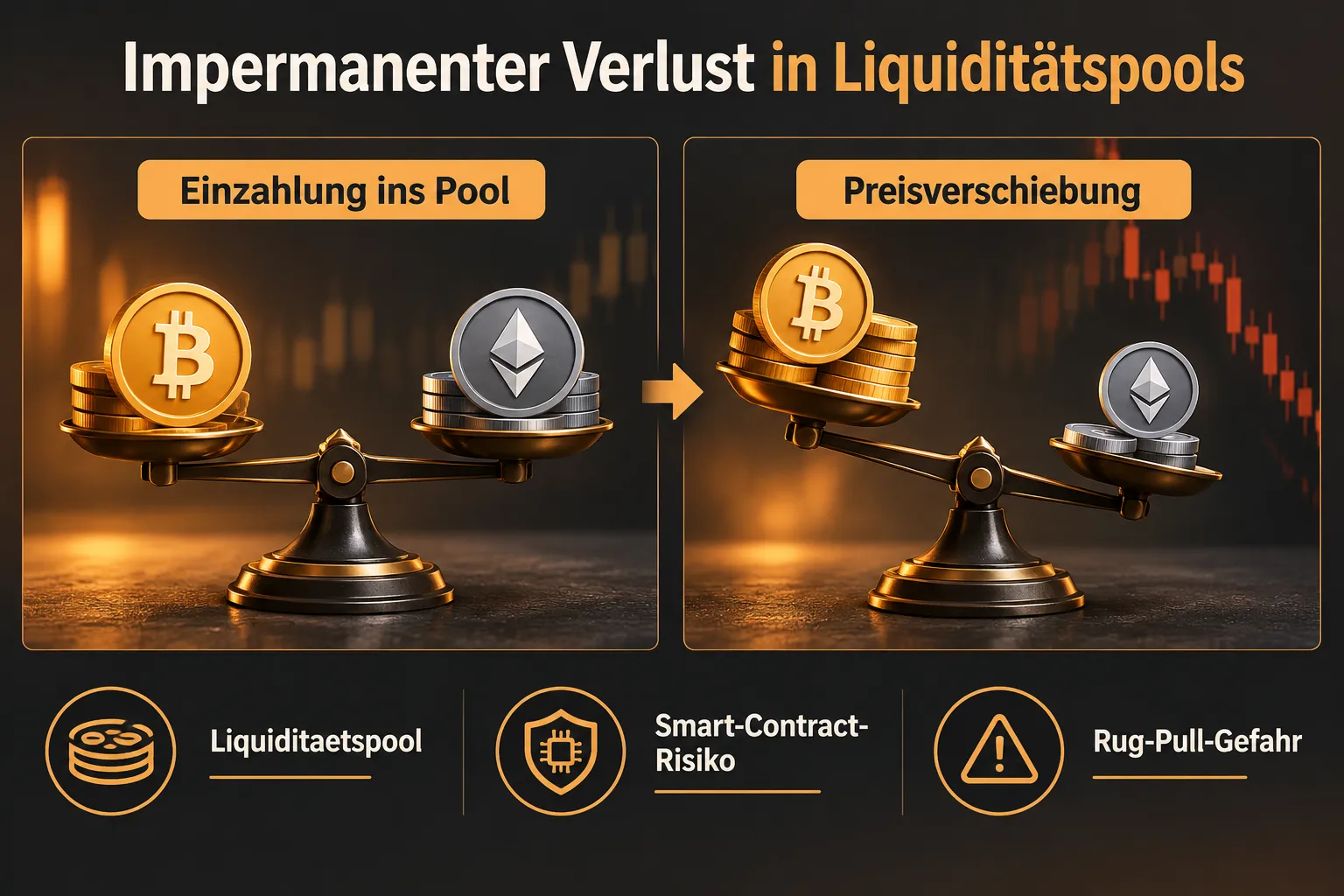
Impermanent loss. When the price of the two pooled tokens shifts relative to each other, the AMM algorithm automatically rebalances the ratio. The result: upon exit, the liquidity provider often ends up with less total value than if they had simply held the tokens. The loss is “impermanent” as long as the pool isn’t exited, but it becomes real quickly during strong price divergence. This mechanism explains why yield farming returns look high on paper but can turn out significantly weaker net of losses.
Smart contract and rug-pull risk. Every pool runs on code, which can contain bugs or be deliberately manipulated. Newer, unaudited protocols carry the additional risk of a rug pull, where developers withdraw liquidity and leave users holding worthless tokens. Established protocols like Aave or Curve Finance reduce this risk through audits and a long track record, but they don’t eliminate it entirely.
Yield Comparison: Staking vs. Yield Farming in September 2026
The yields of both strategies can be clearly categorized as of late summer 2026. Staking on major Proof-of-Stake coins mostly ranges between 3 and 12 percent p.a., depending on network utilization and inflation model [3] [9]. Ethereum currently sits at the lower end around 3 to 4 percent, while Cardano, Solana, and Polkadot offer somewhat higher single-digit to low double-digit yields [4].
Yield farming returns for top coins span a much wider range, roughly 5 to over 50 percent p.a., with especially high figures usually tied to newer, riskier pools or temporary incentive programs and rarely staying stable long-term [10] [2].
A third point of comparison is lending: stablecoin-based CeFi and DeFi offers currently deliver often between 2 and 10 percent p.a. and are considered a lower-risk middle ground, since price fluctuations of the underlying asset don’t apply [8] [7] [6]. Anyone who wants to avoid volatility entirely while still tapping into crypto infrastructure has a third option here alongside pure staking and farming.
A higher nominal yield in yield farming almost always means higher loss risk — the number alone says little about actual net performance.
Risk Profiles Compared: Staking vs. Yield Farming
Staking is generally considered the safer option for several reasons. First, the loss scenario is limited and usually traceable to technical validator misbehavior. Second, the underlying asset remains unchanged, if you stake ETH, you still hold ETH at the end regardless of price movement. Third, the infrastructure at established networks like Ethereum, Cardano, or Solana has been in production for years and is correspondingly well-tested [1] [6].
Yield farming, by contrast, stacks multiple risk layers simultaneously: market risk from both underlying assets, impermanent-loss mechanics, smart contract risk, and in the worst case, rug-pull danger from dubious projects. These compounded risks explain the significantly higher expected returns as compensation.
There has also been some regulatory movement in 2026: the US Securities and Exchange Commission published a no-action statement in April 2026 for certain DeFi interfaces, providing more legal clarity for non-custodial frontends [5]. This reduces regulatory uncertainty as a risk factor but doesn’t replace the technical and market-related risk assessment users need to do themselves.
Staking vs. Yield Farming: The Comparison Table
| Criterion | Staking | Yield Farming |
|---|---|---|
| Typical yield p.a. | 3-12 percent [3] [9] | 5-50%+, highly variable [2] [10] |
| Risk level | Moderate, limited slashing risk | High, multiple compounded risk layers |
| Complexity | Low to medium | Medium to high |
| Lock-up | Often yes, duration varies by network | Usually flexible, but capital tied up in the pool |
| Technical knowledge required | Basic understanding of PoS sufficient | AMM mechanics, impermanent loss, contract audits needed |
| Main risk source | Validator misbehavior, slashing | Impermanent loss, smart contract bugs, rug pulls |
Platform Examples for Staking and Yield Farming
For staking, many advanced investors use liquid staking solutions like Lido or Rocket Pool for Ethereum, native delegation on Cardano, Solana, or Polkadot, or staking offerings from centralized exchanges that simplify management and payouts. The difference between custodial (exchange manages the keys) and non-custodial (own wallet, delegated to a validator) affects both fees and control over capital, custodial solutions are more convenient, non-custodial setups are usually cheaper and more transparent [6].
For yield farming, Uniswap and Curve Finance are well known as an AMM pioneer and a stablecoin specialist respectively, Aave as a lending protocol with farming components, and PancakeSwap as a major AMM in the BNB Chain ecosystem. These mentions are purely informational and do not constitute investment advice. Every platform should be evaluated individually on audit history, team transparency, and total value locked before committing capital.
Which Strategy Fits Whom? Assessing Your Risk Profile
The decision between staking and yield farming should be based less on current yield figures and more on your own risk profile.
Conservative investors typically prefer staking on established networks or stablecoin lending. A set-and-forget character, predictable returns, and lower loss risk take priority here.
More risk-tolerant, active users can use yield farming as a complement, but should budget time for ongoing monitoring of pool performance, fee trends, and protocol updates. Yield farming is rarely truly passive, active rebalancing and risk monitoring are part of the strategy.
As a rough guideline: if you prioritize capital preservation, lean toward staking. If you’re willing to treat part of your capital as a risk position, you can consider yield farming as a smaller portfolio allocation, always aware that a total loss is possible.
Combined and Hybrid Approaches
Between pure staking and pure yield farming, hybrid strategies are increasingly common. Liquid staking tokens like stETH or rETH can be deployed as additional liquidity in DeFi pools after the initial staking step, so the capital simultaneously earns staking yield and farming fees, albeit with compounded risk from both worlds. Stablecoin lending can also be positioned as a lower-risk complement alongside more active yield farming to dampen a portfolio’s overall volatility [7] [8].
Such combined approaches require more oversight of dependencies between protocols, but can improve capital efficiency when structured carefully.
Outlook for 2026 and 2027
Looking ahead to 2027, staking yields at major networks appear set to stabilize further, while yield farming returns could become more moderate but more predictable as competition between protocols increases and regulatory clarity grows, for example through further SEC guidance following the April 2026 no-action statement [5] [6]. This is an assessment based on current trends, not a guaranteed forecast.
Conclusion
Staking vs. yield farming ultimately comes down to a trade-off between predictability and yield potential. Staking offers moderate, relatively stable returns with limited, clearly defined risk and suits investors who prioritize capital preservation. Yield farming can deliver significantly higher returns, but demands active risk management, technical understanding of AMMs, and tolerance for impermanent loss as well as smart contract risks.
As a next step, it’s worth honestly assessing your own risk profile, testing small amounts in both models, and vetting platforms based on audit history and transparency before committing larger sums. This article does not constitute financial advice. Cryptocurrencies are subject to high volatility, and both staking and yield farming can lead to capital losses. If you also want to time entries and exits more precisely, our guide to technical analysis for crypto charts covers the tools worth learning.
References
[1] Staking Vs Yield Farming – https://www.kraken.com/learn/staking-vs-yield-farming [2] Yield Farming Vs Staking Whats The Difference And Which Pays More In 2026 – https://earnpark.com/en/posts/yield-farming-vs-staking-whats-the-difference-and-which-pays-more-in-2026/ [3] Staking Rewards – https://bitcompare.net/staking-rewards [4] Today – https://apystack.com/today [5] Sec Defi No Action Statement Yield Farming Staking 2026 – https://passiveyieldlab.com/blog/sec-defi-no-action-statement-yield-farming-staking-2026/ [6] Staking Vs Yield Farming Vs Lending 2026 – https://passiveyieldlab.com/blog/staking-vs-yield-farming-vs-lending-2026/ [7] Yield Sources – https://safealloc.app/knowledge-base/yield-sources [8] Stablecoins – https://www.cefirates.com/highest-rates/stablecoins/ [9] Staking – https://www.coininterestrate.com/staking/ [10] Best Defi Yields September – https://www.coingabbar.com/en/crypto-blogs-details/best-defi-yields-september
Frequently Asked Questions
How does typical staking yield compare to yield farming?
Staking usually ranges from 3 to 12 percent per year, while yield farming swings between 5 and over 50 percent but carries significantly more risk.
What is slashing in staking?
Validators who double-sign, go offline, or break protocol rules lose part of their staked capital, and delegators bear that risk indirectly too.
What is impermanent loss in yield farming?
When the price of two pooled tokens shifts relative to each other, the AMM rebalances the ratio, often leaving liquidity providers with less value than if they had simply held the tokens.
Who should lean toward staking rather than yield farming?
Conservative investors who prioritize capital preservation and prefer predictable, moderate returns with lower loss risk.