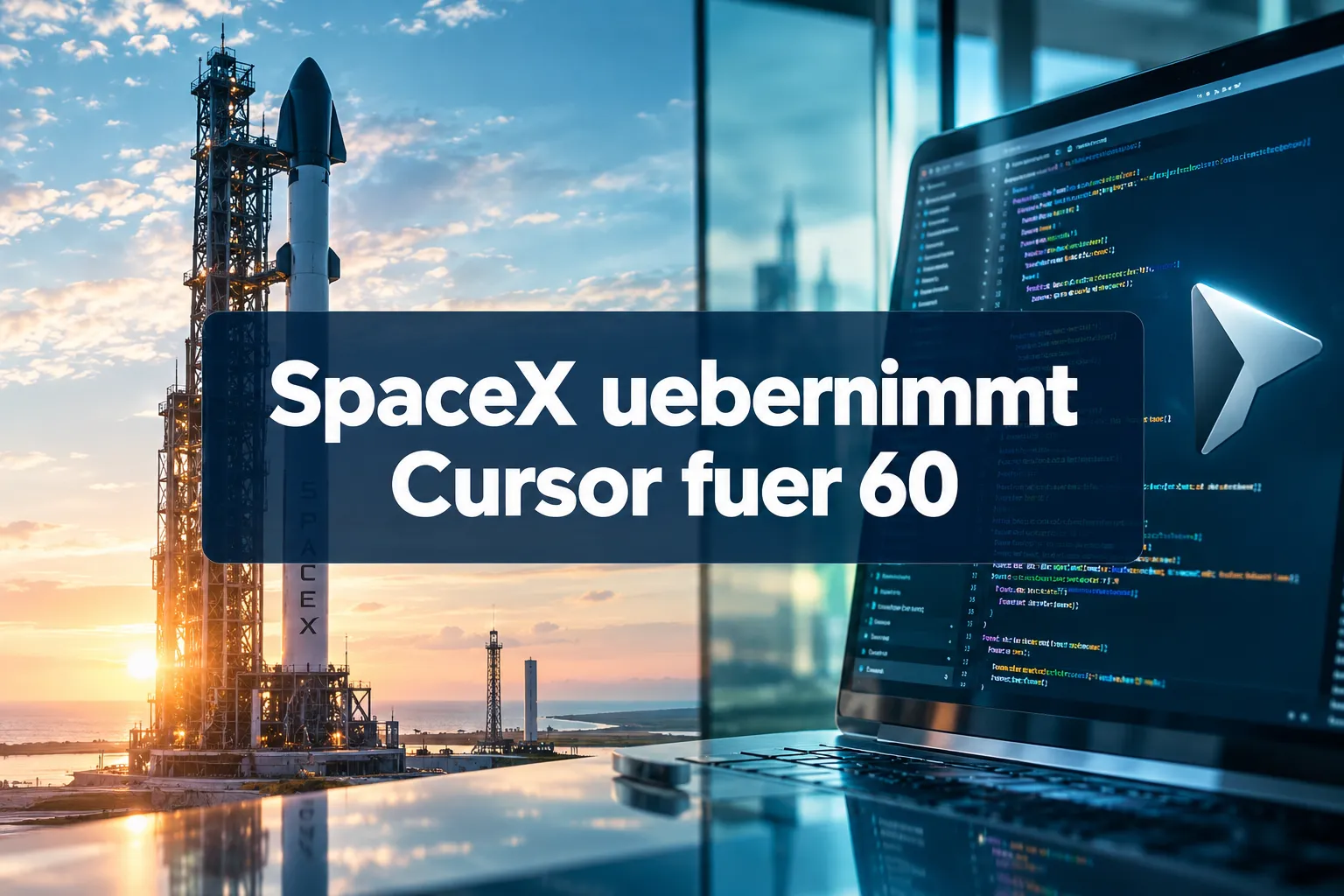
391 million shares. That is how many SpaceX shares changed hands to turn a rocket builder into the new owner of one of the world’s most important AI coding tools. The SpaceX Cursor acquisition is the largest known acquisition of a venture-backed startup to date [2][11]. On August 14, 2026, the deal officially closed, publicly confirmed a day later [1][2]. For developers who work with Cursor or GitHub Copilot every day, this is not an abstract financial event. It changes who owns the tools used to write code.
This article puts the SpaceX Cursor acquisition into perspective: what exactly happened, how the market has positioned itself since the Gartner report, how pricing models differ, and what this concretely means for developer teams.
Table of Contents
Key Takeaways
- SpaceX acquired Cursor (Anysphere) on August 14, 2026 for $60 billion in stock. Cursor now belongs to SpaceX, while GitHub/Copilot remains with Microsoft.
- In May 2026, Gartner named both GitHub Copilot and Cursor “Leaders”: Copilot leads in “Ability to Execute,” Cursor leads in “Completeness of Vision.”
- GitHub Copilot now runs entirely on a credit-based pricing model, while Cursor 2.0 focuses on parallel agents and broad IDE integration.
- According to a JetBrains survey, Copilot holds 29 percent market share, with Cursor and Claude Code each at 18 percent.
- For developers, the SpaceX Cursor acquisition mainly means closer ties to SpaceX’s own AI models and possibly a stronger enterprise focus.
The Deal: How SpaceX Acquired Cursor
The groundwork for the SpaceX Cursor acquisition was laid back in April 2026. At that time, SpaceX signed a partnership and option agreement with Cursor: SpaceX received the right to purchase Anysphere later that year for $60 billion, or alternatively pay a $10 billion breakup fee [6]. According to reports, the goal was to combine Cursor’s coding data with SpaceX’s and xAI’s compute power to train more capable AI models [6][13].
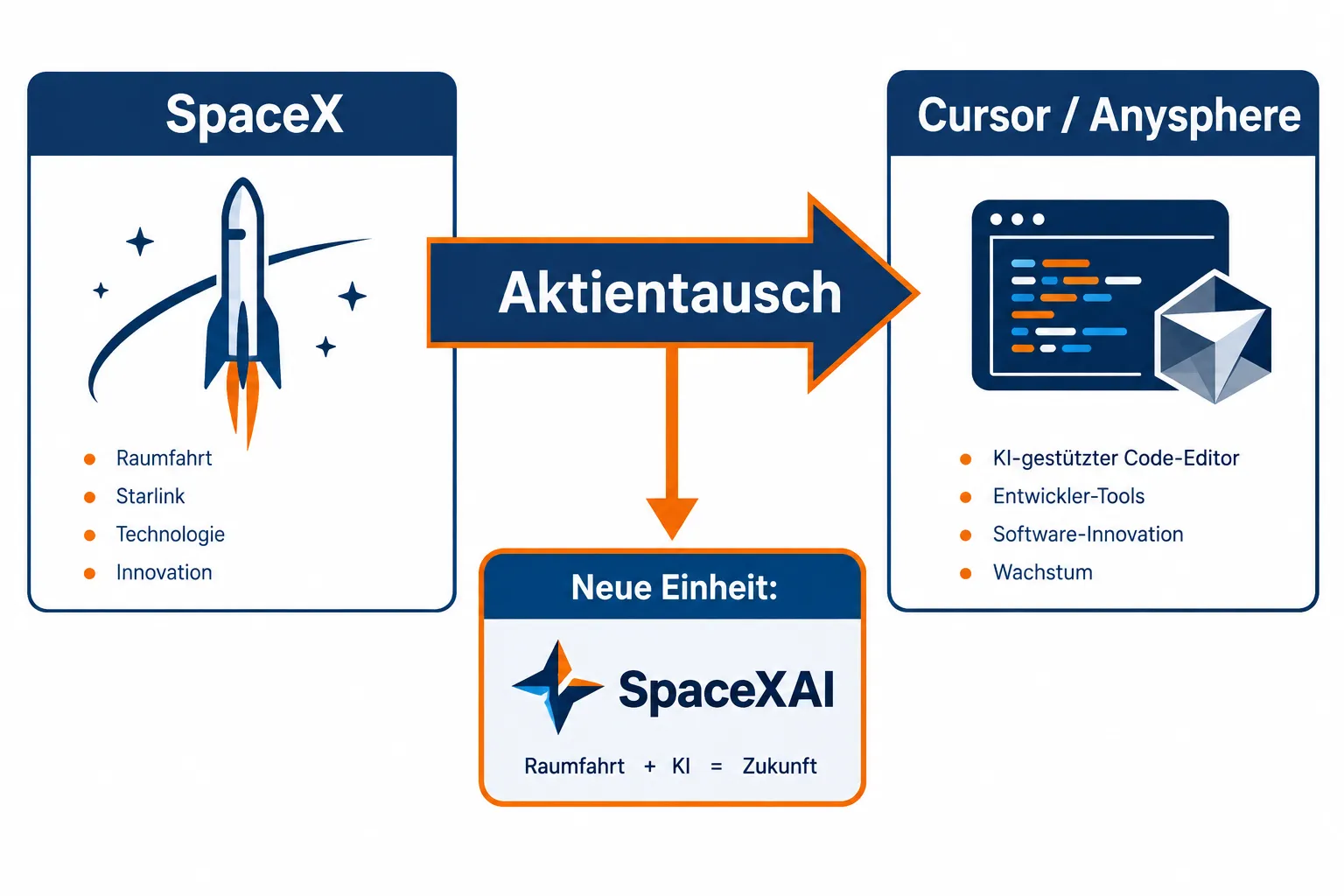
Just days after SpaceX’s highly watched IPO in June 2026, the acquisition intent was officially confirmed: SpaceX paid $60 billion in Class A common stock, representing roughly 3.4 percent dilution relative to the IPO valuation level [4][8]. Reuters and other business media were clear in their assessment: SpaceX wants to close the gap with leading AI companies like Anthropic and OpenAI and compete more directly in enterprise AI tools [2][7].
On August 14, 2026, the transaction became effective, with the closing publicly announced on August 15 [1][2]. Structurally, this was a pure stock swap: approximately 389.3 million shares went to Cursor shareholders, plus assumed restricted stock units and options [11]. Anysphere thus became a wholly owned subsidiary and part of the newly named unit “SpaceXAI” [11][13].
Cursor itself confirmed the move on its own blog, stating it was “now officially part of SpaceX” and describing this as the logical continuation of the collaboration that began in April [3]. Important for developers: Cursor remains as a product, and GitHub Copilot remains with Microsoft. This is not a merger of the two tools, but two separate ecosystems under new ownership.
Analysts note that Anysphere was valued at an estimated annual recurring revenue (ARR) rate of around $4 billion, of which about $2.6 billion comes from the B2B business. That works out to a valuation multiple of roughly 15x ARR [11][13].
Market Context: Gartner, Copilot, and the SpaceX Cursor Acquisition in the AI Coding Market
To properly assess the SpaceX Cursor acquisition, it’s worth looking at both major vendors’ market position shortly before the deal. In May 2026, Gartner’s Magic Quadrant for Enterprise AI Coding Agents named both GitHub Copilot and Cursor as “Leaders.” The ratings differed in detail: GitHub led in “Ability to Execute,” meaning operational execution strength, while Cursor led in “Completeness of Vision,” meaning strategic product vision.
This ranking matches the market distribution shown by the JetBrains AI Pulse Survey as of January 2026:
| Tool | Market Share Among Professional Developers |
|---|---|
| GitHub Copilot | 29 percent |
| Cursor | 18 percent |
| Claude Code | 18 percent |
Notably, Claude Code’s share has grown 1.5x since September 2025. The AI coding agent market is anything but static — it’s shifting quickly.
User numbers also reveal a communication gap. Microsoft reported around 50 million Copilot users for the fourth quarter of fiscal year 2026, and GitHub additionally cites 140,000 organizations as customers, nearly triple the year before. Cursor itself does not publish a specific user count, but states that over 70 percent of Fortune 500 companies use the tool.
“SpaceX is buying Anysphere to close the gap with leading AI companies.” That’s how several business media outlets summarized the strategic logic behind the acquisition [2][7].
For industry observers, the SpaceX Cursor acquisition is also a signal: Elon Musk is building SpaceXAI as a counterweight to Anthropic and OpenAI, one heavily rooted in developer tools [7][14]. At the same time, the Cursor acquisition helps SpaceX diversify beyond rockets and satellites into high-margin software and AI services [11][13].
Pricing Models Compared: GitHub Copilot Credits vs. Cursor 2.0
While ownership structures shift, the products continue to run technically separately. One key difference lies in the billing model.
GitHub Copilot has moved all tiers to usage-based billing via “AI credits.” One credit equals $0.01.
| Plan | Price per Month | Included Credits | Code Completions |
|---|---|---|---|
| Free | $0 | none | 2,000, limited |
| Pro | $10 | 1,500 credits | unlimited |
| Pro+ | $39 | 7,000 credits | unlimited |
| Max | $100 | 20,000 credits | unlimited |
Important: on all paid plans, pure code completions remain unlimited — only agentic requests and more complex tasks consume credits.
Cursor takes a different approach with Cursor 2.0 and its “Composer” feature. It allows up to eight agents to work in parallel on a single prompt, which can significantly speed up complex refactoring or feature work. Since March 4, 2026, the Cursor agent has also been running inside JetBrains IDEs like IntelliJ IDEA and PyCharm via the so-called Agent Client Protocol. This integration is included free on paid Cursor plans.
Another difference concerns the model pool. Alongside its own Composer 2.5, Cursor now also offers Grok 4.6 and Grok 4.5 from SpaceXAI. This is a direct result of the new ownership structure following the SpaceX Cursor acquisition and shows how quickly technical integration between SpaceX infrastructure and the Cursor product is progressing.
For teams choosing between the tools, this creates a clear decision point: Copilot offers predictable, clearly tiered credit packages with unlimited base completions. Cursor leans more heavily on parallelized agents and broad IDE coverage, including the JetBrains world.
What the SpaceX Cursor Acquisition Means for Developers
For software developers and tech decision-makers, the SpaceX Cursor acquisition has several concrete implications that are already observable today or clearly emerging from expert commentary [5][13][15].
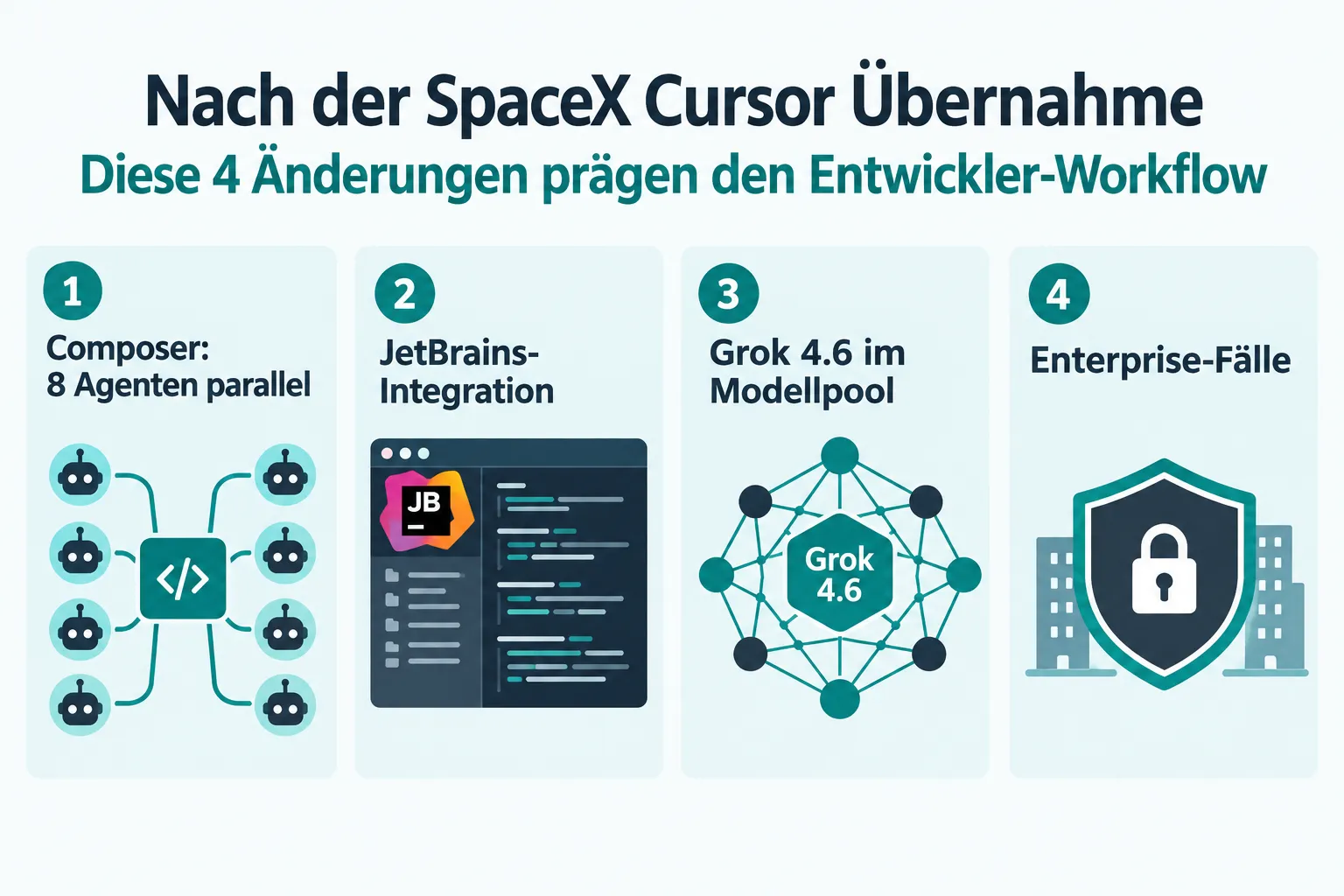
Closer ties to SpaceX models. The addition of Grok 4.6 and Grok 4.5 to Cursor’s model pool is the clearest evidence that integration between the Cursor editor and xAI/SpaceX models is already underway. Developer teams using Cursor gain early access to SpaceX’s own AI models directly within their familiar workflow.
First-party productivity data. A study published by Cursor itself found that companies that adopted Cursor’s agent as their default workflow merged 39 percent more pull requests. This figure comes from Cursor’s own blog and should be understood in context: it’s a company-sponsored survey, not an independent study.
Possible enterprise shift. Analysts expect Cursor’s roadmap to lean more toward compliance, large-scale collaboration, and complex codebase reasoning, driven by SpaceX’s enterprise customer base [5][13].
At the same time, industry analysts also point to dependency risks. Companies that rely heavily on Cursor tie themselves more closely to a Musk-affiliated ecosystem spanning SpaceX, xAI, and Grok. There’s a possibility that SpaceX could prioritize internal and enterprise customers when it comes to resources and roadmap decisions [13][14]. Also under discussion is a strategic shift for Cursor away from a purely general-purpose dev tool toward multimodal coding agents that could also serve robotics- and aerospace-adjacent use cases [13][14][15]. These are analytical assessments, not confirmed facts.
This development fits into a broader series of security- and strategy-related questions that have accompanied the AI coding agent market even before the acquisition, including in connection with the previously documented “Plugin4Shell” vulnerability in AI coding agents. Anyone making tool decisions should consistently factor in such security and dependency questions, as also suggested by the earlier AI Coding Agents Compared article.
Outlook After the SpaceX Cursor Acquisition
In the short term, Cursor remains a standalone product, with ongoing technical integration into the SpaceXAI infrastructure. Financial trade press sees the combination of Cursor’s strong B2B ARR and SpaceX’s compute capacity as a foundation for a growing range of enterprise AI offerings, possibly including Starlink-adjacent developer tools or cloud-like “AI infrastructure” products [11][13][14]. Such expansions should be understood as a plausible strategic direction, not as already-announced products.
For GitHub Copilot, the SpaceX Cursor acquisition changes nothing about its ownership structure — the product stays with Microsoft. Competitive pressure is still likely to increase, however, since Cursor can now draw on the compute resources and model development of one of the world’s most well-capitalized technology companies.
Conclusion
The SpaceX Cursor acquisition marks a turning point in the AI coding agent market. With $60 billion, SpaceX didn’t just buy a startup — it secured direct access to one of the industry’s two leading coding tools, while Microsoft continues to lead the competition with GitHub Copilot. Both providers were rated “Leaders” by Gartner, but they differ significantly in pricing model, model pool, and strategic direction.
For developer teams, this means concretely: now is the right time to review your own tool strategy. Those using Cursor should test the new Grok models in their own workflow and check the JetBrains integration if their team’s IDE landscape would benefit. Those staying with GitHub Copilot should closely monitor their own credit consumption under the new billing model to choose the right plan. In both cases, dependencies on individual vendors and their AI ecosystems should be explicitly factored into strategic tool decisions.
References
[1] Spacex Officially Closes Its Cursor Acquisition – https://techcrunch.com/2026/08/15/spacex-officially-closes-its-cursor-acquisition/
[2] Spacex Completes Its 60 Billion Cursor Acquisition – https://www.bloomberg.com/news/articles/2026-08-14/spacex-completes-its-60-billion-cursor-acquisition
[3] Joining Spacex – https://cursor.com/blog/joining-spacex
[4] Spacex To Acquire Cursor For 60b In Stock Days After Blockbuster Ipo – https://techcrunch.com/2026/06/16/spacex-to-acquire-cursor-for-60b-in-stock-days-after-blockbuster-ipo/
[5] Spacex Closes 60bn Acquisition Ai 085713131 – https://finance.yahoo.com/technology/ai/articles/spacex-closes-60bn-acquisition-ai-085713131.html
[6] Spacex Cursor Deal – https://www.nytimes.com/2026/04/21/business/spacex-cursor-deal.html
[7] Spacex Buy Anysphere 60 Billion 2026 06 16 – https://www.reuters.com/legal/transactional/spacex-buy-anysphere-60-billion-2026-06-16/
[8] Spacex Spcx Cursor Acquisition Ipo – https://www.cnbc.com/2026/06/16/spacex-spcx-cursor-acquisition-ipo.html
[9] Spacex Confirms Cursor Acquisition 60 Billion Ai Coding Startup 2026 6 – https://www.businessinsider.com/spacex-confirms-cursor-acquisition-60-billion-ai-coding-startup-2026-6
[10] Spacex Cursor Aquisition Ipo – https://www.nytimes.com/2026/06/16/business/spacex-cursor-aquisition-ipo.html
Frequently Asked Questions
When did SpaceX officially close its acquisition of Cursor?
The transaction became effective on August 14, 2026, with the closing publicly announced a day later, on August 15, 2026.
How much did SpaceX pay for Cursor and how was the deal structured?
SpaceX paid $60 billion in Class A common stock, representing roughly 3.4 percent dilution relative to its IPO valuation. Structurally it was a pure stock swap: approximately 389.3 million shares went to Cursor shareholders, plus assumed restricted stock units and options.
Does the SpaceX acquisition affect GitHub Copilot?
No. GitHub Copilot remains with Microsoft. This is not a merger of the two tools but two separate ecosystems under different ownership; Cursor became a wholly owned subsidiary of SpaceX as part of the newly named unit "SpaceXAI."
What market share do GitHub Copilot and Cursor hold?
According to the JetBrains AI Pulse Survey as of January 2026, GitHub Copilot holds 29 percent market share among professional developers, while Cursor and Claude Code each hold 18 percent.