A single trading day, a share price jump of roughly ten percent, and suddenly a US chipmaker finds itself in a league previously reserved for only three other companies worldwide. On September 21, 2026, AMD’s stock crossed a market capitalization of 1 trillion US dollars for the first time, while the Nasdaq Composite climbed to a new record high of 27,122.09 points. The AMD trillion dollar market cap is not just a sober statistic, it is the symbol of an AI-driven stock market boom reshaping the entire tech landscape.
The day marked one of the strongest gains in recent stock market history: the S&P 500 rose 1.49 percent to 7,764.70 points, the Dow Jones gained 0.71 percent to 52,048.83 points. The driving force was a broad AI stock rally, led by Meta’s new AI assistant Muse and strong chip stocks. For tech investors and developers, the question now is what this milestone actually means, beyond the headline.
Table of Contents
Key Takeaways
- AMD crossed a market capitalization of roughly 1 trillion dollars for the first time on September 21, 2026, becoming the fourth US chip company in this exclusive club, after Nvidia, Broadcom, and Micron [4][7][9].
- The Nasdaq Composite closed at 27,122.09 points (+2.26 percent), a new record high, driven by AI euphoria around Meta’s Muse assistant [4][6][8].
- AMD’s stock price gained more than 180 percent in 2026, with roughly 200 billion dollars in market value added in the single week before the milestone alone [7][10][14].
- US Treasury yields fell to as low as 4.943 percent, oil prices dropped 4.5 percent, a signal of capital rotating toward growth stocks.
- Hyperscalers like Google and Meta are simultaneously investing heavily in nuclear energy to secure the long-term power needs of their AI data centers.
AMD’s Trillion Dollar Market Cap: The Road to a Historic Milestone
AMD’s trillion dollar market cap had long been anticipated, but the pace surprised even seasoned market observers. During the trading day on September 21, the stock climbed to about 613 to 616 US dollars, a gain of roughly 9 to 10 percent over the previous day [1][3][7][9][12]. Several market data providers put AMD’s market value that day at approximately 1.004 to 1.005 trillion US dollars, meaning the threshold was not just briefly touched but stably surpassed [2][4][6].
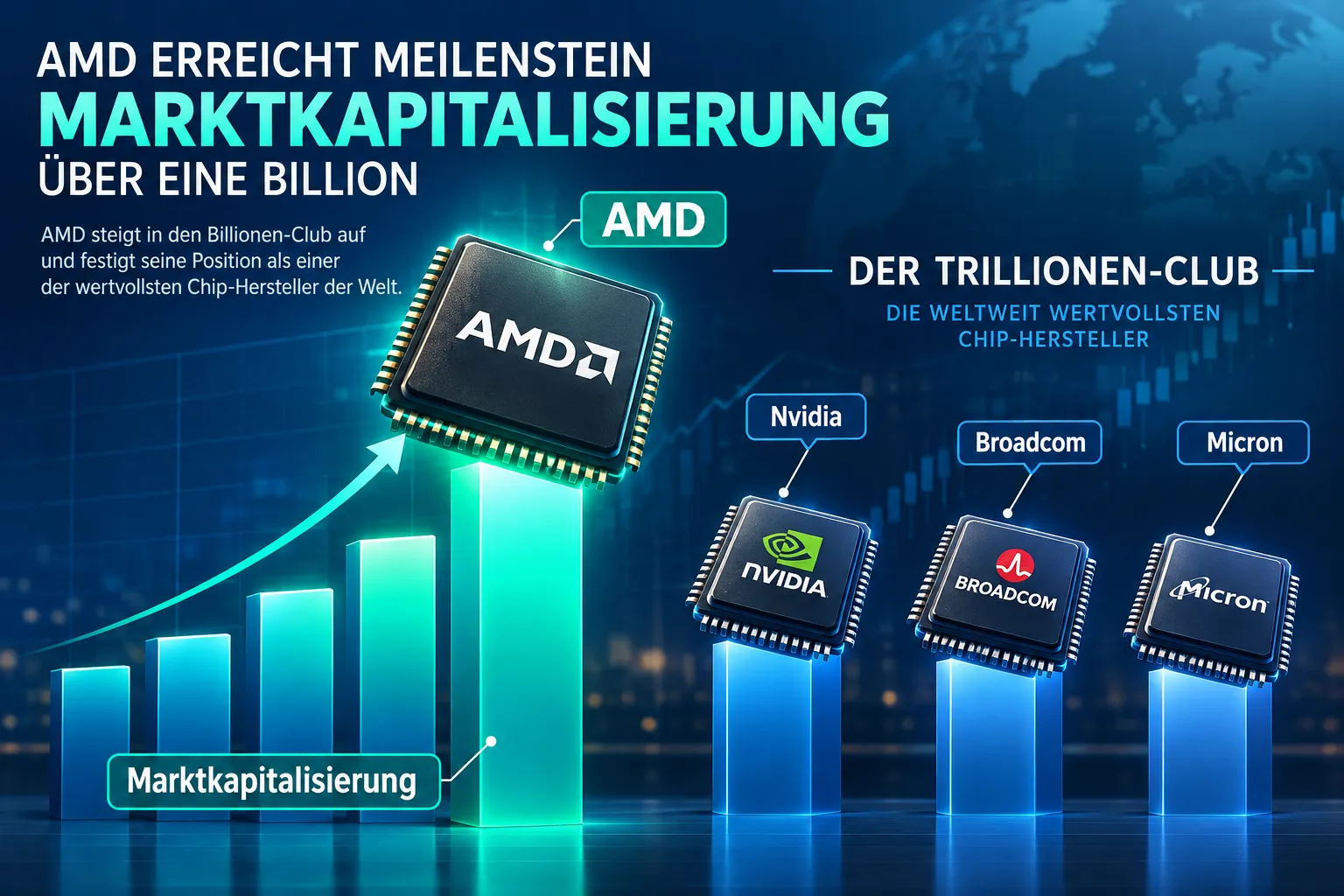
This puts AMD in a very small group. Before AMD, Nvidia, Broadcom, and Micron had already crossed the trillion-dollar threshold [4][7][9][13][14]. AMD is now the fourth US semiconductor company in this club, a clear signal of how strongly the market’s valuation logic has shifted toward AI infrastructure.
The numbers behind the surge are remarkable:
| Metric | Value |
|---|---|
| Share price gain on 9/21/2026 | roughly 9-10 percent |
| Market capitalization (on the day) | approx. 1.004-1.005 trillion USD |
| Share price gain since the start of 2026 | over 180 percent |
| Value gained in the week before the milestone | roughly 200 billion USD |
| Market capitalization just before the breakthrough | approx. 992 billion USD |
Part of the final price jump is attributed to a roughly 10 percent price increase for AI accelerators, consumer GPUs, and chipsets, which significantly improves achievable margins in the AI segment [5]. Add to this the operating substance: in the second quarter of 2026, AMD posted a revenue jump of about 50 percent year-over-year to roughly 11.5 billion US dollars, with data center segment revenue more than doubling [14]. Management expects a further acceleration of data center revenue in the second half of 2026.
Analysts also attribute the price jump to intense institutional buying, with large funds and asset managers apparently positioning themselves specifically in companies considered “AI heavyweights” [3][12]. Partnerships with leading AI companies such as OpenAI and Anthropic additionally secure AMD a strategic position in the market for specialized AI computing hardware and infrastructure [14]. In an environment where new AI models like Jev AI also show how quickly demand for compute power keeps evolving.
AI Rally Dynamics: How Meta’s Muse Moved the Market
The trigger for the broad rally on the Nasdaq can be clearly named: Meta had unveiled its new AI assistant Muse the previous day, after which Meta’s stock jumped more than 11 percent. This optimism spilled over into the entire chip and AI industry and contributed significantly to the Nasdaq Composite’s record high [4][6][8].
The logic behind the rally is straightforward: newer, more capable AI models need more compute power. Whoever supplies that compute power, chipmakers like AMD, Nvidia, and Broadcom, benefits directly from every advance in AI applications themselves. Investors are thus betting not just on a single product, but on a self-reinforcing cycle of AI innovation and hardware demand.
“The surge in AMD and other AI heavyweights has become the key driver behind the Nasdaq’s latest record index close.”
This dynamic also explains why the effect wasn’t limited to individual stocks. Chip stocks broadly advanced, and the breadth of the rally, meaning the number of participating individual names, points to a structural revaluation of the entire AI value chain, not an isolated speculative wave around a single name.
Market Reactions: Bonds, Oil, and the Rally in Asia
The shift of capital toward growth stocks also showed up in other market segments. The yield on 10-year US Treasuries fell to as low as 4.943 percent, an indication that investors were pulling capital out of safer assets to participate in the stock rally, or that rate-cut expectations were supporting sentiment [8].
The oil market also reacted sharply: the WTI October contract fell 4.5 percent to 95.78 US dollars per barrel. A falling oil price alongside rising stock markets is a pattern that often points to changing growth expectations or shifts in global capital flows. Similar capital rotations toward riskier asset classes were also seen recently in the crypto market, for example during the Bitcoin rally above 85,000 dollars.
The rally wasn’t limited to the US. In South Korea, the KOSPI rose 2.2 percent, and the tech-heavy KOSDAQ also gained. Samsung Electronics and SK Hynix, both key suppliers for memory chips and AI hardware, saw significant share price gains [6]. This shows that AMD’s trillion dollar market cap is part of a global trend in which the entire semiconductor supply chain benefits from AI demand, from chip designers in the US to memory manufacturers in Asia.
Nuclear Energy as the Foundation of the AI Boom
An often-overlooked but decisive factor behind the current rally is the energy question. AI data centers require enormous, and above all reliable, amounts of electricity, far more than classic data centers ever needed. That is precisely why the big hyperscalers are now investing massively in nuclear energy.
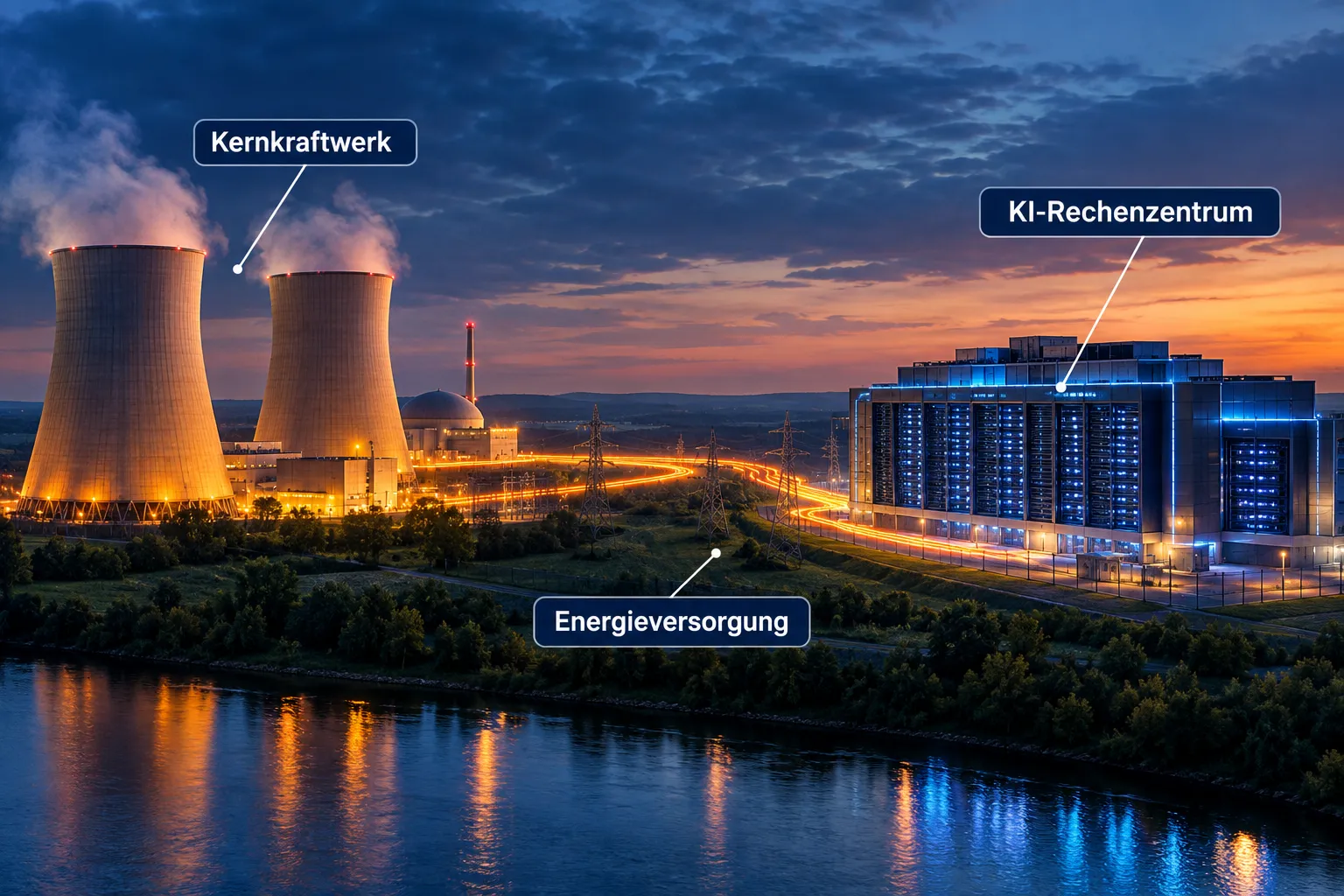
Two examples illustrate the scale of this strategy:
- Google has invested roughly 13 billion euros in Finland and signed a 22-year contract securing the company up to 50 percent of the output of the Loviisa nuclear power plant.
- Meta has committed to up to 6.6 gigawatts of nuclear energy by 2035, including through a partnership with the startup Oklo in Ohio.
These investments show that the current AI boom is not just a software or chip story. It is increasingly also an infrastructure and energy story. Anyone trying to gauge long-term demand for AI compute power needs to factor in the availability of stable, baseload-capable energy. Nuclear energy is considered especially attractive here because, unlike wind or solar, it provides a steady, weather-independent power supply, exactly what heavily utilized AI clusters require.
What AMD’s Trillion Dollar Market Cap Means for Developers and Investors
For developers and investors, this milestone carries several concrete implications that go beyond the headline.
For developers:
- The investment dynamics behind AMD signal that compute power for AI workloads will remain scarce and in demand. This could affect prices for cloud GPU instances and AI accelerators.
- AMD’s partnerships with OpenAI and Anthropic suggest that the hardware landscape for AI development is becoming more diverse, developers are no longer dependent on a single provider.
- The announced roughly 10 percent price increases for AI accelerators and chipsets [5] could affect project budgets for compute-intensive applications and should be factored into planning early.
For investors:
- AMD’s trillion dollar market cap is the expression of an extreme rally: a share price gain of over 180 percent since the start of 2026 also means increased downside risk should the AI sector’s growth pace slow [5][7][10][14].
- The operating substance, strong revenue growth in the data center segment, growing margins through pricing power, distinguishes the current rally from purely speculative bubble phases of earlier tech cycles.
- The parallel move in bond yields and oil prices shows that the rally is part of a broader capital rotation, not just an isolated AMD phenomenon.
- Anyone investing in AI infrastructure should also keep an eye on the energy question: companies with secured, long-term energy contracts, as Google and Meta have concluded with their nuclear projects, could have structural advantages over competitors facing uncertain power supply.
A nuanced view remains important: analysts explicitly point out that a continuation of the rally depends on the AI investment boom persisting and on pricing power for high-performance chips, and that the stock is more vulnerable to corrections after such an extreme rally [5][7][10][14].
Conclusion and Next Steps
AMD’s trillion dollar market cap is more than a symbolic figure. It marks a turning point at which chipmakers are rising to become among the most valuable companies in the world because they supply the physical foundation of the AI revolution. The Nasdaq Composite’s record close, the parallel rally in Asia, and the massive hyperscaler investments in nuclear energy show that this trend is broadly supported and not limited to a single stock.
For developers, this means: the availability and cost of AI compute power remain a central planning factor for new projects. For investors: AMD’s fundamental growth numbers are real, but the valuation is now demanding, a careful weighing of growth opportunities against correction risk is warranted. Anyone wanting to follow the topic further should watch AMD’s upcoming quarterly results, price trends for AI accelerators, and hyperscalers’ progress on energy projects, they will show whether the current rally rests on a stable foundation.
References
[1] Amd Stock 1 Trillion Value – https://www.cnbc.com/2026/09/21/amd-stock-1-trillion-value.html [2] Marketcap – https://companiesmarketcap.com/amd/marketcap/ [3] Amd Becomes Latest Chipmaker Reach 1 Trillion Valuation Ai Demand 2026 09 21 – https://www.reuters.com/business/amd-becomes-latest-chipmaker-reach-1-trillion-valuation-ai-demand-2026-09-21/ [4] Nasdaq Hits Record High As Ai Stocks Surge Amd Tops 1 – https://en.sedaily.com/international/2026/09/22/nasdaq-hits-record-high-as-ai-stocks-surge-amd-tops-1 [5] Amd Is About To Become A Trillion Dollar Stock As It Hikes Chip Prices 10 – https://247wallst.com/investing/2026/09/21/amd-is-about-to-become-a-trillion-dollar-stock-as-it-hikes-chip-prices-10/ [6] Global Markets Global Markets 2026 09 21 – https://www.reuters.com/world/china/global-markets-global-markets-2026-09-21/ [7] Amd Joins 1 Trillion Club As Shares Surge Over 180 In 2026 What S Driving The Chipmaker S Massive Rally 11790003392477 – https://www.livemint.com/market/stock-market-news/amd-joins-1-trillion-club-as-shares-surge-over-180-in-2026-what-s-driving-the-chipmaker-s-massive-rally-11790003392477.html [8] Nasdaq Notches Record High Close Ai Optimism Reignites And Treasury – https://www.kitco.com/news/off-the-wire/2026-09-21/nasdaq-notches-record-high-close-ai-optimism-reignites-and-treasury [9] economictimes – https://economictimes.com/markets/us-stocks/wall-street-guide/amd-briefly-tops-1-trillion-market-cap-as-ai-push-fuels-record-rally-shares-up-9/articleshow/134393413.cms [10] Amd Joins Trillion Dollar Chipmaker Club As Ai Demand Surges – https://www.euronews.com/2026/09/22/amd-joins-trillion-dollar-chipmaker-club-as-ai-demand-surges
Frequently Asked Questions
When did AMD's market capitalization cross $1 trillion?
AMD's market capitalization crossed roughly $1 trillion for the first time on September 21, 2026.
Which US chip companies had already reached a trillion-dollar market cap before AMD?
Nvidia, Broadcom, and Micron had already crossed the trillion-dollar threshold before AMD, making AMD the fourth US semiconductor company in this exclusive club.
How much did AMD's share price gain on September 21, 2026?
AMD stock climbed to about $613-616, a gain of roughly 9 to 10 percent over the previous day.
What drove the broader stock market rally alongside AMD's milestone?
The rally was driven by a broad AI stock rally led by Meta's new AI assistant Muse and strong chip stocks, with the Nasdaq Composite closing at a record high of 27,122.09 points.