A New York startup once known for a 2024 benchmark scandal unveiled a 501-billion-parameter model on October 5, 2026, backed by a $6.3 billion compute deal and a $25 billion valuation. Meet Reflection AI Beam, the company’s first major open-weight language model. It aims to counterbalance dominant Chinese models like DeepSeek, GLM, and Kimi, and shows just how much money and political weight now sits behind the US open-source AI scene.
Reflection AI Beam explicitly targets developers, enterprises, and government agencies looking for a powerful yet openly accessible model for coding, reasoning, and agentic tasks. This article breaks down the key facts, figures, and criticisms surrounding Reflection AI Beam. For an overview of other current language models, see our AI model leaderboard.
Table of Contents
Key Takeaways
- Reflection AI Beam is a sparse Mixture-of-Experts model with 501 billion total parameters, of which only 23 billion are active per token.
- The model was unveiled on October 5, 2026; the model weights are slated to follow later the same month, according to the announcement.
- Reflection AI says Beam achieves results similar to Z.ai’s GLM-5.2, while claiming 3 to 4 times greater efficiency than comparable Western open models.
- Behind the company stand billion-dollar deals with SpaceX ($6.3 billion for Nvidia GB300 access) and Nebius ($1 billion), plus partnerships with the US Department of Energy and the US Department of War.
- Critics point to weaker scores versus DeepSeek V4.1 Flash on some benchmarks, as well as the company’s earlier “Reflection 70B” scandal from 2024.
What Is Reflection AI Beam? Company Background
Reflection AI was founded in March 2024 in New York. The two people behind the company are no strangers to the field: Misha Laskin is CEO, and Ioannis Antonoglou is President and CTO. Both previously did research at Google DeepMind, one of the world’s leading AI labs — lending the startup instant credibility among experts.
On October 5, 2026, the company presented its first major model: Beam. It isn’t being sold as an experimental research project but as a “workhorse” model — built for everyday use at enterprises, in the public sector, and by developers. The focus is on three areas: coding, reasoning, and agentic workloads, i.e., AI systems that independently carry out multi-step tasks.
Particularly notable: Reflection AI Beam is being released as an open-weight model. That means the trained model weights are made publicly available, so developers and companies can run, adapt, and integrate the model into their own systems rather than relying solely on API access.
Technical Specs: How Reflection AI Beam Is Built
At its core, Beam is a sparse Mixture-of-Experts (MoE) model. This architectural principle splits a large model into many smaller “expert” modules. For any given request, only a portion of these experts is activated — not the entire network.
The concrete figures, according to Reflection AI:
- Total parameters: 501 billion
- Active parameters per token: 23 billion
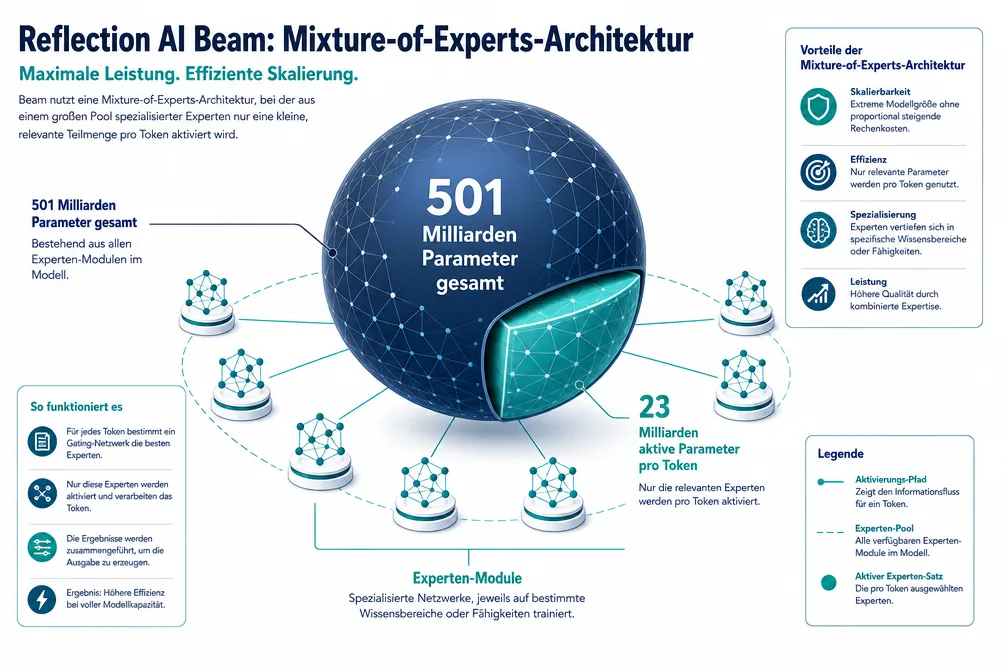
This gap between total and active parameters is the key to the company’s efficiency claim. Because only a fraction of the model has to do work on any given request, compute load drops — and with it, potentially, cost and response time. Reflection AI claims this makes Beam 3 to 4 times more efficient than comparable Western open models, measured in token cost and inference time. This figure comes directly from the company and has not yet been independently verified in full.
On performance, Reflection AI positions its model on par with GLM-5.2 from Z.ai, a Chinese model released in July 2026 that has since been succeeded by GLM-5.3. According to the company’s own benchmarks, Beam achieves similar results there.
Reflection AI Beam Compared: GLM-5.2, Nemotron 3 Ultra & More
To put Reflection AI Beam’s scale in perspective, it’s worth looking at the competition among large open-weight models. The table below shows the known parameter counts of the key comparison models:
| Model | Provider | Origin | Parameters |
|---|---|---|---|
| Reflection AI Beam | Reflection AI | USA | 501B total / 23B active |
| GLM-5.2 | Z.ai | China | ~753B |
| Nemotron 3 Ultra | Nvidia | USA | 550B |
| DeepSeek V4.1 Flash | DeepSeek | China | 552B (backbone) + 196B (Engram) |
| Kimi K3 | Moonshot | China | 2.8 trillion |
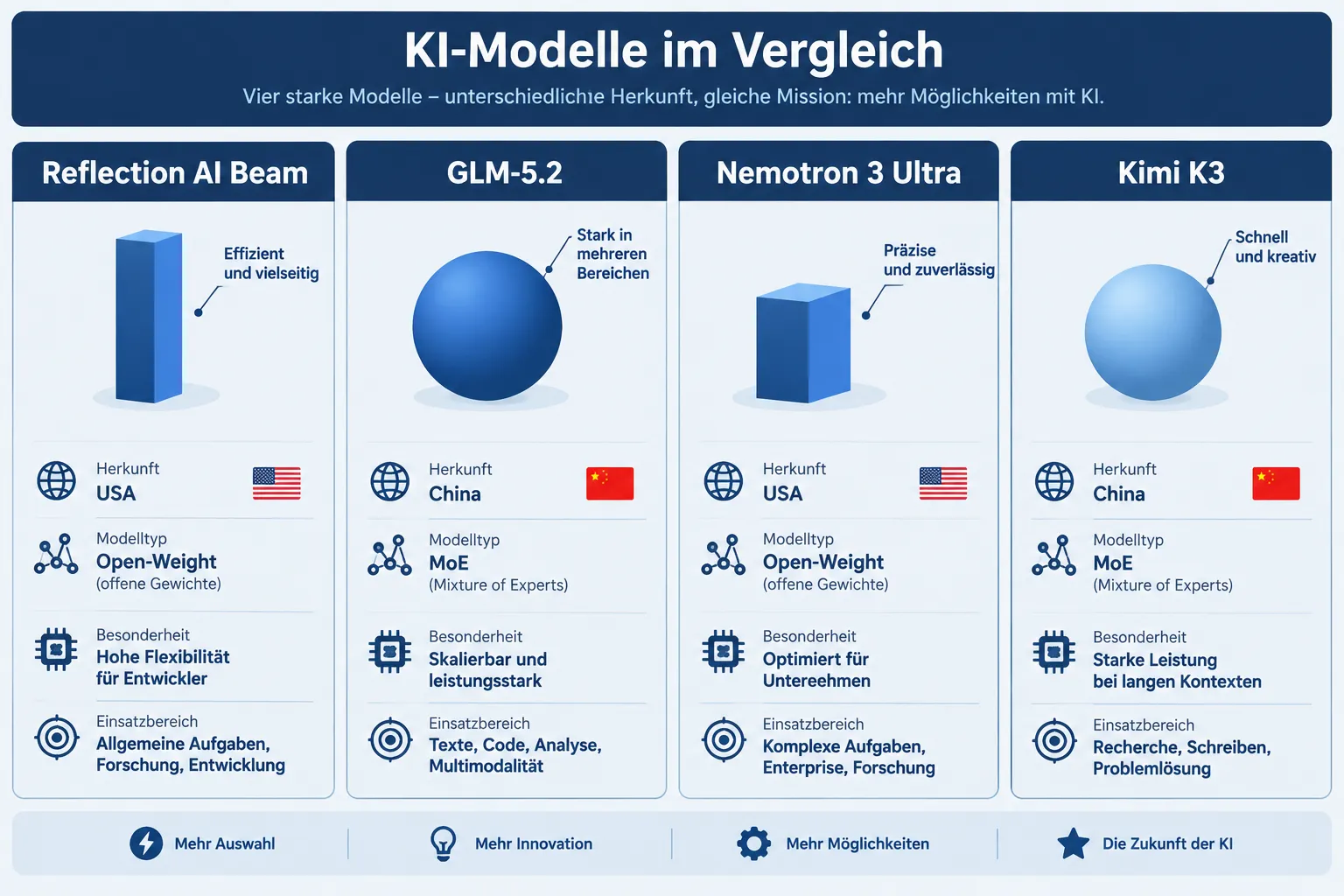
Notably, four of the five models listed here come from China. Reflection AI Beam is the only US model in this table. While Beam, at 501 billion total parameters, is smaller than GLM-5.2, Kimi K3, and even DeepSeek V4.1 Flash in total, it’s larger than Nvidia’s Nemotron 3 Ultra. Raw parameter count, however, says little about actual capability — benchmark results and real-world use cases are what matter.
“Beam is meant to serve as a workhorse model for coding, reasoning, and agentic tasks at enterprises and government agencies.”
Funding and Infrastructure Behind Reflection AI Beam
Training and running a model of this scale requires enormous amounts of compute. Reflection AI has secured substantial resources for this over the past several months.
Key points of the company’s funding:
- Valuation: According to CNBC, the company’s valuation stood at $25 billion as of April 2026.
- SpaceX deal: In June 2026, Reflection AI signed a $6.3 billion compute deal with SpaceX, securing access to Nvidia GB300 chips at the Colossus 2 data center.
- Nebius deal: In July 2026, another $1 billion compute deal followed with cloud provider Nebius (according to Bloomberg).
- Government partnerships: In May 2026, Reflection AI agreed to partnerships with the US Department of Energy and the US Department of War (formerly the Department of Defense) to supply AI models.
This combination of private billion-dollar capital, access to cutting-edge Nvidia hardware, and direct ties to US government agencies shows that Reflection AI is being treated not just as a research project but as a strategically important player in the American AI ecosystem. The partnerships with the Energy and War Departments also suggest Reflection AI Beam could see use in security-relevant and governmental contexts.
Criticism and Open Questions About Reflection AI Beam
Not all reactions to the Reflection AI Beam announcement were positive. Communities like Hacker News and commenters on benchmark platform vals.ai raised several critical points.
Benchmark weaknesses: Some commenters noted that despite its large parameter count, Beam lags behind DeepSeek V4.1 Flash on many benchmarks. That raises the question of whether sheer model size or the claimed efficiency actually translates into a clear performance advantage.
Historical baggage: Others recalled the earlier “Reflection 70B” scandal from 2024, when the company made disputed benchmark claims that were later called into question. This history means new announcements from Reflection AI are viewed with particular caution.
These criticisms don’t automatically mean the current claims about Beam are false. But they do show that independent verification of performance data — for example after the model weights are released in October 2026 — will be essential to assessing Reflection AI Beam’s actual position in the market.
Putting It in Context: Reflection AI Beam in the Geopolitical AI Race
Coverage of Reflection AI Beam largely frames it as a strategic attempt to build a Western counterweight to the currently dominant Chinese providers in the global race for open AI models. DeepSeek, Z.ai with its GLM line, and Moonshot with Kimi have substantially shaped the field of large open-weight models in recent years.
The fact that a relatively small US startup like Reflection AI — rather than an established tech giant — is stepping up with its own 501-billion-parameter model underscores how dynamic this market has become. The ties to government bodies like the Departments of Energy and War also show that open-weight AI models are no longer just a tech-industry topic, but have become security-policy relevant as well.
Whether Reflection AI Beam lives up to this ambition can only be fully assessed once the model weights are actually released and independent tests can be run.
Conclusion
Reflection AI Beam marks a notable attempt to position a large, openly accessible US AI model against the currently leading Chinese providers. With 501 billion total parameters, a Mixture-of-Experts architecture, and billions in infrastructure behind it, the company has the resources to be taken seriously. At the same time, legitimate questions remain: the company’s own benchmark comparisons against GLM-5.2 come from Reflection AI itself, some independent observers see Beam trailing DeepSeek V4.1 Flash in certain areas, and the “Reflection 70B” history is a reason for caution around bold announcements.
For developers and companies considering Reflection AI Beam, a patient but attentive approach makes sense: the release of the model weights in October 2026 will be the decisive moment to verify the company’s claims through independent testing and benchmarks. Only then will it be possible to reliably judge whether Beam truly lives up to its promise as an efficient, high-performing workhorse model.