A single trading day, $648 million in liquidated bets, and a chart signal that hadn’t appeared in 45 weeks: that’s how September 21, 2026 can be summed up on crypto markets. The Bitcoin Rally Past 85,000 Dollars is more than a round number — it marks one of the sharpest price surges of the past two years [3]. Within 24 hours, the Bitcoin price gained roughly 6.7 to 7.3 percent, and nearly 9.4 percent on a weekly basis. Some exchanges reportedly saw intraday prices as high as $87,000, according to market observers [2][4].
Important note for investors: all price figures cited below reflect the situation as of September 21, 2026. Cryptocurrencies are highly volatile, and these figures can change within hours.
Table of Contents
Key Takeaways
- Bitcoin crossed the $85,000 mark on September 21, 2026, with intraday highs of up to roughly $87,000 according to some sources [2][4].
- The trigger was a short squeeze: bearish bets worth about $648 million were forcibly closed, and open interest rose 7.59 percent to $156 billion.
- Bitcoin reclaimed its 50-week moving average for the first time in 45 weeks — historically a signal that has preceded larger bull runs.
- Institutional players such as Strategy, Strive, and Bitmine continued expanding their holdings, while Fundstrat’s Tom Lee points to a structural underweight of crypto among institutions.
- The failed “Clarity Act” in the U.S. Senate is creating regulatory uncertainty; the crypto lobby group “Fairshake” is responding with an announced $30 million campaign against Senator Sherrod Brown.
Bitcoin Rally Past 85,000 Dollars: The Facts Behind the Surge
The jump past $85,000 didn’t come out of nowhere. Back in August 2026, the crypto market reportedly experienced its largest short squeeze since at least 2021, according to analysts [1][9]. September then saw several further waves of squeezes: first in the $80,000 to $82,000 range, followed shortly after by another breakout above $82,000 [6][7]. The move on September 21, in which Bitcoin took the $85,000 threshold, is considered the strongest impulse of this series so far and pushed the price close to an eight-month high [2].
Notably, according to market observations, the rally was driven predominantly by short liquidations rather than crypto-specific news. Instead, macroeconomic shocks and political events acted as catalysts [1]. This structure sets the current move apart from earlier rallies, which were often triggered by product announcements or regulatory breakthroughs.
Futures and spot markets moved largely in lockstep, which analysts read as a sign of broader market participation [4]. Technical analysts see a possible continuation toward $85,000-$90,000 in the current chart pattern, should momentum hold [4][7]. Market-implied probabilities for further upside in September 2026 stood at an elevated level, according to trading-platform data [7].
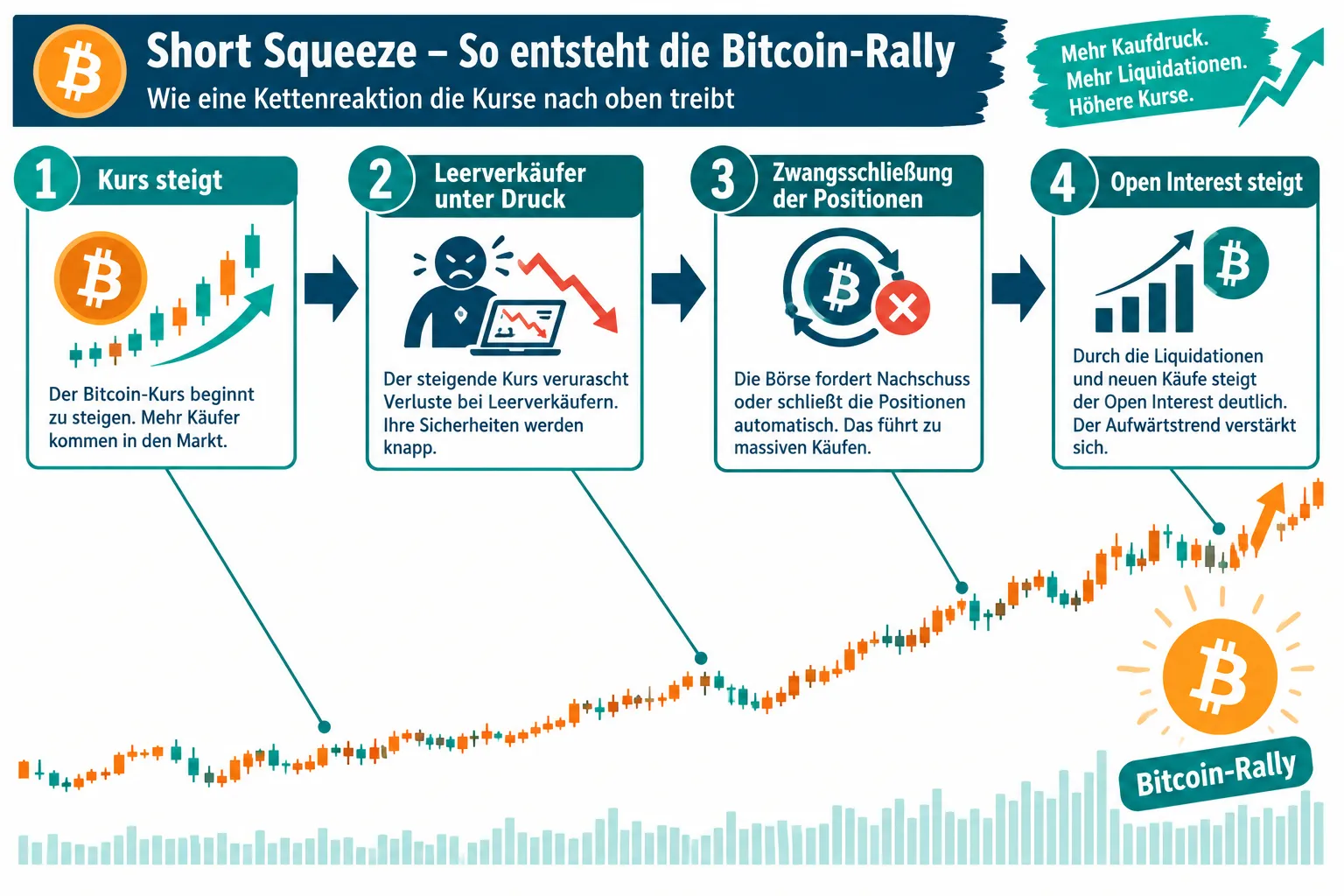
The table below summarizes the key figures behind the move:
| Metric | Value (as of Sep 21, 2026) |
|---|---|
| Bitcoin price | above $85,000, intraday high per some sources up to approx. $87,000 |
| 24-hour gain | roughly 6.7 to 7.3 percent |
| Weekly gain | roughly 9.4 percent |
| Liquidated short positions | roughly $648 million |
| Open interest | up 7.59 percent to $156 billion |
| 50-week moving average | reclaimed for the first time in 45 weeks |
What Is Driving the Short Squeeze?
A short squeeze occurs when many market participants have bet on falling prices (so-called short positions) and the price rises against their expectations. To limit further losses, these traders are forced to close out their positions, usually by buying Bitcoin. This pushes the price up further and amplifies the move.
In the current case, bearish bets worth about $648 million were closed out. At the same time, open interest — the total of all outstanding futures contracts — rose 7.59 percent to $156 billion. Rising open interest alongside a rising price often indicates that fresh capital is flowing into the market, rather than merely existing positions being reshuffled.
Particularly notable: Bitcoin reclaimed its 50-week moving average on September 21, 2026, for the first time in 45 weeks. This moving average is considered an important trend indicator among technical analysts. Historically, reclaiming this line has often preceded larger, multi-week bull runs. Whether this pattern repeats in 2026 can, by nature, only be assessed with certainty in hindsight.
“Market behavior shows a clear shift toward a more aggressive, risk-seeking structure” is how several market observers summarized the current trend in September 2026 [1].
The combination of forced selling among short sellers and a technically significant trend signal explains why the move gained momentum even without a major crypto-specific news catalyst.
Institutional Buyers Fuel the Bitcoin Rally Past 85,000 Dollars
Alongside the technical market move, several large institutional players reported further purchases. These buys coincide with the Bitcoin Rally Past 85,000 Dollars and are being read by market participants as confirmation of the move’s strength.
Strategy (Michael Saylor): The company reportedly bought an additional 950 Bitcoin worth around $75 million. This brings its total holdings to roughly 846,000 BTC, still the largest known Bitcoin treasury of a publicly traded company.
Strive: The company added 1,355 Bitcoin, moving toward a self-set year-end target that would position Strive as the second-largest Bitcoin treasury holder.
Bitmine (Tom Lee): Rather than adding more Bitcoin, Bitmine bought additional Ether worth $75 million, equivalent to 27,562 ETH. The company is thereby approaching its self-stated goal of holding around 5 percent of the total Ethereum circulating supply.
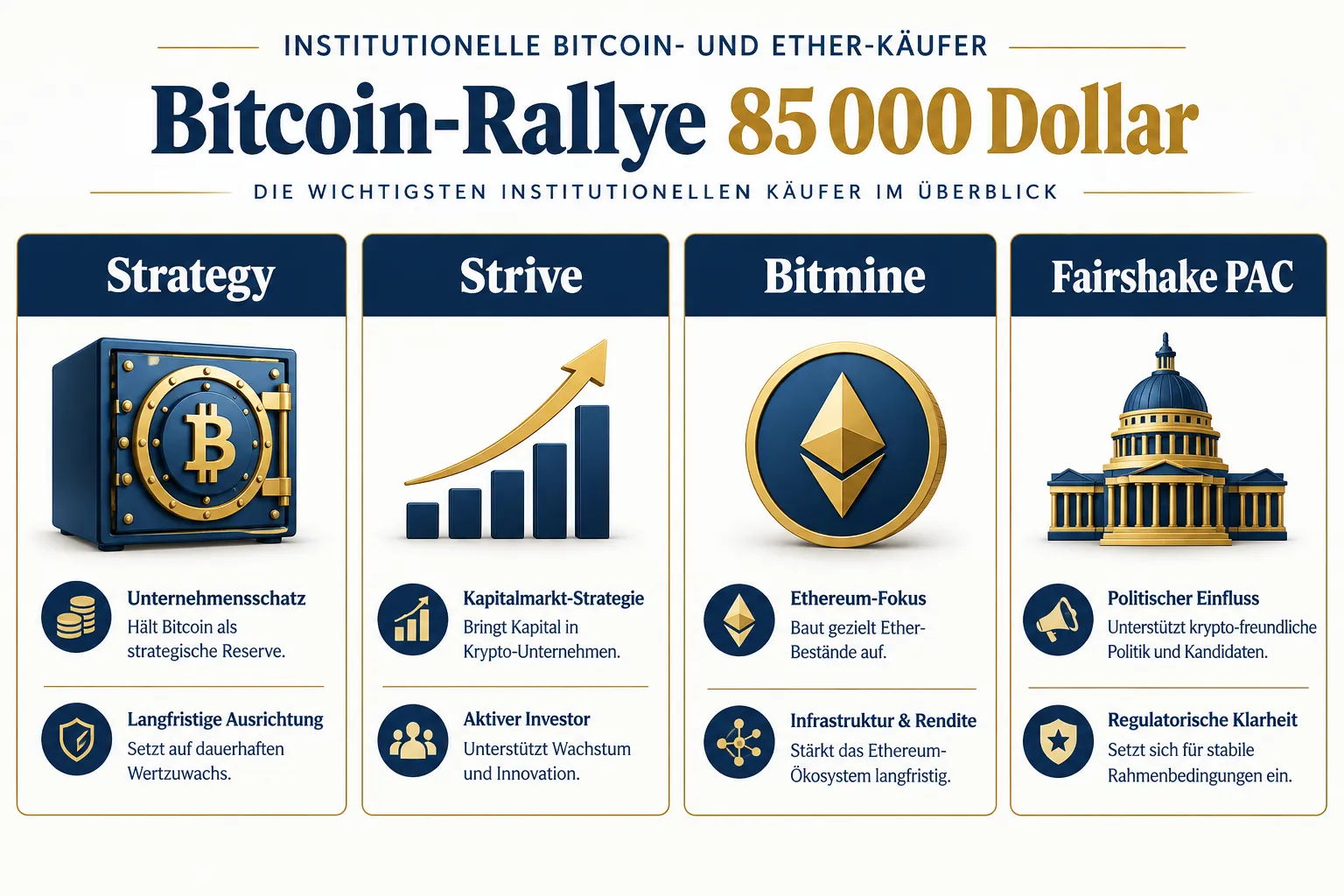
Tom Lee, chairman of Bitmine and known as a market strategist at Fundstrat, commented on the current situation: institutional investors remain structurally underweight in crypto assets, in his view. The strong performance in the third quarter of 2026 — reportedly up 44 percent — could, in his assessment, lead more institutional capital to flow into the market once larger firms adjust their portfolios.
This assessment aligns with the observation that the current Bitcoin Rally Past 85,000 Dollars is being carried by a mix of retail investors forced to close short positions and institutional buyers systematically building up their holdings.
Regulatory Backdrop: The Clarity Act and Fairshake
While the price move appears to be technically and institutionally driven, the regulatory situation in the U.S. remains tense. The so-called “Clarity Act,” a legislative proposal for clearer regulation of cryptocurrencies, previously failed in the U.S. Senate.
In response, the influential crypto lobbying group “Fairshake” announced it would deploy around $30 million specifically against Senator Sherrod Brown. Fairshake is considered one of the best-funded political action committees in the U.S. crypto industry and has previously exerted significant influence on election campaigns where crypto regulation played a role.
For German investors, this political conflict is relevant because regulatory developments in the U.S., as the largest single market for institutional crypto capital, frequently have indirect effects on global prices and the risk appetite of international investors. A failure to achieve clear regulation can create short-term uncertainty, while a regulatory breakthrough has traditionally been viewed as supportive of prices.
Technical Analysis and Outlook
From a technical standpoint, analysts view the reclaiming of the 50-week moving average as a potentially significant signal. The next widely watched resistance zone lies, according to several trading desks, between $85,000 and $90,000 [4][7]. Whether Bitcoin can sustainably overcome this zone depends, among other things, on whether institutional inflows continue and whether open interest stabilizes at a healthy level without tipping again into excessively leveraged positions.
It’s important to distinguish between a rally driven primarily by forced liquidations and one carried by organic buying interest. Both elements appear to be present in the current case: short liquidations delivered the initial impulse, while institutional purchases from Strategy, Strive, and Bitmine provide additional fundamental support.
Investors should nonetheless consider that technical signals such as the 50-week moving average are no guarantee of a trend’s continuation. Cryptocurrencies remain a volatile market in which sentiment can shift within a matter of days. For readers who want to interpret these signals themselves, our crypto technical analysis guide covers the necessary tools, and our crypto market update on the Fed rate hike and ETF flows provides broader market context.
Conclusion and Next Steps
The Bitcoin Rally Past 85,000 Dollars on September 21, 2026 exemplifies how technical market mechanics, institutional capital, and political conditions interact. A short squeeze involving roughly $648 million in liquidated bets provided the immediate trigger, while purchases from Strategy, Strive, and Bitmine signal that institutional players continue to expand their positions. At the same time, the regulatory situation in the U.S. remains unresolved following the failure of the Clarity Act, which could influence market dynamics in the coming weeks.
This article does not constitute financial advice and offers no direct recommendations for German or other investors. It may nonetheless be worthwhile to keep the following points in mind:
- Regularly track current price developments via reliable sources such as CoinDesk, TheBlock, or CoinGecko, since figures can change quickly.
- Watch the further development of open interest to assess whether the rally is being carried by genuine capital inflows or renewed leverage.
- Keep an eye on regulatory news from the U.S., particularly regarding the Clarity Act and the role of lobbying groups such as Fairshake.
- Critically assess your own risk tolerance and investment horizon before making decisions based on short-term price movements.
The coming weeks will show whether the Bitcoin Rally Past 85,000 Dollars develops into a more sustained uptrend or turns out to be a short-term, squeeze-driven correction within a volatile market environment.
References
[1] Bitcoin September 2026 Resilience – https://memeburn.com/bitcoin-september-2026-resilience/ [2] Bitcoin Hits 85000 And Nears 8 Month High Is The Crypto Bull Market Finally Here – https://www.fool.com/investing/2026/09/21/bitcoin-hits-85000-and-nears-8-month-high-is-the-crypto-bull-market-finally-here/?source=mitrade&referring_guid=031053c2-5a9a-4e88-bf3e-e53da3f82146 [3] Bitcoins Sharpest Rally Two Years 160103232 – https://finance.yahoo.com/markets/crypto/articles/bitcoins-sharpest-rally-two-years-160103232.html [4] Btc Breakout Faces 85000 Test – https://blog.bitfinex.com/bitfinex-alpha/btc-breakout-faces-85000-test/ [6] Bitcoin Blasts Past 80k Fresh 152249505 – https://finance.yahoo.com/markets/crypto/articles/bitcoin-blasts-past-80k-fresh-152249505.html [7] Bitcoin Short Squeeze 80000 83000 Next 20260920j1418 – https://www.mitrade.com/insights/crypto-analysis/bitcoin/bitcoin-short-squeeze-80000-83000-next-20260920J1418 [9] Bitcoin Recovery 58000 To 80000 September 2026 – https://www.moneyallotment.com/blog/bitcoin-recovery-58000-to-80000-september-2026
Frequently Asked Questions
When did Bitcoin cross $85,000 and what drove it?
Bitcoin crossed $85,000 on September 21, 2026, with intraday highs up to roughly $87,000, driven by a short squeeze that forcibly closed about $648 million in bearish bets.
What happened to open interest during the rally?
Open interest rose 7.59 percent to $156 billion even amid the liquidation wave, suggesting fresh capital was entering the market rather than just reshuffling.
What technical signal did Bitcoin reclaim?
Bitcoin reclaimed its 50-week moving average for the first time in 45 weeks, a signal that has historically preceded larger bull runs.
What regulatory issue is creating uncertainty?
The failed "Clarity Act" in the U.S. Senate; the crypto lobby group "Fairshake" responded with an announced $30 million campaign against Senator Sherrod Brown.