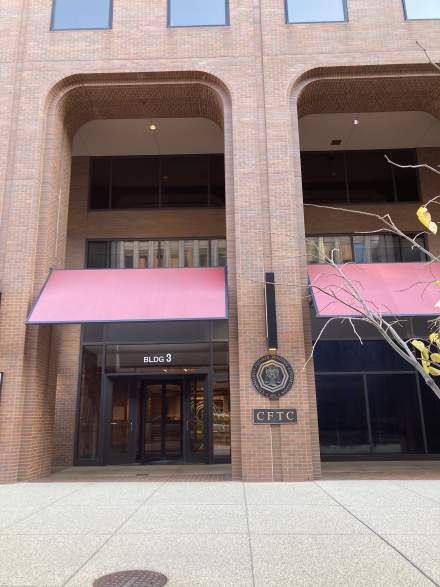
Ten votes were missing. Just ten votes separated the biggest regulatory step forward for digital assets in US history from being shelved indefinitely once again. On September 15, 2026, it wasn’t enough: the Clarity Act, the bill meant to give cryptocurrencies a clear legal home in the United States for the first time, failed in the Senate 49 to 50, short of the 60-vote procedural threshold. The decision on Clarity Act crypto regulation is effectively off the table for the current legislative session, and the market reacted within minutes with a sharp sell-off.
For investors, traders, and anyone tracking US cryptocurrency regulation, this day marks a turning point. What follows is a breakdown of what happened, why it happened, and what to expect next.
Table of Contents
Key Takeaways
- On September 15, 2026, the Senate rejected the cloture vote on the Clarity Act 49 to 50, ten votes short of the required 60-vote majority.
- Three Republicans voted against their own party: Susan Collins, Josh Hawley, and Jerry Moran, while not a single Democrat crossed the aisle.
- Bitcoin fell roughly 3 to 4 percent to around $76,000, Coinbase lost 8 percent, Circle 10 percent, and XRP nearly 10 percent.
- Three core sticking points blocked the bill: stablecoin interest, conflicts of interest around Trump’s crypto investments, and criminal liability protection for software developers.
- A revival of the bill in this form before the 2026 midterms is seen as unlikely, leaving the SEC as the dominant regulator for now.
What is the Clarity Act and why does Clarity Act crypto regulation matter so much
Its official name is the “Digital Asset Market Clarity Act,” registered in Congress as H.R. 3633. The goal of the more than 600-page bill was to end a decades-old gray area: the question of whether a digital asset counts as a commodity or as a security [1].
Until now, the US Securities and Exchange Commission (SEC) largely decides this question case by case, often only in court. The Clarity Act would have created a clear division of labor:
- Digital commodities such as Bitcoin, whose value derives primarily from use and trading, would have been assigned to the Commodity Futures Trading Commission (CFTC).
- Digital securities, i.e. tokens whose value depends on the work of a company, would have remained with the SEC [1] [8].
The bill also included registration requirements, market structure rules, and provisions on anti-money-laundering and consumer protection [1] [12]. For the industry, this would have been the first comprehensive federal regulation ever, one reason exchanges, issuers, and developers lobbied intensively for months.
The vote in detail: how the Clarity Act failed in the Senate
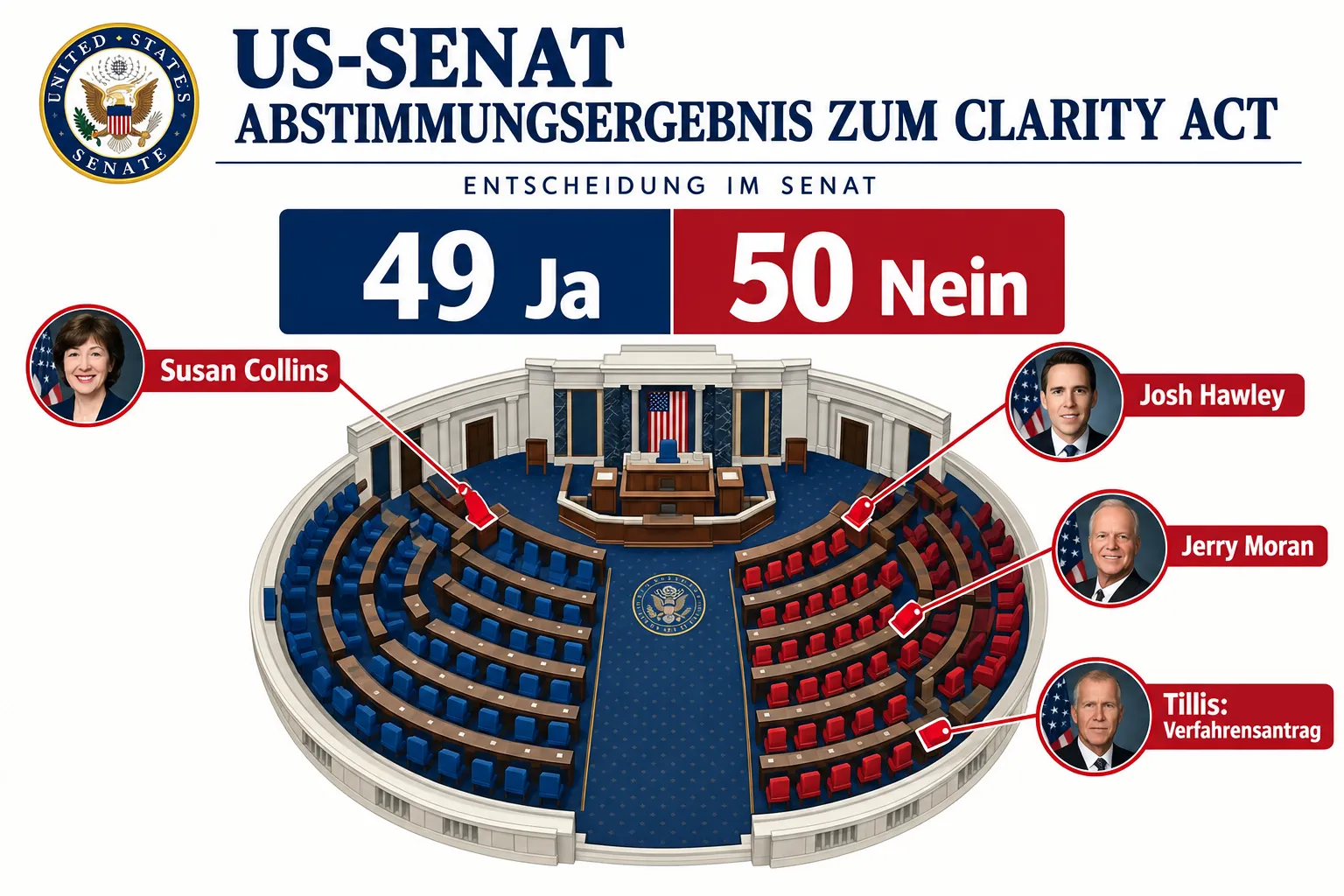
On September 15, 2026, there was no final vote on the bill’s text, but rather a so-called cloture vote, a procedural vote meant to end debate and clear the way for a final vote. That requires 60 of the Senate’s 100 votes. The result: 49 yes votes against 50 no votes [2] [3] [9].
The bipartisan pattern was notable. Three Republican senators voted against their own caucus:
| Senator | State | Party |
|---|---|---|
| Susan Collins | Maine | Republican |
| Josh Hawley | Missouri | Republican |
| Jerry Moran | Kansas | Republican |
Senator Thom Tillis also voted technically no, but via a “motion to recommit,” a purely procedural step without substantively rejecting the bill [2] [13]. What actually mattered was something else: not a single Democrat crossed the aisle. At least seven Democratic defectors would have been needed to reach the 60-vote threshold. Despite months of bipartisan negotiations, none materialized [2] [8].
Reuters journalist Brendan Pedersen summed up the result on X as follows: the Senate failed to advance the Clarity Act, with the three Republican defectors named above as the decisive factor.
Why Clarity Act crypto regulation failed over three sticking points
The rejection didn’t come as a surprise if you look at the final weeks of negotiations. Three lines of conflict remained unresolved to the end:
- Stablecoin interest: Banks pushed for a ban on interest payments on stablecoins to protect their own deposit business. Crypto companies rejected this restriction.
- Conflicts of interest around Trump’s crypto investments: Democratic senators demanded significantly stricter ethics rules, since President Trump holds private stakes in crypto projects. Senator Elizabeth Warren openly warned in a Senate speech of a “crypto-fueled economic crash” and made the lack of distance between government and industry a central point of criticism [6] [13].
- Criminal liability protection for developers: Developers of non-custodial software tools, such as wallet software or decentralized protocols, demanded explicit protection from criminal liability, which many Democrats considered too far-reaching.
Republicans still tried, on the Sunday before the vote, to counter with a revised draft and new ethics rules. It wasn’t enough [4] [10]. Senator Cynthia Lummis, the Republican lead negotiator, had previously called the vote “now or never,” pointing to only around 22 remaining working days left on the Senate calendar before the midterm campaign begins [4].
“This is now or never for the Clarity Act in this legislative session,” Senator Lummis warned, in substance, ahead of the vote.
Market reaction: Bitcoin, Coinbase, Circle and XRP in free fall
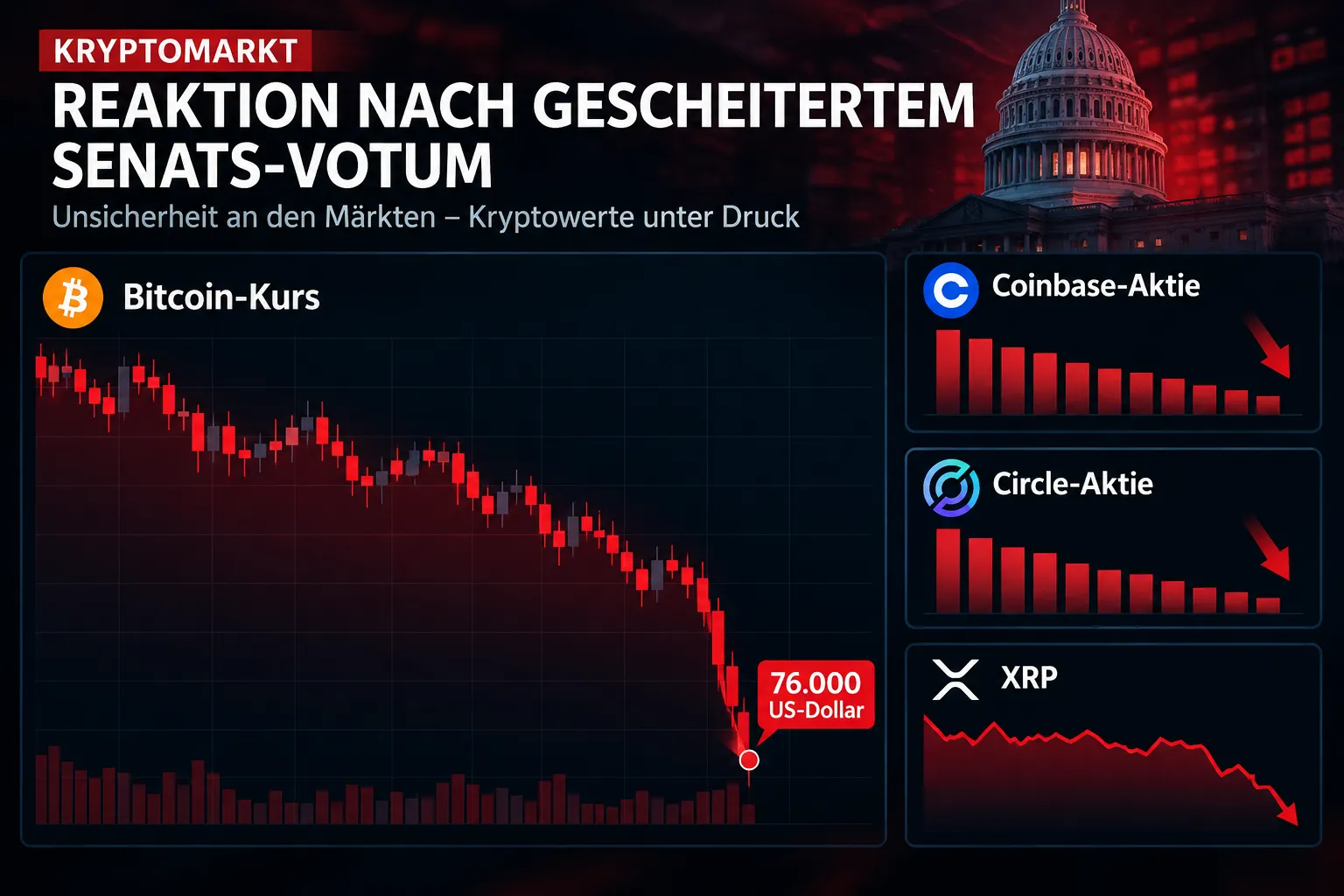
Markets reacted in near real time. Bitcoin fell roughly 3 to 4 percent to around $76,000. Shares of US exchange Coinbase lost 8 percent, and stablecoin issuer Circle’s stock dropped as much as 10 percent. XRP was hit particularly hard, plunging nearly 10 percent to around $1.30 [9] [14].
The sell-off was amplified by massive forced liquidations: more than $300 million in leveraged positions were liquidated within minutes. How quickly sentiment in the crypto market can turn is also shown by our update on Bitcoin ETF inflows and the short squeeze just days earlier. The market situation was further strained by the close timing to the Fed’s rate decision on September 16, where investors priced in a roughly 90 percent probability of a rate hike, a double burden for risk assets.
The news also hit prediction markets. On the platform Polymarket, the priced-in probability of the Clarity Act passing in 2026 fell from around 30 percent to just 5 percent within a single day, a clear signal that market participants expect no near-term political course correction.
Regulatory consequences: back to case-by-case regulation
Without the Clarity Act, the fundamental question of whether a token is a commodity or a security remains unresolved. In practice, that means the SEC will continue its litigation-driven regulatory approach, while the CFTC covers only part of the derivatives market [5] [9] [12]. Industry analysts describe it as “more of the same,” with persistently high legal uncertainty for exchanges, DeFi protocols, and token issuers.
Specifically, this means for various market participants:
- Exchanges and trading venues must continue to individually assess which listed tokens carry legal risk.
- DeFi developers remain without the planned liability protection and continue to operate in a legal gray area.
- Stablecoin issuers like Circle remain without uniform federal rules on interest payments.
Major crypto exchanges and industry associations called the outcome a severe setback and announced they would now focus more heavily on the interpretation of existing rules by the SEC and CFTC, for example via no-action letters, case-by-case approvals, or targeted test cases in court, rather than continuing to hope for a major market structure bill [5] [9] [11].
What happens next politically with Clarity Act crypto regulation
Formally, the Clarity Act is not dead after this vote; legally, it was merely a failed procedural vote, not a final rejection of the bill’s text [3] [9] [13]. De facto, however, the outcome ends realistic chances of passage within this calendar year.
Observers expect the following scenarios in the coming months:
- Smaller, narrowly scoped crypto bills on individual topics instead of a comprehensive market structure law.
- A possible watered-down revival of the Clarity Act only in the next legislative session after the midterm elections [3] [10] [11].
- Increased regulatory pressure from the SEC and CFTC through case-by-case regulation, as long as no new law is in place.
For the upcoming midterm campaign, crypto regulation will therefore remain a politically charged topic, especially since the disputes over Trump’s private investments and consumer protection are unlikely to lose their edge.
What this means for crypto investors in Germany and Europe
For European market participants, the failure reinforces an existing trend: while the EU already has a unified legal framework for crypto assets under the MiCA regulation, the US legal landscape remains difficult to predict [5] [9] [14]. This mainly affects globally operating exchanges, custody providers, and token issuers that must simultaneously meet European and US requirements.
For retail investors in Germany, little changes in the short term regarding the fundamental legal status of already established large coins like Bitcoin or Ether. The risk remains, however, that individual products, such as certain staking programs, yield-oriented tokens, or particular stablecoins, could still be classified by the SEC as unregistered securities [7] [9] [12]. Anyone investing in US-listed crypto stocks or in tokens with a close US connection should factor this legal uncertainty into their risk assessment.
Conclusion: Clarity Act crypto regulation remains a distant prospect for now
The failure of the Clarity Act in the US Senate is more than a missed procedural vote, it is a signal that the United States is, for now, continuing to hold back in the global race for clear crypto regulation, while Europe already has a head start with MiCA. For investors and traders, this means legal uncertainty remains the norm, and price swings tied to political events in Washington are likely to increase.
Concrete next steps for market participants:
- Review portfolios for concentration risk in US-linked tokens and crypto stocks.
- Actively track SEC and CFTC announcements on case-by-case regulation, since these remain the actual source of regulation in the near term.
- Keep an eye on political developments around the 2026 midterm elections, since a revival of the bill appears realistic at the earliest after that.
- Carefully check the regulatory classification of any provider before investing in stablecoins or staking products.
Anyone looking to assess the crypto market long-term cannot ignore political developments in Washington. The Clarity Act has failed, the debate over clear crypto regulation in the United States has not.
References
[1] Clarity Act Crypto Senate Vote – https://www.npr.org/2026/09/15/nx-s1-5968711/clarity-act-crypto-senate-vote [2] Us Senate Vote Advancing Landmark Crypto Bill 2026 09 15 – https://www.reuters.com/legal/government/us-senate-vote-advancing-landmark-crypto-bill-2026-09-15/ [3] Clarity Act Senate Vote Live 183611039 – https://finance.yahoo.com/markets/crypto/articles/clarity-act-senate-vote-live-183611039.html [4] Clarity Act Stalls Senate Crypto 185410147 – https://www.yahoo.com/news/politics/articles/clarity-act-stalls-senate-crypto-185410147.html [5] Failure Of Clarity Act Turns Crypto Industry Focus To Federal Regulators 135914cc – https://www.wsj.com/politics/policy/failure-of-clarity-act-turns-crypto-industry-focus-to-federal-regulators-135914cc [6] Senate Blocks Crypto Bill – https://www.nytimes.com/2026/09/15/technology/senate-blocks-crypto-bill.html [7] Clarity Act Cloture Vote Fails What It Means For Your Crypto Holdings 153849029 – https://finance.yahoo.com/personal-finance/investing/article/clarity-act-cloture-vote-fails-what-it-means-for-your-crypto-holdings-153849029.html [8] Senate Fails To Advance Clarity Act In Blow To Crypto Industry Ahead Of 2026 Midterms – https://nypost.com/2026/09/15/business/senate-fails-to-advance-clarity-act-in-blow-to-crypto-industry-ahead-of-2026-midterms/ [9] Senate Cloture Vote On Clarity Act Fails Dealing Regulatory Setback To Crypto Industry – https://www.cnbc.com/2026/09/15/senate-cloture-vote-on-clarity-act-fails-dealing-regulatory-setback-to-crypto-industry.html [10] Clarity Act Fails Crucial Senate 190534629 – https://finance.yahoo.com/markets/crypto/articles/clarity-act-fails-crucial-senate-190534629.html
Frequently Asked Questions
By what margin did the Clarity Act fail in the Senate?
On September 15, 2026, the Senate rejected the cloture vote 49 to 50, ten votes short of the required 60-vote threshold.
Which Republicans voted against their own party?
Susan Collins (Maine), Josh Hawley (Missouri), and Jerry Moran (Kansas); not a single Democrat crossed the aisle.
How did the market react?
Bitcoin fell roughly 3 to 4 percent to around $76,000, Coinbase lost 8 percent, Circle 10 percent, and XRP nearly 10 percent.
What were the three core sticking points that blocked the bill?
Stablecoin interest payments, conflicts of interest around Trump's crypto investments, and criminal liability protection for software developers.