More than 20,000 different cryptocurrencies are currently listed on major market platforms – yet many people still say “I’m buying Bitcoin” when what they actually mean is “I’m investing in crypto.” This small slip of language sounds harmless, but it regularly leads beginners into misunderstandings, wrong expectations, and risky decisions. The difference between Bitcoin and crypto isn’t a matter of semantics – it’s the single most important building block for understanding this market at all.
That’s exactly what this article covers: the Bitcoin vs. crypto difference, explained clearly and simply, with no prior knowledge required.
Table of Contents
Key Takeaways
- Bitcoin is one single, specific cryptocurrency – not the same thing as “crypto” in general.
- Cryptocurrency is the umbrella term for thousands of digital currencies, including Bitcoin, Ethereum, Solana, and XRP.
- Bitcoin and other cryptocurrencies run on different blockchains built for different purposes.
- Bitcoin is still widely viewed in 2026 as “digital gold” and the market’s lead asset, while platforms like Ethereum enable programmable applications.
- This article is purely educational, not investment advice – the crypto market remains highly volatile.
What Exactly Is Bitcoin?
Bitcoin (ticker: BTC) is one very specific, individual cryptocurrency – the very first of its kind. It was described in a concept paper in 2008 and actually launched in early 2009, by a person or group who remains anonymous to this day under the pseudonym Satoshi Nakamoto. Bitcoin was the starting shot for the entire crypto market as it exists today.
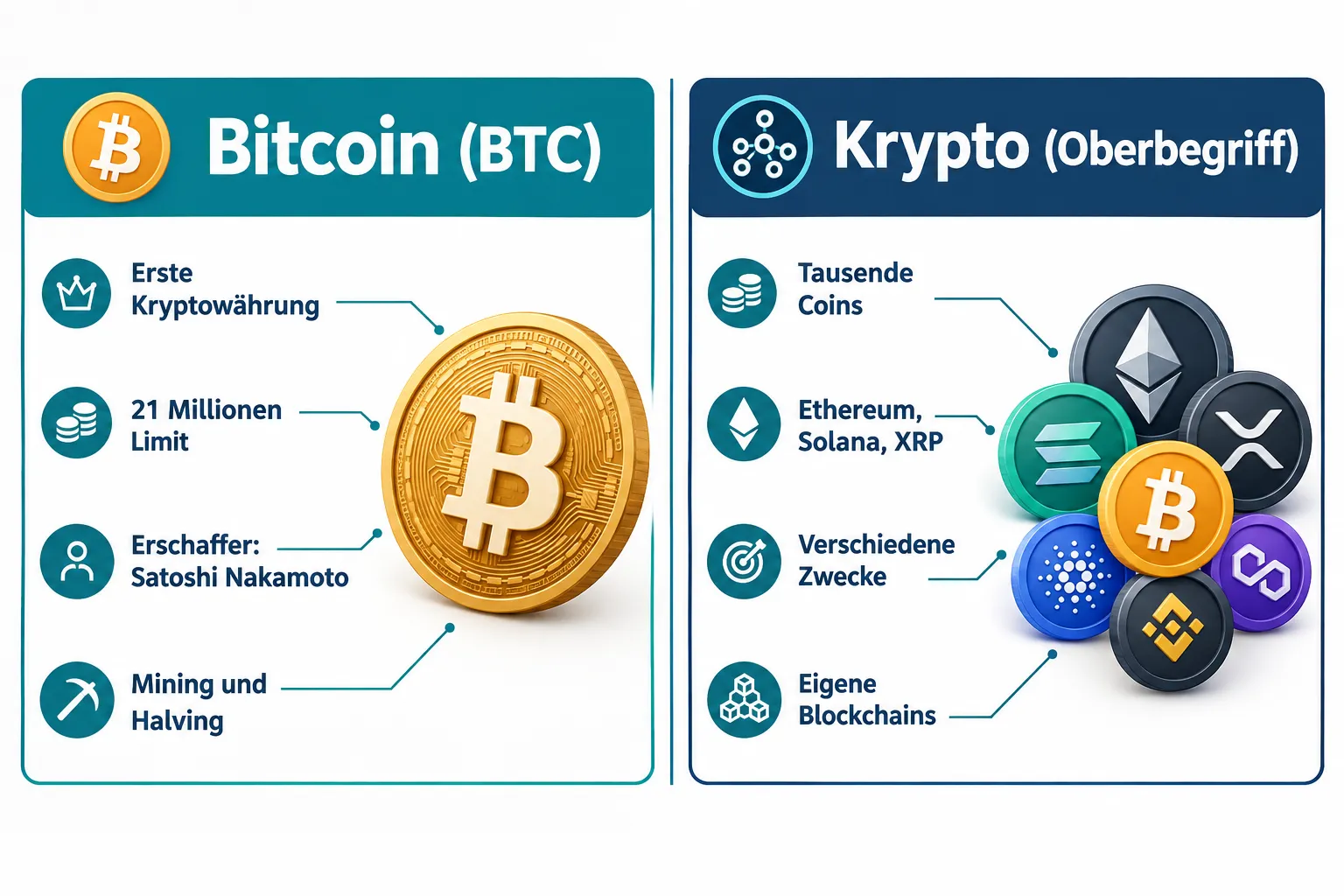
One defining feature of Bitcoin is its fixed supply cap: there will never be more than 21 million Bitcoin. This number is hard-coded into the protocol and can’t simply be raised. That makes Bitcoin fundamentally different from traditional paper money, which central banks can theoretically print without limit.
Because a whole Bitcoin is too large and too expensive for many payments, BTC can be split into tiny units. The smallest unit is called a Satoshi, named after the founder. One Satoshi equals 0.00000001 BTC – one hundred-millionth of a Bitcoin.
New Bitcoins aren’t created at the push of a button – they come from mining: computers around the world solve complex mathematical puzzles to confirm new blocks of transactions. Whoever solves the puzzle first receives a reward in newly created Bitcoin. To keep the total supply from growing too quickly, that reward is automatically cut in half roughly every four years – an event known as the halving. This combination of a fixed cap, mining, and halving is exactly what makes Bitcoin, for many people, a scarce, predictable digital store of value.
Anyone who wants to dig deeper into the basic mechanics of Bitcoin can find a detailed beginner explanation from Bankrate.
What Is Crypto or Cryptocurrency as an Umbrella Term?
This is where the core of the Bitcoin vs. crypto confusion lies: “crypto” or “cryptocurrency” isn’t the name of one specific coin – it’s an umbrella term for an entire category of digital assets. It covers all digital currencies and tokens built on blockchain technology.
Today there are several thousand such cryptocurrencies, each with very different goals, technologies, and market sizes [1]. Well-known examples besides Bitcoin include:
- Ethereum (ETH) – a platform for programmable applications
- Solana (SOL) – known for very fast, low-cost transactions
- XRP – built for fast international payment settlement
- Thousands of other tokens with niche use cases, from gaming to financial applications
Bitcoin, then, is one of many cryptocurrencies – not a synonym for all of them. Think of it like the relationship between “apple” and “fruit”: every apple is a fruit, but not every fruit is an apple. In the same way, every Bitcoin is a cryptocurrency, but not every cryptocurrency is Bitcoin.
In terms of market size and recognition, Bitcoin remains the clear number one across the entire crypto market in 2026, followed by Ethereum as the second-largest coin [5][10].
Blockchain Basics Explained Simply
To really understand the Bitcoin vs. crypto difference, it helps to take a quick look at the underlying technology – without the jargon.
A blockchain is best thought of as a public, shared ledger. Every transaction is stored chronologically inside a “block,” and these blocks are linked one after another like a chain. What makes it special: this ledger doesn’t sit with a single bank or authority – it exists simultaneously on thousands of computers worldwide. No one can quietly alter it on their own.
It’s important to understand that there isn’t just “one” blockchain shared by all cryptocurrencies. Bitcoin runs its own, independent blockchain. Ethereum has a completely separate blockchain. So does Solana. Each of these networks operates under its own rules, with its own speed, and its own set of possible applications.
That’s exactly why “buying crypto” isn’t really a precise statement – you’re always buying one specific cryptocurrency on one specific blockchain, with its own characteristics and its own risk profile.
Bitcoin vs. Ethereum: A Concrete Comparison
A direct comparison between Bitcoin and Ethereum shows the Bitcoin vs. crypto difference especially clearly, because the two networks were built to do completely different jobs.
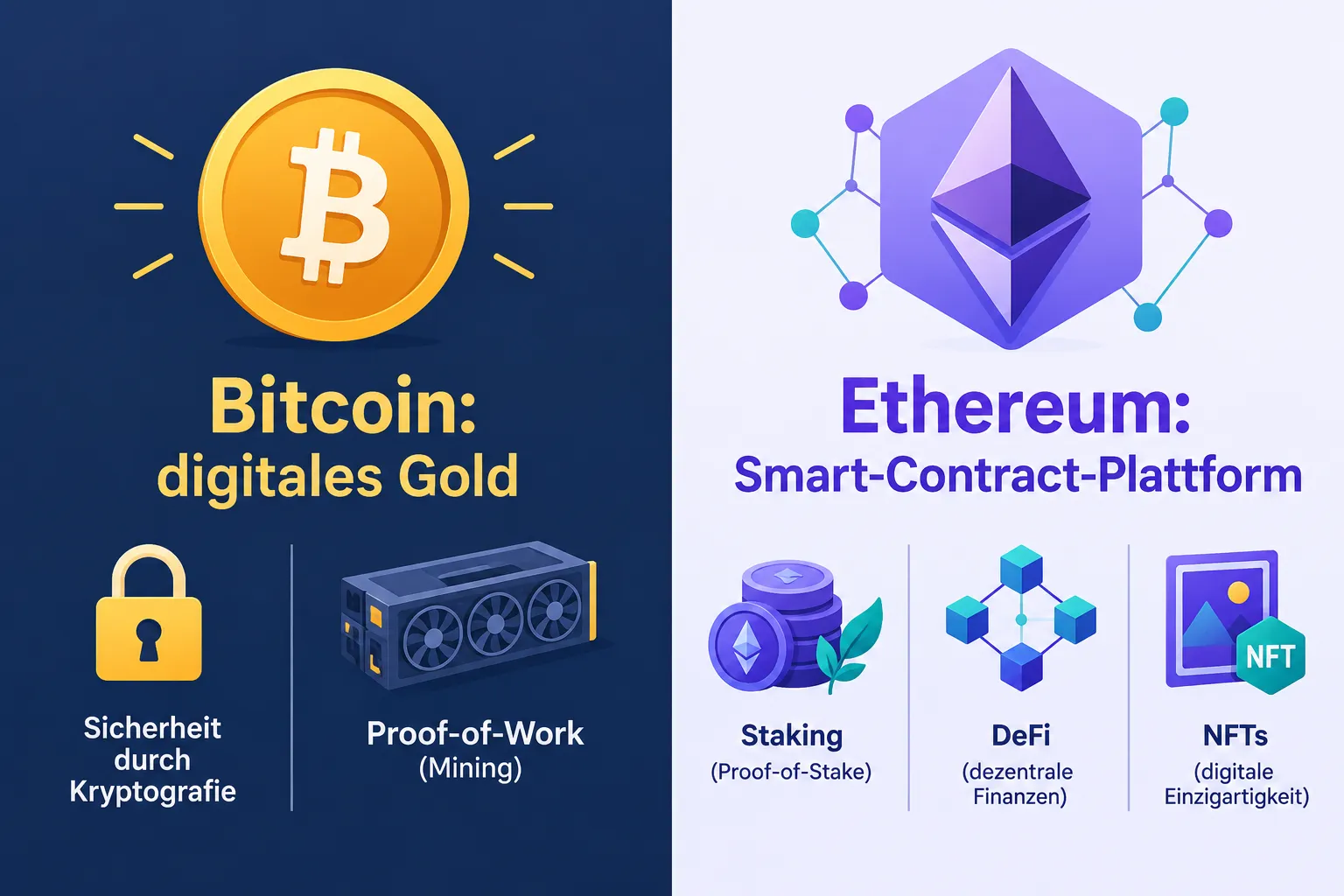
Bitcoin was deliberately kept simple: a digital payment method and store of value, often called “digital gold.” Ethereum, on the other hand, was designed as a platform for so-called smart contracts – small, programmed agreements that execute automatically once certain conditions are met, with no bank, no notary, and no middleman involved. This is the foundation for applications like DeFi (decentralized finance) and NFTs – functions that Bitcoin deliberately doesn’t offer on a technical level [2][3].
The two systems also differ significantly in their consensus mechanism – the method a network uses to confirm that transactions are valid. Bitcoin still relies on Proof-of-Work: miners use computing power to solve tasks, which consumes a lot of energy. Ethereum switched to Proof-of-Stake in 2022: participants lock up (“stake”) their own coins as collateral instead of burning computing power – a far more energy-efficient approach. Detailed technical background on that transition is available on the official Ethereum.org site.
The two networks also differ in transaction throughput and ongoing development: while Bitcoin deliberately introduces changes conservatively and slowly, the Ethereum ecosystem in 2026 continues working on protocol upgrades, scaling solutions, and even a long-term roadmap toward quantum resistance by around 2029 [4][6][7]. Networks like Solana additionally position themselves around especially high transaction speed as a core differentiator [10].
Bitcoin vs. Ethereum at a glance:
| Feature | Bitcoin (BTC) | Ethereum (ETH) |
|---|---|---|
| Main purpose | Digital money, store of value | Platform for smart contracts, DeFi, NFTs |
| Launched | 2009 | 2015 |
| Consensus mechanism | Proof-of-Work | Proof-of-Stake (since 2022) |
| Energy use | Comparatively high | Significantly reduced |
| Market role in 2026 | Lead asset, “digital gold” | Second-largest coin, yield and application platform |
“Bitcoin and Ethereum pursue fundamentally different goals – one is a store of value, the other an application platform.”
Wallet Basics for Bitcoin and Every Other Cryptocurrency
Whether it’s Bitcoin, Ethereum, or a smaller cryptocurrency, storage works on the same basic principle. A wallet doesn’t actually store the coins themselves – those only exist as entries on the respective blockchain. Instead, the wallet stores the cryptographic keys that prove ownership of those coins.
Two terms matter here:
- Public key: works similarly to an account number. It can be shared freely to receive payments.
- Private key: the actual access secret. Whoever holds this key has full control of the coins – which is exactly why it must never be shared with anyone else.
Many modern wallets today support several cryptocurrencies at once, while others – dedicated Bitcoin-only wallets – are deliberately limited to a single currency. Which wallet type fits which use case, what security levels exist, and how setup works step by step is explained in detail in our guide Crypto Wallet for Beginners.
A Cautious Look at Investing in 2026
Important note: The following section is for general educational purposes only and does not constitute investment advice, a purchase recommendation, or financial advice. Cryptocurrencies are highly speculative, highly volatile assets. Independent research and, where appropriate, professional advice are strongly recommended.
Bitcoin is still widely regarded as the crypto market’s so-called “lead asset”: when the Bitcoin price moves sharply, many other cryptocurrencies have historically tended to move along with it – both up and down [5]. Bitcoin is also increasingly held by institutions, for example through regulated spot ETFs and, in some cases, on the balance sheets of large companies, which further reinforces the “digital gold” narrative around Bitcoin [8][9].
Ethereum, by contrast, is increasingly seen by market observers as more of a yield and application platform, driven in part by staking returns and widespread DeFi and NFT usage on the network [2][6]. Some forecasts about the future development of both networks remain explicitly speculative and should not be treated as a reliable prediction [7][9].
Despite these different portfolio roles, the entire crypto market remains highly volatile in 2026 – sharp price swings within short timeframes are still completely normal for Bitcoin, Ethereum, and practically every other cryptocurrency.
Conclusion: The Bitcoin vs. Crypto Difference at a Glance
The Bitcoin vs. crypto difference can ultimately be summed up simply: Bitcoin is one single, specific cryptocurrency – the first of its kind, with a fixed cap of 21 million coins and its own blockchain. “Crypto” or “cryptocurrency,” on the other hand, is the umbrella term for thousands of digital currencies and tokens, which include Bitcoin just as much as Ethereum, Solana, or XRP.
Once you’ve internalized this distinction, it also immediately becomes clear why news about “the crypto market” doesn’t automatically mean just Bitcoin, and why different cryptocurrencies can serve completely different purposes – from a pure store of value to a programmable application platform.
As a next step, it’s worth getting familiar with secure wallet solutions (see our crypto wallet guide) and with reputable trading venues – our article Crypto Exchange Comparison for Beginners offers an overview of that – before even thinking about actual use, always keeping a healthy distance from short-term hype and staying aware of this market’s high volatility.
References
[1] Cryptocurrency Comparison – https://www.finanzen.net/ratgeber/krypto/produkte-vergleiche/kryptowaehrungen-vergleich/
[2] Latest News – https://crypto.com/us/coins-ai/ethereum/latest-news
[3] Ethereum – https://cointelegraph.com/tags/ethereum
[4] Latest Updates – https://coinmarketcap.com/cmc-ai/ethereum/latest-updates/
[5] Which Cryptocurrencies to Buy – https://www.n-tv.de/broker-vergleich/trading-lernen/krypto/welche-kryptowaehrungen-kaufen/
[6] Ethereum – https://cryptonews.net/news/ethereum/
[7] Ethereum – https://www.theblock.co/tag/ethereum
[8] Ethereum – https://crypto.news/tag/ethereum/
[9] cryptonews – https://cryptonews.net/news/ethereum/33432655/
[10] Bitcoin Alternative – https://www.handelsblatt.com/vergleich/bitcoin-alternative/