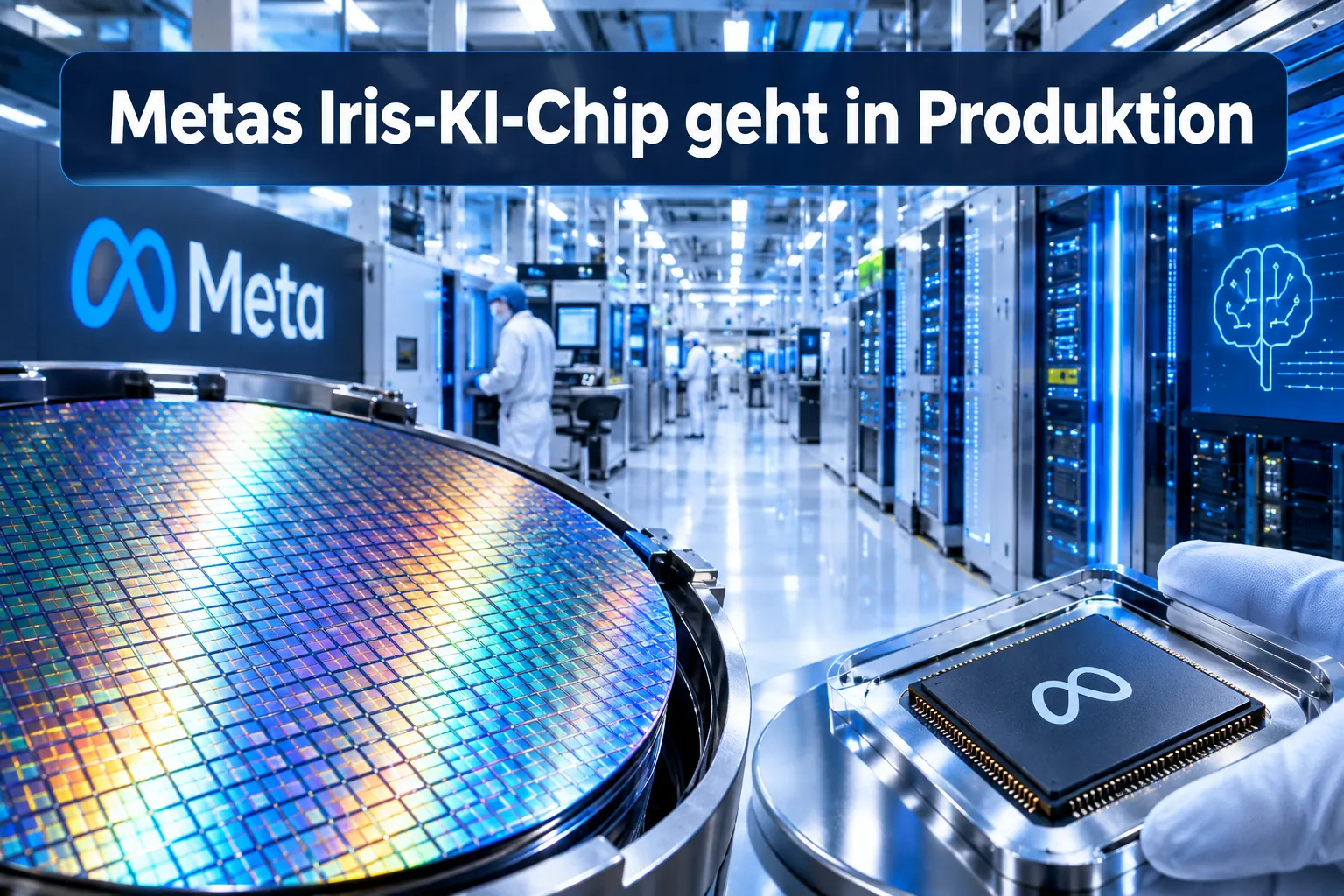
A single six-week test cycle with no significant issues was enough to reshuffle one of the tech industry’s most expensive arms races. In September 2026, Meta begins mass production of its own AI chip codenamed “Iris,” marking one of the most concrete attempts yet by a hyperscaler to break free of Nvidia’s hardware dominance. The Meta Iris AI chip is no longer an experiment — it’s moving into industrial-scale production, manufactured by TSMC and co-designed with Broadcom. For the entire AI chip industry, this is a signal: the era in which Nvidia alone sets the pace may be drawing to a close.
Table of Contents
Key Takeaways
- The Meta Iris AI chip (codename for the fourth MTIA generation) enters mass production in September 2026, after a six-week test cycle with no major issues [1][5].
- Meta plans to double its total compute capacity from roughly 7 gigawatts (2026) to 14 gigawatts in 2027 [1][7].
- Broadcom co-designs the chip with Meta, while TSMC manufactures it, using a 2-nanometer process for the first time [4][6].
- Iris complements Nvidia and AMD GPUs rather than fully replacing them; it focuses on ranking, recommendation, and generative AI workloads [3][8].
- Meta will invest up to $145 billion in AI infrastructure in 2026, while Nvidia still holds roughly 85 percent market share in AI chips [9][8].
What Is the Meta Iris AI Chip? Production Starts in September 2026
Iris is the internal codename for the fourth generation of Meta’s Training and Inference Accelerators, or MTIA. According to an internal memo reviewed by Reuters, the chip completed a six-week test cycle without major architectural issues [1][5]. That’s notable, since earlier chip projects at major tech companies have often stumbled at exactly this stage, hit by unexpected manufacturing defects or software integration problems.
With a clean test result in hand, Meta has given the green light for mass production. Starting in September 2026, the first units of the Meta Iris AI chip roll off TSMC’s production lines [2][6]. Officially, the chip also goes by the designation MTIA 400, while “Iris” remains the internal project name under which it became known in media coverage.
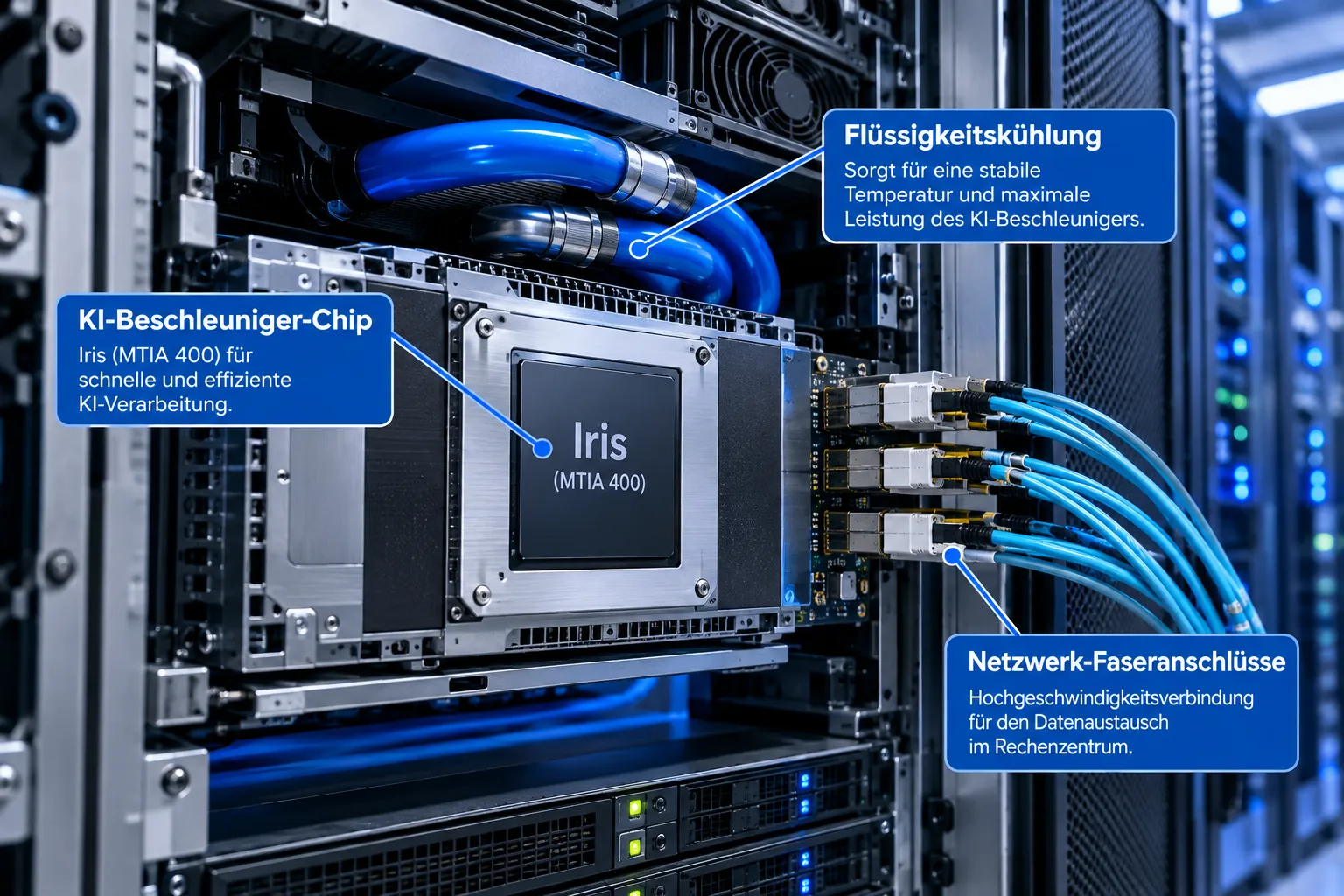
The timing is no coincidence. Meta is in the midst of a phase of massive infrastructure investment: up to $145 billion in AI infrastructure spending is planned for 2026 [7]. A proprietary, mass-produced chip not only cuts costs but also reduces dependence on a single external supplier for the most critical component of the AI value chain.
Technology Partners: Broadcom, TSMC, and the Path to a 2-Nanometer Chip
The Meta Iris AI chip isn’t a solo effort. Meta works closely with Broadcom on design and architecture, while actual manufacturing takes place at TSMC, the Taiwanese semiconductor fabrication giant [1][4]. This division of labor is typical for the industry: almost no company besides TSMC has the manufacturing capacity for the most advanced chip processes.
The manufacturing process itself stands out. According to Broadcom, Iris is the first chip built on a 2-nanometer process — a technological leap that enables higher compute performance at lower energy consumption per calculation [4][6]. In April 2026, Broadcom and Meta extended their partnership through 2029 and agreed to an initial commitment of more than one gigawatt of MTIA compute capacity [4][6].
This long-term commitment signals something important: this isn’t a one-off project, but a strategic realignment of supply chains. It’s reinforced by further long-term supply agreements, including with:
| Partner | Area |
|---|---|
| Samsung Electronics | Memory chips |
| SanDisk | Flash storage |
| Sumitomo Electric | Fiber-optic equipment for data centers |
These agreements don’t just secure Meta’s chip production — they also secure the entire surrounding infrastructure of storage and network connectivity needed to run large AI clusters.
The MTIA Roadmap: From Iris to MTIA 500
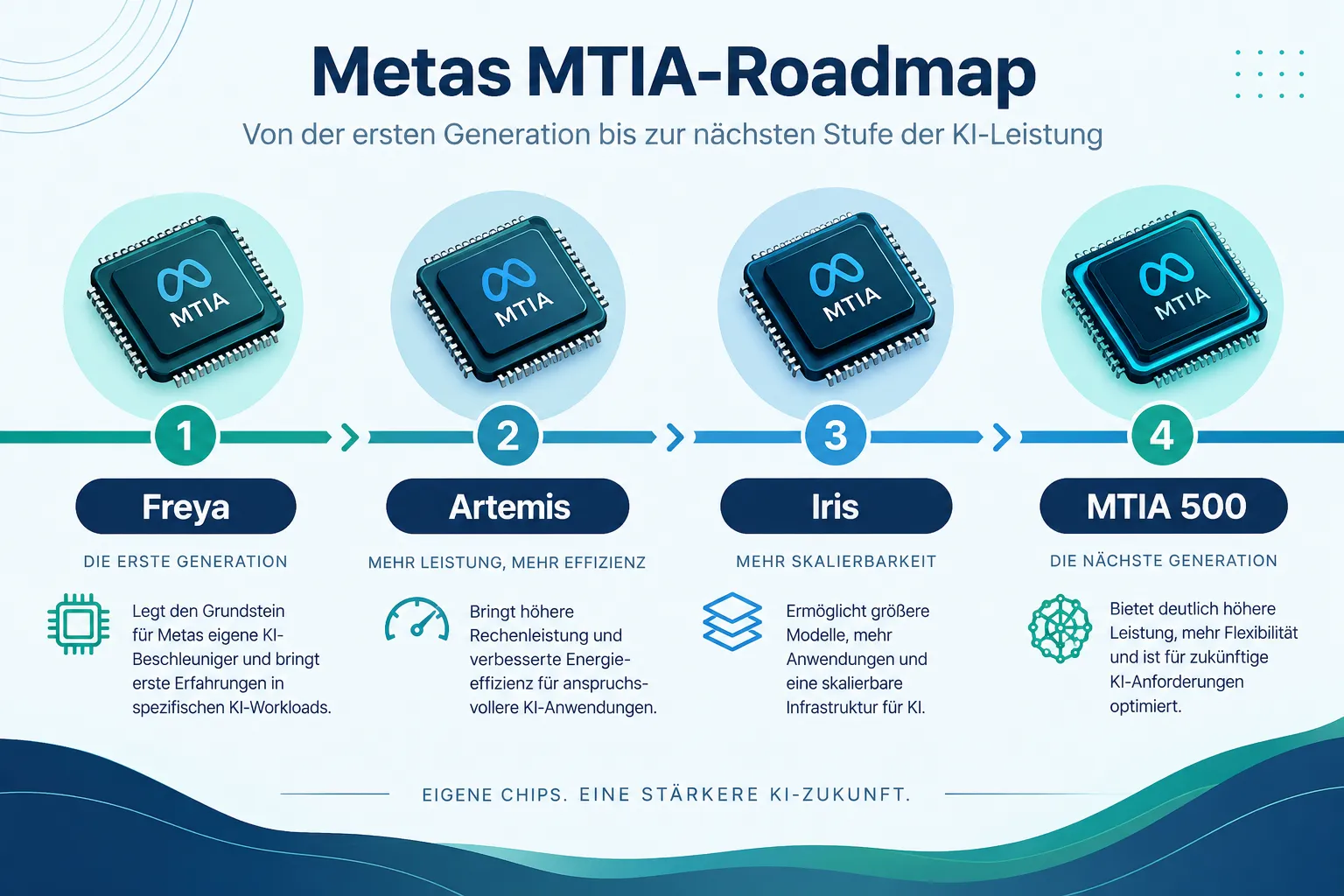
Iris is part of a larger, multi-year plan. Meta’s MTIA roadmap spans several chip generations (MTIA 300, 400, 450, 500), of which Iris is the generation currently entering production [3][5]. Each generation is expected to launch roughly every six months — an ambitious cadence more reminiscent of smartphone release cycles than traditional semiconductor development.
The next major milestone is MTIA 500, planned for mass deployment in 2027 [3][8]. This pace allows Meta to feed technological advances into its own infrastructure quickly, rather than waiting the usual two to three years between generations that classic chip cycles require.
“Hyperscalers like Meta are increasingly building their own chips so they aren’t dependent on individual suppliers,” explains Forrester analyst Mike Gualtieri [8].
That assessment captures the core of the strategy: this isn’t about pushing Nvidia out of the market, but about improving Meta’s own negotiating position and supply chain security.
Why Meta Builds Its Own AI Chips: Cost, Energy, and Independence From Nvidia
The central driver behind the Meta Iris AI chip is a combination of cost and energy efficiency. Nvidia GPUs are powerful but expensive and energy-intensive, and given the sheer scale of compute Meta needs, those costs quickly add up to billions of dollars [9]. A custom-built chip tailored to specific Meta workloads can operate more efficiently than a general-purpose GPU in certain use cases.
Importantly, Iris is not meant to replace the existing GPU infrastructure, but to complement it [3][8]. The chip is primarily designed for the following workloads:
- Ranking algorithms for Facebook and Instagram news feeds
- Recommendation systems for content and advertising
- Generative AI applications across Meta’s platforms
For especially compute-intensive training tasks, such as training large language models, Nvidia and AMD GPUs remain in use. The strategy isn’t a full departure from third-party hardware, but a targeted diversification of compute load — a pattern also seen at other hyperscalers such as Google (with its TPUs) and Amazon (with Trainium).
Nvidia’s Market Power Under Pressure: What Iris Means for the Industry
Nvidia still holds roughly 85 percent of the market for AI accelerators [8]. That dominance rests not only on the hardware itself but also on the deeply entrenched CUDA software ecosystem that developers have relied on for years. A single hyperscaler’s chip won’t shake that position in the short term.
Still, the symbolism of the Meta Iris AI chip matters. When one of the world’s largest cloud and social media companies deploys its own mass-produced chips, it sends a clear signal to the entire market: dependence on a single chip supplier is increasingly seen as a risk, not a given.
For the tech and investor community, the question “is this the end of Nvidia dependence?” is fair but needs a nuanced answer. In the short term, Nvidia remains the undisputed market leader. In the medium term, however, the balance of power could shift if more hyperscalers follow suit and scale their own chip programs to a similar extent.
A comparison of the current positioning illustrates the dynamic:
| Aspect | Nvidia GPUs | Meta Iris AI Chip |
|---|---|---|
| Market share | ~85 percent | Internal use at Meta |
| Primary use | Training, general-purpose AI workloads | Ranking, recommendations, generative AI |
| Manufacturing | In-house design, TSMC fabrication | Broadcom design, TSMC fabrication |
| Ecosystem | CUDA, broad software base | Meta-internal infrastructure |
Outlook: 14 Gigawatts of Compute Capacity and Iris’s Role Through 2027
Meta’s goal of doubling total compute capacity from roughly 7 gigawatts in 2026 to 14 gigawatts in 2027 is one of the industry’s most ambitious infrastructure commitments [1][7]. The Meta Iris AI chip will be a central, though not the only, building block in that plan. In parallel, Meta is investing in memory chips, flash storage, and fiber-optic networks to ensure the additional compute power can actually be put to use.
Looking ahead to 2027 and beyond, several developments are taking shape:
- Mass deployment of MTIA 500 starting in 2027, as the next generation after Iris [3][8].
- Continuation of the roughly six-month cadence for new chip generations.
- Further expansion of the Broadcom partnership through at least 2029 [4][6].
- Continued parallel use of Nvidia and AMD GPUs for training tasks that Meta’s own chips don’t cover.
Whether this course will actually pull significant market share away from Nvidia by 2028 remains an open question that analysts assess differently. There are currently no reliable forecasts on how market shares will concretely shift — the facts cited here are limited to Meta’s own infrastructure plans and partnerships.
Conclusion: What the Meta Iris AI Chip Means for Developers and Investors
The start of mass production for the Meta Iris AI chip is a concrete example of how hyperscalers are working to reduce their dependence on individual hardware suppliers. The combination of in-house chip design, Broadcom’s engineering expertise, and TSMC’s manufacturing capacity shows a pragmatic middle path: Iris doesn’t replace Nvidia, but takes over specifically those workloads where a specialized chip operates more economically.
For developers working with Meta’s infrastructure, this means new optimization opportunities for ranking and recommendation systems in the medium term. For investors, the development sends an important signal: anyone evaluating the AI chip industry shouldn’t just watch Nvidia’s revenue figures, but also keep an eye on the growing number of in-house chip programs at major cloud and platform companies. The next concrete milestones — the mass deployment of MTIA 500 in 2027 and progress toward doubling capacity to 14 gigawatts — will show just how durable this shift really is.
References
[1] Meta Put Ai Chip Into Production September It Looks Double Computing Capacity 2026 07 09 – https://www.reuters.com/world/asia-pacific/meta-put-ai-chip-into-production-september-it-looks-double-computing-capacity-2026-07-09/
[2] Meta Start Production Iris Ai 122141801 – https://finance.yahoo.com/technology/ai/articles/meta-start-production-iris-ai-122141801.html
[3] Meta Iris Ai Chip Mtia Production 2026 – https://tech-insider.org/meta-iris-ai-chip-mtia-production-2026/
[4] Metas Iris Chip Enters Production In September Broadcom – https://letsdatascience.com/blog/metas-iris-chip-enters-production-in-september-broadcom
[5] Metas Iris Ai Chip Passes Testing Broadcom Now Designs Chips Three Rivals – https://www.techtimes.com/articles/320839/20260717/metas-iris-ai-chip-passes-testing-broadcom-now-designs-chips-three-rivals.htm
[6] Meta To Put Ai Chip Into Production In September Report – https://www.cnbc.com/2026/07/09/meta-to-put-ai-chip-into-production-in-september-report.html
[7] Exclusive Meta Put Ai Chip 112222555 – https://finance.yahoo.com/technology/ai/articles/exclusive-meta-put-ai-chip-112222555.html
[8] Meta Iris Ai Chip Nvidia Market Share 2026 – https://tech-insider.org/ca/meta-iris-ai-chip-nvidia-market-share-2026/
[9] Meta Custom Chips Nvidia Cost Energy – https://cryptobriefing.com/meta-custom-chips-nvidia-cost-energy/
[10] Exclusive Meta Put Ai Chip Production September Looks Double – https://www.globalbankingandfinance.com/exclusive-meta-put-ai-chip-production-september-looks-double/