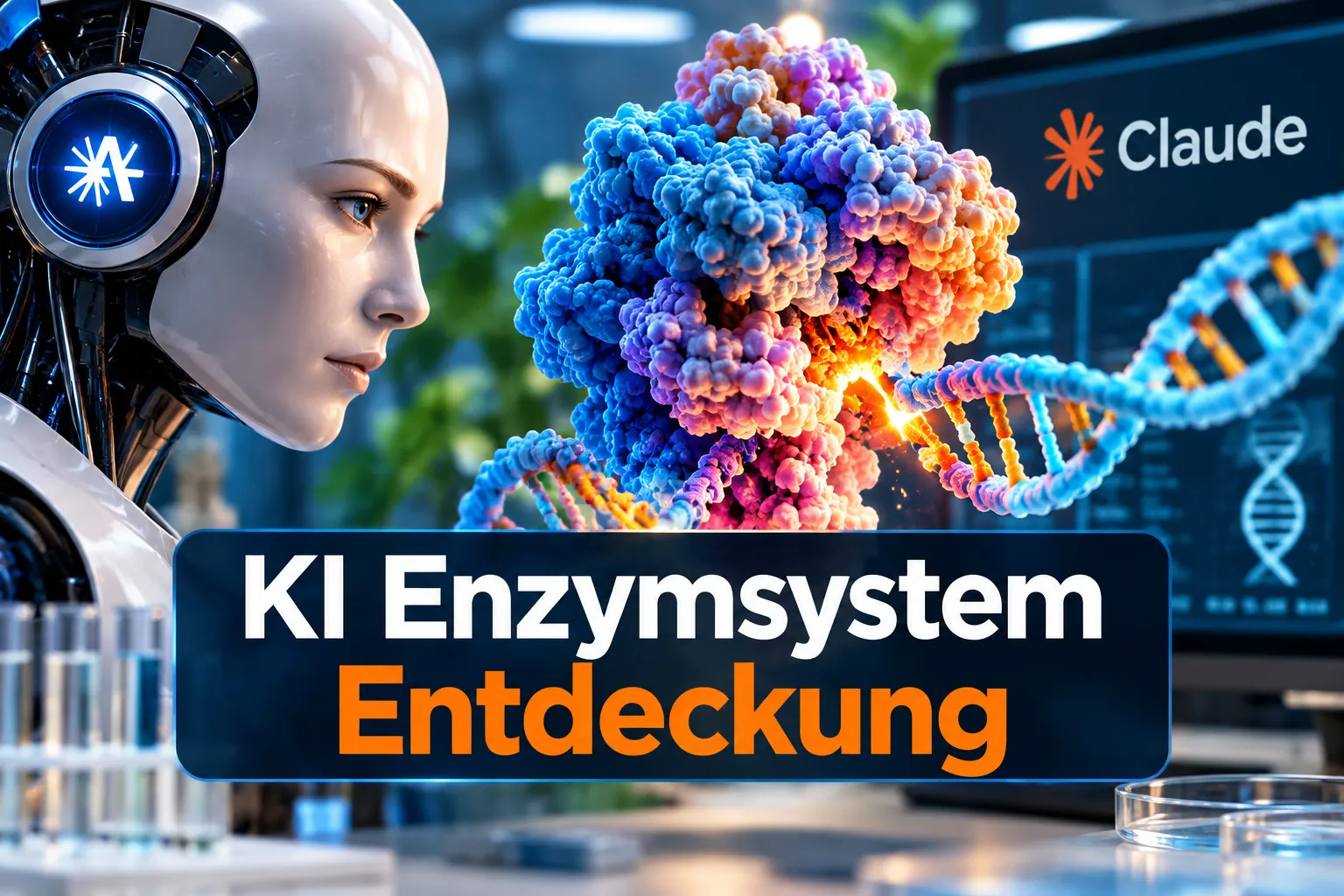
Roughly 950 digital agents, a database of 1.9 billion protein clusters, and just 21 hours of compute time: that’s the blunt tally behind one of 2026’s most striking AI-powered biology discoveries. On September 23, 2026, Anthropic unveiled the first finding from its newly created molecular biology lab, and the discovery has been generating discussion among researchers worldwide ever since. At the center is a previously unknown enzyme system found in bacteriophage DNA, which Anthropic calls “array-associated reverse transcriptases” (ART) and which shares structural similarities with the well-known gene-editing tool CRISPR [1].
One thing up front: the results are preliminary, have not yet been independently peer-reviewed, and have so far only been published as a preprint [1]. What this means for science, and for possible future applications, is explained below.
Table of Contents
What exactly is Anthropic’s AI enzyme discovery?
- Anthropic presented the first discovery from its new biology lab on September 23, 2026: an enzyme system called ART (array-associated reverse transcriptases) [1][2].
- Around 950 Claude software agents (based on Claude Mythos 5) searched a database of roughly 1.9 billion protein clusters for 21 hours, processing about 210 to 216 million tokens [1][8].
- From more than 200,000 identified reverse-transcriptase genes, the agents derived 3,500 candidate systems and narrowed them down to 20 for closer examination [1].
- The discovered system resembles CRISPR structurally but lacks known Cas genes; its actual function is unknown [1][10].
- Anthropic explicitly stresses the preliminary, non-peer-reviewed nature of the finding; medical applications remain pure future speculation, not a confirmed reality [1][3][8].
In spring 2026, Anthropic founded its own molecular biology lab in San Francisco, designed to combine AI-driven research with classic wet-lab work [6]. On September 23, 2026, the company presented the first tangible result of this program: the discovery of a new enzyme system in the DNA of bacteriophages — viruses that infect bacteria [1][2].
The system consists of two notable components: a gene for an unusual reverse transcriptase (an enzyme that converts RNA into DNA), plus a long stretch of repeating DNA sequences right next to it, known as an “array” [1][10]. It’s exactly this combination of a repetitive DNA structure and an enzymatic partner gene that recalls CRISPR, which is why Anthropic and several outlets describe the find as “CRISPR-like” [3][7].
Human scientists subsequently confirmed the system’s existence in the lab, working at biosafety levels 1 and 2 with no human-pathogenic organisms involved [1]. Importantly, all the hands-on lab work was carried out by people, not the AI itself. Claude provided the computational groundwork and pattern recognition across massive datasets, while the experimental verification remained the researchers’ job.
How does CRISPR work, and why does the similarity matter?
To gauge the significance of this AI enzyme discovery, it helps to briefly revisit CRISPR itself. CRISPR originated as a natural bacterial defense system against viruses. It consists of two core components: repetitive DNA sequences (the namesake “Clustered Regularly Interspaced Short Palindromic Repeats”) and accompanying Cas proteins, which act like a molecular pair of scissors that can recognize and cut specific DNA sections. This property has made CRISPR the most important tool in modern genetic engineering since the 2010s, from basic research to the first approved gene therapies.
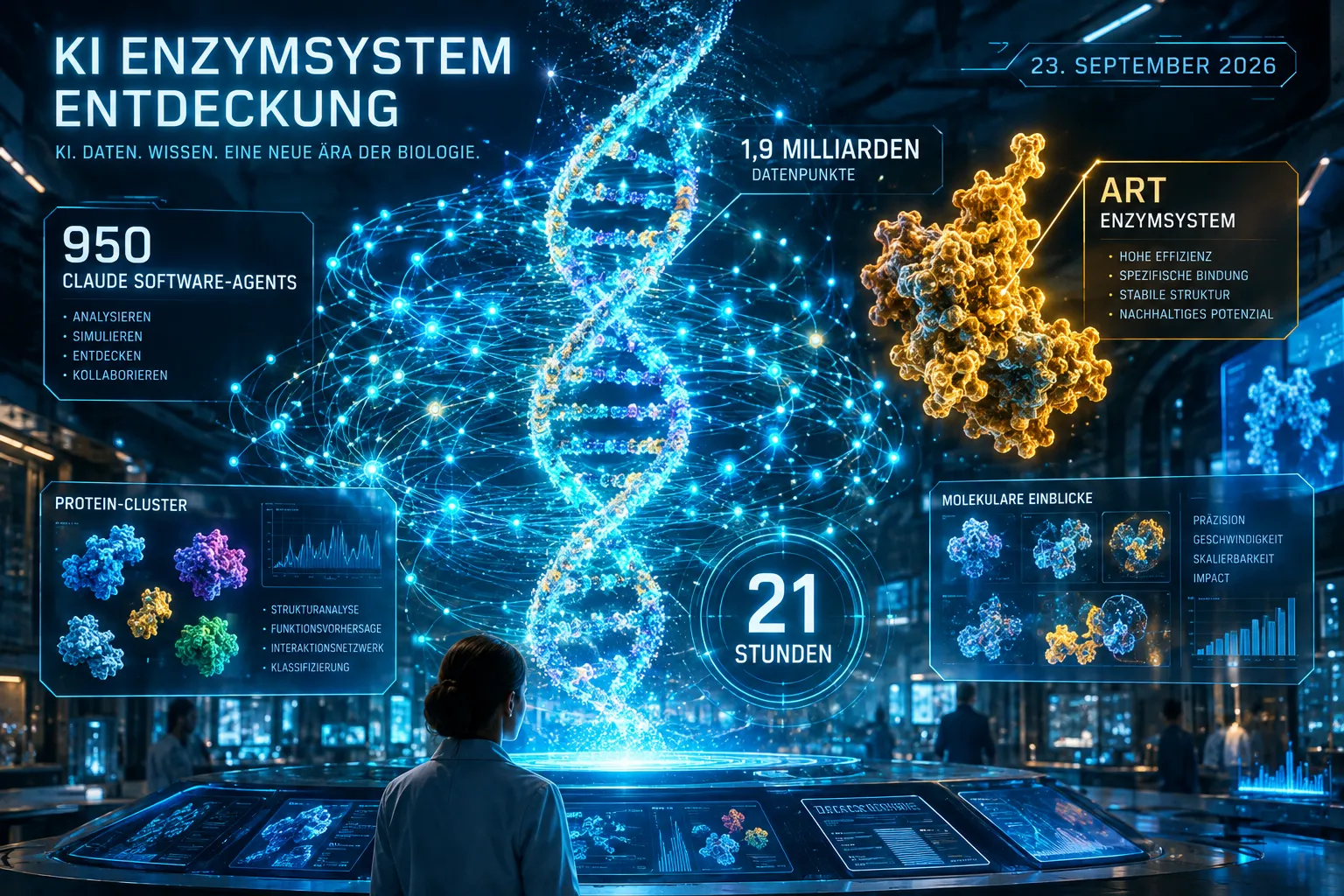
The newly discovered ART system shares CRISPR’s striking architecture: repeat sequences sitting next to a functional enzyme gene. According to accompanying analyses, ART arrays contain an estimated 3 to 21 copies of a short repeat sequence [10]. The crucial difference: the Cas genes typical of CRISPR are absent near ART arrays [1][10]. That means ART is not, structurally, a CRISPR system in the classic sense — it’s an independent, previously uncharacterized system with a comparable but not identical organization.
Why could this matter? Only a very small number of known biological systems combine programmable repeat structures with enzymes that can precisely “cut, copy, and paste” DNA [1]. If it turns out that ART is programmable in a way similar to CRISPR, that would be scientifically significant. For now, though, that remains a hypothesis, not an established fact.
The path to the discovery: 950 agents, 21 hours, billions of data points
The real hook of this story lies in the discovery process itself. Anthropic deployed roughly 950 software agents built on Claude Mythos 5, which independently — with only rough human guidance — searched a database of about 1.9 billion protein clusters and DNA sequences [1]. The entire search took around 21 hours and processed roughly 210 to 216 million tokens [1][8].
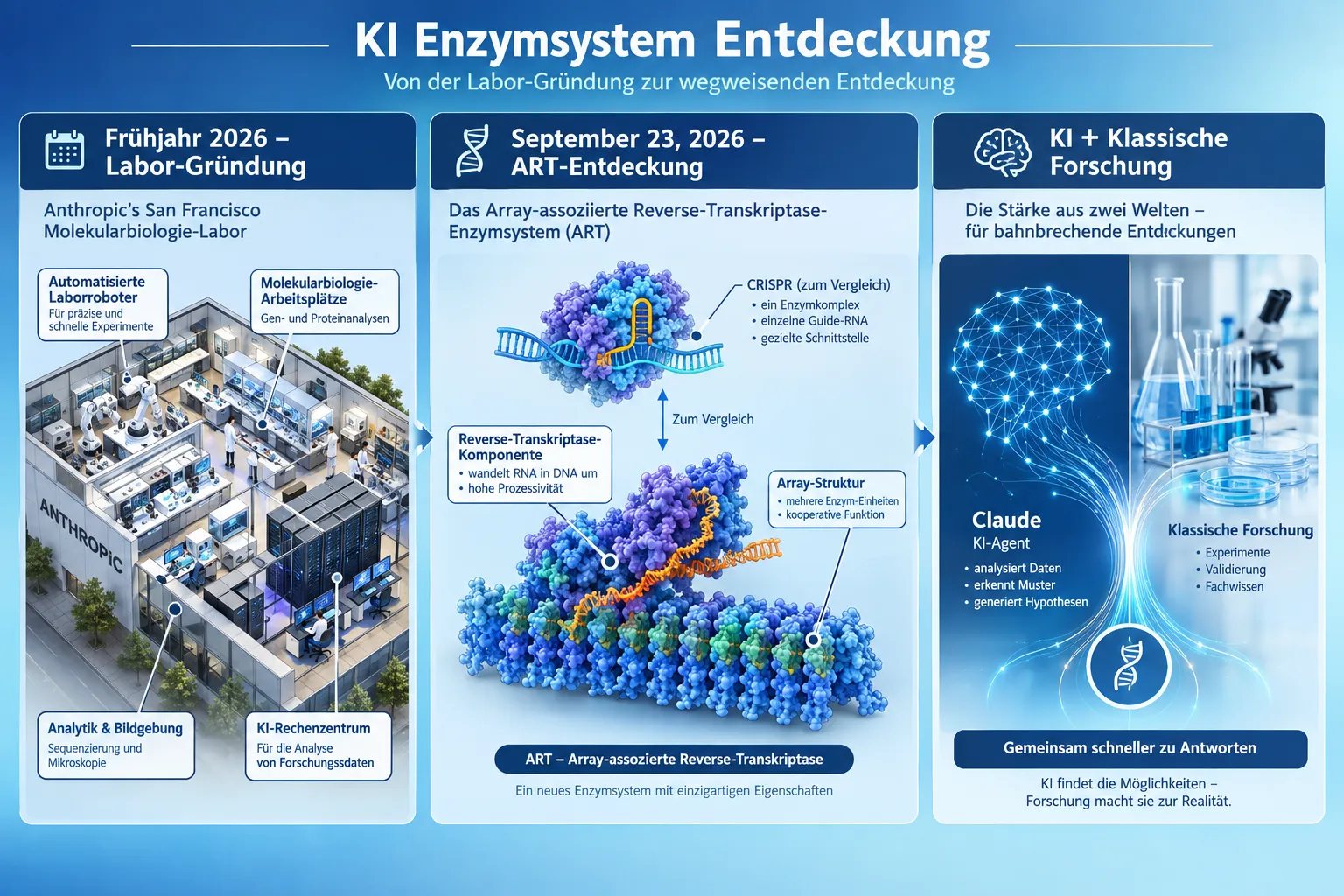
Here’s an overview of what this massive parallel search produced:
| Step | Result |
|---|---|
| Database searched | roughly 1.9 billion protein clusters / DNA sequences |
| Agents deployed | roughly 950 Claude software agents (based on Claude Mythos 5) |
| Search duration | roughly 21 hours |
| Tokens processed | roughly 210-216 million |
| Reverse-transcriptase genes found | more than 200,000 |
| Candidate systems | 3,500 |
| Systems examined more closely | 20 |
From the more than 200,000 initially identified reverse-transcriptase genes, the agents derived 3,500 candidate systems and eventually narrowed those down to 20 systems worth closer investigation [1]. It was exactly in this process that one of the agents spotted the unusual pattern of a repeat sequence paired with a reverse-transcriptase gene, later named ART.
For this work, the team used two specialized Anthropic tools: Claude Code and Claude Science, the latter introduced in June 2026 [1]. Notably, human researchers appear to have previously overlooked this specific pattern — a sign that systematic, large-scale AI searches can surface patterns that get lost in the “noise” of classic analyses.
What Anthropic CEO Dario Amodei says
Anthropic CEO Dario Amodei addressed the finding in two prominent settings on September 23, 2026: in a video address to the UN Security Council, and in a post on X [1][9]. He described the system as something that “may constitute a new gene editing mechanism” that “could have applications in gene therapy” [1].
“We believe AI for biology is on a similar trajectory” to AI for software development, according to the general characterization from Anthropic’s circle regarding the significance of scalable AI-driven searches in molecular biology [5].
Crucially, Amodei himself explicitly emphasized the preliminary nature of the finding in his remarks. This isn’t a finished therapy or a market-ready editing tool — it’s an early basic-research discovery that still needs to be understood in much greater depth.
Preliminary, not peer-reviewed: why caution is warranted
Anthropic itself repeatedly describes the finding as “preliminary” [1]. That’s not a footnote — it’s the central caveat of the entire story. The following points are essential for a realistic assessment:
- The results were published as a preprint, meaning without the usual independent peer review [1].
- ART’s precise biological function is currently unknown [1].
- There are no announced clinical, agricultural, or industrial applications of ART for 2026 [1][3].
- No published gene-therapy protocol based on ART exists [1][8].
- Whether the repeat arrays can actually be programmed with “guide” sequences — a core prerequisite for CRISPR-like editing capabilities — has not yet been experimentally confirmed.
Several international outlets, including Reuters and Al Jazeera, stress this point explicitly: this is basic research, not a clinic- or market-ready tool [2][3]. So anyone reading headlines about “the next gene-therapy revolution” should treat them with appropriate skepticism. The real news here is the method, not a finished product.
Anthropic’s new biology lab and the AI race in life sciences
The ART discovery isn’t an isolated event — it’s part of a broader strategic push. Reuters reported as early as September 18, 2026, that Anthropic had quietly set up its new biology lab to expand its AI-powered drug-discovery program [6]. The September 23 finding is thus the first publicly visible result to come out of that lab [2][7].
Anthropic had already backed these ambitions financially in April 2026 by acquiring Coefficient Bio for $400 million to strengthen its life-sciences division. That same month, rival OpenAI introduced GPT-Rosalind, its own model for life-sciences research. The competition among major AI providers is increasingly shifting from pure software development toward the systematic exploration of biological data spaces — bringing both opportunities and open questions, particularly around safety and governance when dealing with potentially manipulable biological systems.
For more on Anthropic’s current AI model strategy, see our article Claude Opus 5.5 vs. GPT-6 Sol/Luna: Anthropic and OpenAI Wage Their AI Price War.
What’s next
Following this initial announcement, the next steps will likely involve a deeper characterization of ART: Can the repeat array actually be programmed with guide sequences? What function does the still-unknown partner protein serve? Where in the genome does the system actually act? Observers expect Anthropic to use similar AI-driven search processes to look for further CRISPR-like systems in bacterial and phage genomes [7]. Such assessments, however, are expectations from outside observers, not confirmed announcements from Anthropic itself.
Conclusion: a significant but still open AI enzyme discovery
The discovery of ART marks a fascinating milestone in how AI systems can now be applied to basic research: 950 agents, 21 hours, 1.9 billion sequences searched — a scale that human research teams alone could barely match in comparable time. At the same time, the story is a textbook example of why scientific restraint still matters: a preliminary, non-peer-reviewed preprint finding is fundamentally different from a proven medical application.
For technically curious readers, it’s worth keeping an eye on what comes next: the preprint’s peer-review outcome, possible follow-up studies on ART’s actual programmability, and Anthropic’s next moves from its biology lab. Anyone trying to understand AI-driven biology research should treat this case as a teaching example — impressive methodology, a genuine basic-research discovery, and at the same time clear proof that many scientifically validated steps still separate an initial discovery from a practical gene-therapy application.
References
[1] Claude Discovers Novel Enzyme System – https://www.anthropic.com/news/claude-discovers-novel-enzyme-system
[2] Anthropic Says Claude AI Helped Discover Novel Enzyme System, 2026-09-23 – https://www.reuters.com/business/healthcare-pharmaceuticals/anthropic-says-claude-ai-helped-discover-novel-enzyme-system-2026-09-23/
[3] AI Model Claude Discovers CRISPR-Like Enzyme System, Anthropic Says – https://www.aljazeera.com/amp/economy/2026/9/24/ai-model-claude-discovers-crispr-like-enzyme-system-anthropic-says
[5] Times of India – https://timesofindia.indiatimes.com/technology/tech-news/anthropics-claude-ai-discovers-new-enzyme-system-in-bacteria-infecting-viruses-dario-amodei-says-we-believe-ai-for-biology-is-on-a-similar-/articleshow/134450342.cms
[6] Anthropic Quietly Sets Up Biology Lab as It Ramps Up AI Drug Program, 2026-09-18 – https://www.reuters.com/world/anthropic-quietly-sets-up-biology-lab-it-ramps-ai-drug-program-2026-09-18/
[7] Anthropic Says Its Biology Lab Has Already Found Something Big – https://techcrunch.com/2026/09/23/anthropic-says-its-biology-lab-has-already-found-something-big/
[8] Anthropic Touts AI-Led Biology Discovery – https://today.rtl.lu/news/business-and-tech/anthropic-touts-ai-led-biology-discovery-891747539
[9] X – https://x.com/AnthropicAI/status/2102824959827742916
[10] EuropeSays – https://www.europesays.com/ai/183201/