Over 50,000 GitHub stars in just a few weeks. That’s the number that shows how hard Paperclip AI shook up the multi-agent orchestration market when it launched in March 2026. Anyone searching for Paperclip AI alternatives today quickly runs into a surprisingly diverse field: from Microsoft’s research framework AutoGen to the local personal agent OpenClaw, which racked up five times as many stars in even less time. For technical founders and operators who want to run agent fleets across multiple business functions, it’s worth taking a close look at the differences before making a decision.
This article breaks down the most relevant Paperclip AI alternatives, compares them along clear criteria, and shows which tool fits which use case.
Table of Contents
Key Takeaways
- Paperclip AI is a coordination layer above individual agents, not just another chatbot wrapper.
- OpenClaw, built by developer Peter Steinberger, is the most popular alternative with over 250,000 GitHub stars, but it operates at the executor level, not the orchestration level.
- LangChain and CrewAI are the most widely used options for engineering teams building their own LLM pipelines.
- AutoGen remains the strongest choice for research-oriented multi-agent experiments with human-in-the-loop.
- Choosing the right Paperclip AI alternative mainly comes down to agent model, setup effort, and governance needs.
What Is Paperclip AI, and Why Are Users Looking for Alternatives?
Paperclip AI doesn’t position itself as a single chat agent, but as a coordination layer that manages multiple agents within an organization. The tool launched in March 2026 and collected over 50,000 GitHub stars in its first few weeks, a clear sign of massive interest from the developer community. The core idea: instead of manually wiring individual agents together, teams get a control layer that distributes tasks, merges results, and automates processes across departments.
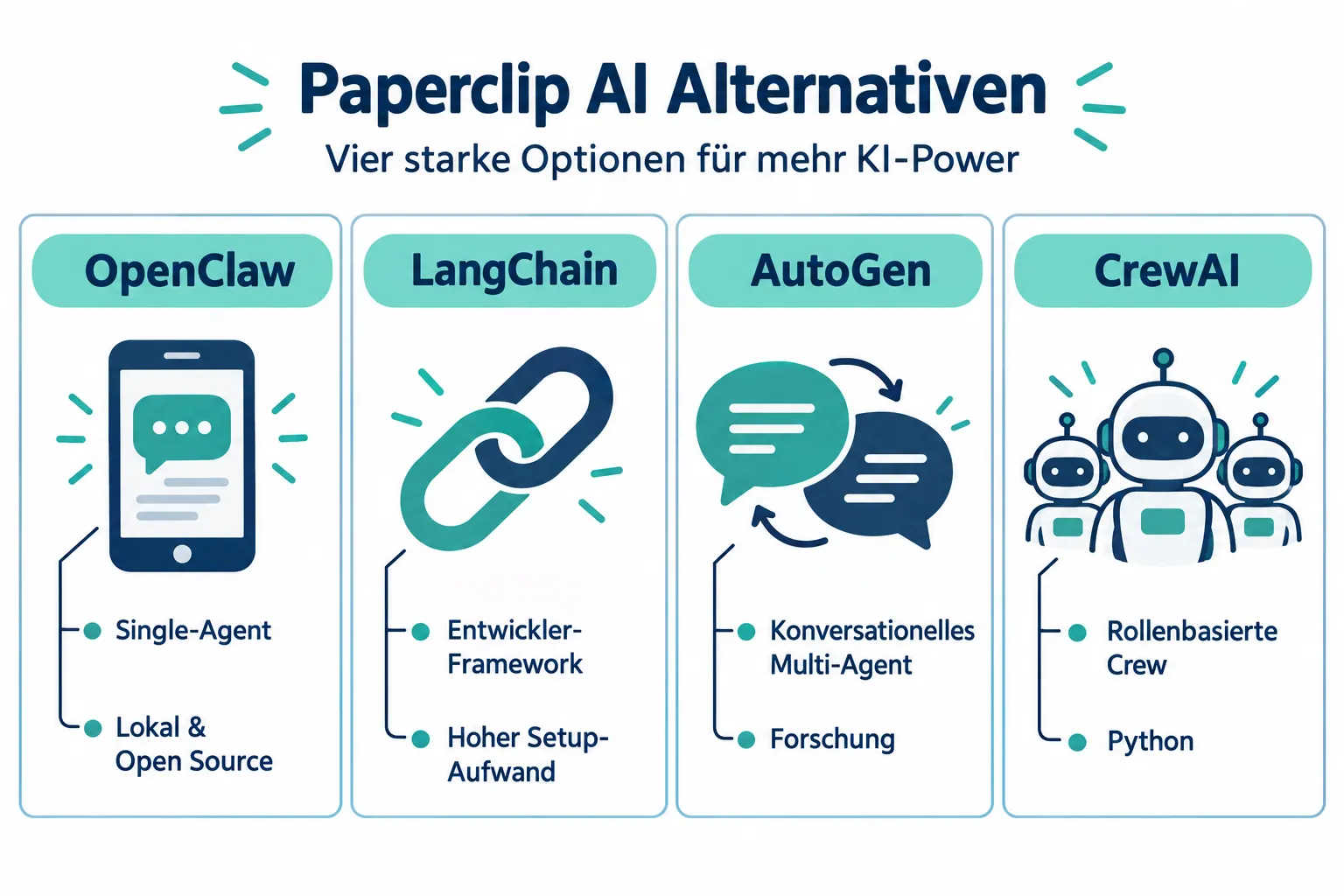
Despite its strong launch, many users are looking for Paperclip AI alternatives for different reasons: some want full control over the code, others need local execution without cloud dependency, and others prefer experimenting with research frameworks. That’s exactly where tools like OpenClaw, LangChain, AutoGen, and CrewAI come in, each with its own focus.
The Best Paperclip AI Alternatives at a Glance
The four most relevant alternatives differ significantly in architecture and target audience. While Paperclip AI focuses on ready-made orchestration across multiple agents, the following tools either offer individual building blocks to assemble yourself or a focused single-agent approach.
The table below summarizes the key differences:
| Tool | Type | Agent Model | Setup Effort | Open Source | Self-Host | Best For |
|---|---|---|---|---|---|---|
| OpenClaw | Personal AI Agent | Single-Agent Executor | Moderate | Yes, MIT | Yes | Personal productivity and local task automation |
| LangChain | Developer Framework | Configurable Chains/Graphs | High | Yes | Varies | Engineering teams building custom LLM pipelines |
| AutoGen | Python Framework | Conversational Multi-Agent | Moderate to high | Yes, MIT | Yes | Researchers and ML engineers |
| CrewAI | Python Framework | Role-Based Crew | Moderate | Yes, MIT | Yes | Python developers building multi-agent applications |
OpenClaw: The Closest Peer in Open-Source Spirit
OpenClaw was built by Peter Steinberger and launched in late 2025, originally under the name “ClawdBot.” Within just a few months, the project collected over 250,000 GitHub stars, more than any other alternative in this comparison. The reason for its popularity lies in its focus: OpenClaw runs locally, connects directly to WhatsApp, Telegram, Slack, and Discord, and works as a single-agent executor for personal productivity.
Important for teams already working with Paperclip AI: OpenClaw doesn’t compete directly, it can be deployed as an execution worker inside a Paperclip organization. It handles the execution layer, while Paperclip manages coordination across multiple agents. As an MIT-licensed, self-hostable solution, OpenClaw is the Paperclip AI alternative discussed here with the closest philosophical kinship to Paperclip’s open-source and self-hosting approach, but it clearly operates at the executor level rather than the orchestration level.
LangChain: The Building-Block Framework for Engineering Teams
LangChain first appeared in late 2022 and is considered one of the foundational frameworks for LLM orchestration, available for Python and JavaScript. Unlike Paperclip AI, LangChain doesn’t ship a finished product with a dashboard, it provides building blocks: chains, tool integrations, RAG pipelines, and agent loops that development teams assemble themselves.
This building-block approach means a high setup effort, but maximum flexibility in return. LangChain is especially well suited for engineering teams that want to build their own, custom-tailored LLM pipeline and don’t want to rely on a pre-built orchestration layer.
AutoGen: Microsoft’s Framework for Multi-Agent Research
AutoGen is Microsoft’s open-source framework for multi-agent systems, first released in 2023 and actively developed ever since. The focus is on conversational multi-agent workflows in Python: agents communicate with each other through structured conversations, with optional human-in-the-loop participation.
AutoGen is especially popular in research and among teams experimenting with new patterns of agent collaboration. Setup effort sits in the moderate-to-high range. As an MIT-licensed, self-hostable framework, AutoGen is the natural choice for researchers and ML engineers who want to dig deep into agent interaction patterns rather than look for an out-of-the-box business orchestration layer.
CrewAI: Role-Based Coordination for Python Developers
CrewAI launched in early 2024 as an open-source Python framework with a role-based coordination model. Groups of AI agents work toward shared goals, similar to a team with clearly defined roles. CrewAI offers an accessible set of automation tools without requiring developers to write the entire orchestration logic from scratch.
Setup effort is moderate, the license is MIT, and the framework is self-hostable. That makes CrewAI a clear fit for Python developers who want to build multi-agent applications without starting completely from zero.
What to Look for in a Paperclip AI Alternative
The decision for a specific Paperclip AI alternative depends heavily on the use case. Six criteria help with a systematic evaluation.
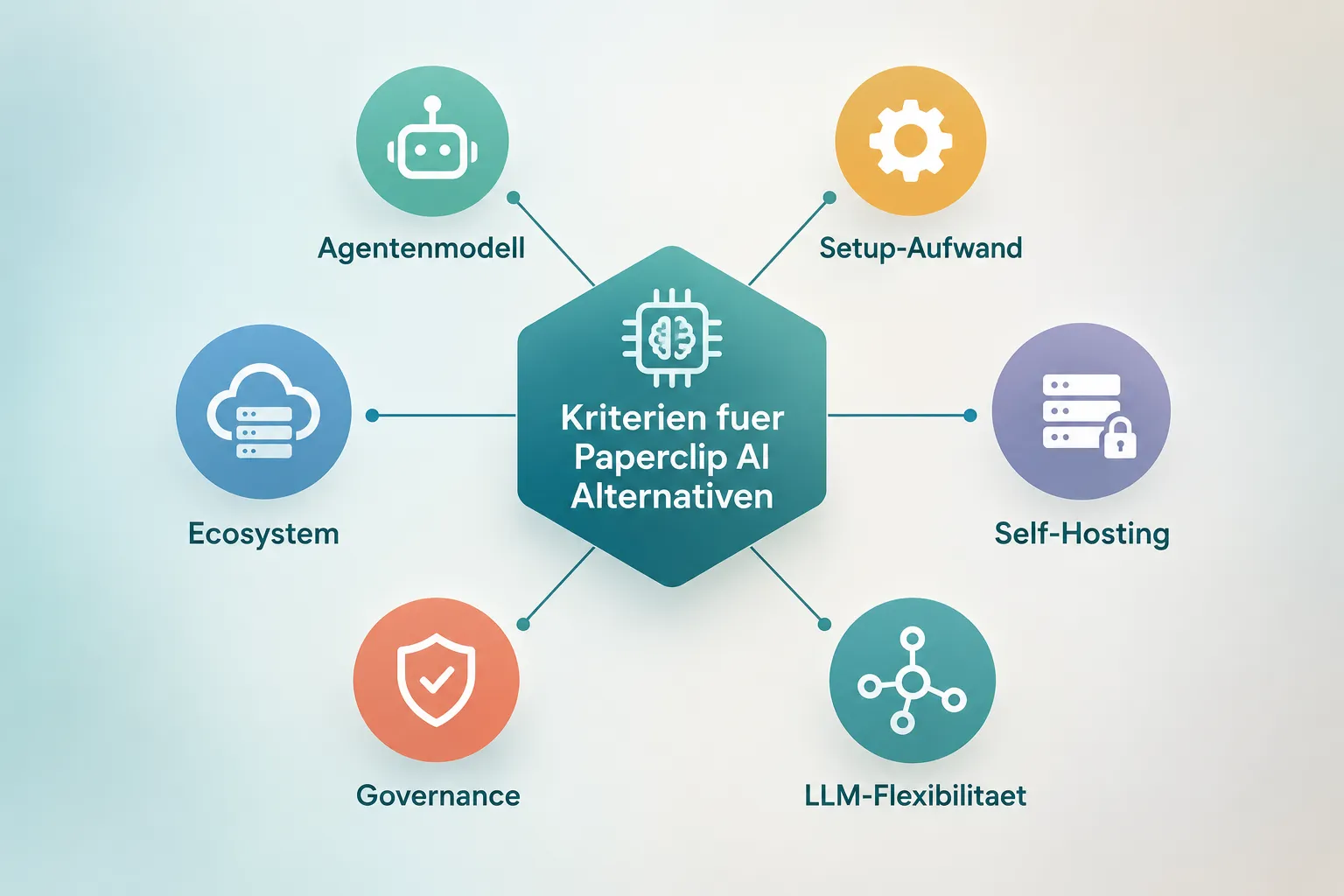
Agent model. The central distinction is multi-agent coordination versus single-agent executor. Anyone who wants to orchestrate multiple agents across departments needs a real coordination model like Paperclip AI, AutoGen, or CrewAI. Anyone automating a single personal task can get by with a single executor like OpenClaw.
Setup effort. DIY frameworks like LangChain require significantly more engineering time than ready-to-run solutions with a dashboard. That pays off when maximum customization is required, but it costs time until the first productive use.
Self-hosting and open source. For data privacy, cost control, and infrastructure flexibility, it’s crucial whether a tool is self-hostable. All four compared alternatives are open in this sense; LangChain varies depending on the component.
LLM provider flexibility. Vendor lock-in to a single model provider should be avoided. Frameworks that support multiple LLM providers stay more flexible long-term, especially as prices or model quality change.
Governance and control. When running agents autonomously, approval gates, audit trails, and budget enforcement quickly become business-critical. Anyone letting agents act independently should check how granularly approvals and cost limits can be controlled.
Ecosystem and extensibility. Pre-built integrations, skill libraries, and community templates significantly speed up onboarding. An active ecosystem means less in-house development and faster time-to-value.
“There’s no single ‘best’ alternative for every use case,” is how the core of the market analysis can be summed up. The choice follows the concrete use case, not a generic ranking.
Which Paperclip AI Alternative Is Right for You?
For personal productivity and local single-agent automation, OpenClaw is currently the most obvious choice among Paperclip AI alternatives, with a close kinship to Paperclip’s open-source and self-hosted philosophy, but clearly positioned at the execution rather than the coordination level.
Engineering teams that need custom LLM orchestration pipelines most often reach for LangChain or CrewAI, both among the most widely adopted frameworks in this space. Research-oriented teams looking to test new multi-agent collaboration patterns will find AutoGen the strongest option.
For technical founders and operators who want to run agents autonomously across multiple business functions without permanently maintaining their own codebase, Paperclip AI remains, as of 2026, the most complete out-of-the-box solution. The other four tools complement this picture rather than replacing it, depending on which layer of the agent architecture the work needs to happen at.
Conclusion
The search for Paperclip AI alternatives doesn’t lead to a single winning solution, but to a map of different layers: execution with OpenClaw, DIY pipelines with LangChain, conversational multi-agent research with AutoGen, and role-based teams with CrewAI. Anyone who has to decide today should first clarify their own agent model, then weigh setup effort and governance requirements against the resources available.
As a next step, a small proof of concept is recommended: a concrete business scenario with two to three agents, tested in parallel in Paperclip AI and whichever alternative fits best. That makes it possible to reliably assess within a few days which tool actually holds up for your own organization in 2026.
Source: Contabo Blog, “Paperclip AI vs LangChain, AutoGen & More: 5 Alternatives Compared,” published May 22, 2026, author Tobias Mildenberger. https://contabo.com/blog/paperclip-ai-alternatives/