A large language model that only trusts its training data has no idea, by default, about the notice period in your current lease, your company’s price list from last week, or the internal handbook that was updated just yesterday. This is exactly where Retrieval-Augmented Generation comes in — and exactly why it’s worth treating building RAG systems as a concrete, learnable skill rather than an abstract buzzword. If you already work with ChatGPT or Claude, you know the limits of pure model knowledge. RAG shifts those limits fundamentally: the model gets fresh, verified knowledge from your own documents at every request, instead of guessing or hallucinating.
This guide walks step by step through the architecture, the core components, and the tools you need to build your own RAG systems — practical, technically grounded, and without unnecessary fluff.
Table of Contents
Key Takeaways
- RAG combines the language ability of LLMs with targeted document search, significantly reducing hallucinations.
- The three central building blocks are chunking, embeddings, and a vector database — every component directly affects answer quality.
- The pipeline always follows the same pattern: embed the query, find similar chunks, write context into the prompt, generate the answer.
- Frameworks like LangChain and LlamaIndex handle a lot of the groundwork, but they don’t replace clean chunking and evaluation.
- Modern production systems increasingly rely on hybrid retrieval (vector plus keyword) and reranking instead of pure vector search.
Why Build RAG Systems at All?
LLMs are trained with a knowledge cutoff and know neither your internal documents nor events that happened after that date. When context is missing, models often fill the gaps with plausible-sounding but false statements — the well-known hallucination problem. RAG solves this by giving the model relevant text passages from your own knowledge base at runtime, before it answers.
If you’re considering training your own model instead of a knowledge base, read our comparison Fine-Tuning vs. Prompt Engineering: Is Training Your Own AI Model Worth It? first. If you’re unsure how to phrase your queries to the model, our guide Prompt Engineering for Beginners: How to Get Better AI Answers covers the basics.The advantage over classic fine-tuning: you don’t need to retrain the model when content changes. A new document in the knowledge base is enough. That makes RAG especially attractive for companies that want to make internal handbooks, support tickets, contract documents, or product catalogs searchable — up to date, traceable, and without touching the model itself.
Vector databases are the search engine behind the scenes: highly optimized systems for finding the semantically closest matches among millions of text passages in milliseconds — but on their own they aren’t enough to guarantee correct answers [2].
The Core Components of Building RAG Systems
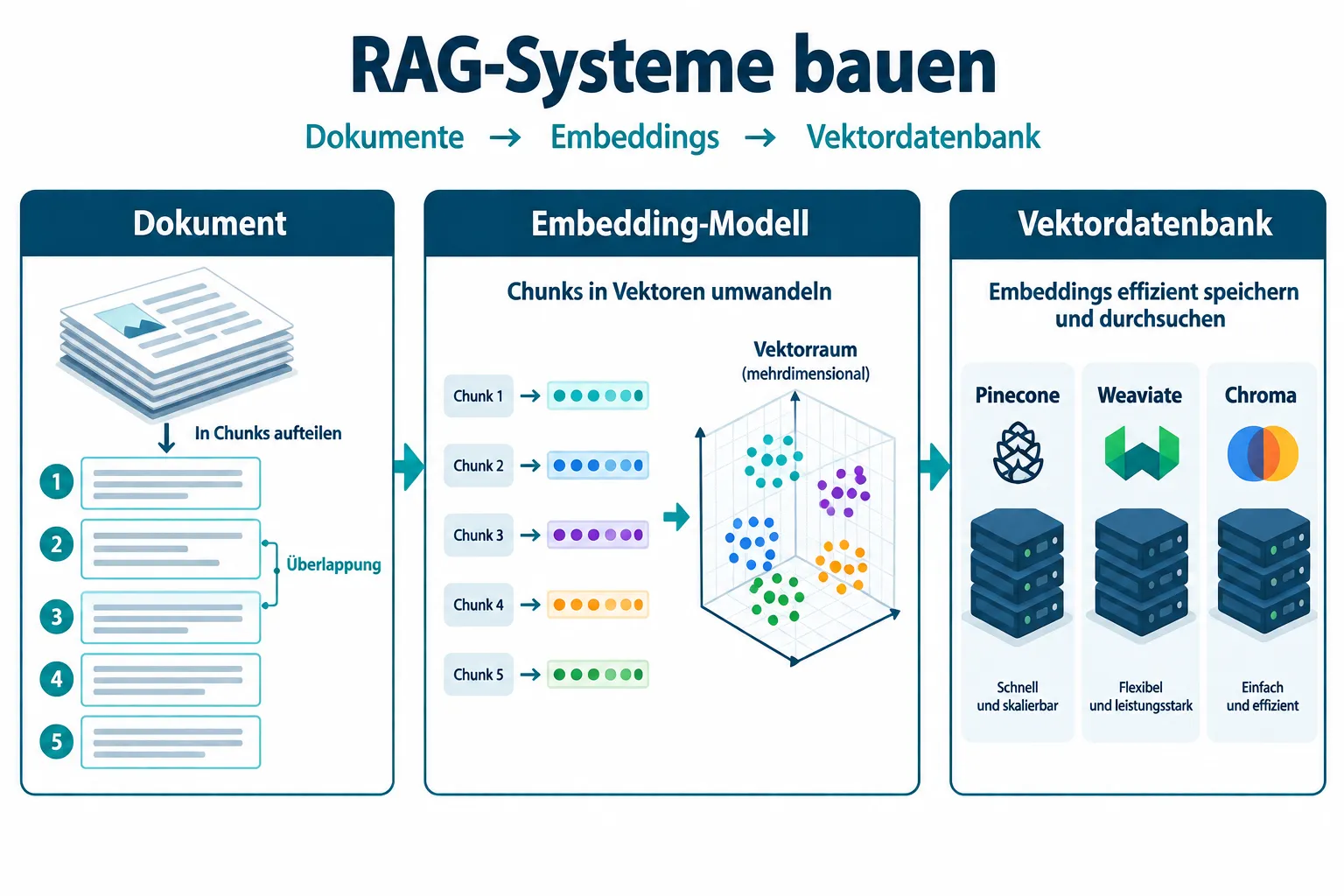
If you want to build RAG systems, you need to understand and align three building blocks: chunking, embeddings, and the vector database. Any weakness in one of these blocks directly affects answer quality.
Chunking: Splitting Documents Sensibly
Before anything can be embedded, documents need to be broken into manageable sections, called chunks. Chunks that are too large dilute search relevance; chunks that are too small tear sentences out of their context.
Proven rules of thumb:
- Chunk size: usually 300 to 800 tokens, depending on the document type
- Overlap: 10 to 20 percent overlap between adjacent chunks so information isn’t lost at the boundaries
- Use structure: use headings, paragraphs, and tables as natural dividing lines instead of rigid character limits
Newer approaches like semantic chunking group sentences by content similarity instead of fixed token counts, which improves context fidelity especially for heterogeneous documents. For legal or technical documents with a clear structure, a hybrid search that finds exact passages via keyword matching is also worthwhile — pure semantic similarity doesn’t automatically guarantee the right answer [14].
Embeddings: Turning Text into Vectors
An embedding model translates text into a vector — a list of numbers that encodes the meaning of the text in a mathematical space. Semantically similar texts end up close together, regardless of the exact wording. This property makes it possible to match a user question phrased with completely different words to the right document passage anyway.
Comparing Vector Databases
The vector database stores these embeddings and enables fast similarity search. The choice depends heavily on the use case:
| Solution | Strength | Typical Use Case |
|---|---|---|
| Pinecone | Fully managed, very low latency under high query load | Production RAG with scaling requirements [5][7] |
| Weaviate | Open source, good for large or on-premise deployments | Enterprises with compliance requirements [3][10] |
| Chroma | Lightweight, deployable locally | Prototypes and smaller projects [3] |
| Qdrant | Self-hosted, very performant | Latency-critical self-managed setups [5][10] |
| pgvector | Extension for PostgreSQL | Teams with an existing Postgres stack [10] |
"Semantically similar text is not automatically the right answer" — this principle should guide every decision about a retrieval strategy [14].
Before committing, it’s worth running a realistic test: take a set of at least 200 example queries with typical difficulties — paraphrases, technical terms, multi-step questions — run them against the same dataset across several candidates, and compare recall, answer accuracy, and latency under realistic load, instead of blindly trusting vendor claims [4].
The Retrieval-Plus-Generation Pipeline in Detail
The actual workflow when building RAG systems always follows the same basic pattern, regardless of which tools run in the background:
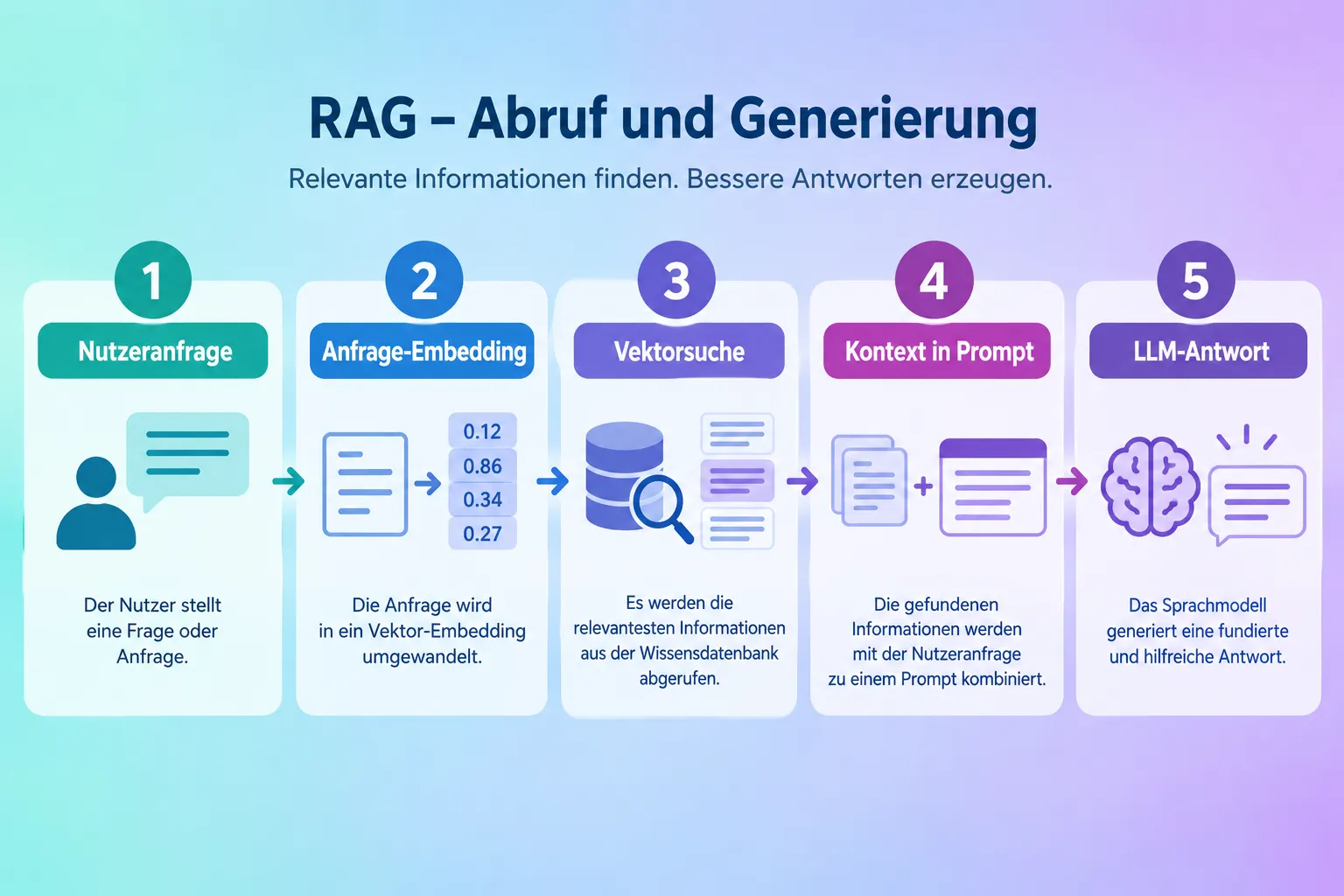
- User query: The user asks a question in natural language.
- Embedding the query: The same embedding method used for the documents converts the question into a vector.
- Vector search: The database searches for the chunks whose vectors are closest to the query, often combined with keyword search and a reranking step to sharpen the result list.
- Inserting context into the prompt: The retrieved text passages are written into the prompt together with the original question, usually with an instruction like "answer exclusively based on the following context."
- LLM generates the answer: The language model formulates an answer based on the provided facts, not purely on training knowledge.
A simple architecture sketch for this system looks like this: an ingestion process loads documents, splits them into chunks, and writes embeddings into the vector database. In parallel, a query process accepts user requests, also embeds them, queries the database, and forwards the matches to the LLM. Both processes share the same vector database as the central knowledge base.
In production environments, there’s often an additional step: logging the retrieved chunks, so it stays traceable what an answer is based on — an important building block for systematically reducing sources of error. Studies show that targeted optimizations to chunking, retrieval, and prompt construction can drastically reduce the error rate of such systems, when you measure consistently instead of just guessing [9].
Tools and Frameworks: LangChain and LlamaIndex
To build your own RAG system, you don’t need to program every component from scratch. Two frameworks currently dominate the field, each with a different focus.
LangChain has evolved into a broad orchestration layer that connects retrieval with agent tools, cost control, and model fallbacks. It’s especially well suited when RAG is just one component in a larger system — for example when an agent searches documents, delegates subtasks to sub-agents, and merges the results. Important for production use: LangChain’s default components carry some overhead, and tracing features can noticeably consume memory under high throughput. If you’re processing many requests per day, keep chains lean and cache retrieval results aggressively.
LlamaIndex positions itself more clearly as a data framework for RAG and knowledge bases. It offers ready-made building blocks for data connection, indexing (such as VectorStoreIndex or keyword-based retrievers), query engines for complex, multi-step questions, and built-in evaluation metrics like Recall@k or groundedness. Especially practical: for heterogeneous knowledge bases, queries can automatically be routed to specialized sub-indexes instead of dumping everything into one unwieldy data pool — for example, keeping financial reports separate from presentations.
A quick orientation:
- Choose LangChain when RAG is meant to be part of a larger agent workflow with multiple tools and decision steps.
- Choose LlamaIndex when the focus is clearly on a structured, well-evaluable knowledge base.
If you’re already experimenting with autonomous AI agents and automated workflows, you’ll notice that RAG is usually embedded there as one of several tools, not as a standalone end product.
A Practical Roadmap: Building RAG Systems in Practice
Getting started is easier if you begin small and test iteratively, instead of immediately planning a complex architecture.
- Start small: Begin with a local vector database like Chroma and a manageable document set before introducing a managed solution.
- Test chunking first: Experiment with chunk size and overlap before fine-tuning embeddings or model choice — poor chunks are hard to compensate for later with better models.
- Plan for hybrid retrieval: Combine semantic search with classic keyword search from the start, for exact terms, names, or codes.
- Don’t forget reranking: An additional reranking step before prompt construction often improves result quality more than a larger embedding model.
- Evaluate systematically: Build a fixed set of test questions with known correct answers and check metrics like context relevance and faithfulness before going live [4].
- Define a scaling path: As the knowledge base grows, check early on whether a self-hosted solution or a fully managed vector database better fits your budget and compliance requirements.
For advanced use cases with multi-step reasoning or strong entity relationships — for example in legal or medical knowledge bases — it’s also worth looking at knowledge-graph-backed approaches that extend RAG with structured relationship knowledge [9][8].
If you’re already working on building autonomous AI systems, it’s worth checking out our guide on AI Agents and Automation — it explains how autonomous AI workflows really work in 2026 and how the concept of RAG systems can be meaningfully combined with them.
Conclusion
Building RAG systems isn’t magic — it’s solid engineering craft: clean chunks, well-chosen embeddings, a well-selected vector database, and a pipeline that gets evaluated consistently. Once you master these fundamentals, you can build your own AI knowledge bases that reduce hallucinations and reliably make current, proprietary knowledge accessible.
The best next step: start with a small, clearly bounded set of documents, test different chunk sizes, choose a vector database that fits your scaling needs, and build a simple evaluation routine in from the beginning. From there, you can gradually extend the system, up to more complex architectures that combine RAG with autonomous agents and multi-step workflows.
References
[2] How Vector Databases Enable Rag And 9 Tools To Know In 2026 – https://www.instaclustr.com/education/vector-database/how-vector-databases-enable-rag-and-9-tools-to-know-in-2026/ [3] Top Vector Database Solutions – https://azumo.com/artificial-intelligence/ai-insights/top-vector-database-solutions [4] Best Vector Databases For Rag 2026 – https://futureagi.com/blog/best-vector-databases-for-rag-2026/ [5] Best Vector Databases For Rag 2026 Top 7 Picks – https://alphacorp.ai/blog/best-vector-databases-for-rag-2026-top-7-picks [7] Best Vector Databases 2026 – https://iternal.ai/insights/best-vector-databases-2026 [8] Best Vector Database Rag Applications 2026 – https://ranksquire.com/2026/02/26/best-vector-database-rag-applications-2026/ [9] Vector Databases Knowledge Graphs Rag 2025 – https://futureagi.com/blog/vector-databases-knowledge-graphs-rag-2025/ [10] Best Vector Databases Rag – https://engineersguide.substack.com/p/best-vector-databases-rag [14] How Vector Databases Enable Rag And 9 Tools To Know In 2026 – https://www.instaclustr.com/education/vector-database/how-vector-databases-enable-rag-and-9-tools-to-know-in-2026/
Frequently Asked Questions
What does RAG (Retrieval-Augmented Generation) mean?
RAG combines a language model with an external knowledge base. Instead of relying only on its training data, the model retrieves relevant information from your own documents before answering.
Why isn't a language model alone always enough?
A language model only knows what was in its training data. Recent, internal, or highly specific information like a company handbook is missing, and RAG fills that gap.
What is chunking in a RAG system?
Chunking means splitting documents into appropriately sized text segments so they can be stored efficiently in a vector database and retrieved precisely when needed.
What tools are commonly used to build a RAG system?
Popular frameworks include LangChain and LlamaIndex, which simplify chunking, embeddings, and connecting to vector databases.