A value between 70 and 500 milliseconds versus up to 329 seconds for leading frontier models: that number is the core this article revolves around. If you already know Jev from Part 1 of this series, you know it’s a so-called System One model, a decision-based model rather than a text-generating one. This second part covers what’s happening under the hood, why Jev AI performance deviates so drastically from classic LLMs on certain task classes, and where the system’s technical limits lie.
This article is Part 2 of a three-part series on Jev AI (TypeSafe AI). Part 1 explained the core idea, Part 3 will cover concrete use cases, Part 4 presents ten real community projects. Here the focus is on architecture, benchmarks, and the hard technical limits developers need to know before integrating Jev into a production environment.
Table of Contents
Key Takeaways
- Jev works with three question primitives, Choice, Score and Noul, which deliver structured, calibrated probabilities instead of free text.
- Jev AI performance sits at end-to-end response times of 70 to 500 milliseconds, compared to 3 to 329 seconds for comparable frontier LLMs.
- Architecturally, Jev generates all probabilities in parallel instead of token by token, which eliminates the classic hallucination risk.
- Technical limits exist mainly around the context window (64,000 tokens total), the input modality (text only), and rate limits (250,000 tokens/second, 1,200 requests/minute).
- Jev doesn’t replace generative models like GPT, Claude, or Gemini — it complements them as a fast decision layer in agent architectures.
The Three Question Primitives: Choice, Score and Noul
Jev doesn’t answer open-ended questions with freely generated text. Instead, the model works with three fixed, defined primitives, each of which returns a type-safe, structured output value [7][8].
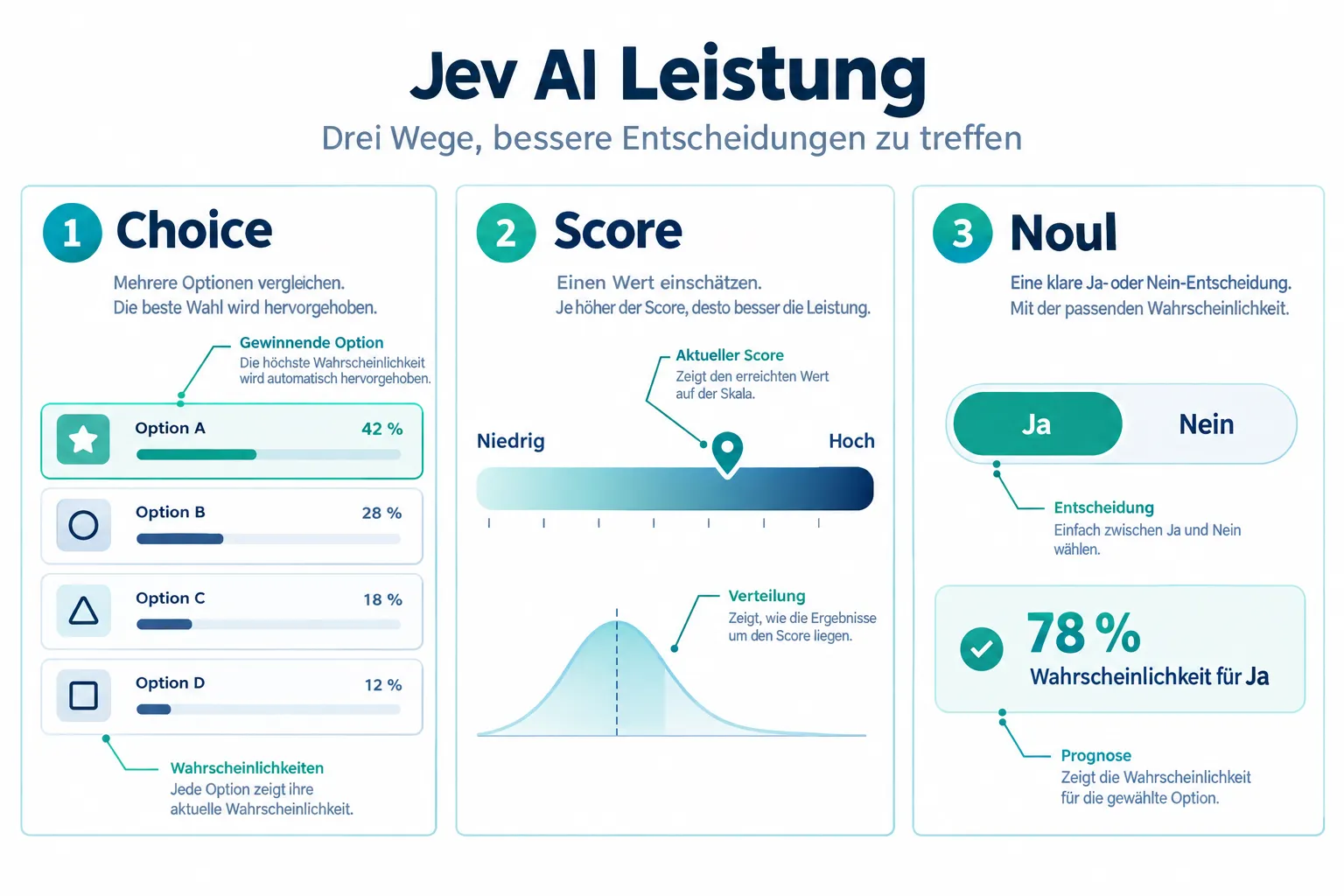
- Choice selects one option from a set defined by the caller. The response contains probabilities for each individual option plus an overall confidence score.
- Score evaluates the given state against an ordered scale, e.g. low/medium/high. The output includes a continuous score, a full distribution across the levels, and a confidence score.
- Noul answers a pure yes/no question and returns a probability between 0 and 1 that a given statement is true.
Especially relevant in practice: multiple questions can be asked in parallel against the same state within a single request. Since Jev generates all answers in one pass rather than sequentially token by token, response time barely changes whether one question or ten questions are asked — latency stays nearly irrelevant [1][7]. This fundamentally distinguishes the architecture from classic LLM calls, where every additional question means additional generation steps and therefore additional time.
Jev AI Performance vs. Classic LLMs
The most striking difference between Jev and generative frontier models shows up in response time. According to TypeSafe, Jev’s end-to-end response time is between 70 and 500 milliseconds [1][5]. Leading frontier LLMs need between 3 and 329 seconds for comparable tasks such as classification, risk assessment, or routing decisions [4][5].
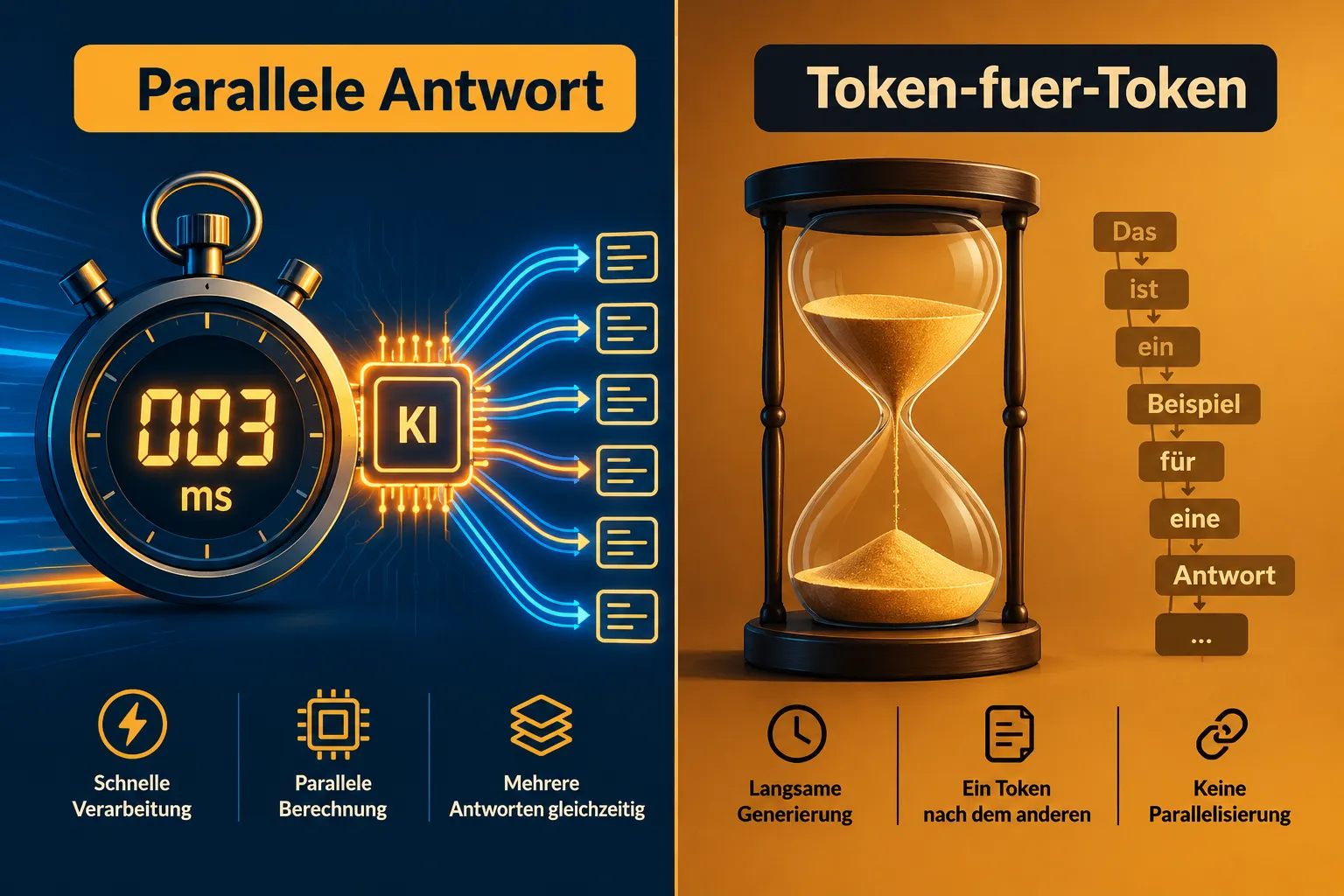
TypeSafe itself positions Jev AI performance on “System One-type” tasks at a factor of 40x to 200x faster compared to generative models of comparable intelligence [1][5]. This figure applies specifically to tasks that are clearly bounded: a decision, a category, a probability — not open-ended, creative text generation.
| Criterion | Jev | Comparable Frontier LLMs |
|---|---|---|
| Response time | 70-500 ms | 3-329 s |
| Generation mode | Parallel, all values at once | Sequential, token by token |
| Multiple questions per request | Negligible time cost | Additional time per question |
| Output format | Type-safe structured values | Free text |
“On System One-type tasks, Jev is 40x to 200x faster, at a comparable level of intelligence.”
This order of magnitude explains why TypeSafe doesn’t market Jev as another general-purpose language model, but as a specialized answer to a concrete performance problem in agent systems, where many small decisions occur every second [2][6].
Technical Limits of Jev
Despite its speed advantages, Jev is not a general-purpose tool. Anyone assessing Jev AI performance realistically needs to know the current technical limits [7][8]:
- Context window: A total of 64,000 tokens are available, covering the state and all questions in a request. Of that, a maximum of 32,000 tokens may be spent on the state plus the longest individual question.
- Text input only: Jev processes text exclusively. Images, audio, or video cannot be passed directly — they would first need to be converted into text form.
- Training language: The primary training language is English. For other languages, expect potentially lower calibration quality.
- Rate limits: The API limits requests to 250,000 tokens per second and 1,200 requests per minute.
These limits are generally uncritical for Jev’s target tasks — short, clearly bounded decisions. They become problematic only when developers try to stuff very long documents entirely into the state, or try to use Jev for tasks that actually require multimodal input. For those cases, a generative model remains the right choice [7][8].
Architecture: Why Jev Doesn’t Hallucinate
The central architectural difference from classic LLMs lies in the generation process itself. Classic autoregressive models generate text token by token, with each new token depending on all previous ones. Jev, by contrast, is based on a non-autoregressive, parallel sampler: all probabilities for a response are computed simultaneously in a single pass, not sequentially [1][6].
This architecture has an important consequence for reliability. Because the output type and the possible values — the options in Choice, the scale in Score, or the yes/no question in Noul — are already fixed before generation begins, Jev cannot produce values outside that defined space. There is no free text generation in which a model could invent plausible-sounding but false facts. This structurally eliminates the ability to hallucinate the way generative models can [1][10].
Jev isn’t trained with the methods common for generative models, such as RLHF (Reinforcement Learning from Human Feedback) or RLVR (Reinforcement Learning with Verifiable Rewards). Instead it uses its own approach called Reinforcement Learning for Calibrated Decisions (RLCD) [1][6]. While RLHF optimizes primarily for text quality and human preferences, RLCD targets calibrated probability honesty: a confidence score of 80 percent should actually mean the answer is correct in roughly 80 out of 100 comparable cases. This calibration is the foundation that lets developers build thresholds and risk assessments on top of Jev’s probabilities.
Price and Cost Performance
Besides speed, price is the second big lever TypeSafe highlights for Jev. For input tokens, TypeSafe charges $0.042 per million tokens, with output tokens free [1][5]. Combined with the speed advantage, TypeSafe states a cost advantage of up to 400x over comparable LLMs on classification tasks [1][4].
This cost advantage arises from two effects at once: first, output incurs no cost at all, since the output consists of compact structured values rather than long blocks of text. Second, parallel processing of multiple questions in one request significantly lowers the overhead per individual decision. For systems that need to make hundreds or thousands of classification or routing decisions per second, this difference can be the difference between an economically viable and an unviable operation.
Positioning: Jev as a Decision Layer, Not a Replacement for Generative Models
One misunderstanding worth avoiding when evaluating Jev AI performance is the assumption that Jev directly competes with models like GPT, Claude, or Gemini. That’s explicitly not the case [2][9]. Jev is not a generative model and cannot write long texts, generate code, or solve open-ended creative tasks.
Instead, Jev positions itself as a complementary decision layer that runs alongside a generative main model within an agent architecture [2][6]:
- The generative model plans workflows, writes text or code, and handles open-ended, creative tasks.
- Jev handles the frequent, narrowly bounded intermediate decisions — such as classifying incoming requests, routing between different agent paths, or checking the risk of individual steps.
In such an architecture, Jev often runs multiple times per second in the background, while the generative model is called less often but for more complex steps. This division of labor also explains why the speed and price figures are so high: Jev was specifically trained and optimized for a narrow but frequently recurring task class, not for general-purpose language processing [3][6].
Conclusion
Jev AI performance isn’t a marketing promise made in a vacuum — it’s the result of a deliberately different architectural decision: parallel instead of sequential generation, type-safe outputs instead of free text, calibrated probabilities instead of pure text quality. For developers, this means concretely: anyone who needs to make many small, clearly bounded decisions within an agent pipeline will find in Jev a tool that can drastically reduce latency and cost, within the stated limits of context window, input modality, and rate limits.
The next sensible step for technical teams is to identify concrete decision points in their own agent architecture — classification, routing, risk checks — and check whether these can be formulated as a Choice, Score, or Noul question. Part 3 of this series takes a closer look at what such use cases look like in practice.
References
[1] Introducing System One Models And Jev – https://typesafe.ai/blog/introducing-system-one-models-and-jev [2] Building A Harness With Jev – https://www.langchain.com/blog/building-a-harness-with-jev [3] Jev System One Model Launch – https://www.mindstudio.ai/blog/jev-system-one-model-launch [4] Typesafe Jev System One Models Release Guide 2026 – https://www.developersdigest.tech/blog/typesafe-jev-system-one-models-release-guide-2026 [5] Typesafe Ai Releases Jev – https://www.marktechpost.com/2026/09/19/typesafe-ai-releases-jev/ [6] System One Models Jev – https://www.datacamp.com/blog/system-one-models-jev [7] Introduction – https://docs.typesafe.ai/introduction [8] What Is Jev – https://apidog.com/blog/what-is-jev/ [9] typesafe.ai – https://typesafe.ai/ [10] Jev Typesafe Ai – https://powerdrill.ai/blog/jev-typesafe-ai
Frequently Asked Questions
What is Jev AI's end-to-end response time?
Jev AI's end-to-end response time is between 70 and 500 milliseconds, compared to 3 to 329 seconds for comparable frontier LLMs on similar tasks like classification, risk assessment, or routing decisions.
What are the three question primitives Jev works with?
Jev works with three fixed primitives: Choice, which selects one option from a defined set with probabilities per option; Score, which evaluates a state against an ordered scale with a continuous score and distribution; and Noul, which answers a yes/no question with a probability between 0 and 1.
What are the technical limits of Jev?
Jev has a total context window of 64,000 tokens (with a maximum of 32,000 tokens for the state plus the longest question), processes text only (no images, audio, or video), is primarily trained on English, and is rate-limited to 250,000 tokens per second and 1,200 requests per minute.
Why doesn't Jev hallucinate like generative models?
Jev is based on a non-autoregressive, parallel sampler that computes all probabilities in a single pass instead of token by token. Because the output type and possible values are fixed before generation begins, Jev cannot produce values outside that defined space, which structurally eliminates the classic hallucination risk of free-text generation.
The Jev AI Series
- Part 1: What Is Jev AI? TypeSafe New AI Model Explained
- Part 3: Jev AI Use Cases in Practice – 5 Fast AI Decision Patterns for Software
This article is part of the Jev AI series. Part 5: Jev AI as an LLM-as-a-Judge Alternative: The LangChain Study on Agent Evaluation.