
This article is Part 1 of a four-part series on Jev AI. Continue with Part 4: 10 Community Projects from Desktop Automation to High-Frequency Trading.com/en/web-development/jev-ai-performance-architecture-explained/”>Part 2: Performance, Architecture, and Technical Limits and Part 3: 5 Practical Use Cases.
For two years, a startup worked in complete secrecy, without publishing a single line of marketing copy. On September 15, 2026, it suddenly emerged with 40 million dollars in funding and a model that explicitly cannot write text, and that is supposed to be its biggest advantage. The model’s name: Jev AI. The company’s name: TypeSafe AI. If you have never heard of it, you are not alone, but that is likely to change quickly.
This article explains what Jev AI is, who is behind it, and why the model is meant to establish a new category of AI systems that differs fundamentally from ChatGPT, Claude, or Gemini.
Table of Contents
Key Takeaways
- Jev AI is the first model from TypeSafe AI, a startup that emerged from two years of stealth mode on September 15, 2026, with a $40 million seed round led by DCVC.
- Co-founder and CEO is Diogo Almeida, a former OpenAI researcher and co-author of the InstructGPT paper, which is considered the basis for ChatGPT.
- Jev belongs to a new model category called “System One Models”: instead of generating prose, Jev delivers structured, type-safe answers such as Choice, Score, or a yes/no probability (Noul), including calibrated confidence values.
- Jev was trained with a new method called RLCD (Reinforcement Learning for Calibrated Decisions), which optimizes for honest, calibrated answers instead of text quality.
- The current model jev-1.13.0 has been available since September 2026 via a waitlist through a hosted API, costs $0.042 per million input tokens, output tokens are free, and self-hosting is not possible.
Jev AI in Brief: The Key Facts
Before diving into detail, here are the key facts compactly summarized:
| Aspect | Details |
|---|---|
| Developer | TypeSafe AI |
| Founder/CEO | Diogo Almeida (formerly OpenAI, co-author of InstructGPT) |
| Announcement | September 15, 2026, after two years in stealth mode |
| Funding | $40 million seed round, led by DCVC |
| Model category | “System One Model” |
| Current version | jev-1.13.0 (aliases: jev-latest, jev-preview) |
| Access | Hosted API, Early Access, waitlist |
| Price | $0.042 per million input tokens, output free |
| Self-hosting | Not possible, weights not released |
This table already makes one thing clear: Jev AI is not another chat model competing with ChatGPT. It pursues a completely different goal.
Who is Behind Jev AI? TypeSafe AI and Diogo Almeida
TypeSafe AI is the company that developed Jev. Co-founder and CEO is Diogo Almeida, who worked as a researcher at OpenAI before founding the company. Almeida is a co-author of the InstructGPT research paper, the paper that formed the technical basis for ChatGPT. This background lends TypeSafe AI considerable credibility in the AI sector from the outset.

For two years, the company operated in so-called stealth mode, meaning no public communication, no product announcements, no press work. Only on September 15, 2026, did TypeSafe AI step out of the shadows and simultaneously unveil its first product: Jev. The announcement was accompanied by news of a seed funding round of $40 million, led by investor DCVC. Such a sum for a first funding round signals that investors attribute considerable potential to TypeSafe AI’s approach.
What is a “System One Model”? The New Model Category
The central term for understanding Jev AI is “System One Model”. TypeSafe AI positions Jev as the first model in this new category, deliberately distinguishing it from classic large language models (LLMs).
Classic LLMs like ChatGPT, Claude, or Gemini fundamentally work like this: they receive a text prompt and generate text, prose, explanations, code, or dialogue in response. That is their strength, but also their weakness when software needs a clear, machine-readable answer.
Jev AI reverses this principle. Instead of generating text, Jev answers typed questions about a given “state,” which can be a text, a JSON object, or an array of text values. The answer is always structured and type-safe:
- Choice, a selection from defined options
- Score, a numeric value
- Noul, a yes/no probability
Every answer additionally comes with a calibrated confidence value. Because the output type is fixed in advance, Jev, according to TypeSafe AI, cannot hallucinate, there is simply no room for freely invented text, since the answer structure is limited from the start.
“Jev doesn’t generate text, it makes decisions that software can use directly.”
This property makes Jev AI a kind of decision function within an application, not a conversation partner.
Why the Name “Jev”? Kahneman and the Jevons Paradox
The model’s name is no coincidence but refers to two different ideas that TypeSafe AI deliberately combines.
On one hand, the “System One” model category refers to the work of psychologist Daniel Kahneman and his book “Thinking, Fast and Slow.” Kahneman distinguishes between two modes of thinking: the fast, intuitive “System 1” and the slow, deliberate “System 2.” Classic LLMs, which think through and formulate long answers, resemble the slow System 2 more closely. Jev, on the other hand, is meant to function like System 1: fast, automatic, immediately usable.
On the other hand, the model itself is named after William Stanley Jevons, a 19th-century economist. Jevons is known for the so-called Jevons paradox: the observation that efficiency gains in a resource do not lead to less, but to more overall consumption. Historically, this was seen with coal consumption after the steam engine became more efficient, consumption rose despite (or precisely because of) the efficiency gain. TypeSafe AI expects AI usage to develop similarly: if AI becomes cheaper and faster to deploy through models like Jev, overall demand for AI decisions is likely to increase rather than decrease.
How Does Jev AI Work Technically?
Technically speaking, Jev AI takes a so-called “state” as input. This state can be a simple text, a structured JSON object, or an array of text values. Based on this state, Jev answers a predefined, typed question.
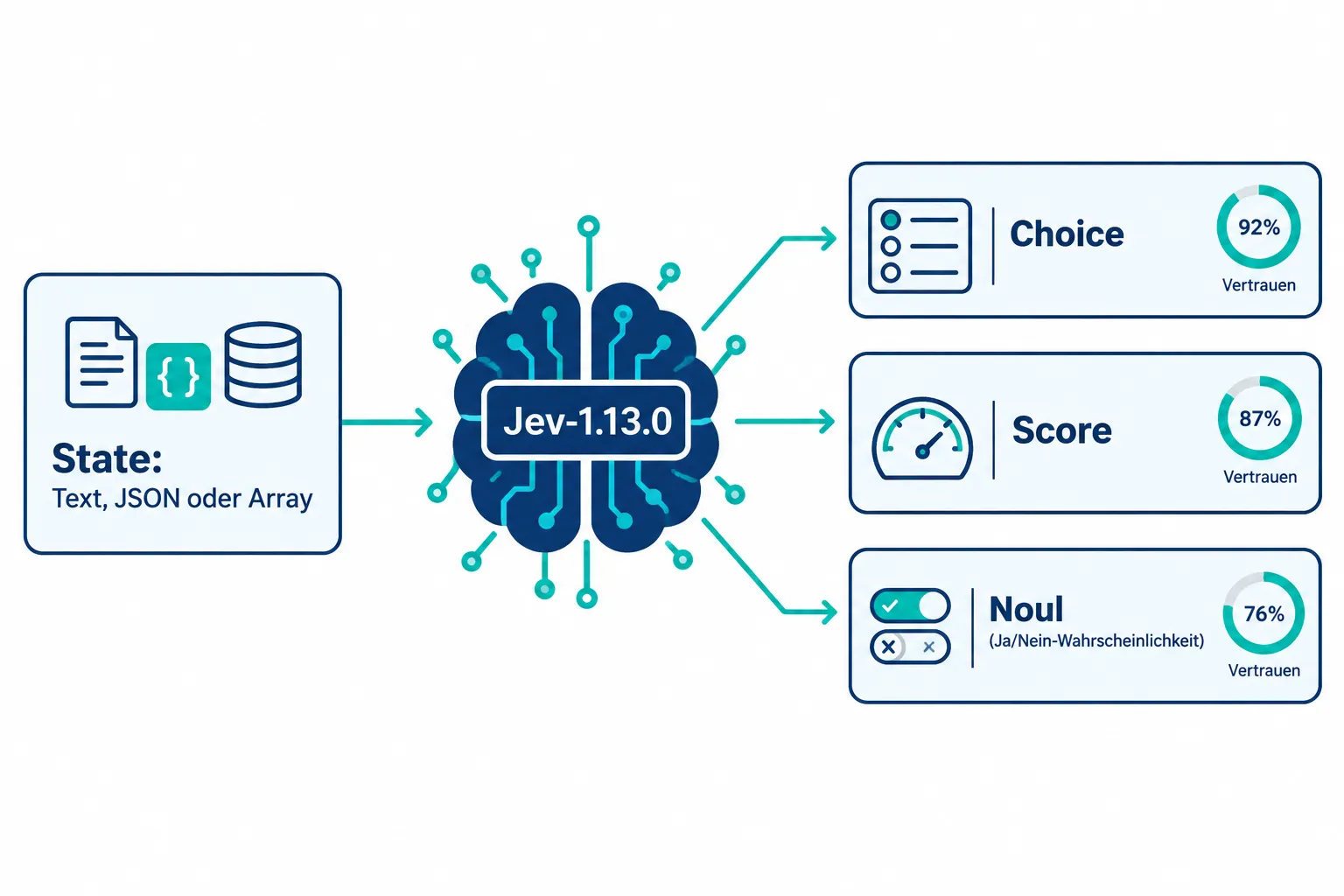
The process can be described in simplified terms as follows:
- An application passes a state to Jev, such as a customer chat history or a dataset.
- The application defines in advance what kind of answer is expected: Choice, Score, or Noul.
- Jev analyzes the state and delivers the answer exactly in this predefined format.
- Jev additionally provides a calibrated confidence value indicating how certain the model is of its assessment.
Because the answer type is fixed from the outset, there is no room for interpretation for the software processing the result. A classic LLM could theoretically answer the same question with a lengthy paragraph that first needs to be parsed. Jev delivers a machine-readable value directly.
Training with RLCD Instead of RLHF
Another difference from known models lies in training. Most current LLMs are trained with RLHF (Reinforcement Learning from Human Feedback) or RLVR (Reinforcement Learning with Verifiable Rewards). Both methods ultimately optimize toward high-quality, human-preferred text answers.
Jev AI, on the other hand, was trained with a new method TypeSafe AI calls RLCD, Reinforcement Learning for Calibrated Decisions. The crucial difference lies in the training objective: RLCD does not optimize for linguistic quality but for calibrated, honestly probabilistic answers. This means: if Jev states an 80 percent probability, this assessment should actually hold true in about 80 percent of cases in practice. This calibration is far more important for systems that make automated decisions than eloquent phrasing.
Availability, Pricing, and Access to Jev AI
Since its announcement in September 2026, Jev AI has been available in Early Access. Access is via a hosted API and is currently tied to a waitlist, interested parties must first register and wait to be granted access.
Important details on availability:
- Current model: jev-1.13.0
- Aliases: jev-latest and jev-preview currently both point to the same version
- Access model: Hosted API, no self-hosting option
- Weights: Not publicly available
One number stands out regarding pricing: $0.042 per million input tokens, which is roughly $42 per billion tokens. Output tokens, on the other hand, are free. This pricing model fits Jev’s functional principle: since the model doesn’t produce long text answers but only compact, typed values, the output volume barely matters, costs arise essentially from processing the input.
Conclusion: A Different Path for AI Decisions
Jev AI pursues an approach that differs significantly from known chat models. Instead of generating prose, the model delivers structured, type-safe decisions with calibrated probabilities, trained with the new RLCD method and developed by a team led by former OpenAI researcher Diogo Almeida. The combination of naming (Kahneman and Jevons), technical design, and pricing model makes it clear that TypeSafe AI wants to occupy a very specific niche: AI as a fast, reliable decision function within software rather than as a conversation partner.
Anyone interested in practical use should keep an eye on Jev AI’s development: the Early Access waitlist is currently the only way to try the model yourself. This article is part 1 of a four-part series on Jev AI. Part 2 takes a closer look at the model’s technical capabilities, part 3 examines concrete use cases in practice.
Frequently Asked Questions About Jev AI
What is Jev AI?
Jev AI is an AI model from TypeSafe AI, the first model in a new category called "System One Models." Instead of generating text/prose, Jev answers typed questions about a given state (text, a JSON object, or an array of text values) and returns structured, type-safe answers such as Choice, Score, or a yes/no probability (Noul), including calibrated confidence values.
Who is behind TypeSafe AI?
TypeSafe AI was co-founded by Diogo Almeida, who previously worked as a researcher at OpenAI and co-authored the InstructGPT paper that forms the basis of ChatGPT. Almeida is CEO of TypeSafe AI. The company emerged from two years of stealth mode on September 15, 2026, with a $40 million seed round led by DCVC.
What does Jev cost?
Jev has been available in Early Access since September 2026 via a hosted, waitlist-based API. Pricing is $0.042 per million input tokens (roughly $42 per billion tokens). Output tokens are free. Self-hosting is not possible, as the model weights have not been released.
Can Jev hallucinate?
According to TypeSafe AI, no, because Jev's output type is fixed in advance (Choice, Score, or Noul). Since the model does not generate free-form prose but only delivers answers within a predefined, constrained format, there is structurally no room for freely invented text. Jev was also trained with a new method called RLCD (Reinforcement Learning for Calibrated Decisions), which optimizes for calibrated, honestly probabilistic answers.
The Jev AI Series
- Part 2: Jev AI Performance in Detail – Architecture and Technical Limits
- Part 3: Jev AI Use Cases in Practice – 5 Fast AI Decision Patterns for Software
This article is part of the Jev AI series. Part 5: Jev AI as an LLM-as-a-Judge Alternative: The LangChain Study on Agent Evaluation.