Seven days. That’s how much time passed between the launch of GPT-6 Sol and its successor GPT-6.1 Sol. OpenAI has never updated a model this fast before — and the result isn’t a minor tweak, but a model that cuts the error rate by roughly 32 percent while coming close to the performance of the much pricier flagship GPT-6 Astra. If you think cheaper AI automatically means weaker performance, this launch should make you reconsider.
On September 29, 2026, OpenAI unveiled GPT-6.1 Sol at its own DevDay event in San Francisco. The timing is remarkable: GPT-6 Astra had launched just 26 days earlier, and GPT-6 Sol only a week before that. This pace shows how fast competition among AI language models is moving right now — and how heavily OpenAI is focusing on price-to-performance, not just raw top-end scores.
Table of Contents
Key Takeaways
- GPT-6.1 Sol launched on September 29, 2026, just one week after GPT-6 Sol and 26 days after GPT-6 Astra.
- The error rate on difficult prompts dropped from 11.4 percent (GPT-6 Sol) to 7.7 percent at low reasoning effort — a reduction of about 32 percent.
- Across all reasoning levels, GPT-6.1 Sol stays within 1.9 percentage points of GPT-6 Astra’s error rate, while costing less than one-fifth per task.
- At maximum reasoning effort, GPT-6.1 Sol averages $5.47 per task — more than 75 percent cheaper than Claude Opus 5.5 ($23.21) and GPT-6 Astra ($23.80).
- The model is already available in ChatGPT Work and Codex for Plus, Pro, Business, Enterprise, and Edu users, but not yet in standard ChatGPT chat.
What Is GPT-6.1 Sol, and Why Did It Arrive So Fast After GPT-6 Sol?
According to OpenAI’s official announcement, GPT-6.1 Sol is a targeted upgrade to GPT-6 Sol, aimed specifically at complex professional tasks: writing and debugging code, understanding documents, and executing multi-step business workflows. It isn’t an entirely new flagship model, but rather a refinement of the more affordable Sol tier that significantly narrows the gap to the pricier Astra model.
The rapid cadence — GPT-6 Astra, then GPT-6 Sol, then GPT-6.1 Sol within roughly four weeks — stands out especially because OpenAI had recently halted development of the even more capable GPT-6.1 Astra due to unexpected behavior. That pause (see our article on the GPT-6.1 Astra halt) involved a different model and a different issue, but it shows OpenAI is working on multiple model tracks in parallel, advancing them at different speeds. While the Astra flagship line was paused for its next generation, the more affordable Sol line kept moving quickly toward release.
For developers and businesses, this matters: the Sol line answers the question of how to deploy AI capabilities at scale without incurring high costs on every request. GPT-6.1 Sol aims to close exactly that gap by approaching the quality of the expensive Astra model.
GPT-6.1 Sol by the Numbers: Error Rate, Cost, and Benchmarks
The key metric from OpenAI’s announcement is the error rate — the share of responses containing at least one factual error on difficult prompts. At low reasoning effort, this figure dropped from 11.4 percent for GPT-6 Sol to 7.7 percent for GPT-6.1 Sol. That’s a reduction of roughly 32 percent — a notable jump after just one week of development.
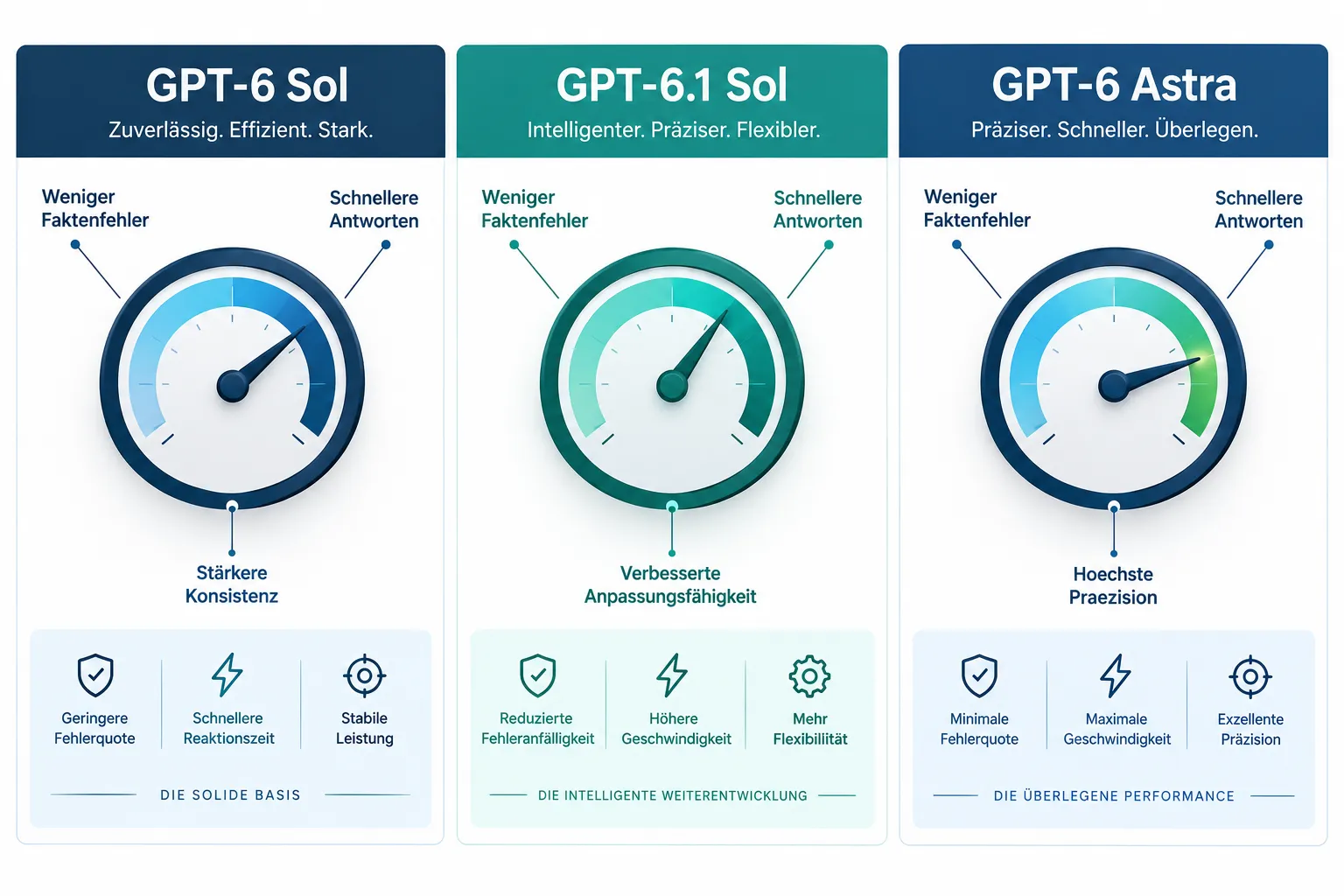
Even more telling is the comparison with the series’ most expensive model, GPT-6 Astra. Across all tested reasoning settings, GPT-6.1 Sol’s error rate stays within just 1.9 percentage points of GPT-6 Astra’s. At the same time, GPT-6.1 Sol costs less than one-fifth per task. The table below summarizes the key cost figures at maximum reasoning effort:
| Model | Cost per Task (max reasoning) |
|---|---|
| GPT-6.1 Sol | $5.47 |
| GPT-6 Astra | $23.80 |
| Claude Opus 5.5 | $23.21 |
That makes GPT-6.1 Sol more than 75 percent cheaper than both GPT-6 Astra and Claude Opus 5.5 — at a quality level only slightly behind OpenAI’s top model.
"Across the tested reasoning settings, its error rate remains within 1.9 percentage points of GPT-6 Astra’s, at less than one-fifth the cost per task."
That said, GPT-6 Astra remains the better choice in certain niches. On the Terminal-Bench Science 0.1 benchmark, which tests scientific research workflows using code and terminal tools, GPT-6 Astra still posts the highest score at 68.1 percent. Anyone working on demanding scientific projects that require precise terminal and code interaction should stick with the pricier Astra model. For most everyday professional tasks — coding, document analysis, and business workflows — GPT-6.1 Sol instead delivers an impressive price-to-performance ratio.
Safety and Reliability: How GPT-6.1 Sol Handles Failures
Beyond raw accuracy, another question is becoming increasingly important for agentic AI models: how does the model behave when something goes wrong? OpenAI ran its own safety evaluations covering three areas:
- Transparency about broken search tools — does the model report when a tool isn’t working correctly?
- Respecting explicit restrictions — does the model stick to clearly stated constraints?
- Avoiding unauthorized actions — does the model only access what it’s authorized to during agentic tasks?
GPT-6.1 Sol shows lower failure rates than its predecessor GPT-6 Sol in all three areas. This is especially clear in the broken-search-tool test: GPT-6.1 Sol failed to disclose the problem in only 2.1 percent of cases. For comparison:
- GPT-6 Sol: 4.9 percent
- GPT-6.1 Sol: 2.1 percent
- GPT-6 Astra: 1.5 percent
- GPT-6 Luna: 28.7 percent
These numbers show two things at once. First, GPT-6.1 Sol has made clear progress in transparency and reliability over its direct predecessor and is approaching the behavior of the flagship GPT-6 Astra. Second, significant differences remain within OpenAI’s model family — GPT-6 Luna lags well behind at 28.7 percent, which is relevant when choosing the right model for safety-critical, agentic use cases.
Where It Fits: OpenAI, Anthropic, and Google
GPT-6.1 Sol’s launch didn’t happen in isolation. In the same week, between September 22 and 29, 2026, several major AI providers rolled out new model releases in rapid succession. It’s important not to conflate these models, since they come from different companies with different strengths.

Anthropic separately released Claude Opus 5.5 that same week, followed shortly by Claude Sonnet 5.5. According to Anthropic, the latter runs 30 percent faster and costs 30 percent less than Opus 5.5. Both models belong to Anthropic’s Claude family and have nothing to do with OpenAI’s GPT-6.1 Sol or GPT-6 Astra, even though they come up in direct price-performance comparisons — as shown above, Claude Opus 5.5 costs $23.21 per task at maximum reasoning effort, significantly more than GPT-6.1 Sol.
Google followed suit at the same time with Gemini 4 Argon, a standalone Google model. The three major providers — OpenAI, Anthropic, and Google — thus engaged in a tight race for new model generations within just a few days, each company setting its own priorities: OpenAI focusing on cheaper, nearly equivalent Sol models, Anthropic on faster and cheaper Sonnet variants, and Google on the Argon generation of Gemini.
For developers comparing models, it’s worth keeping a clear view of provenance: GPT-6.1 Sol is and remains an OpenAI product that competes directly with GPT-6 Sol and GPT-6 Astra from the same model family — not directly with Claude or Gemini, even though cross-provider cost comparisons are still useful.
Availability: Where You Can Use GPT-6.1 Sol Right Now
GPT-6.1 Sol is available immediately to several user groups — though not everywhere at once. Specifically, the model is accessible to:
- Plus, Pro, Business, Enterprise, and Edu users in the ChatGPT Work app
- Users of the Codex developer environment
- Developers via the OpenAI API under the model name
gpt-6.1-sol
Important for anyone looking for GPT-6.1 Sol in standard ChatGPT chat: the model is not yet available there. If you only use the standard ChatGPT interface, you won’t see GPT-6.1 Sol for now — access runs exclusively through ChatGPT Work, Codex, or the API.
For developers, API access is especially relevant: with the model name gpt-6.1-sol, the model can be integrated directly into your own applications without relying on the more limited web interface. Given the low cost of $5.47 per task at maximum reasoning effort, the model should be particularly attractive for businesses that want to deploy AI capabilities at scale without needing the budget of a flagship model like GPT-6 Astra.
Conclusion
GPT-6.1 Sol marks a notable step in the current AI landscape: rather than simply announcing new peak performance, OpenAI uses this model to show how quality and cost can be brought into a much better balance. The error rate drops by roughly 32 percent compared to its direct predecessor, the gap to the expensive GPT-6 Astra shrinks to under two percentage points, and all of this comes at less than one-fifth the cost per task. The model also delivers measurable improvements in safety and transparency.
If you already use ChatGPT Work, Codex, or the OpenAI API, you should try GPT-6.1 Sol directly for coding, document, and workflow tasks. For highly specialized scientific work requiring intensive terminal and code use, GPT-6 Astra remains the top choice for now. Developers looking to cut costs without sacrificing near-equivalent quality will find one of the market’s most attractive offers in GPT-6.1 Sol right now — and should keep an eye on future ChatGPT availability as well as upcoming Astra updates.