One detail surprises many teams only after they’ve made the switch: numerous companies that fully committed to microservices a few years ago are consolidating parts of their systems back into modular monoliths in 2026 [5][8]. The reason is rarely technical nostalgia — it’s plain cost accounting and operational complexity. The microservices vs. monolith debate is no longer a matter of belief, but a question of team size, domain complexity, and concrete scaling needs [1][9].
If you already run a PHP/Node.js/MySQL backend in production, you’re now facing the next fork in the road: keep growing the monolith, or selectively extract services. This article gives you the decision framework for that choice.
Table of Contents
Key Takeaways
- Microservices vs. monolith is primarily an organizational question, not primarily a performance question — Conway’s Law often decides more than latency numbers [6][9].
- Monolith-first remains the standard recommendation in 2026 for early product stages; microservices only pay off once you have demonstrable scaling or team bottlenecks [1][3].
- Distributed debugging and observability overhead are the most underestimated cost factor in microservices [4][6].
- The Strangler Fig Pattern remains the proven, low-risk migration path from monolith to microservices [10].
- Solid API design is the technical prerequisite for stable service-to-service communication.
Monolith vs. Microservices: Core Definitions and Differences
A monolith is an application with a single codebase, a single deployment unit, and usually one central database. All modules — user management, orders, payments — run in the same process and are built, tested, and rolled out together.
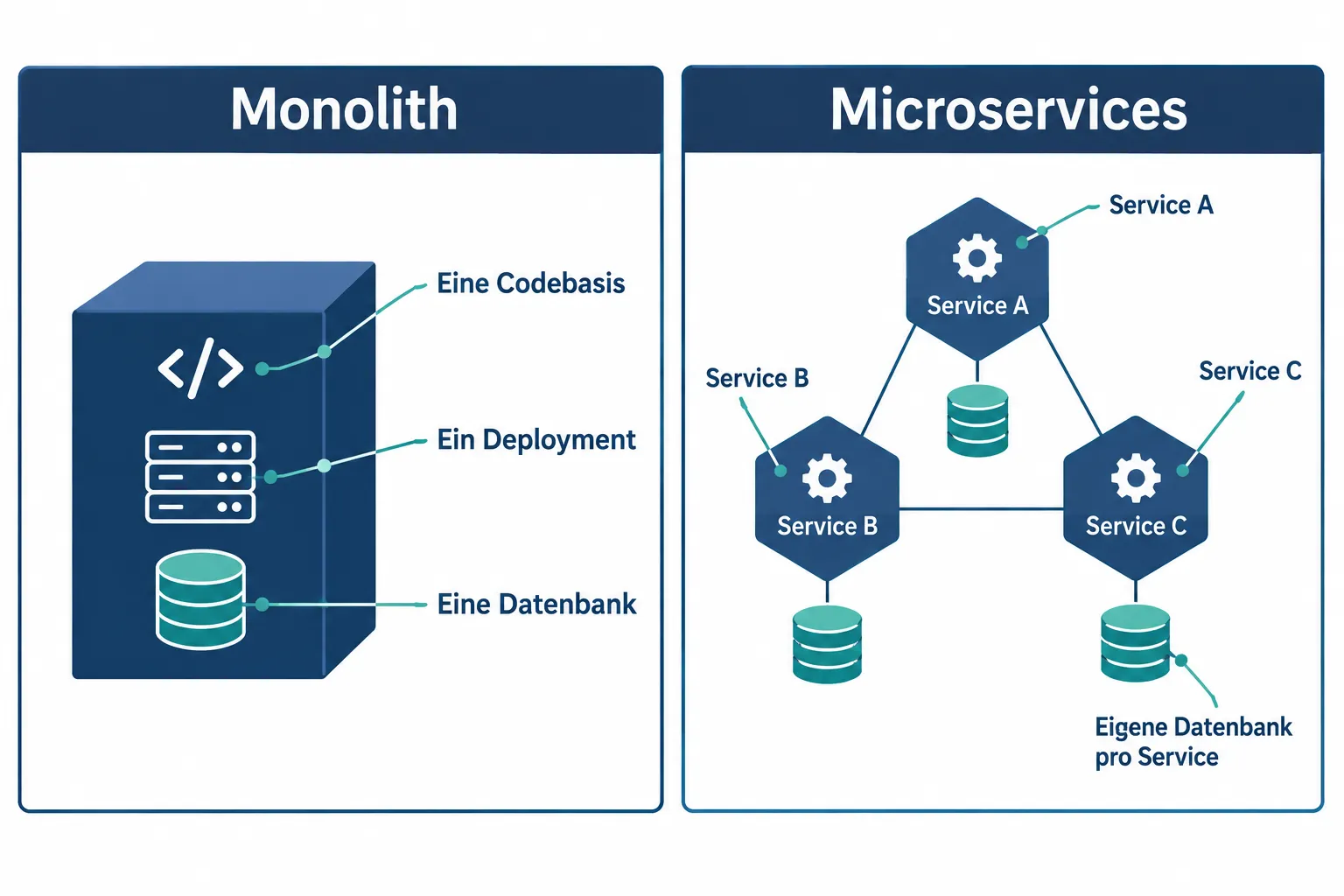
A microservices architecture breaks the same application into multiple independently deployable services, each with a clearly bounded business responsibility. Ideally, each service owns its own data store and is addressed via network protocols (HTTP/REST, gRPC, messaging).
| Criterion | Monolith | Microservices |
|---|---|---|
| Codebase | One shared codebase | Multiple independent repositories |
| Deployment | One artifact, one rollout | Many independent deployments |
| Data storage | Usually one central database | Database per service |
| Communication | In-process function calls | Network calls (REST, events, gRPC) |
| Scaling | Entire application scales | Individual services scale independently |
Important: a well-structured monolith with clear module boundaries (a “modular monolith”) is not an anti-pattern. It’s often the more efficient intermediate stage before real service boundaries are drawn [3][9].
Pros and Cons in Detail: Microservices vs. Monolith Compared
The microservices vs. monolith decision has four central trade-off dimensions that are consistently underestimated in practice.
Deployment Complexity
In a monolith, a release is a single, easily testable event. With microservices, deployment complexity grows with every additional service: versioning, backward compatibility between services, and rollout ordering all need to be actively managed. Without CI/CD maturity and container orchestration, this overhead quickly becomes a bottleneck [4][6].
Scaling: Horizontal, Vertical, Independent
Monoliths typically scale vertically (a bigger machine) or horizontally by running complete copies of the application — even for parts that don’t need the extra load. Microservices allow independent scaling of individual components: the checkout service gets more instances while the reporting service stays untouched. Current benchmarks show, however, that this advantage only becomes measurable past a certain load distribution and user count — at moderate load, a well-optimized monolith often delivers comparable latency [2][6].
Team Organization and Conway’s Law
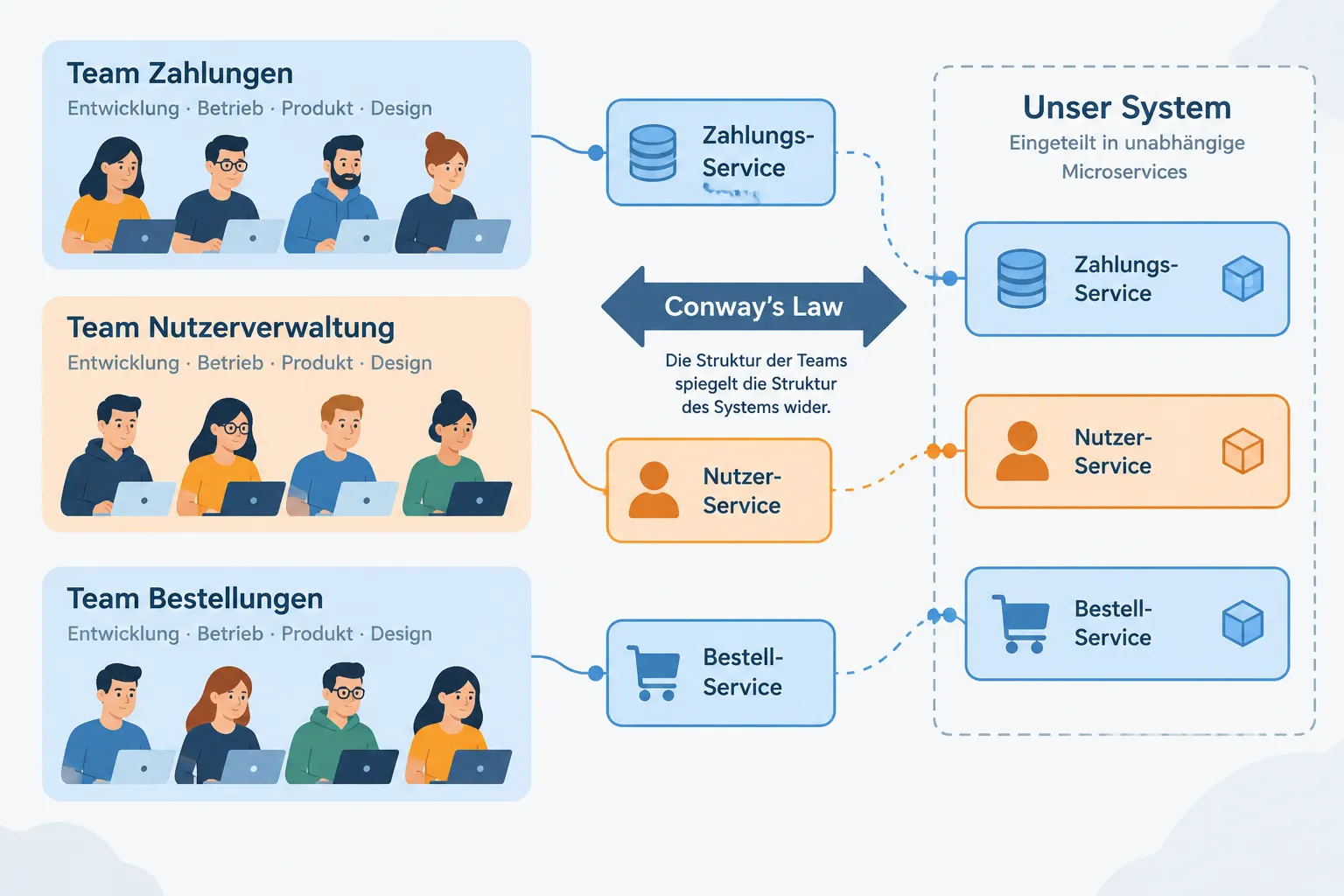
Conway’s Law states that system architecture mirrors an organization’s communication structure. In practice this means: microservices work well when every team has clear ownership of “their” service, including deployment responsibility. Without that organizational separation, you get distributed monoliths — many services, but a single coupled release window. Current analyses confirm that microservices are primarily a tool for organizational scaling, not primarily for performance optimization [6][9].
Debugging and Observability
This is where the most underestimated cost factor lies. In a monolith, a stack trace and a log file are often enough. With microservices you need distributed tracing (e.g., OpenTelemetry), centralized logging across all services, and monitoring dashboards per service. A single failing request can travel through five services before the actual error becomes visible. This observability overhead is a major reason why many teams feel cost and complexity pressure in 2026 and are consolidating parts of their landscape again [4][5][8].
“Microservices solve an organizational problem, but they create a new operational problem if observability doesn’t grow with them.”
When Does Which Approach Make Sense? Monolith-First vs. Scaling Up with Microservices
The recommendation for early product stages is clear: monolith-first. A startup team of three to eight developers benefits from a single codebase, fast iteration, and easy debugging. At this stage, domain boundaries usually aren’t stable enough yet to be meaningfully cut into services [1][3].
Signals that point toward a move to microservices:
- Team size: more than two or three teams regularly work in the same codebase and block each other on releases.
- Independent release cycles needed: one area (e.g., payments) needs to be deployed significantly more often than the rest.
- Clearly identifiable bounded contexts: business domain boundaries are stable and repeatably identifiable.
- Different scaling profiles: one part of the application has drastically different load patterns than the rest.
- Technological heterogeneity is needed: a service demonstrably benefits from a different language or database.
If these signals are absent, the move is usually premature. 2026 decision frameworks increasingly emphasize: the question isn’t “microservices or monolith as the ideal,” but “which architecture currently fits our team size, domain complexity, and scaling needs” [1][9][15].
Migration Strategies: From Monolith to Microservices with the Strangler Fig Pattern
The most proven migration path is the Strangler Fig Pattern, named after the plant that slowly grows over and replaces its host tree. Instead of a risky big-bang rewrite, the monolith is gradually “strangled”: functionality is extracted piece by piece into new services while the rest of the monolith keeps running.
The Process in Practice
- Put an API gateway in front of the monolith as a facade. All incoming requests initially continue to flow through the monolith.
- Isolate the first business area, e.g., the search or notification service, since these usually have low coupling to core transactions.
- Build the new service in parallel and selectively route traffic for exactly that route through the gateway.
- Only remove the old code in the monolith once the new service is running stably in production and monitoring confirms it.
- Isolate the next area until the monolith has been “shrunk” step by step.
This approach is well established in .NET and similar stacks too, and works independently of the underlying technology [10].
Data Migration as a Risk Factor
The most complex part is rarely the code — it’s the data layer. As long as the monolith and the new service access the same database, a hidden coupling remains. Proven practice:
- First redirect reads through the new service, while writes stay in the monolith.
- Only transfer write ownership once consistency has been proven.
- Synchronize changes via event-based synchronization (e.g., change data capture) instead of direct database access between systems.
If the underlying databases themselves become the bottleneck in this process, our guide on Database Performance Optimization covers indexing and query tuning for exactly these scaling challenges.
Avoiding Risks
- Never migrate without stable observability, or errors during the transition stay invisible.
- No “all at once” — every stage must be independently rollback-capable.
- Communicate clear deprecation deadlines for old endpoints in the monolith to avoid double maintenance.
According to current modernization analyses, the Strangler Fig Pattern remains the reference approach for low-risk legacy transformation, because it allows rollback capability and incremental validation instead of betting everything on a single cut-over date [10].
Service Communication and API Design Between Microservices
Once multiple services need to talk to each other, API design becomes critical infrastructure — no longer just a matter of convenience. Every interface between services is a contract: versioning, error formats, idempotency, and rate limiting determine whether a microservices landscape stays stable or generates new coupling problems with every deployment.
This is exactly where it’s worth taking a deeper look at our existing guide REST API Design for Advanced Users: Best Practices for Scalable Backends, since the principles described there — consistent resource modeling, clean versioning strategies, meaningful error codes — form the technical foundation for reliable inter-service communication. If you don’t get this foundation right, you end up building microservices that are independently deployable but constantly collide through incompatible interfaces.
Conclusion: Microservices vs. Monolith as a Deliberate Architecture Decision
The microservices vs. monolith debate can’t be answered with a blanket “better” architecture. A monolith is usually the more efficient choice for small to medium teams — faster to debug, cheaper to operate, easier to deploy. Microservices pay off when team size, domain complexity, and independent scaling requirements specifically call for them [1][6][9].
Concrete next steps:
- First modularize your existing monolith before thinking about splitting it into services.
- Systematically check the signals mentioned above (team size, release conflicts, scaling profiles) before migrating.
- When migrating: use the Strangler Fig Pattern, with an API gateway as a facade and gradual data migration.
- Build observability infrastructure (tracing, centralized logging) before the first service split, not after.
- Take API contracts between services just as seriously as public APIs.
References
[1] Monolith Vs Microservices Decision – https://www.agilesoftlabs.com/blog/2026/02/monolith-vs-microservices-decision [2] Microservices Vs Monolith 2026 – https://zanisssoftwares.com/infographics/microservices-vs-monolith-2026 [3] Monolith Vs Microservices Which Architecture Wins In 2026 – https://itidoltechnologies.com/blog/monolith-vs-microservices-which-architecture-wins-in-2026/ [4] Microservices Vs Monolith Architecture 2026 – https://devvpro.com/blog/microservices-vs-monolith-architecture-2026/ [5] Microservices Vs Monolith 2026 – https://blobstreaming.org/notes/microservices-vs-monolith-2026/ [6] Microservices Vs Monolith 2026 Scaling – https://www.dharmsy.com/blog/microservices-vs-monolith-2026-scaling [8] Microservices Vs Monolith 2026 – https://backendapplication.com/current-trends/microservices-vs-monolith-2026/ [9] Microservices Vs Monoliths In 2026 When Each Architecture Wins – https://www.javacodegeeks.com/2025/12/microservices-vs-monoliths-in-2026-when-each-architecture-wins.html [10] Insight Legacy Modernization – https://sisisolutions.ie/insight-legacy-modernization
Frequently Asked Questions
What's the core difference between a monolith and microservices?
A monolith runs as one shared codebase with a single deployment and usually one central database, while microservices split the application into independently deployable services that each own their own data.
When does switching to microservices actually pay off?
Only once concrete signals appear: more than two or three teams colliding in the same codebase, the need for independent release cycles, or clearly different scaling profiles. Monolith-first remains the default for early-stage products.
What is the Strangler Fig Pattern?
A low-risk migration approach that extracts functionality from the monolith into new services piece by piece behind an API gateway, instead of a risky big-bang rewrite.
Why does observability matter so much for microservices?
Because a single request can pass through several services before an error becomes visible; without distributed tracing and centralized logging, operational overhead becomes the most underestimated cost of the whole approach.