In late September 2026, a new model name appeared in the developer dashboards of Vercel and Novita AI: Ling-3.1-flash. What initially looked like just another update among many turns out, on closer inspection, to be one of the larger Mixture-of-Experts models currently publicly accessible. Ant Group, through its research lab InclusionAI in Hangzhou, released Ling-3.1-flash, a model with 560 billion parameters, at a time when Chinese AI labs are introducing new, highly efficient architectures on a near-weekly basis.
For developers and IT decision-makers, the figure of 560 billion is impressive at first glance but not very meaningful without context. What matters is that Ling-3.1-flash only actively uses around 25 billion parameters per request. This article breaks down what that means technically, how the model fits into the competitive landscape, and where it is already usable today.
Table of Contents
Key Takeaways
- Ling-3.1-flash is a Mixture-of-Experts model from Ant Group / InclusionAI with 560 billion total parameters, of which only around 25 billion are activated per request.
- The context window natively reaches up to 1 million tokens; some platforms currently deliver 256K tokens.
- The model is designed for coding, multi-step analysis, and agentic workflows using tools.
- Access is available through, among others, Vercel AI Gateway (free for a limited time until October 13, 2026) and Novita AI as a serverless API.
- Ling-3.1-flash follows Ling-3.0-flash (124B parameters, July 2026, MIT license) and continues the trend of affordable, efficient Chinese MoE models.
What Is Ling-3.1-flash? Technical Specs at a Glance
Ling-3.1-flash was released on September 29 and 30, 2026 by Ant Group through its research lab InclusionAI. The model identifiers are inclusionai/ling-3.1-flash and inclusionai/ling-3.1-flash-free, depending on the platform and licensing model. The model belongs to the Ling series that Ant Group has been building since 2025 for developer and enterprise applications.
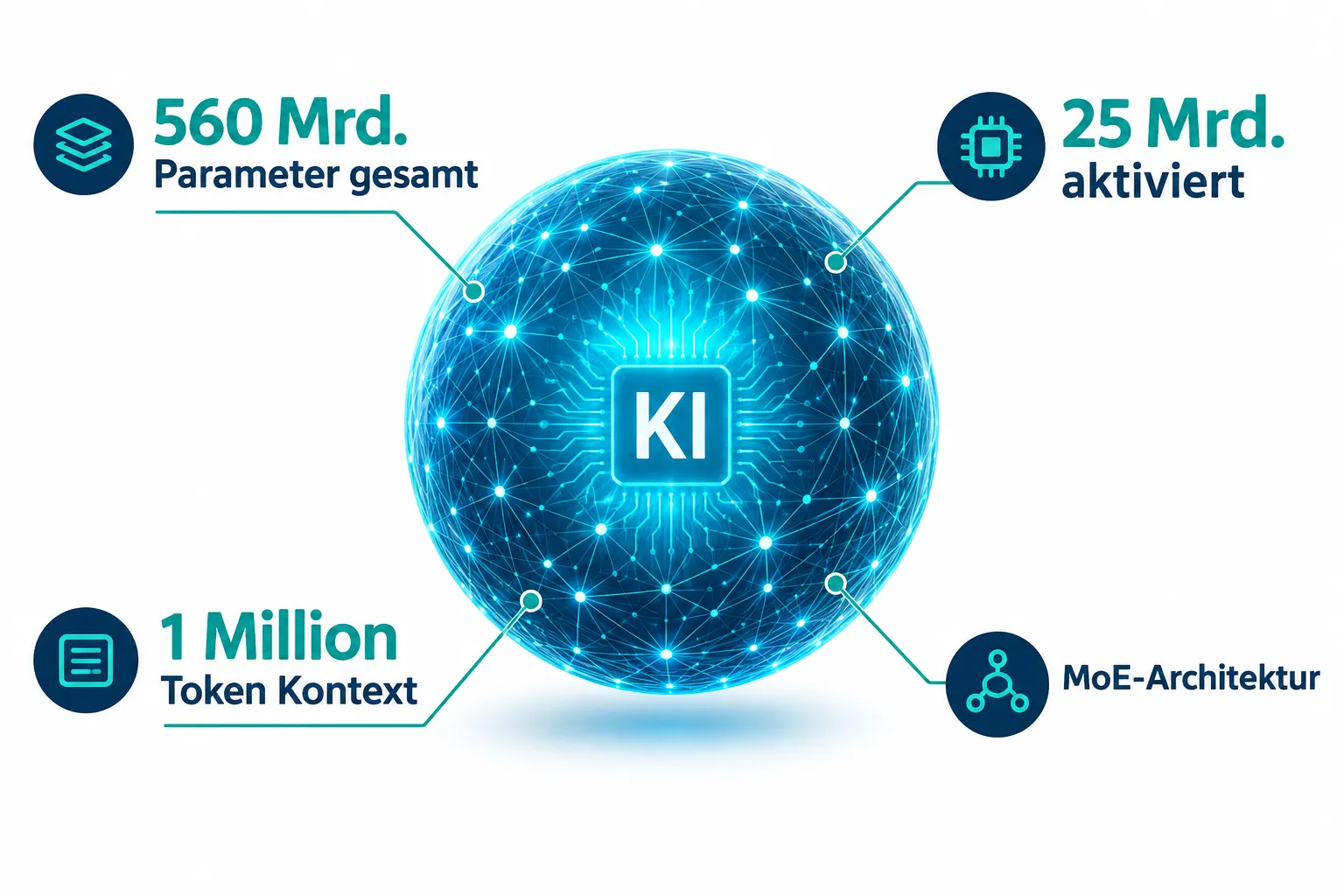
The key technical specifications can be summarized as follows:
| Feature | Value |
|---|---|
| Architecture | Mixture-of-Experts (MoE) |
| Total parameters | 560 billion |
| Activated parameters per request | around 25 billion |
| Context window (native) | up to 1 million tokens |
| Context window (some platforms) | 256,000 tokens |
| Release | September 29-30, 2026 |
| Publisher | Ant Group / InclusionAI |
The large context window is particularly relevant in practice. A model that can process up to a million tokens can be applied to entire code repositories, long technical documentation, or multi-step agent histories without constantly needing to truncate or re-summarize content. In practice, some hosting providers currently only deliver 256K tokens, an indication that full context capacity is being rolled out gradually across different platforms’ infrastructure.
Mixture-of-Experts Explained: Why 560 Billion Parameters Can Be Efficient
To understand why Ling-3.1-flash, despite its size, is positioned as a “flash” model, that is, a fast and cost-efficient variant, it’s worth taking a brief look at the underlying architecture.
A classic, “dense” language model uses all of its parameters on every request. A model with 560 billion parameters built this way would be extremely compute-intensive and slow. Mixture-of-Experts takes a different approach: the model consists of many specialized sub-networks, called “experts.” For each individual request, an upstream mechanism, the router, decides which experts are actually needed. Only these selected experts are activated and do the computation.
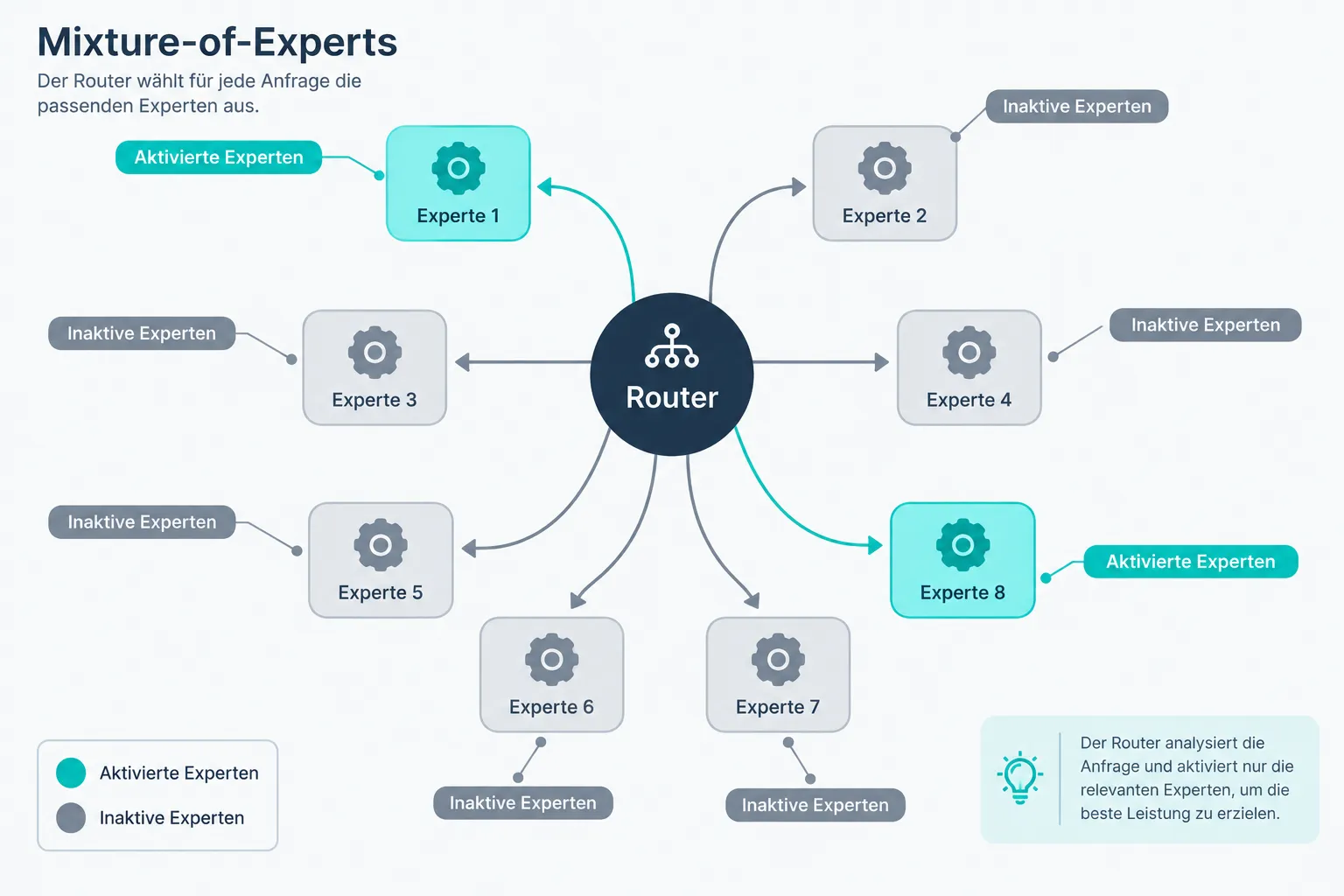
For Ling-3.1-flash, this means in practice: of the 560 billion total parameters, only about 25 billion are actually active for a typical request, around 4.5 percent of the total model. This has two practical consequences:
- Lower compute cost per request, because the entire network does not need to be run.
- A large knowledge base is still retained, because the model overall can draw on a very wide range of specialized sub-networks, depending on the task.
This combination of large total capacity and lean activation is the reason MoE architectures have become the standard since 2024/2025 for large yet affordable models. Ling-3.1-flash thus joins a line of models trying to combine the quality of very large networks with the speed of smaller ones.
Ling-3.1-flash vs. Its Predecessor Ling-3.0-flash
The direct predecessor, Ling-3.0-flash, was released in July 2026 under the MIT license as an open-weight model. It had 124 billion total parameters, of which 5.1 billion were activated per request.
The jump to Ling-3.1-flash is significant across several dimensions:
| Feature | Ling-3.0-flash | Ling-3.1-flash |
|---|---|---|
| Release | July 2026 | September 2026 |
| Total parameters | 124 billion | 560 billion |
| Activated parameters | 5.1 billion | around 25 billion |
| License | MIT, Open Weight | depending on platform / API access |
| Focus | General tasks | Coding, agent workflows, long documents |
The increase in both total parameters and activated parameters by a factor of roughly 4.5 to 5 suggests that Ant Group is targeting more complex, multi-step tasks more heavily with Ling-3.1-flash, precisely the use cases where a model needs to stay consistent across multiple steps, for example when analyzing large codebases or when agents call several tools in sequence.
“A model that can process long contexts while coordinating multiple tools is often more important for agentic applications than raw benchmark scores.”
Availability: Where Ling-3.1-flash Can Be Used Today
Developers can currently test and integrate Ling-3.1-flash through several channels. Two access routes stand out:
- Vercel AI Gateway: The model is available here under the identifiers inclusionai/ling-3.1-flash and inclusionai/ling-3.1-flash-free. As an introductory offer, usage is free until October 13, 2026, after which regular, usage-based billing is expected.
- Novita AI: Here Ling-3.1-flash is available as a serverless API, enabling integration without the need for your own inference infrastructure.
For IT decision-makers, this multi-channel availability is relevant: a model available across several independent platforms reduces the risk of single-vendor lock-in and allows for comparing latency, pricing structure, and availability before making a production decision. Anyone wanting to evaluate Ling-3.1-flash should use the free trial period via Vercel to run initial benchmarks with their own workloads before setting up a long-term API integration via Novita AI or other providers.
Use Cases: Coding, Agent Workflows, and Long Documents
Ant Group specifically positions Ling-3.1-flash for three areas of application:
- Coding support: Thanks to the large context window, the model can analyze larger code sections or even entire repository excerpts simultaneously, which is helpful for refactoring, debugging, and documentation.
- Multi-step analysis: Long reports, contracts, or technical specifications can be processed without being broken into fragments.
- Agentic workflows with tool use: The model is designed to interact with external tools, such as search functions, code execution, or database queries, across multiple steps while keeping track of long task histories.
For development teams already using agent frameworks, the combination of a large context window and comparatively low activation cost is especially interesting: long agent histories that accumulate context over many intermediate steps benefit directly from the million-token capacity.
Placing It in the Global AI Race
Ling-3.1-flash does not appear in isolation. It is part of a broader movement among Chinese AI labs that, since 2025, have increasingly adopted MoE architectures to combine large model capacity with low operating costs. Active players in this space include: At the same time, a completely different AI model made headlines in the US with Gemini 4 Argon, though with a focus on cybersecurity rather than cost-efficient agent workflows.
- Alibaba Qwen, with several open and commercial MoE model lines.
- DeepSeek, known for striking efficiency gains in large models.
- Zhipu AI, with its own agent- and reasoning-focused models.
- Ant Group / InclusionAI, with the Ling series that includes Ling-3.1-flash.
Compared to major US providers such as OpenAI (GPT series) and Google (Gemini series), these Chinese labs often pursue a strategy of fast, low-cost availability through open weights or inexpensive APIs. This differs from the more closed, enterprise-focused approach taken by many Western frontier models.
Important for context: in the same week as Ling-3.1-flash, Google DeepMind also made headlines with its own, completely unrelated model, a frontier model specialized in cybersecurity. The two releases have no substantive or technical connection; they come from different vendors, are based on different architectures, and serve different purposes. This article covers exclusively Ling-3.1-flash from Ant Group and InclusionAI, not Google’s Gemini 4 Argon.
Frequently Asked Questions About Ling-3.1-flash
Is Ling-3.1-flash an open-source model? Its predecessor, Ling-3.0-flash, was released under the MIT license with open weights. For Ling-3.1-flash, access varies by platform, partly through free introductory offers and partly through paid APIs.
What context window does Ling-3.1-flash actually offer? Natively, the model supports up to 1 million tokens. Some platforms currently deliver only 256,000 tokens, depending on the specific infrastructure integration.
What tasks is Ling-3.1-flash especially suited for? Ant Group explicitly names coding tasks, multi-step document analysis, and agentic workflows with tool use as its core target use cases.
How does Ling-3.1-flash differ from Gemini 4 Argon? These are two completely independent models from different vendors. Ling-3.1-flash comes from Ant Group/InclusionAI and is an MoE model for coding and agentic tasks. Gemini 4 Argon is a separate frontier model from Google DeepMind focused on cybersecurity.
Conclusion and Next Steps
Ling-3.1-flash demonstrates how Mixture-of-Experts architectures make it possible to put models with enormous total capacity, 560 billion parameters, to practical use by activating only a fraction of that, around 25 billion parameters, per request. Combined with a context window of up to one million tokens, the model is clearly positioned for developers working with large codebases, extensive documents, or complex agentic workflows.
For development teams and IT decision-makers, this translates into concrete next steps: it’s worth testing the free introductory offer on Vercel AI Gateway, which runs until October 13, 2026. In parallel, Novita AI’s serverless API can be used to check latency and cost under realistic load. Anyone already working with Ling-3.0-flash should directly compare their own benchmarks, especially for long contexts and multi-step agent tasks, against Ling-3.1-flash, since the expanded parameter count and larger context window are expected to produce measurable differences on complex tasks. Given the dynamic competitive landscape among Chinese AI labs, it’s also worth regularly monitoring further model updates to keep your technology choices current.
References
- Ant Group / InclusionAI, official model announcement for Ling-3.1-flash, September 2026.
- Vercel AI Gateway, documentation and model catalog, as of September/October 2026.
- Novita AI, product announcement for the Ling-3.1-flash serverless API, September 2026.
- InclusionAI, release of Ling-3.0-flash under the MIT license, July 2026.