535.4 out of a possible 600 points. That number would have beaten every single human competitor at the 2026 International Olympiad in Informatics, including the world’s best contestant. Nvidia achieved exactly that result with its Nemotron 3 model family, and only a few weeks later official graders at the International Mathematical Olympiad confirmed a second gold-level result. The Nemotron 3 IOI IMO story has quickly become one of the most discussed AI topics of 2026, and it is worth taking a close look at what was actually measured.
The manufacturer itself warns against overstating the results: not every one of these achievements should be weighed equally. One run was officially verified, the other explicitly unofficial. This article puts the facts in context, explains the underlying methodology, and shows why the real news here is less a single score than a reusable training recipe.
Table of Contents
Key Takeaways
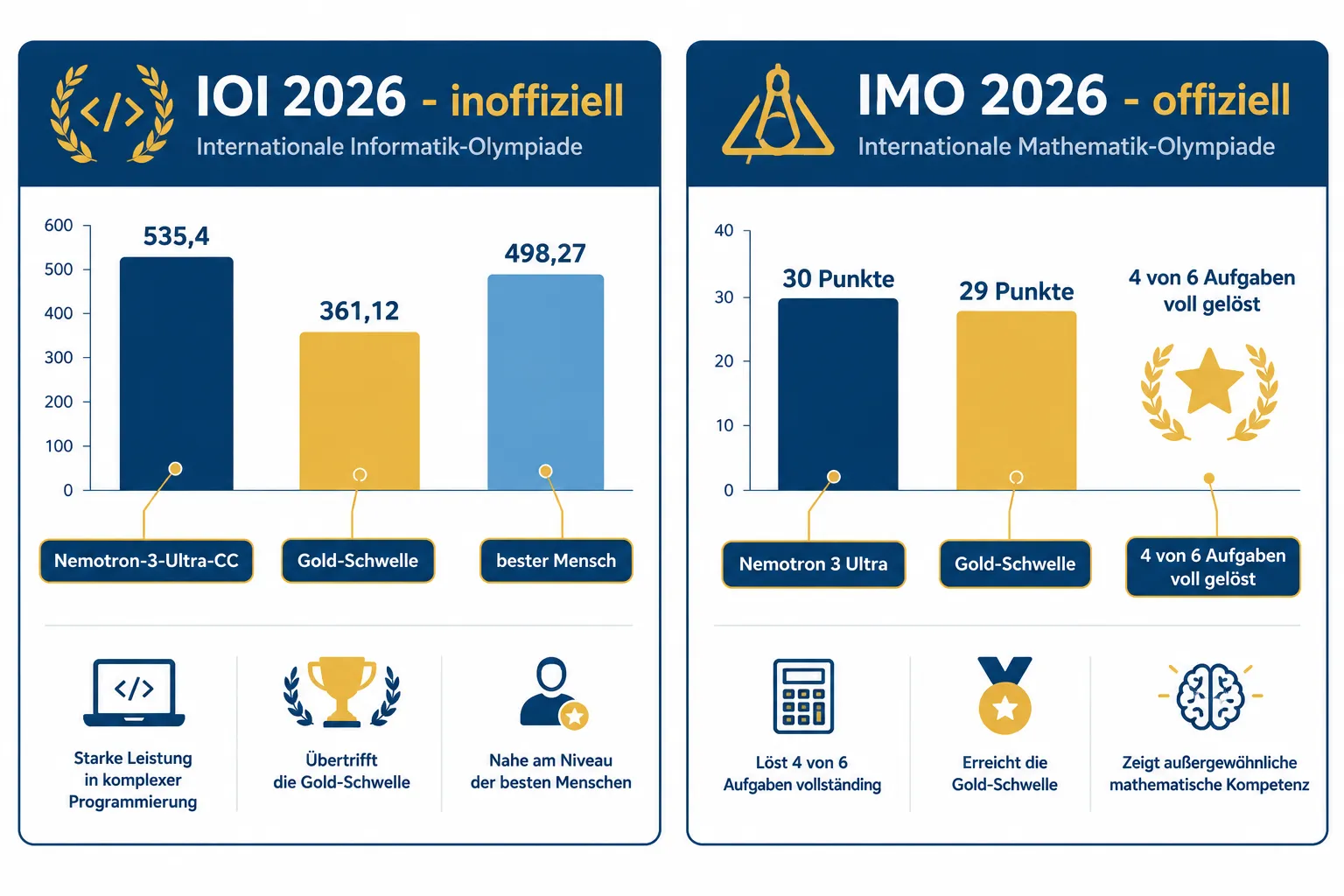
- IMO 2026 (officially verified): A Nemotron-3-Ultra system scored 30 out of 42 points, above the gold threshold of 29 points, with full marks on 4 of 6 problems.
- IOI 2026 (unofficial): “Nemotron-3-Ultra-CC” scored 535.4 out of 600 points under contest-like conditions, well above the gold threshold of 361.12 points, but not included in the official ranking.
- Both systems rely on the same methodological toolkit: supervised fine-tuning, in part reinforcement learning, and specialized inference strategies such as “GenCorrect” and “Generate-Verify-Refine” respectively.
- Nvidia openly published models, training data, and the complete recipe on Hugging Face, reproducible by anyone with the right hardware.
- Nemotron 3 IOI IMO is not a direct comparison to competing models such as GPT-5 or Claude, but evidence that a specialized training method can transfer across two completely different domains.
What Are IOI and IMO, Exactly?
Both competitions are considered the most demanding academic olympiads in their respective disciplines, drawing the world’s best young talent every year.
The International Olympiad in Informatics (IOI) is the world’s most significant programming competition for secondary-school students. Competitors solve complex algorithmic problems under time pressure, requiring precise problem-solving, efficiency thinking, and flawless implementation. The maximum score is 600, distributed across several tasks with graded partial credit.
The International Mathematical Olympiad (IMO) is the mathematical counterpart. Here it’s not about code, but about rigorous, verifiable proofs for six challenging problems spanning algebra, geometry, number theory, and combinatorics. The maximum score is 42, i.e. seven points per problem. Gold, silver, and bronze thresholds are set anew each year based on the performance of the human competitors.
For an AI system, solving problems at this level means: multi-step logical reasoning, algorithmic creativity, and, in the case of the IMO, the ability to formulate proofs in natural language precisely enough to withstand scrutiny by human judges.
Nemotron 3 IOI IMO in the Programming Contest: The IOI 2026 Result
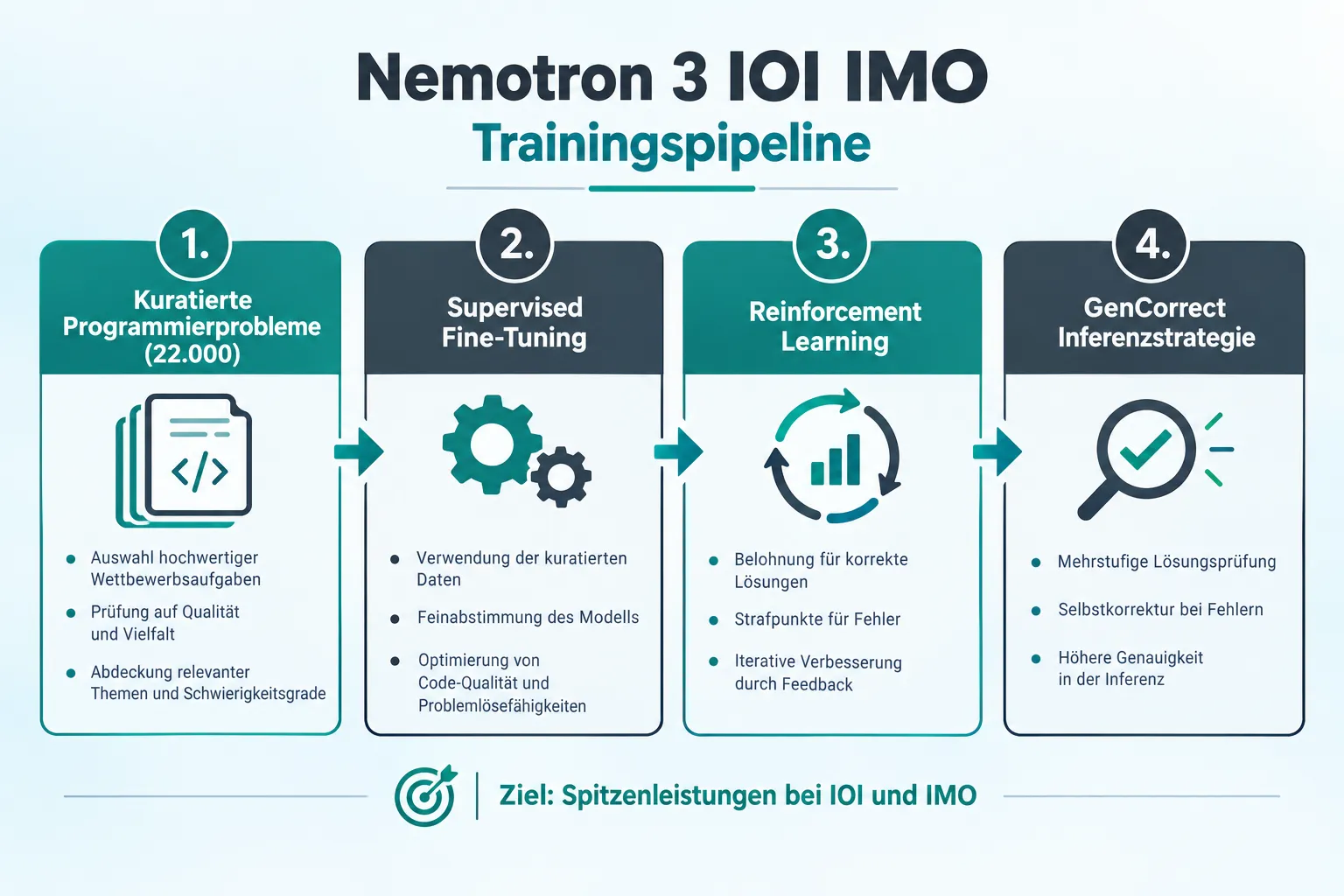
For IOI 2026, Nvidia built the specialized system “Nemotron-3-Ultra-CC.” It is based on supervised fine-tuning and additionally uses an inference strategy called “GenCorrect,” in which the model generates its own solution drafts, checks them, and corrects them before giving a final answer.
The result: 535.4 out of 600 points. To put the scale of this result in context:
| Metric | Score |
|---|---|
| Nemotron-3-Ultra-CC (2026) | 535.4 of 600 |
| IOI 2026 gold threshold | 361.12 |
| Best human competitor 2026 | 498.27 |
The system was thus clearly above both the gold threshold and the performance of the best human competitor. What matters, however, is the qualification Nvidia itself attaches to it: the run took place under the same time, internet-access, and submission constraints as human competitors, but was not part of the official IOI ranking. It was, in other words, an unofficial, unsupervised test run outside the regular competition framework.
This distinction is central to evaluating Nemotron 3 IOI IMO: an impressive result under comparable conditions is not the same as an official placement in a real competition against human rivals with independent oversight.
Nemotron 3 IOI IMO at the Math Olympiad: The Official IMO 2026 Result
The second half of the Nemotron 3 IOI IMO story looks different. For IMO 2026, Nvidia combined a general Nemotron-3-Ultra model with SFT and RL checkpoints in a “Generate-Verify-Refine” pipeline: the system generates a proposed solution, checks it for logical gaps, and refines it iteratively.
The result: 30 out of 42 points, above the official gold threshold of 29 points. The system earned full marks on four of the six problems. The crucial difference from the IOI result: this outcome was graded by official IMO judges and therefore counts as officially verified.
The methodology behind the solutions is also notable. The answers were formulated exclusively in natural language, with no formal proof prover, no external tools, and no internet access. Like a human competitor, the model had to build mathematical chains of reasoning in clearly understandable text that would hold up under strict review by subject-matter judges.
“Nemotron 3 IOI IMO shows two different degrees of verification maturity: an officially judged gold result in mathematics, and an unofficial but methodologically clean test result in computer science.”
The Recipe Behind Nemotron 3 IOI IMO: SFT, RL, and GenCorrect
Both results share a common technical foundation. For the coding training, Nvidia curated 22,000 programming problems and generated synthetic reasoning traces — traceable chains of thought that teach the models to work through problems step by step.
This produced two model variants:
- Nemotron-3-Nano-CC: 30 billion total parameters, 3 billion active, trained with SFT plus additional reinforcement learning.
- Nemotron-3-Ultra-CC: 550 billion total parameters, 55 billion active, trained exclusively with supervised fine-tuning.
Both models follow a “mixture of experts” architecture, where only a fraction of the total parameters is active per request — one reason for the comparatively efficient inference despite the enormous model size.
The real performance boost, however, doesn’t come from training alone, but from how the model operates at test time. With GenCorrect, the system generates multiple candidate solutions, evaluates their consistency, and corrects errors before committing to an answer. The IMO pipeline runs a similar principle under the name “Generate-Verify-Refine.” Both approaches show that a large share of the additional capability emerges only after training itself, through smarter use of compute time during answer generation.
IOI 2025 as a Reference Point: How Big Is the Progress, Really?
To put the development in perspective, it’s worth looking at last year’s IOI 2025 data, which Nvidia used as an internal benchmark. The smaller Nano model improved step by step:
| Training stage | Score (IOI 2025) |
|---|---|
| Before post-training | 130 |
| After supervised fine-tuning | 280 |
| After additional reinforcement learning | 291 |
| With GenCorrect (test-time strategy) | 468 |
The gold threshold back then was 438.3 points; with GenCorrect, the small Nano model cleared that mark comfortably. The larger Ultra-CC model reached 502 points with the same test-time strategy. These numbers show two things clearly: first, every single training stage delivers a measurable improvement. Second, the GenCorrect inference strategy delivers the single largest performance jump, bigger than SFT and RL combined. This exact pattern repeated itself in 2026, now at a higher level.
Open Release: Models, Data, and Benchmark on Hugging Face
A central aspect of the Nemotron 3 IOI IMO initiative is the openness of the release. Nvidia made models, training data, and the complete recipe available in the “Nemotron Labs IMO 2026 Collection” on Hugging Face. This also includes a new benchmark called “Nemotron-IMO-Bench” with 200 olympiad-level problems, serving as a testbed for future research teams.
It is specifically emphasized that this is not a scaled-down marketing version, but a complete, reproducible documentation with no withheld trade secrets. Any team with sufficient hardware can retrace the procedure and apply it to their own problems. Open weights have become a recurring pattern among major model releases in 2026, as seen for instance with Reflection AI’s Beam model at 501 billion parameters. This open approach sets Nvidia’s move apart from many other AI announcements, where results are presented but methods are not fully disclosed.
Putting It in Perspective: What Nemotron 3 IOI IMO Really Means
It would be reductive to read these results as simple proof that Nemotron 3 is “smarter” than competing models like GPT-5 or Claude. Nvidia itself explicitly emphasizes the methodological caveat on the IOI result: it is unofficial and not included in the regular competition ranking. A direct performance comparison between models from different vendors cannot be reliably drawn from these numbers.
The real news lies elsewhere: Nvidia developed a reusable specialization recipe — built from curated training data, supervised fine-tuning, reinforcement learning, and a clever inference strategy — and applied that recipe twice to two completely different domains: once to algorithmic programming, once to mathematical proof-writing. In both cases, the result reached world-class level. This transferability is the real takeaway developers should draw from the Nemotron 3 IOI IMO story.
Conclusion and Next Steps
The Nemotron 3 IOI IMO results mark a remarkable moment for specialized AI systems in logical reasoning. The official gold-level result at IMO 2026, with 30 out of 42 points, is a verified milestone, while the unofficial IOI result of 535.4 out of 600 points is impressive but should be read with methodological caution. Looking at both numbers side by side reveals one thing above all: a consistent training approach combining SFT, RL, and smart test-time strategy works across disciplinary boundaries.
For developers who want to engage with this topic hands-on, there are concrete next steps: the “Nemotron Labs IMO 2026 Collection” on Hugging Face is worth a close look, as is the new “Nemotron-IMO-Bench” as a testbed for your own reasoning experiments. Anyone looking to train their own models for complex problem-solving will find a realistic starting point in the openly documented recipe, with no hidden trade secrets.