Choosing the wrong exchange for your first cryptocurrency purchase can end up costing more than the actual investment. Anyone looking to buy Bitcoin, Ethereum, or other digital currencies for the first time quickly faces a confusing array of providers, fee structures, and security claims. This guide explains what really matters, compares the best-known exchanges, and walks beginners step by step through their first purchase.
Table of Contents
Key Takeaways
- When buying cryptocurrency, fees, verification effort, regulation, and payment methods are the main factors in choosing the right exchange.
- Bitpanda, Coinbase, Binance, and Kraken differ significantly in cost, German-language support, and deposit protection.
- A valid ID and a SEPA-capable bank account are enough to open an account with most providers.
- After buying, safe storage in your own wallet is one of the most important steps for beginners.
- Buying cryptocurrencies involves substantial price risk and does not replace individual investment advice.
Why Choosing the Right Exchange Matters When Buying Cryptocurrency
Not every exchange is equally suited to beginners. Some providers target experienced traders with complex trading interfaces, while others deliberately focus on simple apps and beginner-friendly guidance. Anyone buying cryptocurrency for the first time should therefore look beyond the Bitcoin price and consider the broader conditions: How high are the actual costs? How strict is the identity verification? Is there support available if something goes wrong? And how is the provider regulated in case the platform runs into trouble?
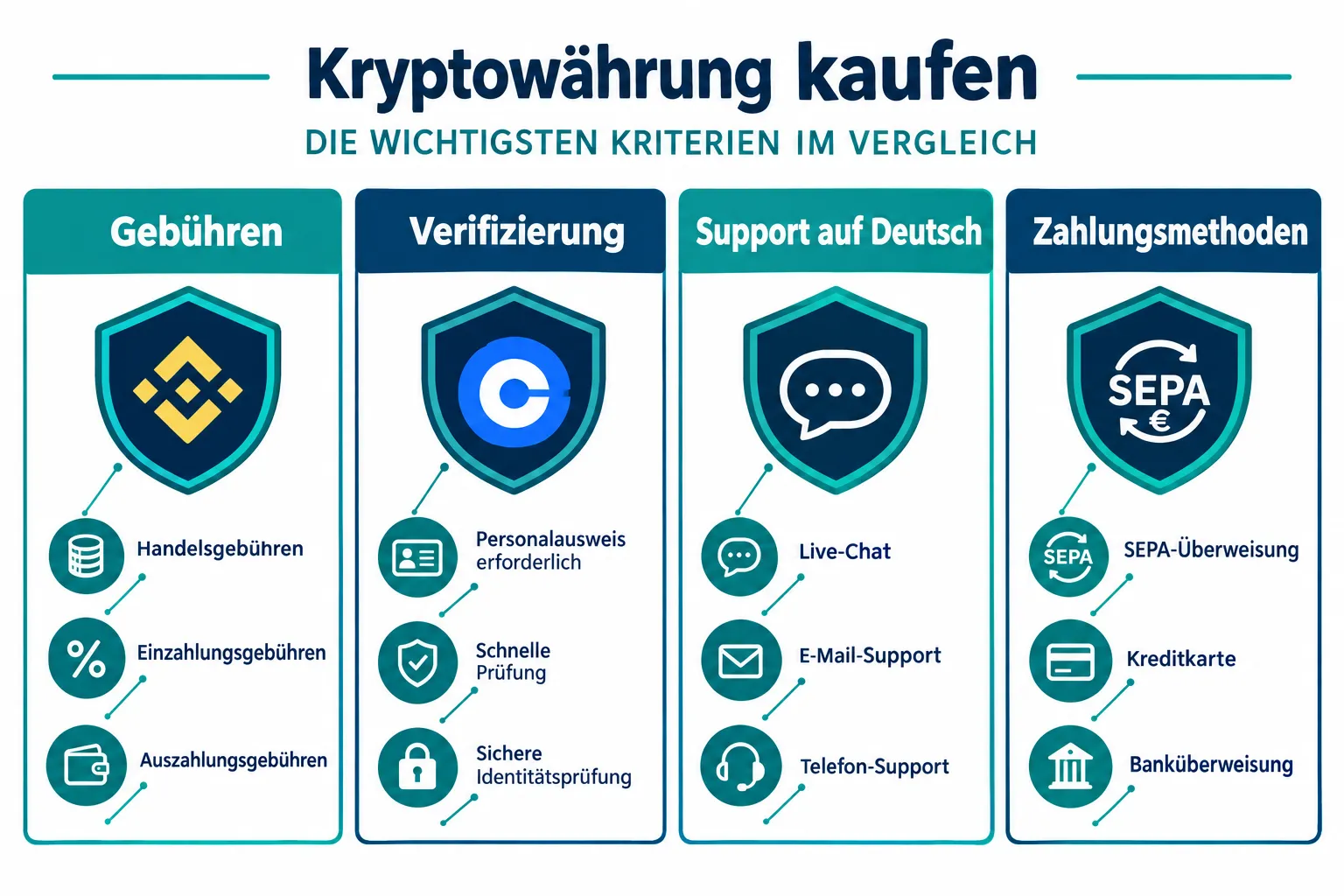
These questions matter more for beginners than short-term price movements, because they form the foundation for a safe and predictable start.
Exchange Comparison: Bitpanda, Coinbase, Binance and Kraken
Bitpanda, Coinbase, Binance, and Kraken are among the best-known crypto exchanges used in Germany and beyond. However, they differ considerably in details that matter to beginners.
| Criterion | Bitpanda | Coinbase | Binance | Kraken |
|---|---|---|---|---|
| Trading fees | Moderate, usually mid-range percentage | Somewhat higher on small amounts | Comparatively low | Low to moderate |
| Withdrawal fees | SEPA usually free | SEPA partly free | Depends on payment method | SEPA usually cheap |
| Verification (KYC) | Simple via ID and selfie | Simple, often with ID scan | More extensive, can be multi-tier | Multi-tier, depending on account level |
| English/German-language support | Available | Limited availability | Usually limited | Partially available |
| Regulation/licenses | EU-regulated, Austrian FMA supervision | EU licenses via subsidiaries | Licenses in individual EU countries | Licenses through international entities |
| Payment methods | SEPA, credit card, partly PayPal | SEPA, credit card, partly PayPal | SEPA, credit card | SEPA, credit card |
For absolute beginners, providers with a simple, user-friendly interface, a low entry threshold, and clear EU regulation are generally considered the most accessible. Important: no provider offers statutory deposit protection comparable to bank deposits. Crypto assets themselves are not covered by deposit protection schemes, even though euro balances are kept separate from company assets on some platforms. This separation should always be checked in the terms of service before opening an account.
How to Buy Your First Cryptocurrency Step by Step
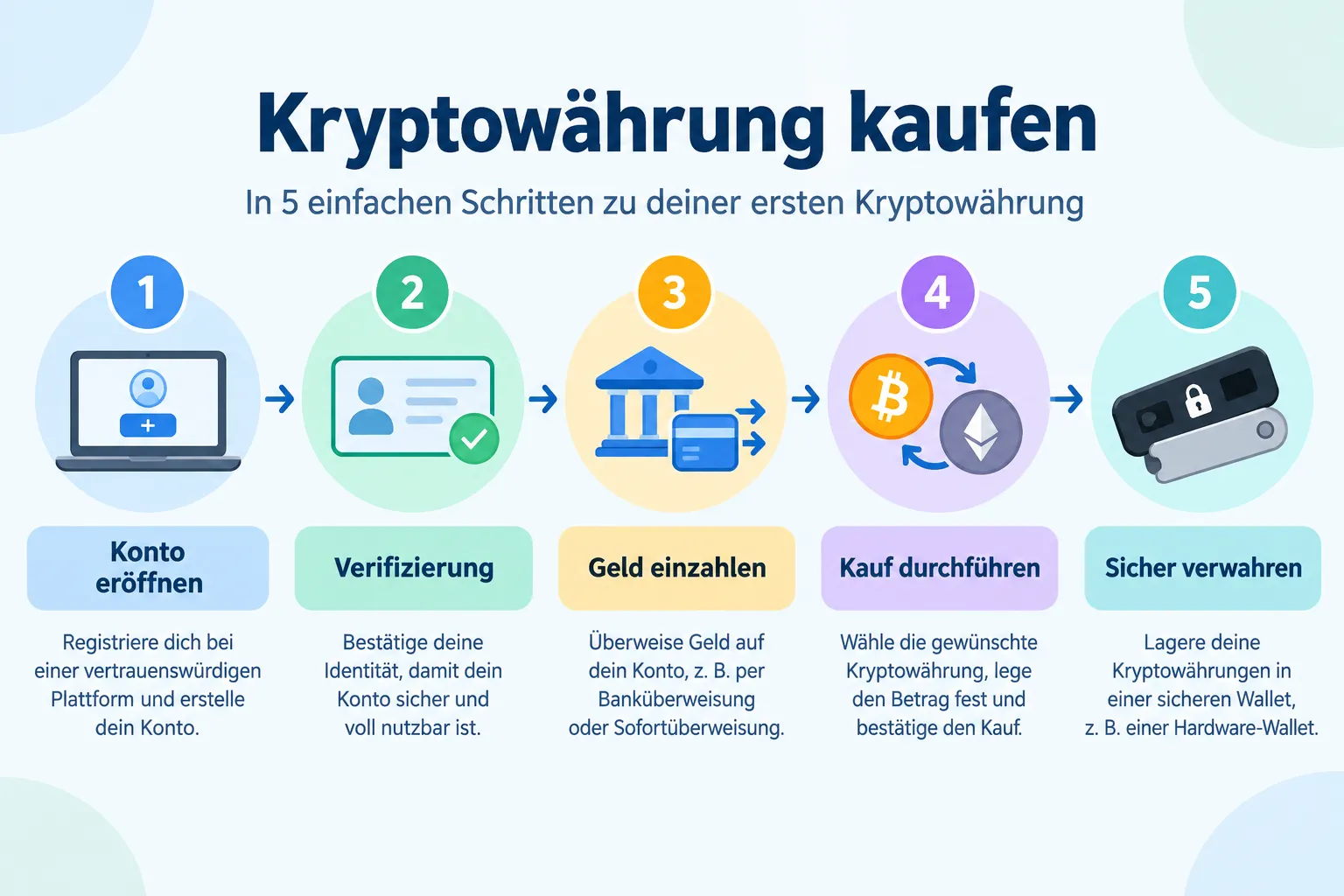
The process is similar across most exchanges and can be broken down into five clear steps.
- Open an account: Create an account on the website or in the app of your chosen provider using an email address and a secure password.
- Complete verification (KYC): Identity verification usually requires uploading an ID document, often combined with a selfie or video identification process. This step is legally required and helps prevent money laundering.
- Deposit funds: Deposits are typically made via SEPA bank transfer, credit card, or instant transfer. SEPA is usually the cheapest option but takes one to two business days.
- Make the purchase: Once the funds arrive, select the desired cryptocurrency and enter an amount. Many platforms allow purchases starting from small amounts, making it possible to try things out with little risk.
- Store safely: After buying, larger amounts should not remain on the exchange long-term, but should instead be transferred to your own crypto wallet.
As with other structured beginner guides in the technology space, a step-by-step learning path is recommended here too, where each process is first understood and then carried out before investing larger amounts [8][9].
Safe Storage: Wallet Instead of Exchange
A crypto exchange is meant for buying and selling, not for long-term storage. Anyone wanting to hold cryptocurrencies for longer should use their own wallet. There are generally two types:
- Software wallets (hot wallets): Apps or programs connected to the internet. Practical for smaller amounts and regular transactions.
- Hardware wallets (cold wallets): Physical devices that store private keys offline. They are considered the safest option for larger amounts, since they are not directly exposed to online attacks.
In both cases, it’s essential that the so-called seed phrase—a list of words used to recover the wallet—is kept offline and secure. Anyone who loses it without a backup generally loses access to their crypto assets permanently.
Buying cryptocurrency also means taking on responsibility for its safe storage.
Risk Disclaimer: Not Investment Advice
This article is for general information purposes only and does not constitute investment advice, financial advice, or a recommendation to buy. Cryptocurrencies are subject to significant price volatility and can result in substantial losses, up to a total loss of the invested capital. Anyone interested should do their own research before investing, seek independent advice where appropriate, and only invest amounts they can afford to lose.
Frequently Asked Questions About Buying Cryptocurrency
Is it safe to buy cryptocurrency through an exchange? Regulated exchanges with an EU license offer basic security standards, for example in account verification. However, there is still no complete protection against price losses or technical risks.
How much money do you need for your first purchase? Many providers allow purchases starting from very small amounts. For getting started, it’s advisable to invest an amount whose potential loss you could financially handle.
Why does verification sometimes take several days? Processing time depends on the provider’s workload and the quality of the submitted documents. A sharp, clearly legible photo of your ID usually speeds up the process considerably.
Do you have to use your own wallet right away? For very small test amounts, this isn’t strictly necessary. For larger sums, however, using your own wallet is strongly recommended in order to retain control over your private keys.
Which fees should beginners pay particular attention to? Beyond the obvious trading fee, it’s worth checking withdrawal fees, spread costs, and possible credit card payment fees, as these often significantly increase the actual cost.
Conclusion: How to Successfully Enter the Crypto Market
Buying your first cryptocurrency is technically straightforward today, but it does require a deliberate decision when choosing an exchange. Comparing fees, verification effort, language support, and regulation in advance helps avoid unnecessary costs and unpleasant surprises. Equally important is safe storage after the purchase: your own wallet gives you full control over your crypto assets.
As a next step, it’s advisable to first invest a small test amount through a regulated exchange, go through the entire process from verification to wallet transfer once, and only then consider larger amounts. This way, entering the crypto market can be done gradually and with manageable risk. Once you are comfortable holding and securing coins, our guide to DeFi and yield farming for advanced users covers how to put idle holdings to work.
References
[1] BaFin – Fact Sheet on Crypto Assets – https://www.bafin.de/EN/unternehmen-maerkte/erlaubnis-registrierung/geschaefte-krypto/kryptoverwahrgeschaeft/kryptoverwahrgeschaeft_node_en.html [2] Bitpanda – Fee Overview – https://support.bitpanda.com/hc/de/articles/360000902525-Welche-Geb%C3%BChren-und-Aufschl%C3%A4ge-erwarten-mich-auf-Bitpanda [3] Kraken – Fee Overview – https://www.kraken.com/de-de/features/fee-schedule [4] Coinbase – Fee Overview – https://www.coinbase.com/de/advanced-fees [5] BaFin – Consumer Warning on Crypto Assets – https://www.bafin.de/SharedDocs/Veroeffentlichungen/DE/Fachartikel/2026/fa_260825_kryptowissen.html
buy cryptocurrency, crypto exchange comparison, buy bitcoin for beginners, bitpanda, coinbase, binance, kraken, crypto wallet, beginner crypto, kyc verification, sepa deposit crypto, store cryptocurrency safely
Frequently Asked Questions
Is it safe to buy cryptocurrency through an exchange?
Regulated exchanges with an EU license offer basic security standards, but there is still no complete protection against price losses or technical risks.
How much money do you need for your first purchase?
Many providers allow purchases starting from very small amounts, it is best to start with an amount whose potential loss you could comfortably afford.
What are the steps to buy your first cryptocurrency?
Open an account, complete KYC verification, deposit funds via SEPA or card, buy the cryptocurrency, then move it to your own wallet for safe storage.
How do Bitpanda, Coinbase, Binance, and Kraken differ most?
Mainly in trading fees, language support, and regulation, for example Bitpanda is EU-regulated under Austrian FMA supervision.