A single GPT-4 call with a 6,000-token system prompt can cost more per response than a fine-tuned, smaller model handling the same task [2]. That’s the core of the fine-tuning vs. prompt engineering debate: it’s not about which method is fundamentally “better,” but which one makes economic and technical sense for a specific use case. If you already know your way around prompt engineering and RAG systems, sooner or later you’ll ask whether the next step, training your own model, is worth it. This article gives you the decision framework.
Table of Contents
Key Takeaways
- Prompt engineering runs into clear limits around context window size, consistency, and cost for long, repeated prompts.
- Fine-tuning permanently changes a base model’s weights, unlike RAG, which injects external knowledge at runtime.
- The 2026 baseline strategy: try prompt engineering plus RAG first, only consider fine-tuning afterward [3][6].
- PEFT/LoRA methods significantly lower the barrier to entry for fine-tuning and are often the smarter intermediate step before a full fine-tune [1][7].
- Fine-tuning pays off with large, stable data volumes, recurring specialized tasks, and compliance requirements, not with rapidly changing knowledge.
The Limits of Prompt Engineering in Practice
Prompt engineering is the right starting point for most AI projects, as we already showed in our beginner guide Prompt Engineering for Beginners: How to Get Better AI Answers. But as complexity grows, four recurring limitations show up.
Often a well-built knowledge base already solves the problem — learn more in our guide Build Your Own RAG System: How to Create AI Knowledge Bases. For the fundamentals of writing effective prompts, see our article Prompt Engineering for Beginners: How to Get Better AI Answers.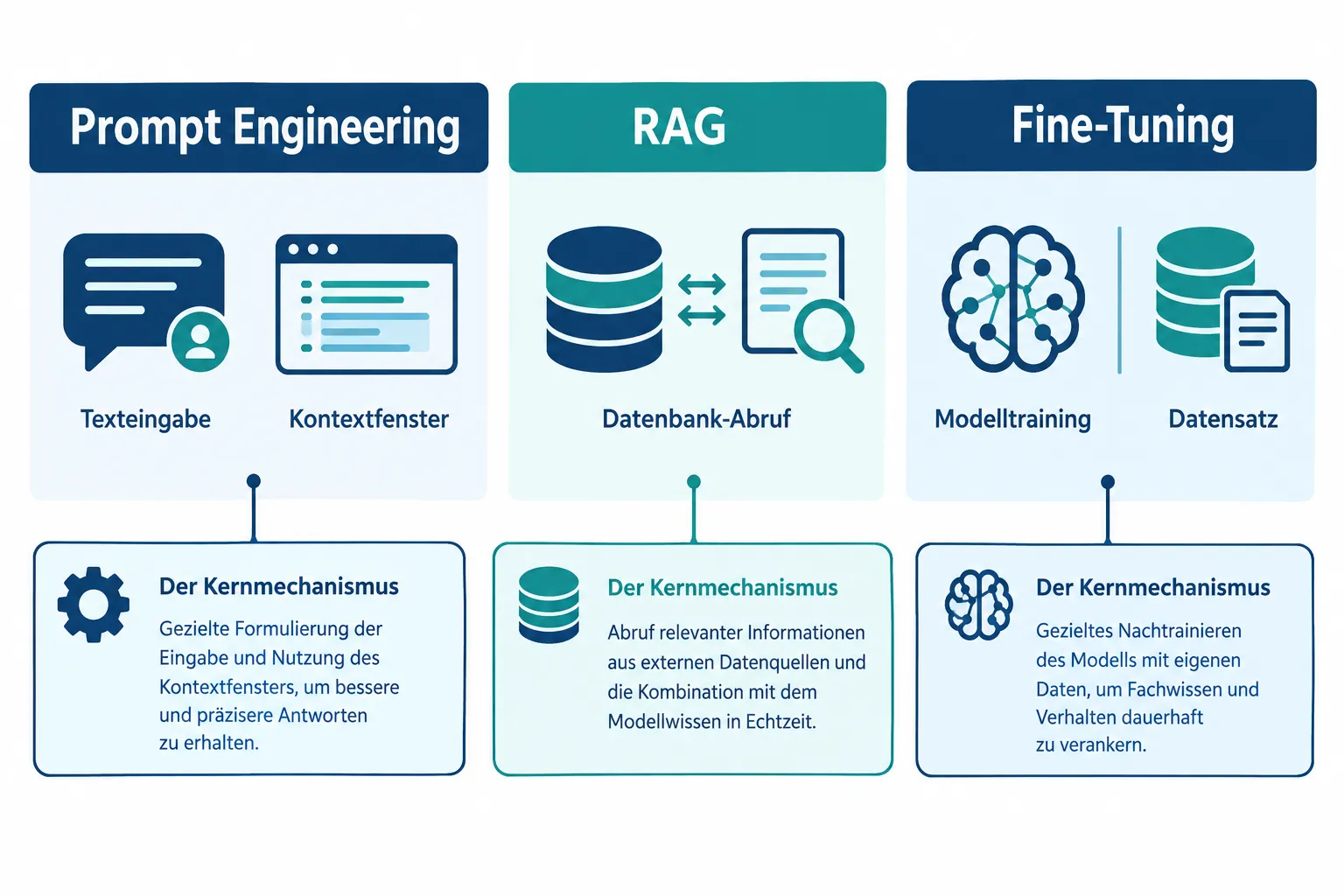
First, the context window: even large models have a limit on input tokens. If you need to pack a lot of domain knowledge, examples, or style guides into every prompt, you’re wasting capacity and performance.
Second, consistency: for complex tasks, the same prompt template often produces fluctuating results in tone, structure, or accuracy across hundreds of requests, especially critical in regulated industries.
Third, cost per request: long prompts with extensive few-shot context get billed again on every single API call. At high request volumes, this adds up to a significant cost factor [2][5].
Fourth, missing domain knowledge: a general-purpose base model doesn’t reliably know company-specific terminology, internal processes, or niche jargon, no matter how cleverly the prompt is written [9].
What Fine-Tuning Actually Is: Fine-Tuning vs. Prompt Engineering, Technically Compared
Fine-tuning means further training an already-trained base model on your own, task-specific datasets. This adjusts the model’s internal weights, so the model permanently “learns” new patterns instead of having them explained again with every request [3][10].
The key difference from prompt engineering: prompt engineering only changes the input, not the model itself. The model stays identical on every call; only the wording of the request steers the outcome.
RAG (Retrieval-Augmented Generation) also doesn’t change the model. Instead, relevant knowledge is retrieved from an external database at runtime and added to the prompt. RAG is therefore ideal for current, frequently changing factual knowledge, while fine-tuning is better suited to stable patterns, style, and structure [3][6]. How to actually build such a system is the subject of a separate guide on this blog, Build Your Own RAG System.
An important technical note for 2026: instead of a full fine-tune, where all model parameters are retrained, many teams today rely on PEFT methods like LoRA (Low-Rank Adaptation). Only a small fraction of parameters are adjusted, which significantly lowers training costs and infrastructure overhead, often with comparable quality [1][7].
Cost and Effort Comparison: Fine-Tuning vs. Prompt Engineering in Production
The economic comparison is rarely one-dimensional. It spans several cost categories that hit at different points in time.
Prompt Engineering / RAG:
- Low entry costs, no training infrastructure needed
- Ongoing API costs rise with prompt length and request volume
- Fast iteration, but recurring “cost per token” on every request [2]
Fine-Tuning:
- High initial effort for data preparation (collecting, cleaning, labeling)
- Training costs depend on model size and method (significantly lower with LoRA/PEFT than full fine-tuning) [1][7]
- Additional infrastructure for hosting your own model, unless using a managed service
- Maintenance overhead: retraining as new data or model updates arrive
Enterprise analyses show that fine-tuning pays for itself at high, recurring request volumes because shorter prompts per request lower ongoing costs, a fine-tuned model often no longer needs a long context to answer correctly [2][8]. At the same time, practical guides report measurable accuracy gains on specialized tasks after fine-tuning, compared to pure prompting of the same base model [8].
When Is Fine-Tuning Really Worth It, and When Do Prompt Engineering or RAG Suffice?
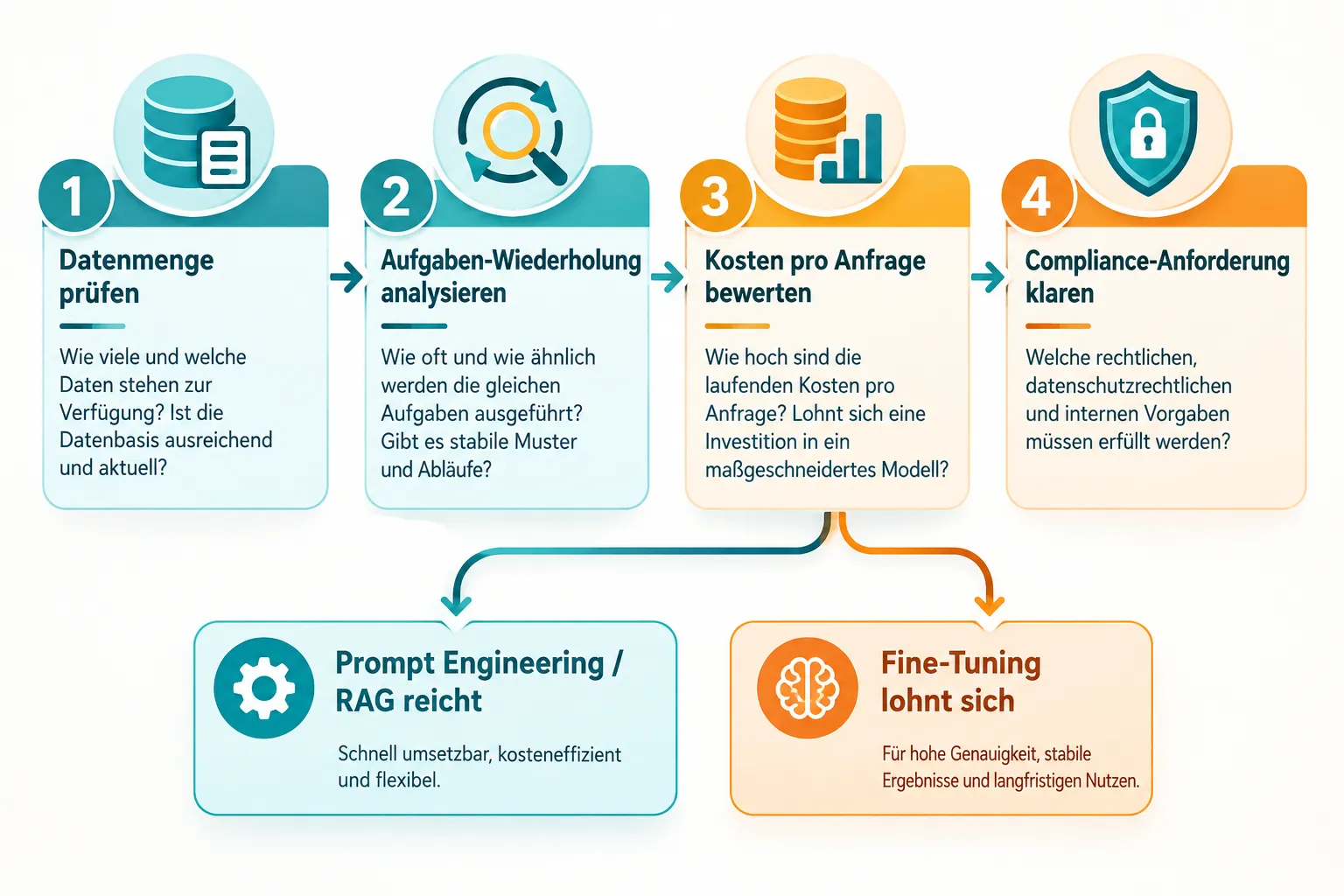
The 2026 baseline strategy, according to major vendors’ official guidance, is clear: exhaust prompt engineering and RAG first, only evaluate fine-tuning once those methods hit their limits [3][10]. Many companies’ roadmaps follow the pattern Pilot → Prompt/RAG → Fine-Tuning → possibly a custom model [6].
Fine-tuning is worth it when:
- Large, high-quality volumes of training data are available
- A recurring, clearly defined specialized task needs to be automated (e.g. classification, extraction into a fixed format)
- Tone, style, or formatting must stay consistent across thousands of requests
- Long, complex prompts can be “compressed” into trained behavior, lowering ongoing costs
- Compliance or on-premise requirements demand a self-hosted, controlled model
Prompt engineering or RAG are enough when:
- The required knowledge changes frequently (current facts, prices, product data, the classic RAG case) [3]
- Only a handful of training examples are available
- Fast iteration and experimentation matter more than maximum efficiency
- Request volume is (still) low and training effort wouldn’t pay off
Decision Guide: Fine-Tuning vs. Prompt Engineering Checklist
The table below summarizes the key decision criteria, based on common enterprise evaluation frameworks [6][9].
| Criterion | Prompt Engineering / RAG | Fine-Tuning |
|---|---|---|
| Data availability | Little to moderate, no training set needed | Large, clean datasets required |
| Type of knowledge | Current, frequently changing | Stable, recurring patterns |
| Request volume | Low to medium | High, many recurring requests |
| Cost focus | Pay-per-use, rises with prompt length | High upfront cost, lower cost per request afterward |
| Iteration speed | Very fast, testable immediately | Slower, requires training cycles |
| Compliance / On-premise | Limited with external APIs | Full control over model and data possible |
| Entry effort | Low | Medium to high (lower with LoRA/PEFT) |
A quick self-assessment checklist:
- Do you have at least a few hundred to a few thousand high-quality examples? If not, lean toward prompt engineering/RAG.
- Is the task clearly scoped and recurring, rather than constantly changing factual knowledge? If yes, that favors fine-tuning.
- Will ongoing API costs for long prompts foreseeably exceed training costs? Then fine-tuning is more likely worth it.
- Are there regulatory requirements around data handling or model control? Then a self-hosted, fine-tuned or on-premise model is often unavoidable.
- Is fast adaptability more important than maximum efficiency? Then prompt engineering remains the better choice.
Conclusion
Fine-tuning vs. prompt engineering isn’t an either-or decision, it’s a question of sequencing and a project’s maturity level. For most use cases, the rule still holds: exhaust prompt engineering and RAG first, since they’re faster, cheaper, and more flexible. Fine-tuning only becomes economically sensible once large data volumes, high request volume, consistency requirements, or compliance demands push past the limits of pure prompting. As a practical next step, it’s worth looking at PEFT/LoRA methods as a lower-risk entry point into fine-tuning before considering a full model training run. If you also need to incorporate current factual knowledge, check out this blog’s guide on building RAG systems as well.
References
[1] Fine Tuning Vs Prompt 2025 – https://randomcommits.com/fine-tuning-vs-prompt-2025/ [2] Fine Tuning Vs Prompt Engineering Which One Actually Saves You Money – https://dev.to/pullflow/fine-tuning-vs-prompt-engineering-which-one-actually-saves-you-money-1bm4 [3] Rag Vs Fine Tuning Vs Prompt Engineering – https://www.ibm.com/think/topics/rag-vs-fine-tuning-vs-prompt-engineering [5] Fine Tuning Vs Prompt Engineering Explained – https://simplico.net/2025/12/03/fine-tuning-vs-prompt-engineering-explained/ [6] Rag Vs Fine Tuning Vs Prompt Engineering Enterprise 2026 – https://internative.net/insights/blog/rag-vs-fine-tuning-vs-prompt-engineering-enterprise-2026 [7] Prompt Engineering Vs Fine Tuning Gen Ai – https://smartdev.com/prompt-engineering-vs-fine-tuning-gen-ai/ [8] ijsat – https://www.ijsat.org/papers/2025/2/3098.pdf [9] Fine Tuning Vs Prompt Engineering – https://unicoconnect.com/blogs/fine-tuning-vs-prompt-engineering [10] Fine Tuning – https://developers.openai.com/learn/fine-tuning
Frequently Asked Questions
What is the difference between fine-tuning and prompt engineering?
Prompt engineering optimizes how you phrase requests to an existing model, while fine-tuning retrains the model itself on your own data to permanently change its behavior.
When is fine-tuning worth it compared to prompt engineering?
Fine-tuning pays off mainly for high-volume, repetitive tasks with a stable format, where a smaller specialized model becomes cheaper than long prompts over time.
Is fine-tuning more expensive than prompt engineering?
Setting up fine-tuning costs more upfront, but it can pay for itself at high request volumes since each individual response becomes cheaper and faster.
Can RAG be an alternative to fine-tuning?
Yes, in many cases a well-built knowledge base using RAG already solves the problem of missing current information without needing to train your own model.