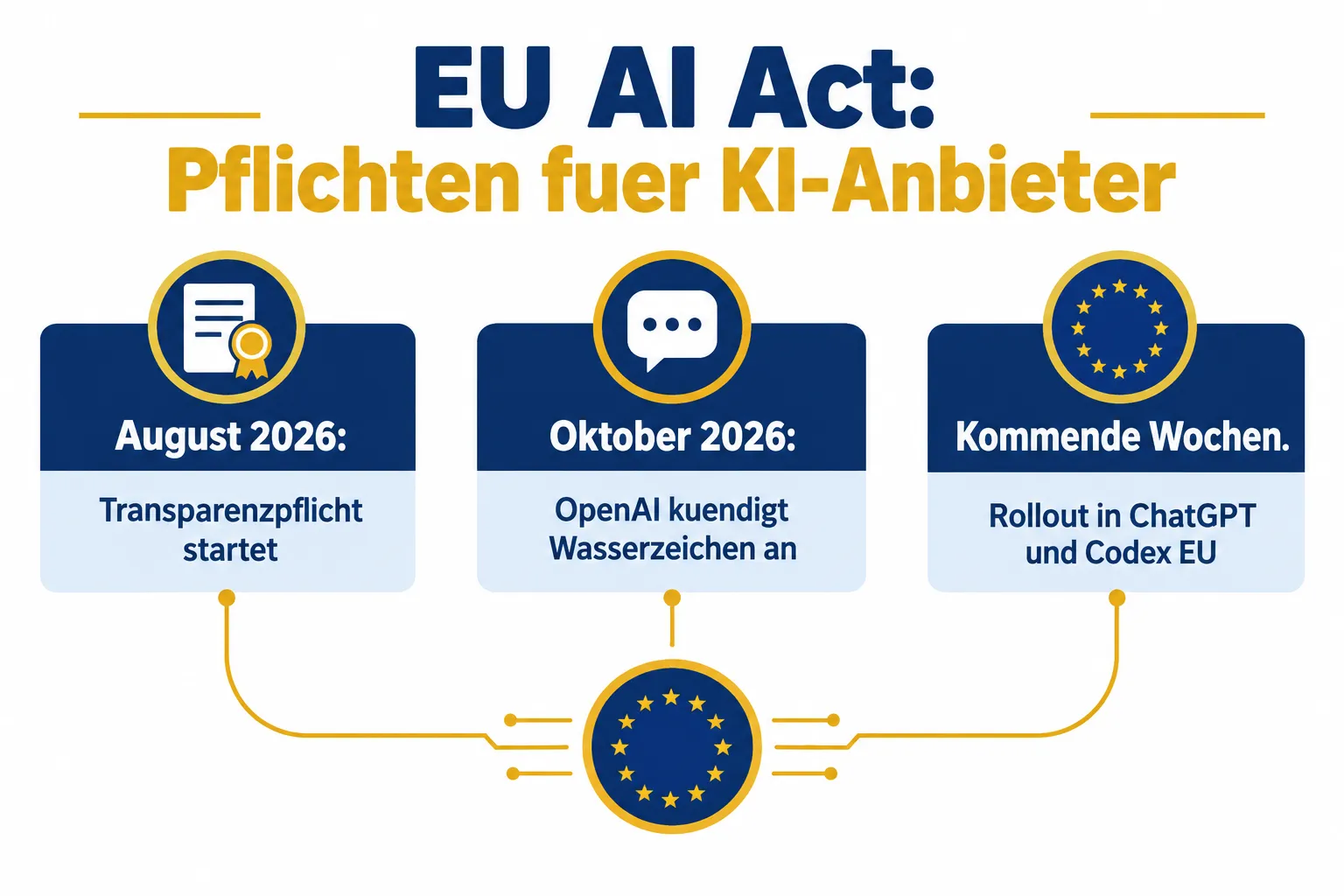
A text that looks like it was written by a human could now carry a silent signal that no eye can detect, but software can read. That is exactly what OpenAI announced on Monday, October 5, 2026: the company is introducing an invisible watermark for ChatGPT and Codex output in the European Union, marking AI-generated text in a machine-readable way. The OpenAI ChatGPT watermark is a direct response to new transparency requirements under the EU AI Act, and it joins a growing list of similar moves across the industry.
For developers, IT decision-makers, and anyone who works professionally with generated language, this announcement is more than a technical footnote. It changes how AI-generated content can be verified, documented, and regulated going forward.
Table of Contents
Key Takeaways
- OpenAI is introducing an invisible text watermark for ChatGPT and Codex in the EU to meet the transparency requirements of the EU AI Act.
- The method is called “textGrain” and subtly influences the model’s word choices without visibly altering the text.
- API customers worldwide can already opt in voluntarily; ChatGPT and Codex in the EU will get it automatically on all plans in the coming weeks.
- Detection accuracy drops significantly when text is edited: from about 92% to roughly 66% when 10% of words are swapped for synonyms.
- Anthropic already announced a worldwide watermark for Claude in August 2026; OpenAI is now following suit, but for now only in the EU.
What the EU AI Act Requires From AI Providers
On August 2, 2026, the EU AI Act‘s transparency rules took effect. They require providers of AI systems to mark artificially generated content in a way that machines can automatically recognize. This is not about a visible label for users, but about a technical signal that systems can read out.
The rule is rooted in growing concern that AI-generated text, images, and videos are becoming nearly indistinguishable from human-made content. That affects news articles, academic work, customer communication, and much more. The European Commission wants the labeling requirement to create transparency without fundamentally restricting the use of AI tools.
Several major providers had already agreed in advance on a voluntary framework: the so-called Code of Practice on transparency for AI-generated content. Signatories include:
- Anthropic
- Meta
- Microsoft
- OpenAI
This voluntary commitment shows that the industry broadly supports the direction of regulation, even though the concrete technical implementation, as in OpenAI’s case, is only becoming visible now.
How the OpenAI ChatGPT Watermark Works Technically
The new method is called “textGrain” and was published in a technical report co-authored with researchers from the University of Pennsylvania and Yale University. The paper is titled “textGrain: entropy-calibrated watermarking for language model text.”
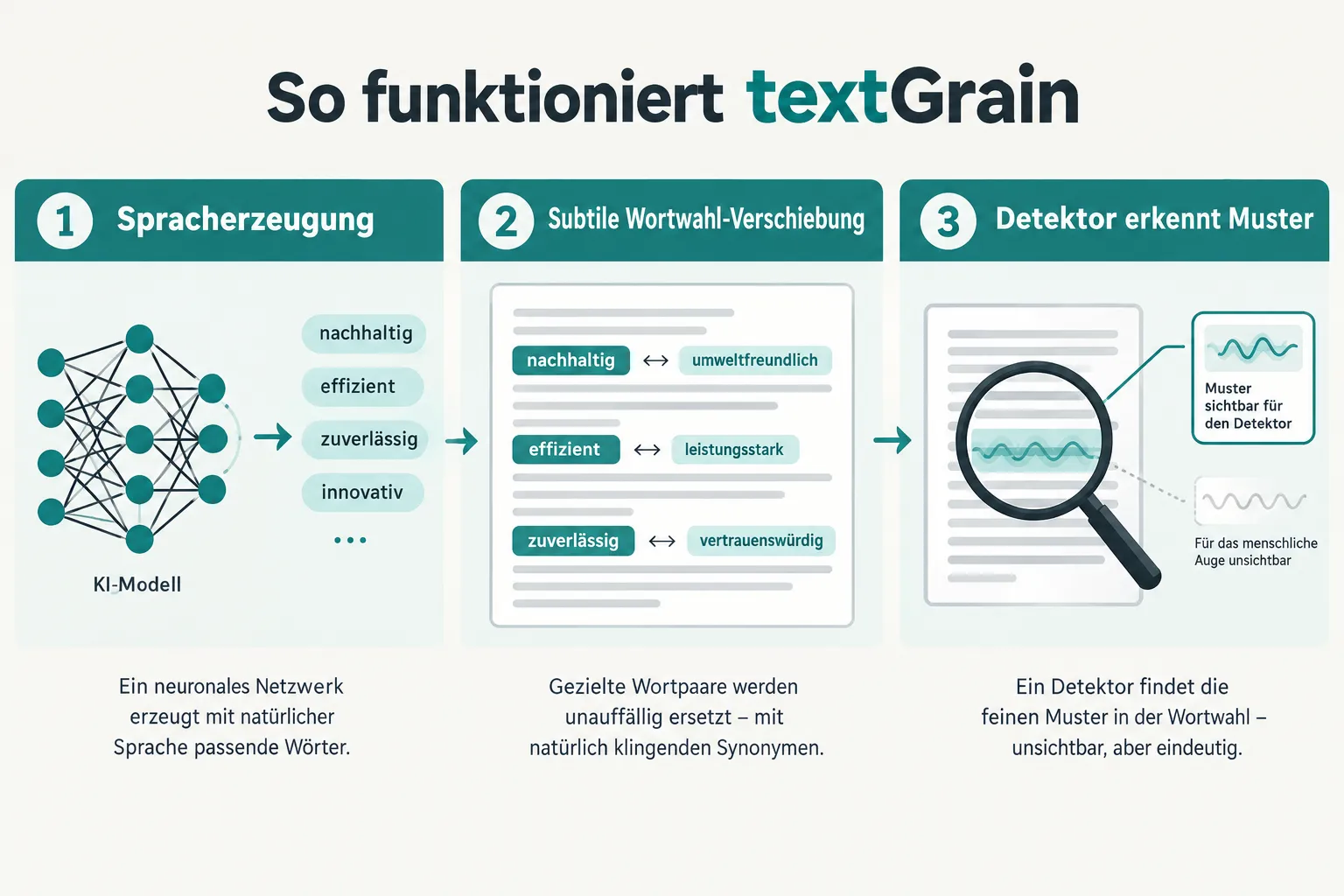
Unlike a classic watermark on a photo, the OpenAI ChatGPT watermark is completely invisible to humans. There is no symbol, no stamp, and no notice text in the generated content. Instead, the method intervenes directly in the generation process:
- Word generation: When ChatGPT or Codex writes a text, the model frequently has to choose between several similarly fitting words.
- Subtle steering: textGrain slightly influences this choice so that certain word patterns appear somewhat more often than others, without making the text feel unnatural.
- Detectable pattern: Across many sentences, a statistical signature emerges that a special detector can recognize.
- No user identification: The pattern points to the model and the generation process, not to the individual person who requested the text.
OpenAI states that internal tests found no measurable performance loss for the models. Answer quality is meant to stay the same whether the watermark is active or not.
Availability: Who Can Use the Feature
The rollout happens at two different speeds:
| Area | Status | Activation |
|---|---|---|
| API worldwide | Available now for select models | Opt-in, off by default |
| ChatGPT and Codex in the EU | Rolling out in the coming weeks | Automatic on all plans |
| ChatGPT and Codex outside the EU | Not announced for now | Not available |
In other words: while API customers around the world can decide for themselves whether to enable the watermark, it becomes a fixed part of ChatGPT and Codex inside the EU, regardless of the subscription plan.
Limits of the OpenAI ChatGPT Watermark: What It Cannot Do
No technical method is perfect, and OpenAI makes that clear in its own communication. The most important limitation concerns the watermark’s robustness against editing.
“A missing watermark does not prove a text was written by a human,” OpenAI states clearly.
Tests showed that detection accuracy drops significantly once a text is edited afterward. When about 10% of words were replaced with synonyms, the detection rate fell from roughly 92% to about 66%. Anyone who deliberately rephrases a text can substantially weaken the signal.
Other situations where detection is harder:
- Short texts: the fewer words, the less statistical pattern is available to the detector.
- Math answers: formulas and numbers leave little room for subtle word-choice steering.
- Translated text: translation changes word structure so much that the original pattern can be lost.
These limitations matter for how the feature should be understood in practice. The OpenAI ChatGPT watermark is an additional indicator, not proof. A missing detection does not automatically mean a human wrote the text — the content could simply be too short, too heavily edited, or generated by a different AI system that uses no comparable method.
OpenAI vs. Anthropic: Two Paths to the Same Goal
OpenAI is not the first provider to introduce a text watermark. Anthropic had already announced in August 2026 that it would watermark text generated by Claude worldwide. The difference from OpenAI’s current announcement lies mainly in geographic scope.
The table below highlights the key differences:
| Feature | Anthropic (Claude) | OpenAI (ChatGPT, Codex) |
|---|---|---|
| Announcement | August 2026 | October 2026 |
| Geographic scope | Worldwide | EU only, for now |
| Reason | Voluntary commitment under the Code of Practice | Compliance with the EU AI Act transparency requirement |
OpenAI is thus taking a regionally limited but regulation-driven path, while Anthropic opted for a global rollout from the start. Both companies are signatories of the EU Code of Practice, which shows the industry is broadly moving in a similar direction, even if pace and scope differ.
For internationally active companies, this is a relevant point: anyone creating content with both Claude and ChatGPT now needs to know that labeling practices differ by provider and region.
What This Means for Developers and IT Decision-Makers
For teams integrating ChatGPT or Codex into products, workflows, or internal tools, the announcement carries several practical consequences.
For API users outside the EU, the update initially creates no obligation. The watermark is off by default and can be voluntarily enabled for select models, for example if a company wants to create transparency on its own initiative or prepare for future regulation.
For companies with EU exposure, the situation is clearer: once the rollout for ChatGPT and Codex is complete, the watermark will run automatically on all plans. Businesses serving EU customers with AI-generated text should internally document that this labeling exists, in case compliance questions come up.
For content teams and quality assurance, it is worth taking a realistic look at the method’s limits. Since editing significantly reduces detectability, nobody should treat the watermark as a reliable tool for catching plagiarism or AI use in job applications, student papers, or news articles. It is an additional signal, not courtroom-grade proof.
A short practical checklist:
- Check whether your own applications run through the API and whether voluntary activation makes sense.
- Update internal policies if EU customers are affected.
- Communicate realistic expectations about detection accuracy, especially for short or translated text.
- Watch whether OpenAI later expands the rollout to other regions.
Conclusion
The OpenAI ChatGPT watermark marks a clear step toward more traceability for AI-generated content, but for now it remains a regionally limited and technically incomplete solution. The textGrain method is cleverly built, invisible to readers, and comes without a noticeable quality loss for the model. At the same time, OpenAI’s own test data shows that the signal can be significantly weakened through deliberate editing, and that it reaches its limits with short, mathematical, or translated text.
For developers and IT decision-makers, the practical takeaway is: acknowledge the new feature, adjust relevant processes if you have EU exposure, and treat the watermark as one building block among several for handling AI-generated content, not as the sole answer to questions of origin and authenticity. Anyone already using the API can test the feature today, before it becomes a fixed part of ChatGPT and Codex in the EU in the coming weeks.
Sources
- TechCrunch, October 5, 2026
- 9to5Mac, October 5, 2026
- PYMNTS, October 5, 2026