A single GPT-4 chat call for a simple yes/no decision often costs more time and money than the actual business logic behind it. That mismatch is exactly what Jev addresses. While generative models like GPT, Claude, or Gemini remain responsible for open-ended reasoning in agent architectures, Jev handles the mass of small, tightly scoped decisions that occur in every production software pipeline. This article walks through five concrete Jev AI use cases showing how developers apply this structured decision layer in practice — from intent classification to guardrails for tool calls.
This is the third part of a series: Part 1 introduced Jev as a concept, Part 2 covered performance and architecture questions. Part 4 goes on to show ten concrete community projects built on Jev AI Here we focus on practice: exactly where Jev replaces an expensive LLM call with a fast, type-safe decision — and where it doesn’t.
Table of Contents
Key Takeaways
- Jev AI use cases focus on recurring, tightly scoped decisions: classification, routing, scoring, extraction, and guardrail checks.
- The official LangChain integration via
TypeSafeClassifierlets you pass state and questions directly to.invoke()and get structured results instead of a chat response [1][2]. - Model-routing middleware and AutoModeMiddleware are two documented patterns where Jev makes a pre-decision before the actual model or tool execution [1][7].
- Jev does not replace generative models: it produces no prose, no code, no open-ended explanations — only structured, type-safe decisions.
- Type safety guarantees that the response matches the defined format, not that the underlying decision is correct. Business accuracy still needs to be validated with real data [4][5].
What Jev Actually Does in Agent Architectures
Jev, also referred to as “TypeSafe AI,” positions itself as a decision-model category alongside the main generative models — not as their replacement [3][4]. In a typical agent pipeline, the main model handles planning, text generation, and complex reasoning, while Jev answers a narrowly defined question at clearly identified points: Is this request urgent? Which team should handle the ticket? Is this tool call risky?
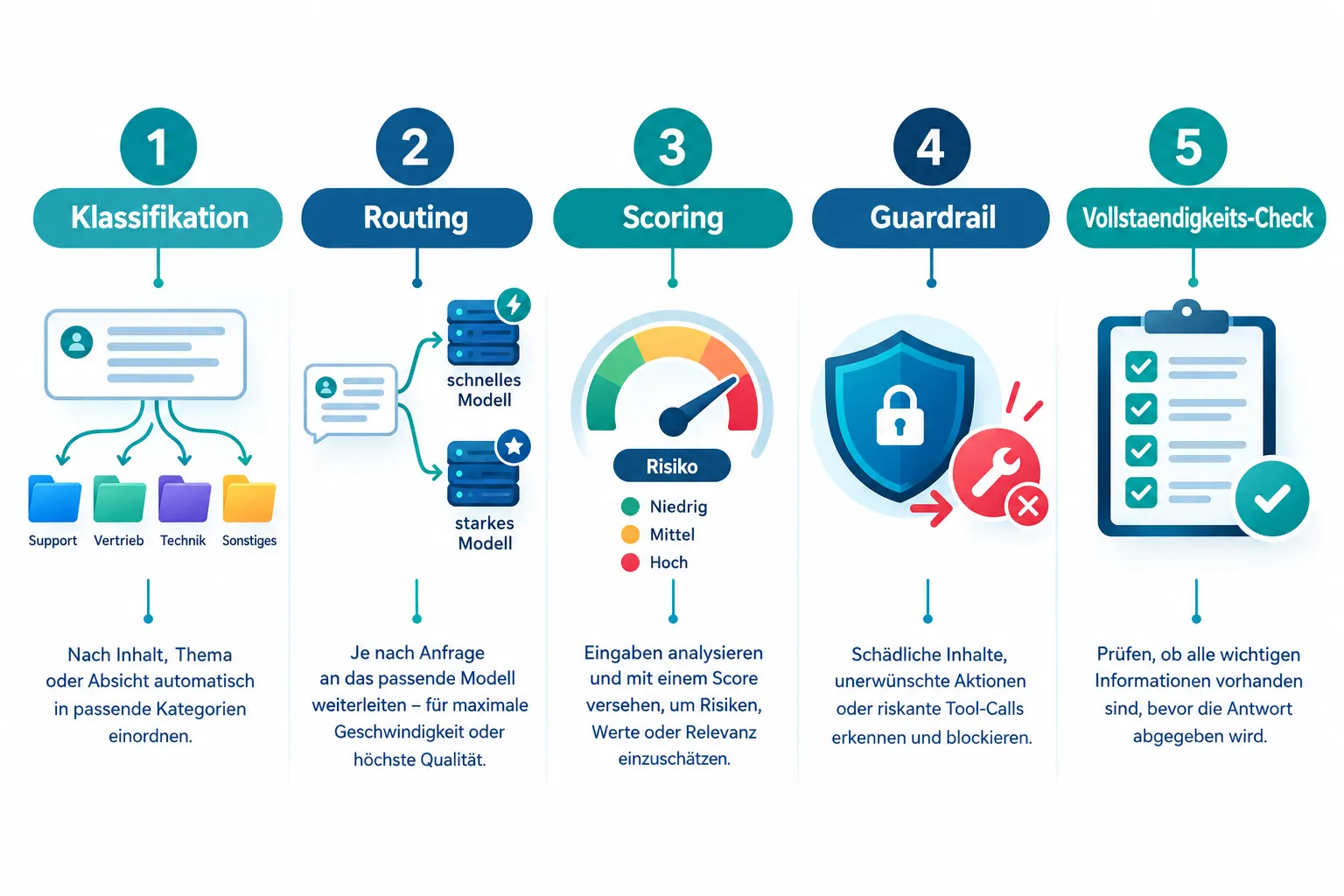
This division of labor is the core of all Jev AI use cases: Jev gets used wherever hand-written if-rules would be too rigid or brittle, but a full LLM chat call would be too expensive or too slow. The result is a structured, predictable answer that can be processed just like an ordinary program variable — hence the term “smart if-statement.”
Jev AI Use Cases at a Glance: 5 Patterns for Fast Decisions
From TypeSafe’s own documentation, the LangChain integration, and independent analyses, five recurring application patterns can be derived that are already used in production systems [1][2][6][7].
1. Agent Routing, Escalation, and Tool Selection in LangChain
The best-documented use case is arguably routing within LangChain agents. A model-routing middleware uses Jev to decide, based on the latest user message, which model is best suited for the request [1]. Simple questions get a fast, cheap model, while complex or ambiguous requests are routed to a more capable, more expensive model. This decision happens in milliseconds, instead of requiring a full LLM call just to assess complexity.
Analogously, Jev can be used for escalation decisions: should a request be handed off to a human support agent, or can the agent resolve it autonomously? Selecting the right tool from an agent’s toolset can also be delegated to Jev as a classification task [7].
2. Support Ticket Triage and Customer Operations Automation
In customer service, thousands of requests come in daily that need to be sorted before actual handling. Jev can take over intent detection here: is this a complaint, a billing question, or a technical issue? Urgency can additionally be scored — a ticket containing the words “server down” gets a higher priority than a general product question.
This combination of classification and scoring reduces the number of cases where an expensive language model is invoked purely for sorting. Instead, pre-sorting runs through Jev, and the generative model is only used for the actual, content-demanding response.
3. Moderation, Risk Assessment, and Policy Enforcement
Guardrails are one of the most sensitive Jev AI use cases, because a wrong decision here has direct consequences. The documented AutoModeMiddleware uses Jev to check an agent’s tool calls for risky decisions and blocks the call before the tool is actually executed [1]. An agent that, for example, wants to trigger a payment or delete a file is first routed through a Jev check: does this action comply with the defined policies?
Content moderation also falls into this category — for instance, assessing whether user-generated text violates guidelines, or whether a high-probability purchase intent has been detected and an offer should be triggered.
4. Log, Anomaly, and Event Classification for Reliability Engineering
Systems in production continuously generate log data, metrics, and events. A recurring problem for site reliability teams is quick triage: is an error event critical, or is it known, non-critical noise? Jev can be used as a classification layer between the monitoring system and alerting, sorting events into categories such as “immediate escalation,” “watch,” or “ignore” — without every alert triggering a full LLM call.
5. Agent Evaluation and Benchmarking as an AI Judge
A specific pattern discussed in the LangChain community is using Jev as an evaluation instance for other agents — an “AI judge” [6]. Jev structurally assesses whether an agent’s response meets a defined quality criterion, whether a task has been fully completed, or whether a result matches the expected format. Because this evaluation is itself a bounded, repeatable decision, it’s well suited for the Jev layer instead of an additional, expensive evaluation call by a generative model.
The table below summarizes the five patterns:
| Use Case | Typical Question for Jev | Replaces |
|---|---|---|
| Agent Routing | Which model/tool fits the request? | Manual rules, expensive pre-calls |
| Ticket Triage | Which category, which urgency? | Manual first-pass sorting |
| Guardrails | Is this tool call risky? | Missing or rigid security checks |
| Log Classification | Critical, watch, or ignore? | Static alert thresholds |
| Agent Evaluation | Does the response meet the criterion? | Manual review sampling |
Smart If-Statements: Integrating Jev AI Use Cases into Existing Code
The practical appeal of these Jev AI use cases lies in the fact that the structured outputs can be plugged into existing code just like ordinary conditions. Instead of a free-text answer, Jev delivers a defined format — say, a category from a fixed list or a numeric score — that can be evaluated directly in an if or switch statement.
Technical access happens via the endpoint POST https://api.typesafe.ai/v1/systemone, authenticated via an Authorization: Bearer header [8]. The official Python and JavaScript SDKs read the API key by default from the TYPESAFE_API_KEY environment variable [8]. The workflow follows a simple pattern: state (the relevant context, e.g., a message or structured data), questions (the specific decision to be made), and decisions (the structured result) [2][4].
Jev is also reachable through multiple platforms, including Vercel’s AI Gateway, Cloudflare, OpenRouter, and the TypeSafe console itself [8][9]. On Vercel’s AI Gateway, Jev is reportedly one of the platform’s fastest-adopted launches — a signal that developers have already recognized the need for a dedicated decision layer alongside generative models [9].
LangChain Integration: TypeSafeClassifier in Practice
For teams already working with LangChain, the official integration is the most direct entry point into Jev AI use cases. The TypeSafeClassifier accepts state and questions and returns a classification result via .invoke() — not a chat response [1][2]. The state can be plain text, structured data, or a sequence of LangChain messages, which makes integration into existing agent graphs straightforward.
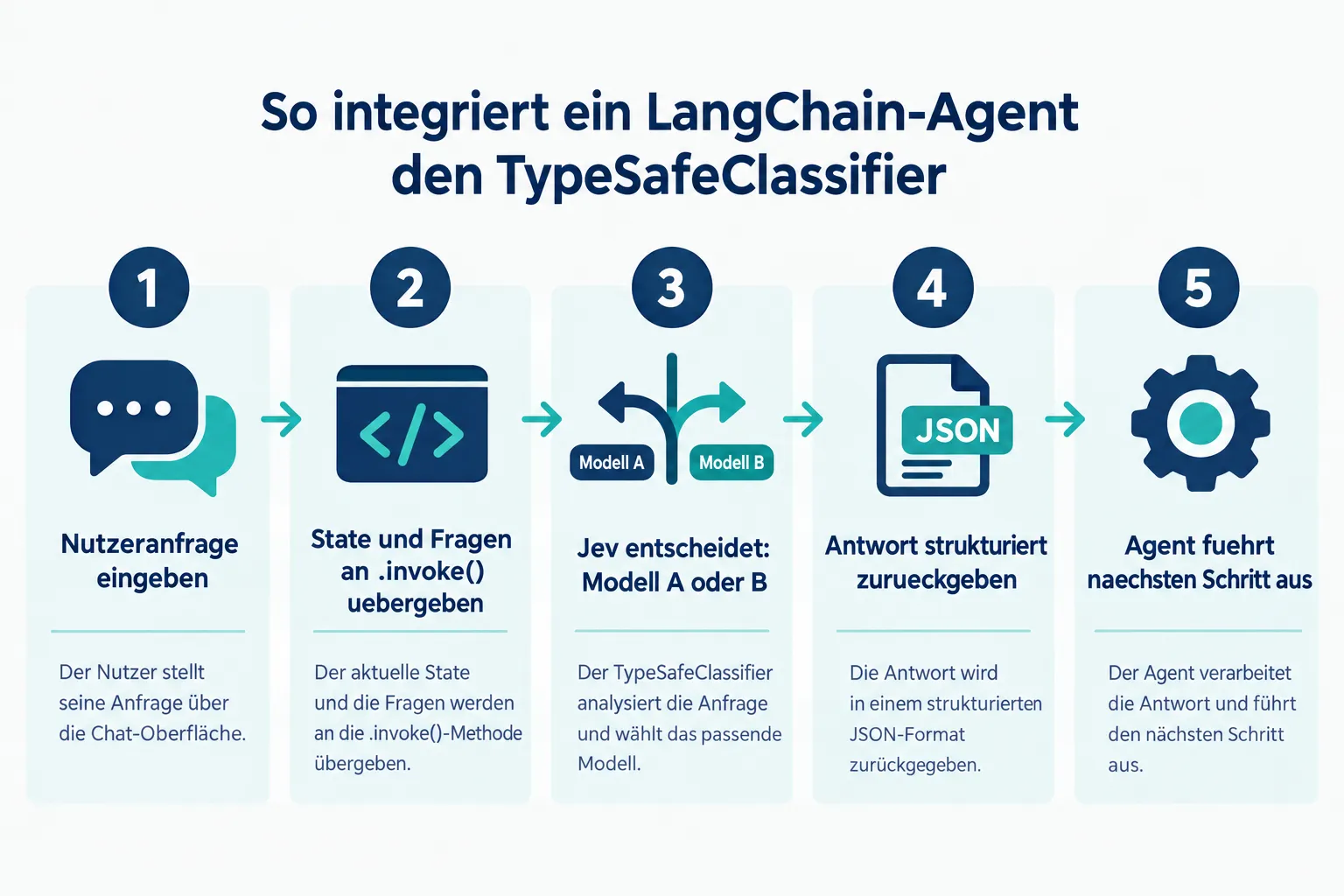
Two concrete middleware patterns are described in the LangChain documentation and accompanying analyses:
- Model-routing middleware: decides, based on the latest user message, whether a fast or a more capable model should handle the request [1][7].
- AutoModeMiddleware: checks an agent’s tool calls for risky decisions and blocks execution before the tool is actually called [1].
Both patterns share the same basic idea: Jev sits as a pre-decision step before a more expensive or riskier step, reducing both budget and latency for the application [3][10].
Limitations of Jev: No Replacement for Generative Models
Despite its practical closeness to smart if-statements, one limitation remains central to every Jev AI use case: Jev is explicitly not a replacement for a generative model. It cannot produce prose, cannot generate code, and cannot deliver open-ended explanations [4][5]. For those tasks, GPT, Claude, or Gemini remain responsible.
Equally important: type safety only guarantees that the response matches the defined format — not that the underlying decision is correct [4][5]. A Jev output can be syntactically perfect and still be factually wrong, for example if a ticket is miscategorized or a risk is underestimated. Developers therefore still need to validate the business accuracy of these decisions using real, production data — through test sets, monitoring, and regular sampling, as is standard practice for any classifying or scoring system.
This limitation isn’t a drawback of the approach — it follows directly from its role: Jev is a decision layer for narrowly scoped, recurring questions, not a general-purpose language model.
Conclusion and Next Steps
The five Jev AI use cases presented here — routing, ticket triage, guardrails, log classification, and agent evaluation — show a common pattern: wherever software repeatedly has to make the same kind of bounded decision, a structured layer like Jev can replace a full LLM call with a fast, type-safe result. The official LangChain integration via TypeSafeClassifier makes getting started especially straightforward for teams already working with agent graphs.
For developers building AI agents, a pragmatic starting point is worthwhile: first review your own pipeline for recurring, clearly bounded decision points — routing, prioritization, security checks — and trial a Jev call there instead of a full chat call. It remains important to validate the decisions made with real data, rather than relying solely on formal type safety. This lets the decision layer be introduced step by step, exactly where it actually saves speed and cost — without replacing the generative models that remain indispensable for open-ended reasoning.
References
[1] Building A Harness With Jev – https://www.langchain.com/blog/building-a-harness-with-jev [2] Typesafe – https://docs.langchain.com/oss/python/integrations/providers/typesafe [3] Langchain Adds Jev Decision Model Agent Workflows – https://runtimewire.com/article/langchain-adds-jev-decision-model-agent-workflows [4] What Is Jev – https://atomicbot.ai/blog/what-is-jev [5] How To Use Jev – https://aiprofitboardroom.com/blog/how-to-use-jev/ [6] Langchain Jev Agent Evals Benchmark September 2026 – https://www.explainx.ai/blog/langchain-jev-agent-evals-benchmark-september-2026 [7] How To Integrate Jev Agent Routing 2026 – https://explainx.ai/blog/how-to-integrate-jev-agent-routing-2026 [8] typesafe.ai – https://typesafe.ai/ [9] cnblogs – https://www.cnblogs.com/sing1ee/p/23040079 [10] Langchain Adds Jev Classifier To Agent Workflows For Routing And Tool Checks – https://superpowerdaily.com/posts/langchain-adds-jev-classifier-to-agent-workflows-for-routing-and-tool-checks
Frequently Asked Questions
What are the main Jev AI use cases in agent architectures?
The five recurring Jev AI use case patterns are agent routing/escalation/tool selection in LangChain, support ticket triage and customer operations, moderation/risk assessment/policy enforcement (guardrails), log and anomaly classification for reliability engineering, and agent evaluation as an AI judge.
How does the LangChain integration with Jev work?
The official TypeSafeClassifier integration accepts state and questions and returns a structured classification result via .invoke() instead of a chat response. The state can be plain text, structured data, or a sequence of LangChain messages, making integration into existing agent graphs straightforward.
Can Jev replace generative models like GPT, Claude, or Gemini?
No. Jev cannot produce prose, generate code, or deliver open-ended explanations. It is explicitly not a replacement for a generative model but a complementary decision layer for narrowly scoped, recurring questions like classification, routing, or risk checks.
Does type safety guarantee that Jev's decisions are correct?
No. Type safety only guarantees that the response matches the defined format, not that the underlying decision is correct. A Jev output can be syntactically perfect and still factually wrong, so developers still need to validate business accuracy with real, production data.
The Jev AI Series
- Part 1: What Is Jev AI? TypeSafe New AI Model Explained
- Part 2: Jev AI Performance in Detail – Architecture and Technical Limits
This article is part of the Jev AI series. Part 5: Jev AI as an LLM-as-a-Judge Alternative: The LangChain Study on Agent Evaluation.