A puzzle for every CTO in 2026: the programming language that powers nearly three-quarters of all websites worldwide is, at the same time, seen by many junior developers as “outdated.” That language is PHP. Facing it is Node.js, which developer surveys show has far more active users, but which in absolute job counts still trails PHP in many markets. Anyone making a backend decision in 2026 can no longer rely on these contradictions alone. The PHP vs Node.js 2026 debate is no longer a purely technical question, but a matter of recruiting strategy, team availability, and concrete use case.
This article breaks down the current market and hiring data and shows where PHP and Node.js are each the better choice.
Table of Contents
Key Takeaways
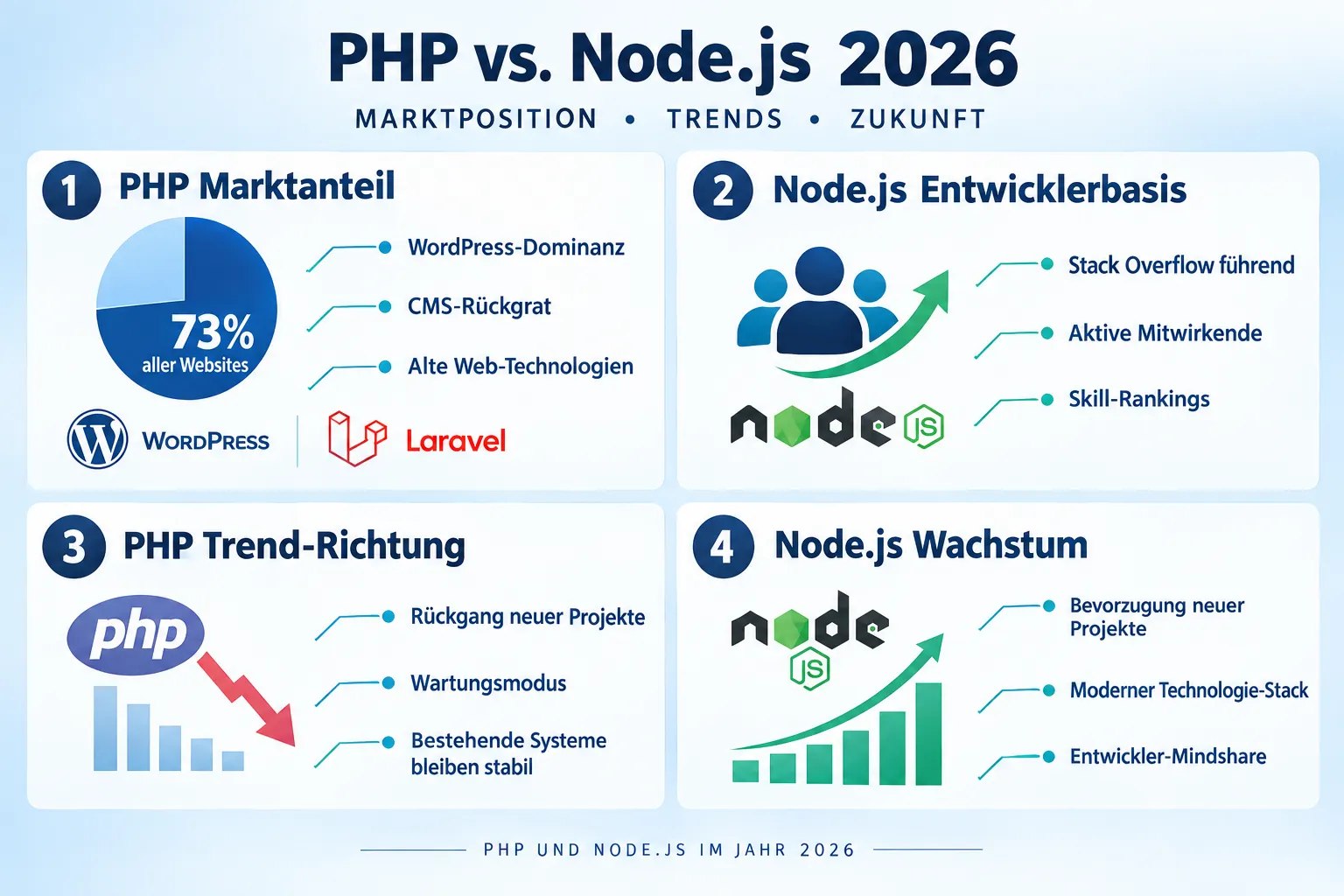
- PHP still powers an estimated 73 percent of websites worldwide, mainly via WordPress, Laravel, and classic CMS systems, but is losing market share in new projects.
- According to Stack Overflow data, Node.js has a significantly larger active developer base and ranks higher than PHP in many skill rankings.
- In hiring, PHP talent is often available faster and cheaper, while Node.js developers are in higher demand at startups and in API-first environments, and command higher salaries on average.
- The use-case split remains clear: PHP/Laravel for CMS, e-commerce, and classic SaaS dashboards; Node.js for real-time systems, microservices, and API-first architectures.
- Zero-trust security, edge computing, GraphQL, and blockchain integration are reshaping both ecosystems in 2026 without tipping the underlying distribution of use cases.
Market Data 2026: Where PHP and Node.js Really Stand
The raw usage numbers paint a two-sided picture. On one side is PHP’s sheer footprint across the live web: current web development statistics for 2026 put PHP’s share of overall web language usage at around 18.2 percent, with the language powering roughly 77 percent of all CMS-driven websites. That keeps PHP effectively indispensable for the existing web via WordPress, Drupal, and similar platforms, even as its growth curve has been described as declining for years.
On the other side, developer surveys tell a different story. According to 2025 Stack Overflow data cited in current 2026 hiring guides, around 49 percent of surveyed developers use Node.js, while PHP comes in at only about 19 percent — roughly 2.5 times as many active Node.js users worldwide. In the TIOBE Index, PHP has also slipped to rank 13 with about 1.11 percent share, while professional usage per Stack Overflow figures sits at around 18.9 percent — PHP remains present in daily professional work but is no longer seen as a growth language.

This gap between installed base and developer mindshare is the core of the PHP-vs-Node.js-2026 debate: PHP dominates the existing stock, Node.js dominates the growth. Our article on PHP 8.5 and Laravel 2026 details just how relevant PHP still is, covering the latest performance and productivity improvements.
Hiring Trends 2026: Salary, Demand, and Time-to-Hire Compared
For technical decision-makers, market distribution is only half the story. What matters is how easily teams can be built and what it costs.
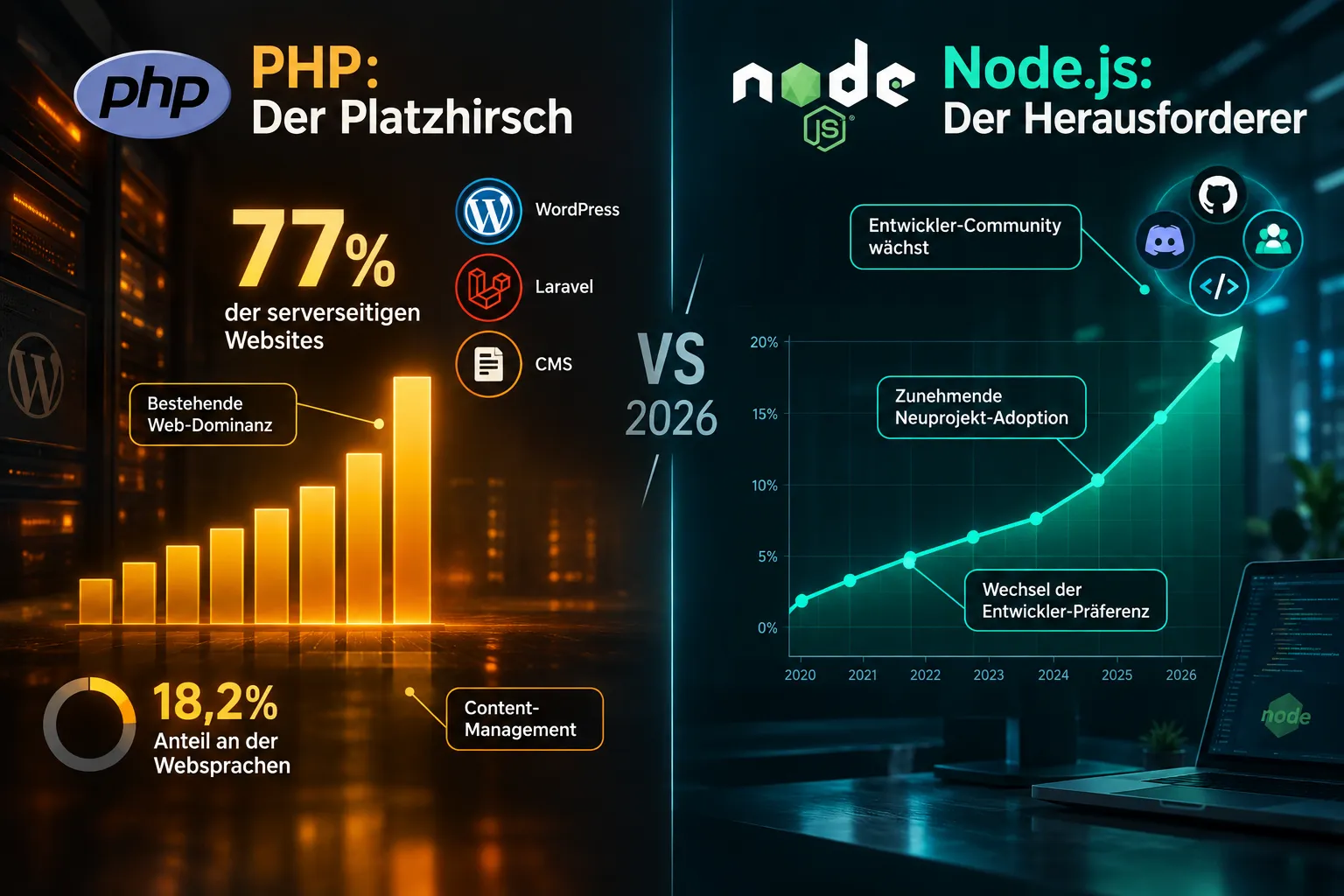
Demand dynamics: Node.js shows a clear upward trend in 2026. Market observations on hiring activity report a slow start in January, followed by a recovery with a net gain of 27 job postings in the first quarter year-over-year and around 28 open Node.js roles by March 2026. At the same time, skill-search analyses show Node.js searches up 57 percent within a year, landing in the top 10 tech skill searches, while PHP ranks only 14th.
Absolute job counts: Still, PHP often remains strong in raw job numbers. A LinkedIn-based analysis of backend stacks counts around 3,261 PHP-related backend jobs, of which roughly 700 explicitly mention Laravel, compared to 1,879 jobs for Node.js via Express and 112 for Nest.js. PHP therefore still holds more classic backend roles, while Node.js dominates modern JavaScript-centric backend positions. However, broader analyses also show a negative growth trajectory for PHP: 2026 estimates put PHP job postings at around 21,000 worldwide, down roughly 10 percent year-over-year, with PHP’s share of all developer job postings reportedly falling from about 10 percent in early 2025 to around 4 percent by year-end.
Salaries: On compensation, Node.js is usually ahead on average. Current analyses put average salaries for Node.js developers in the US at around $113,000 per year, with a range of roughly $60,000 to $210,000[1]. Other surveys put the global average even higher, around $149,500[1], while median-based comparisons place Node.js around $105,000 versus roughly $81,000 for PHP developers. Regional 2026 salary tables show Node.js ranges in the US of roughly $70,000–$105,000 for junior roles, $105,000–$145,000 for mid-level, and $135,000–$195,000 for senior positions; in Western Europe, senior Node.js salaries often fall in the range of €111,000–€160,000.
PHP developers earn less on average, though with considerable variance by seniority level: 2026 US surveys put figures between roughly $72,000 and just under $87,000 for regular PHP roles, while specialized “Senior PHP Software Developer” positions can reach up to around $125,000 annually — a range that matches or exceeds many Node.js salaries.
Time-to-hire and availability: Here the picture often flips in PHP’s favor. Offshore comparisons for SaaS stacks put experienced PHP/Laravel developers at roughly $38–$55 per hour, or $5,500–$8,000 per month, while noting a “very deep” talent pool and a significantly shorter time-to-hire compared to Node.js. Regional reports, for example from Saudi Arabia, confirm this pattern: Laravel is the most-searched-for backend framework on local job boards there, and hiring a PHP developer is roughly 20 to 30 percent cheaper than hiring a Node.js developer, while Node.js is growing fastest at startups and in fintech.
The table below summarizes the key hiring differences:
| Criterion | PHP (mostly Laravel) | Node.js |
|---|---|---|
| Talent pool | Large, stable, deep | Smaller, but growing fast |
| Time-to-hire | Usually shorter | Often longer, especially for senior roles |
| Average salary | Lower to mid | Higher on average |
| Demand trend | Declining in new projects | Rising, especially at startups |
| Typical use | CMS, e-commerce, SaaS dashboards | APIs, real-time, microservices |
PHP vs Node.js 2026: Use Cases Head-to-Head
Beyond the hiring numbers, technical fit remains the deciding factor. Several comparative analyses for 2026 arrive at a consistent pattern.
PHP (in practice almost always Laravel for new projects) is the obvious choice for:
- Content-heavy websites and editorial platforms
- CMS products and WordPress extensions
- E-commerce systems with classic checkout flows
- Conventional SaaS dashboards with mostly synchronous CRUD behavior
Node.js is the preferred choice for:
- Real-time applications with WebSockets at scale
- API-first products that depend on fast, asynchronous I/O
- Microservices architectures with high concurrency
- Full-stack JavaScript teams that want a single language across client and server
A growing trend for 2026 is a polyglot pattern: PHP/Laravel handles an application’s core business logic, while Node.js microservices are added specifically for real-time features like chat, notifications, or live dashboards. That decouples the PHP vs Node.js 2026 decision from an either/or choice and turns it into a question of architectural modularity.
Regional examples confirm this hybrid picture: in the UK, for instance in Greater Manchester, backend roles including PHP remain among the fastest-growing digital jobs, while modern, scalable applications increasingly rely on Node.js.
Backend Trends 2026: Zero Trust, Edge Computing, GraphQL, and Blockchain
The choice between PHP and Node.js in 2026 doesn’t happen in a vacuum — it plays out within larger architectural trends affecting both ecosystems.
Zero-trust security architectures are becoming the standard regardless of backend stack. Both Laravel-based and Node.js-based systems increasingly need granular, service-level identity verification instead of relying solely on perimeter security.
Edge computing pushes logic closer to the user. Node.js benefits here from its lightweight runtime and compatibility with edge platforms, while PHP is also being made edge-capable through specialized deployment models, albeit with more integration effort.
GraphQL alongside or instead of REST is establishing itself in both ecosystems as a complement, not a replacement. Node.js teams often adopt GraphQL faster thanks to the native JavaScript toolchain, but Laravel extensions now also offer mature GraphQL support for PHP projects.
Blockchain integration into traditional backends remains a niche trend but is gaining relevance in 2026 for fintech and supply-chain applications. Node.js has an advantage here through its proximity to Web3 tooling, while PHP systems are usually connected via external services.
“In 2026, the language matters less than the use case. PHP remains the right choice for classic web applications and CMS, Node.js for real-time and I/O-intensive systems.”
This expert consensus runs through nearly all current comparative analyses: technical fit to the use case matters more than trends in skill searches or hype cycles.
Conclusion: What the PHP vs Node.js 2026 Decision Really Means
The PHP vs Node.js 2026 debate can’t be settled with a simple winner. PHP remains the backbone of the existing web, with a deep, affordable talent pool and short time-to-hire, but it’s losing ground in new projects and developer mindshare. Node.js is pulling ahead on demand, salary, and modern architectural patterns, but in absolute job counts it’s often still smaller than PHP in many markets.
For technical decision-makers, three concrete action steps follow:
- Clarify the use case first: for content-driven, CRUD-heavy products, PHP/Laravel makes a strong case; for real-time or API-first systems, Node.js does.
- Factor in recruiting reality: teams that need to scale quickly and cheaply often benefit from the depth of the PHP talent pool; teams betting on growth and modern stacks should budget for higher Node.js salaries.
- Consider hybrid architectures: a PHP core with Node.js microservices for real-time features is no longer a compromise in 2026 — it’s increasingly best practice.
In the end, it’s not the language with the loudest hype that wins, but the team that consistently aligns its architecture with the actual use case. For a hands-on introduction to the basics of PHP, Node.js, and MySQL, see our backend developer starter guide.
Frequently Asked Questions
nWhat share of websites does PHP still power in 2026?
nPHP still powers an estimated 73 percent of websites worldwide, mainly via WordPress, Laravel, and classic CMS systems, but is losing market share in new projects.
nHow does the active developer base of Node.js compare to PHP?
nAccording to Stack Overflow data, Node.js has a significantly larger active developer base and ranks higher than PHP in many skill rankings; around 49 percent of surveyed developers use Node.js versus about 19 percent for PHP.
nHow do average salaries compare between PHP and Node.js developers?
nNode.js developers command higher salaries on average, with median-based comparisons placing Node.js around $105,000 versus roughly $81,000 for PHP developers, while PHP talent is often available faster and cheaper to hire.
nWhat is the typical use-case split between PHP and Node.js?
nThe use-case split remains clear: PHP/Laravel for CMS, e-commerce, and classic SaaS dashboards, while Node.js is used for real-time systems, microservices, and API-first architectures.
nReferences
[1] Node Js Developer Salaries – https://rubyonremote.com/node-js-developer-salaries/
[3] Salary – https://www.payscale.com/research/US/Job=Node.JS_Developer/Salary
[5] Node Js Salary – https://www.ziprecruiter.com/Salaries/Node-Js-Salary
[9] Nodejs – https://www.toptal.com/developers/nodejs