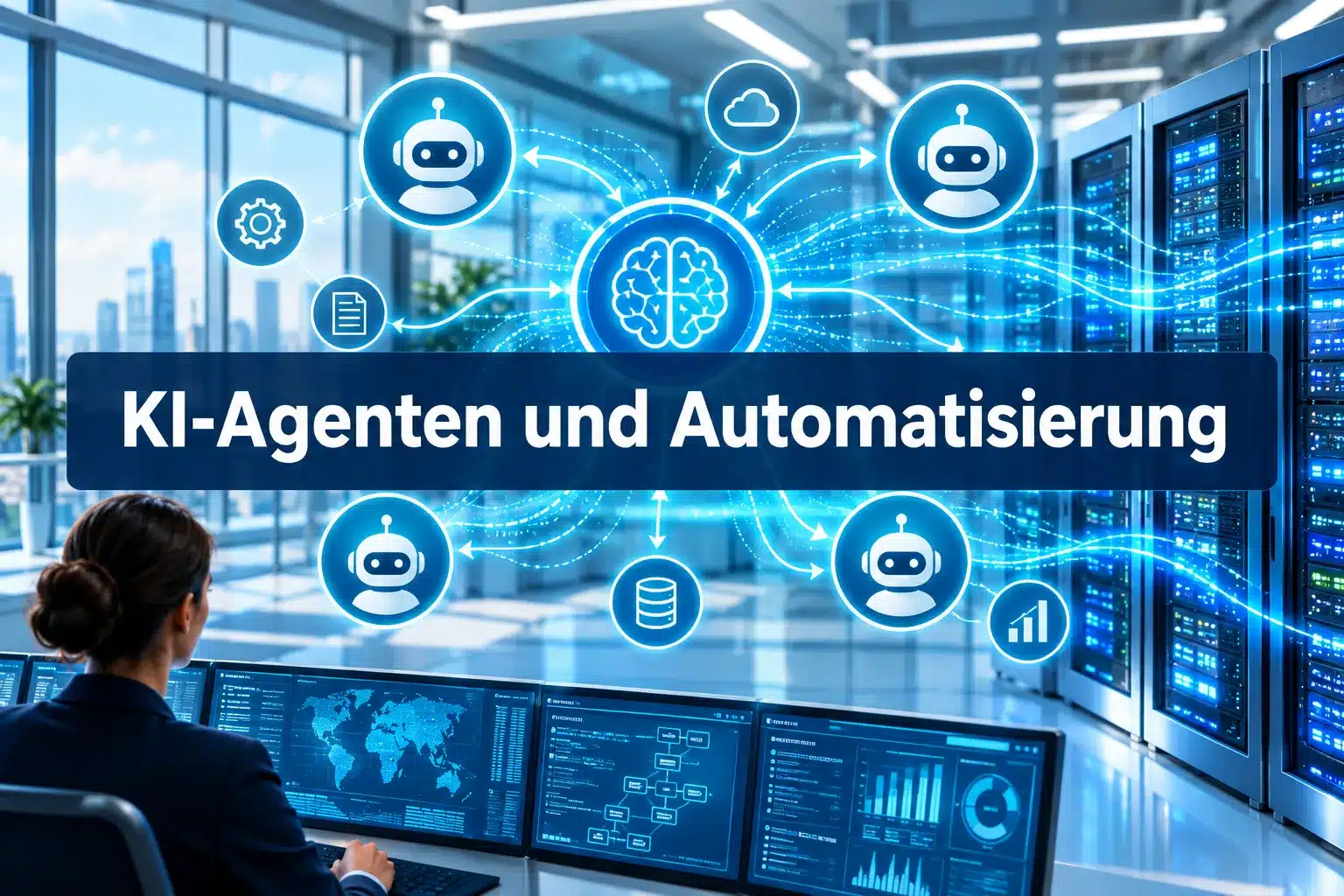
Forty percent. That’s how much of enterprise software is projected to include task-specific agents by 2026, not as a feature gimmick, but as core infrastructure [1][9]. Anyone who still believes a chatbot and an AI agent are basically the same thing with a different name is missing the actual paradigm shift. AI agents and automation describe exactly this leap: from reactive text responses to systems that autonomously plan, use tools, and carry multi-step tasks through to completion. This guide is aimed at readers who already use chatbots like ChatGPT or Claude productively and now want to understand how autonomous workflows actually work technically, where their limits lie, and which frameworks are genuinely used to build them in 2026.
If you don’t have hands-on experience with ChatGPT and similar tools yet, start with our beginner’s guide “AI for Beginners” first – this article assumes basic knowledge of prompting and LLM usage.
Table of Contents
Key Takeaways
- Agents differ fundamentally from chatbots: they carry out multi-step tasks autonomously instead of only reacting to individual prompts.
- Tool use / function calling is the technical foundation of every agent architecture — without structured API calls, an agent remains a plain text generator.
- Reasoning patterns like ReAct and reflexion determine whether an agent learns from mistakes or repeats them.
- LangGraph, Claude Code, and browser agents are the most practically relevant platforms for productive AI agent automation in 2026.
- Cost control, hallucination risk, and security guardrails are not side issues — they are the central success factors for productive deployment.
What distinguishes an agent from a chatbot
A chatbot answers a question and waits for the next input. An AI agent receives a goal, breaks it down into subtasks, independently calls tools, checks the results, and keeps working without a human needing to intervene after every step. This capacity for autonomous multi-step execution is exactly what makes the difference.
We discuss the related security risks of autonomous agents in detail in AI Security Debate: The OpenAI Breach, Amodei’s Warning, and the Risks of Autonomous AI Agents. Many agents rely on an external knowledge base for this, as described in our article Build Your Own RAG System: How to Create AI Knowledge Bases.Technically, an agent is a loop: the language model observes the current state, decides on the next action, executes it via a tool interface, ingests the result, and repeats the cycle until a stop criterion is reached [6]. The dominant architectural patterns today are:
- Single-agent tool loop — one model, multiple tools, simple tasks
- Planner/executor split — one model plans, another executes
- Supervisor/worker hierarchy — a coordinator distributes subtasks to specialized sub-agents
- Graph/state-machine flows — explicit state transitions instead of free-form loops [6][13]
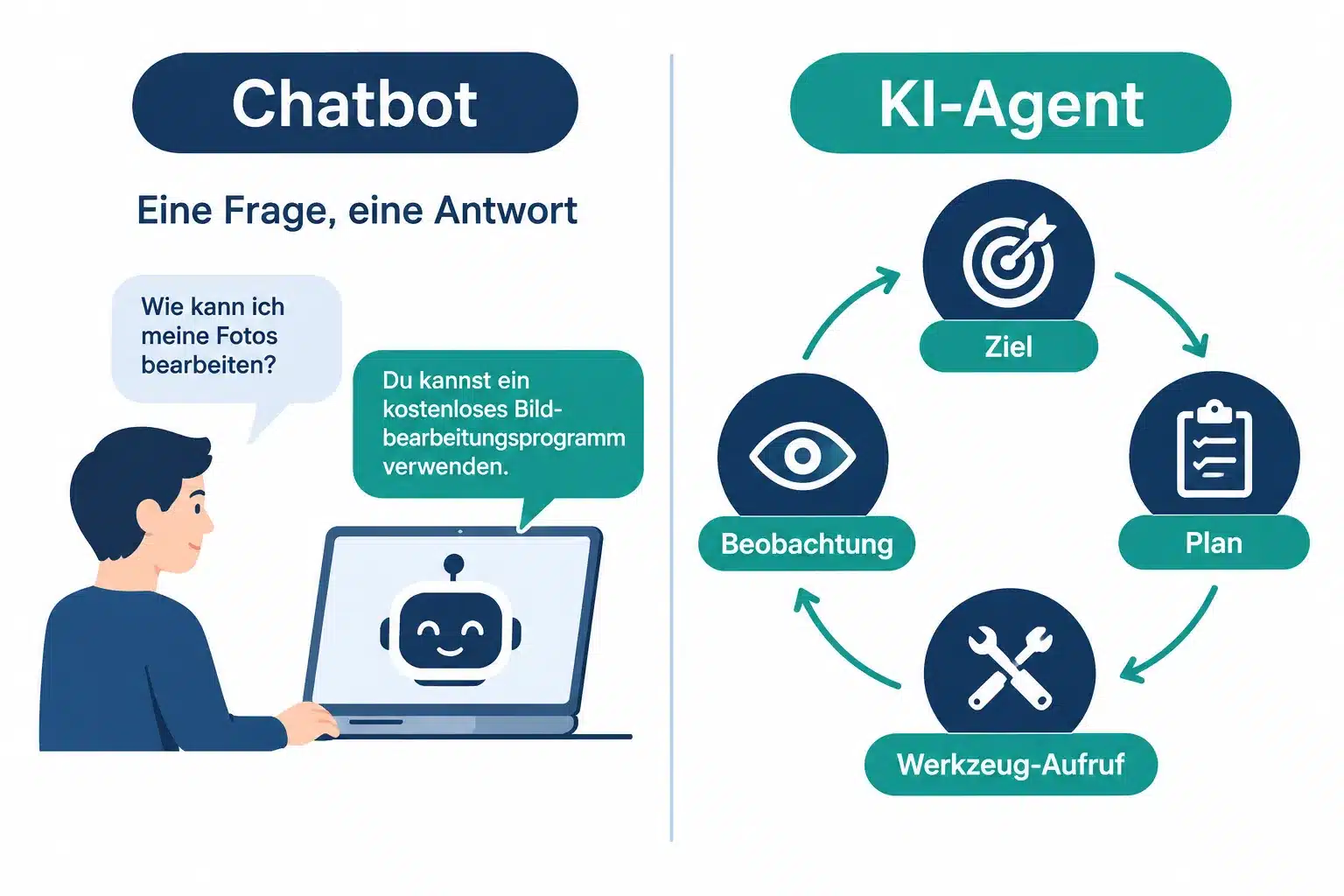
A chatbot responds. An agent acts — and keeps acting until the goal is reached or a stop condition is met.
This distinction isn’t a marketing nuance. It determines what risks a system carries: a chatbot can at worst deliver a wrong answer, while an agent can execute a wrong chain of actions, including real API calls, file changes, or payment transactions.
Tool use and function calling as the technical foundation of AI agent automation
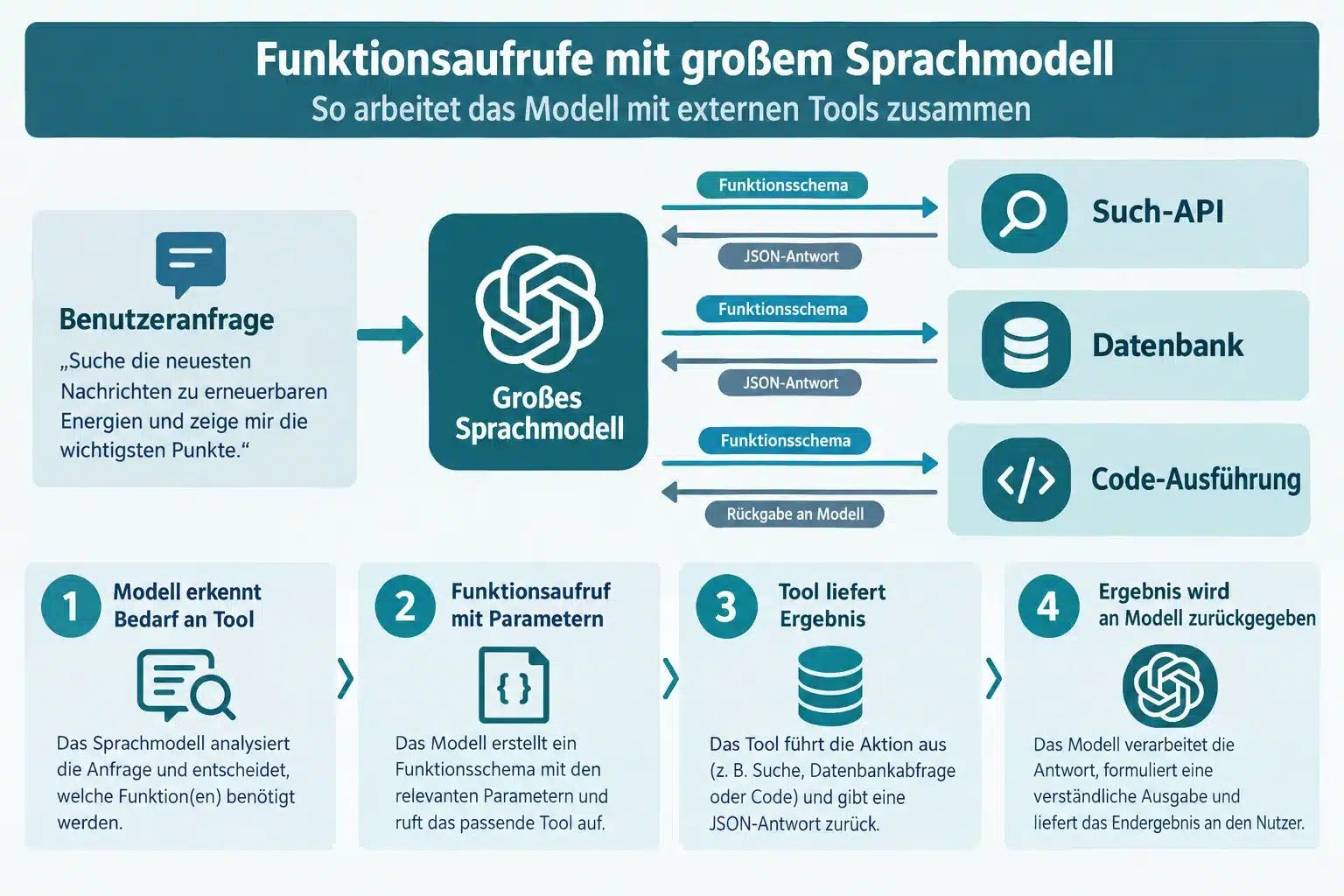
Without tool use, there is no real agent automation. Function calling means the language model doesn’t just generate text but formulates structured calls to defined functions or APIs — a web search, a database query, or code execution, for example. The model itself decides which tool it calls, when, and with which parameters.
The technical flow typically looks like this:
- The model receives a list of available tools with names, descriptions, and parameter schemas.
- Based on the current task, it selects a tool and generates the matching arguments in a structured format (usually JSON).
- The surrounding system executes the actual call — the model itself has no direct access to external systems.
- The result is fed back into the model’s context, which uses it to make the next decision.
Practical guides on agent frameworks consistently emphasize several technical safeguards that should be standard in production systems: a hard limit on iterations, typically five to ten steps per run; strict validation of every tool output before it’s returned to the model; and streaming execution so intermediate steps can be tracked live [8]. Once more than two tools are active, full observability is no longer optional — it’s mandatory [8].
Planning and reasoning capabilities: chain-of-thought, ReAct, and reflexion
Tool access alone doesn’t make an intelligent agent. What matters is how the model thinks between observation and action. Three reasoning patterns shape today’s AI agent automation:
Chain-of-thought (CoT) has the model spell out its reasoning in intermediate steps before delivering a final answer or action. This reduces logical leaps and makes errors traceable.
The ReAct pattern (Reasoning + Acting) explicitly interleaves thinking and acting: the model formulates a thought, executes an action, observes the result, thinks again, and repeats the cycle. This pattern underlies nearly all modern tool-use agents.
Reflexion goes a step further: after a failed attempt, the agent itself evaluates why a step failed and adjusts its strategy for the next attempt — a form of self-correction without human intervention.
In production workflows, these patterns are monitored via concrete metrics: task success rate, correctness of tool calls, hallucination rate at intermediate steps, plan fidelity, trace length, and the so-called “unrecoverable error rate” — the share of runs that can no longer self-correct [6][8]. Observability tools like LangSmith or OpenTelemetry-based trace frameworks make these metrics visible, complemented by LLM-judging, simulations, and spot-check human reviews [6][8].
Common frameworks and platforms for AI agent automation
The framework landscape has consolidated significantly by 2026. Here’s an overview of the most relevant approaches:
| Framework/Platform | Core idea | Typical use case |
|---|---|---|
| LangGraph | Graph/state-machine-based agent orchestration with branching and retries | Production multi-agent systems |
| LangChain (base) | Tool selection and decision loops | Prototyping, simple tool-use agents |
| Deep Agents | Pre-configured “batteries-included” agent environment | Quick start without building from scratch |
| Claude Code | Coding agent with parallel sub-agent orchestration | Codebase audits, migrations, refactoring |
| Browser/Operator-style agents | Controlling web applications via GUI interaction | Research, form filling, web automation |
LangChain itself explicitly positions agents as decision-and-action loops that select tools, call them, and continue planning based on intermediate results. Since version 0.3, the project primarily recommends LangGraph for production agent workloads, since it offers better debuggability, branching, and multi-agent coordination compared to the classic agent-executor logic [4][7][10].
For coding tasks, Claude Code has established itself as a category of its own: instead of individual prompt responses, the system generates dynamic scripts that orchestrate multiple sub-agents in parallel, for example for large-scale codebase audits or research. A recurring practical pattern is the “plan-then-build” cycle, where a plan is first presented for human approval before actual execution begins.
Operator-style browser agents control web applications directly through the user interface — useful when no API exists. Automation platforms classified such agents as production-ready in early 2026 for clearly structured tasks like extraction, classification, or summarization, while fully autonomous, multi-step decision-making is still considered experimental [5]. In parallel, the Model Context Protocol (MCP) is emerging as a standard for connecting agents and tools consistently [5].
Practical use cases for autonomous AI workflows
Three areas illustrate the practical value of AI agent automation particularly clearly:
Research automation: an agent breaks an open-ended question into sub-research tasks, calls multiple search sources in parallel, synthesizes intermediate results, and delivers a structured report at the end instead of a single, superficial answer.
Coding agents: instead of individual code suggestions, agents take on complete refactoring runs, tests, and migration projects. Claude Code, for example, can assign multiple sub-agents to different parts of a codebase simultaneously and then merge the results.
Content pipelines: from topic research through drafting to quality review, multiple agent steps run in sequence, with each step using the previous one’s output as input — often including a reflexion step that critically reviews its own output before release.
For smaller companies, the practical value shows up especially clearly in pre-built workflow libraries that enable scheduled agent runs across existing tool stacks like Shopify, Salesforce, or Zapier, without needing to build new infrastructure from scratch.
Limits and risks of AI agent automation
Autonomous workflows carry specific risks that barely matter with simple chatbot responses:
- Hallucination in multi-step tasks: a single incorrect intermediate step can propagate across multiple iterations before it’s caught — so-called error propagation.
- Cost control for API calls: every tool call incurs cost. Without iteration limits and budget caps, agent runs can become uncontrollably expensive.
- Security aspects of tool access: an agent with write access to files, databases, or payment systems can cause real damage if it plans poorly — not just produce a wrong text output.
- Lack of traceability: without trace logging, it’s often impossible to reconstruct afterward why an agent made a particular decision.
This also has regulatory implications for how such systems are designed: the EU AI Act has brought specific requirements for high-capability AI models since 2025, while high-risk rules are being phased in through 2026/2027 [6][12][15]. In practice, companies therefore rely on governance patterns such as clearly defined policy boundaries, complete audit trails, and human approval at critical decision points — for example, before an agent triggers a payment or deploys production code.
Practical countermeasure: rubric- and scenario-based evaluation instead of pure unit tests, combined with strict iteration limits, is now considered the minimum standard for production agent deployments [8].
Conclusion: how to think about AI agent automation
AI agent automation isn’t a hype term — it’s a technically well-defined evolution of the chatbot paradigm: away from reactive single answers, toward autonomous loops of planning, tool use, and observation. Anyone looking to deploy agents productively today should prioritize three things: first, choose a framework that brings observability and iteration limits from the start, such as LangGraph for general workflows or Claude Code for coding tasks. Second, establish structured metrics like task success rate and trace length early, rather than blindly trusting agent runs. Third, always secure critical actions — payments, deployments, data changes — with human approval until the system has proven reliable. Once these fundamentals are mastered, agents can be scaled gradually from simple research tasks to more complex automations, without incurring uncontrolled cost or security risks.
References
[1] Agentic AI Takes Over: 11 Shocking 2026 Predictions – https://www.forbes.com/sites/markminevich/2025/12/31/agentic-ai-takes-over-11-shocking-2026-predictions/
[4] LangChain Tutorial 2026 – https://blog.jetbrains.com/pycharm/2026/02/langchain-tutorial-2026/
[5] AI Agents In Automation 2026 – https://automationatlas.io/guides/ai-agents-in-automation-2026/
[6] Agentic AI Workflows: Game Changer, Automation, Ethics, Future – https://futureagi.com/blog/agentic-ai-workflows-game-changer-automation-ethics-future/
[7] LangChain Agents Complete Guide – https://easyclaw.com/blog/ai-agent-101/langchain-agents-complete-guide/
[8] LangChain Agents, Tools & Functions: Practical Guide 2026 – https://freeacademy.ai/blog/langchain-agents-tools-functions-practical-guide-2026
[9] AI Business Trends Report 2026 – https://blog.google/innovation-and-ai/infrastructure-and-cloud/google-cloud/ai-business-trends-report-2026/
[10] Deep Agents – https://github.com/langchain-ai/deepagents
Frequently Asked Questions
What distinguishes an AI agent from a regular chatbot?
An AI agent can independently plan tasks, call tools, and execute multi-step processes, while a classic chatbot only responds to individual requests.
What is tool use or function calling in AI agents?
Tool use lets an AI agent call external functions or APIs, for example to fetch data or take actions, instead of only generating text.
What are the risks of autonomous AI agents?
Autonomous agents can amplify errors through chain reactions, take unintended actions, or be misused for attacks, which is why oversight and monitoring matter.
What is ReAct in the context of AI agents?
ReAct is a prompting approach where an agent alternates between reasoning and acting to solve complex tasks step by step.